Ski passes

Spending so much time in the mountains in the winter, I tend to take for granted how the charges for lift passes work, so I was surprised to be asked the other day by somebody who was considering going skiing for the first time whether it was like a theme park, with one ticket providing you access to all the facilities.

So if you are unsure how the whole ski pass system works, here is Swiss ski pass 101.
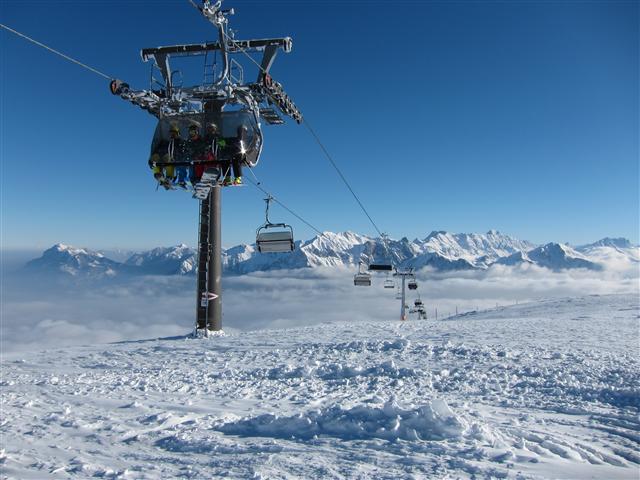
Lifts at Meiringen
Of course there is clearly a lot of variation, but generally you buy one pass to access the lift system in the mountains, and pay separately for any equipment you may wish to hire. If you are prepared to walk up the slopes and have your own equipment, you can use the mountains for free! Conversely if you wish to simply access a mountain restaurant, you will still need to buy a lift pass to get there if you are not prepared to walk.

Most occasional skiers, snowboarders, tobogganists and snow shoe walkers have the option of buying a ski pass for a single ascent or descent, a period of a part of a day, or for one or more days, or can use cards based on points where each ride deducts points from the amount recorded on your pass. Seniors and youngsters get discounts and generally kids upto six years old go free. In addition, the more days you buy, the cheaper the per diem rate is – and you can normally buy a pass for any given number of days. There are also passes that cover the whole season, or the entire year, and these may be discounted for residents of the gemeinde or canton in which the resort is located – if that applies to you, enquire locally.

Sometimes lift passes cover only one resort, but many cover a ski area that links more than one resort or even a cluster of unconnected ski resorts, such as the Gstaad Mountain Rides pass. If you only intend to ski part of a ski area, there are usually reduced rate lift passes for a reduced domain. These are particularly useful for beginners or intermediates.

I will use Verbier as an example of how ski passes tend to be structured. The skiing in and around Verbier can be broken up into four areas, Verbier, La Tzoumaz/Savoleyres, Bruson and one for the whole area, 4 Vallées/Mt Fort. A day pass for Verbier alone costs CHF 65 and for the entire area, CHF 70.

A pass for the whole 4 Vallées area for 6 days is CHF 355, for 13 days CHF 634, for 21 days CHF 914 and for the season CHF 1435. In addition there is a refundable CHF 5 deposit on the key card you use to access lifts, as is the case in most resorts. Discounts of 15% apply for groups of 15 or more, young people and seniors; discounts of 10% are available for families. There are also specially-priced pedestrian access passes.

The 4 Vallées Club Card allows you to ski the 4 Vallees area at a reduced price all season and works like a credit card, with your days on the mountain being debited from the card at the end of each ski day. The discount ranges from 10% to 50%. Of course you can also use the Valais Card to access Verbier too – see below.

The Valais Card is an example of a scheme that covers an even wider range of resorts. The main ones are:

  • The Schneepass Central Schweiz provides 500 km of slopes in 13 different ski resorts, notably Engelberg, Klewenalp, Meiringen-Hasliberg, Melchsee-Frutt, Andermatt, Sörenberg and Stoos. Adult season pass is CHF 1100 with various reduced rates for seniors, families and younger skiers.
  • The Meilenweiss skipass covers 13 resorts, including Braunwald, Elm, Flumserberg, Grüsch Danusa, Pizol, Stoos and Toggenburg. The adult pass bought before the end of November is CHF 998 and CHF 1048 after, with various reduced rates for seniors and younger skiers.
  • TopCard covers 773km of slopes at Davos, Klosters, Flims Laax Falera and Ischgl Samnaun. The adult pass bought before the 11th November is CHF 1040 and CHF 1230 after, with various reduced rates for seniors and younger skiers.
  • The Valais Card covers virtually every resort in Valais (including Zermatt and all the usual suspects) – a staggering 2800km piste, 54 ski areas and 4 thermal baths. You buy a card and charge it with points, which are deducted each time you use a lift or spa, with discounts of upto 10% off advertised lift prices. The minimum purchase is CHF 100.
  • In the Vaud Alps the Free Pass provides you with a keycard that works like credit card, with discounts of 30% on weekdays and 15% on Saturdays and Sundays.

Finally there is the Snow’n’Rail scheme covered in an earlier post, which gives you a 20% discount on the combined use of public transport getting to a resort and for the lift pass once you get there.
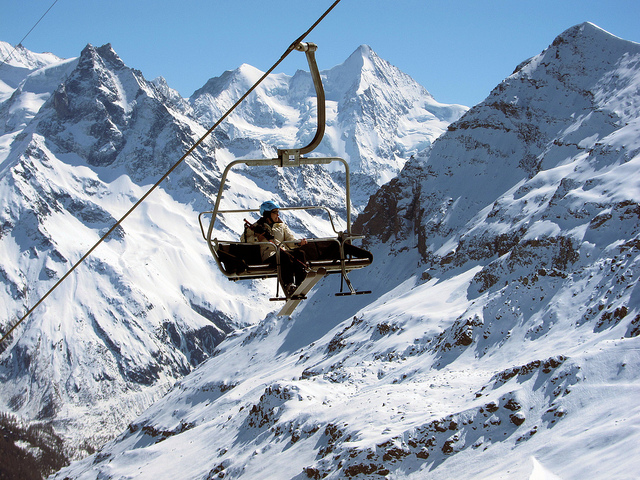
Lift in Zinal

Ski and Snowboard Deals in Graubünden

As was the case last season, Graubünden is offering skiers, snowboarders and other winter sports enthusiasts some of the best winter sports deals in the entire Alps. We are not talking obscure resorts with minor discounts, but really outstanding offers at top destinations.
Lenzerheide
I am salivating at being able to take advantage of the new lift connecting Arosa and Lenzerheide, but there are also some great deals there too. When you stay in Arosa for 2 nights or more in selected hotels and holiday homes, kids get free ski–school group training all season. Lenzerheide, not to be out-done is offering a free lift pass if you book a stay for before Christmas.

Davos and Klosters offered a similar deal last year and I guess it was successful, because again you get your lift pass for free if you stay in one of the participating hotels or holiday homes before Christmas too.

Scuol is one of my favourite small resorts with its pleasant, scenic slopes and its spa, and this resort too is providing free lift passes if you stay in the participating hotels, but this time it is throughout the whole season.

Incidentally, the participating partners in my experience include pretty much every hotel, even the youth hostels and B&Bs.

Meanwhile St Moritz is offering lift passes for CHF25 (that’s £18) for the duration of your stay throughout the season if you book two nights or more in participating hotels in the Engadine. This makes the Youth Hostel in St Moritz a really attractive option for budget skiing and snowboarding in one of the world’s swankiest towns (with some of the world’s best slopes too).

Finally Flims/Laax, surely one of the best resorts for snowboarders, is offering one-day lift passes at CHF39 if you book in advance, and a range of combined bed and breakfast with lift pass deals from as little as CHF545 (GBP370) per adult per week. Incidentally the resort now has a shuttle bus service from Zurich airport.
Flims Laax Falera
Full details on the deals and offers are here.

Snow’n’Rail 2013-4

Swiss Railways provide a unique service called “Snow’n’Rail” to provide discounted use of public transport in combination with discounted lift passes for dozens of winter sports destinations. With new resorts added every season, the arrival of the new season brochures is always a memorable event.

The new Snow’n’Rail brochures should be available from railway stations throughout Switzerland from 21st October, and available online in full (in English) from 1st November at http://www.sbb.ch/ – Gstaad (Glacier 3000), St Moritz (Diavolezza) and Engelberg are already open and details are available online.Snownrail-DE-2013-4

The brochures, although available only in local languages, are invaluable companions for skiing and snowboarding in Switzerland. As well as useful information on the resorts, prices, events and tips, this year also features a competition to win a weekend break for four at one of eight youth hostels located in major ski areas such as Zermatt and St Moritz. As a huge fan of Swiss Youth Hostels you can be sure that I will be entering this competition!

Snow’n’Rail enables you to combine public transport to resorts with a lift pass, gaining a 20% discount on the combined tickets. It is available in a variety of combinations for trips of 1,2 or 6 days. If you use the service a lot, it is well worth using it with a half-price card, available from the SBB, giving even better value for money.

Although the most comprehensive information about the scheme is available from the SBB themselves, I have summarised some of the key features at http://www.swisswintersports.co.uk, and the new season prices and details are listed there. In addition the site provides some useful additional information on getting to the resort and where to go once you are there.

There are a few changes in the Snow’n’Rail scheme from last year. Prices are generally around the same as last year with most smaller resorts holding their prices, and some even reducing them for the second day. There are some small increases for some of the bigger resorts, although Zermatt has held its prices. New for this year are the small but excellent Brigels and Disentis resorts, whilst the listings for Arosa and Lenzerheide are combined with the imminent opening of a gondola uniting the two resorts. Sensibly the resorts of the Four Valleys are now combined in a single entry.

Kitting up kids for the new season

Ski season is just around the corner so it is time to start thinking about getting your family equipped for the season. Basic equipment includes clothing, goggles, gloves and sun protection. As for footwear, you always have shoe hero to go to. Additionally you will need a ski helmet, ski boots, skis and sticks. These can of course be bought or hired, but you may want to contemplate hiring the kit for the first year.
Ski Family
All ski resorts have at least one hire shop for rental equipment. If you hire skis, boots, helmet and sticks every trip it can become quite expensive as well as time-consuming, so you may prefer to hire for the season. Many of the sports shops in Switzerland – and even department stores – hire out kit. You can also hire your equipment from shops in neighbouring France or Germany, generally at a much cheaper price. A lot of skiers in North-West Switzerland also head for SportShop Karrer in Laufen (100 metres from the train station), which has very competitive pricing.
Child skiing in Feldberg
If you prefer to purchase your ski equipment, there are many sport stores that carry a wide selection, but these can be fiendishly expensive. Alternatively, you may consider buying equipment across the border in France (Décathlon, the French Intersport stores, or even Carrefour) or Germany. The Swiss flea markets often have good quality second hand ski clothing and equipment, and many churches and community centres organize “Sportbörse” (sports exchange) where people can bring their second hand sports equipment for sale or exchange. We have kept the kids in skis for several years now, picking up discarded skis people have left out for recycling after their own kids have outgrown them!
For clothing you can improvise to an extent rather than have specialist ski clothing, although Aldi and Schribo do some great deals on new kit – I just bought myself a new pair of ski pants in Aldi in Germany for less than 20 euro! If you don’t buy specialist gear, the trick is to ensure it is sufficiently warm and weather resistant. Typically we dress the kids in a pair of thick socks and full length thermal underwear, a T-shirt, a fleece, a tube scarf, a pair of waterproof, thermal mittens, ski goggles and a one-piece ski suit with a high collar. My preference for a one piece over a separate jacket and trousers or salopettes is that snow has a habit of getting up the back of the jacket if the kids fall over, go tobogganing or play in deep snow. Normally the nursery slopes are in less exposed areas, so the kids may not need quite so many layers, but it is always better to be prepared for the temperatures to be colder than expected rather than warmer. However, it can get very warm if the sun comes out, so you may want to reduce the layers accordingly once you are on the piste. Also make sure every potential bit of exposed skin is covered in factor 50 sun protection cream whether it is sunny or not. Learn how to treat skin problems at mum-writes.com.
Needless to say, with all the kids’ equipment, bottles of water, tissues, snacks, sunscreen and the like, you are advised to take a backpack with you. Often there are lockers where you can leave the gear in resorts if you do not want to take it with you if you go off skiing yourself, and in Switzerland it is generally reasonable to expect a bag left in a corner to still be there when you get back! Most railway stations and major lift stations provide lockers.
One final point – check that your insurance covers you for winter sports, specifically search and rescue, hospital costs and third party liability. You can get top up insurance from Snowcare or in resort and may be interested in joining Rega, who provide helicopter rescue to members.

(This article is based on an upcoming article in the excellent Basel Family Magazine)