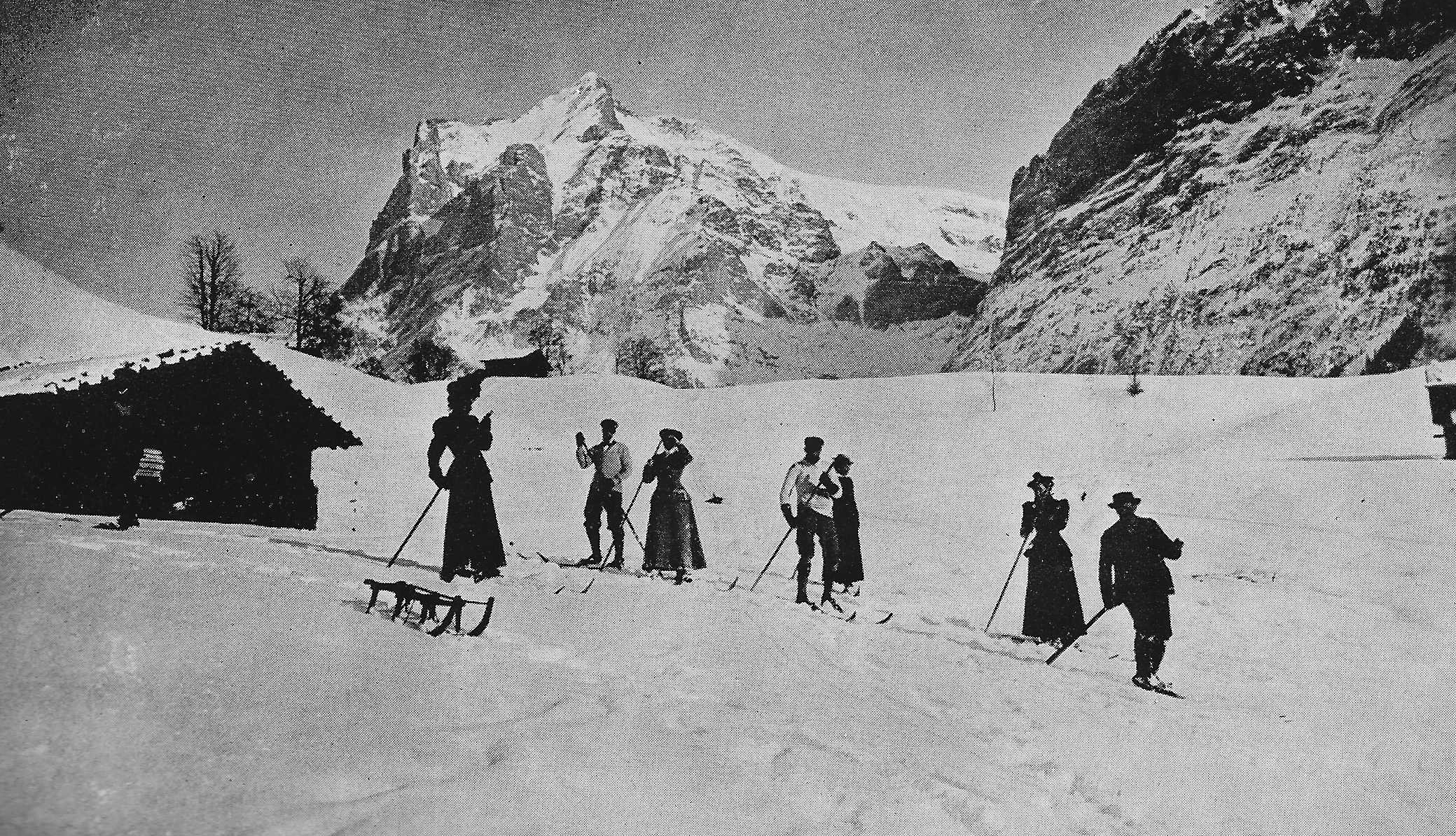
Early Days in Grindelwald

BY A. MANWARING ROBERTSON.

I HAVEN’T yet discovered what brought my old friend W. out to Switzerland in January, 1904. His usual programme was to take his army leave in one bloc and spend the whole of it hunting in Leicestershire. What went wrong in January, 1904, I don’t know, but W. suddenly appeared at the Bear Hotel, Grindelwald. I had been going out to the Bear since the winter season 1900-1901 to skate, just for the short time one could get between the Winter and Easter term at Oxford. W.’s skating being of the type that likes to hit a ball with some sort. of stick, he wasn’t exactly popular on the Bear rink where, in those days, everybody was to be found during the mornings. At that date I think three of four visitors at the Bear owned a pair of ski, and W. somehow made a start on a pair which he got from Jacob Apblanalp; the well-known shop opposite the Bear. After a couple of days he insisted that I should get hold of a pair of ski, and try my luck. The next day I rather reluctantly gave up my morning’s skating and he and I repaired to some good practice slopes at the back of the Bear Hotel. Since then I have put in many hours’ hard work practising turns on those selfsame slopes, but in 1904 turns were practically unheard of, at any rate among the English at Grindelwald. We ran varying distances and fell heavily, picked ourselves up and reclimbed the practice slope with a certain amount of difficulty. Our equipment was poor. We had “shoe” bindings with a strap from the heel over the instep and, of course, only a toe strap over the toe of the boot and no toe irons. These fittings, we were told, were a great advance on the old cane bindings. We used ordinary English shooting boots, and we carried one stout ash pole, about six feet along, shod with a solid ash disc. We had no skins for climbing and no ski wax, at least I never saw any, but we very soon carried old candle ends which we rubbed on the running surface of our ski. After W. and I had spent a morning of two in so-called practice (I said “so-called” advisedly, as there was no one to tell us anything, and all the elementary things we had to evolve for ourselves), W. insisted that we should go for an all-day trip. He I worked the whole thing out as follows. He proposed taking the 7.10 a.m. train from Grindelwald to Zweilütschinen, walking or langlaufing to Lauterbrunnen, breakfasting at Lauterbrunnen and climbing from there to the Kl. Scheidegg Pass and then running down back to Grindelwald. For the benefit of those who do not happen to know the places I have mentioned, perhaps I had better state at once that Grindelwald is about 1,000 metres U.M. and Lauterbrunnen about 700 metres U.M., so that our train journey wasted about 300 precious metres of height! I think W. must have realised very early in his ski-ing career the axiom that for a perfect ski trip you should not run down the same way you night, we caught the 7.10 a.m. one morning, put our ski into the van and bundled ourselves into a very comfortable “Dritte.” How often since, at the end of a long day on ski have I been thankful to settle down in the warmth of a Swiss third class carriage, with its hardish seat “fug” that you could cut with a knife! We had ordered breakfast a less didn’t worry us, and having ordered our lunch at the Bear and at the only hotel open at the only hotel open at Lauterbrunnen, and as we knew we had got to footslog from Zweilütschinen to Lauterbrunnen we had taken the precaution of ordering coffee for two and omelette for four, a tip that has stood me in good stead many times since. While I was smoking a satisfactory after-breakfast pipe, W. succeeded in hiring a Swiss boy to carry his ski up as far as Wengen as we learned that we could walk up to this point. This unfortunate youth was hounded ahead of us by W. to ensure the safe arrival of his ski at the top. I always find the walking part of a climb, carrying one’s ski as well as a rucksack rather a dull affair to say the least of it, but directly one gets on ski, even with skins, there is a certain amount of skill required, especially if there is no track. We, of course, had neither skins nor track. I think we were all glad when we got to Wengen; the Swiss boy certainly was! W. duly paid him, and off he started back to Lauterbrunnen on his toboggan. As far as I remember we followed the railway most of the way, and as a rule were just able to hold the gradient without slipping back. It seems almost absurd to call it an interesting climb from Wengen to the Kl. Scheidegg to people who get hauled up by train two or three times a day, but to us it was marvellous! Neither W. nor I had ever done more than go for walks round Grindelwald with a toboggan, when snow or thaw had made skating impossible, and here we were approaching a real pass! We lunched by the deserted station with a full-bore sun and some of the finest mountains in the Bernese Oberland to look at. Now comes the tragedy of the trip. We had slogged up about 1,400 metres from Lauterbrunnen and there we were, with, as I know now, at least three good routes to Grindelwald none of which we knew, really good powder snow without a single ski track on its perfect surface, and neither of us capable of running more than a few hundred yards without taking a toss or with any real control whatever! I have been at the Kl. Scheidegg or outside the Männlichen Hut a good many times since, feeling fairly confident, as a tourer, of running comfortably, but looking down at snow conditions very different from that day in January, 1904. I haven’t been to that part of Switzerland since 1935, but the last time I came down from the Männlichen there was a “toboggan” track the whole way down! W. and I started off on the run down and got on pretty well on those very pleasant open slopes just below the Scheidegg Hotel. The snow was powder, which suited us, and we made good time till we got down to the real treeline. We plunged straight into the wood thinking that if we kept going downhill we should get to the valley eventually. This sounds reasonable enough, but there are one or two very steep and deep gullies in the large belt of wood marked on the map as the Itramen Wald. We didn’t feel like tackling these, especially as we weren’t at all sure that if we had it would have been an end of our troubles. We floundered about for some considerable time and were just coming to the conclusion that we were lost, when we slid out into a small clearing where there was a neat stack of wood with a sleigh track leading down from it. Now a track of this sort, steep in places, and too narrow for any sort of check turn, isn’t ideal for two complete beginners to finish a day, but W. and I stuck to that track till we reached the bottom just as it was getting dark. I don’t flatter myself that any of the Down Hill Only fraternity are likely to read this somewhat tame account of a very tame day on ski nearly forty years ago, but if one should happen to read it, let me beg him not to be put off but to try a tour, even if it means giving up so many thousand feet of running over ground that he knows every inch of, without climbing a yard!

On the whole I think I have been lucky. I have had a certain amount of ski-running each year from 1904 to 1938-39, missing the five war seasons 1914-15 to 1918-19, and I cannot think of a better way to spend a day than on ski under reasonably good conditions with someone of about one’s own form to run with. May it not be too long before the younger generation can get at it again.

Source: Year Book of the Ski Club of Great Britain 1942, p32-34
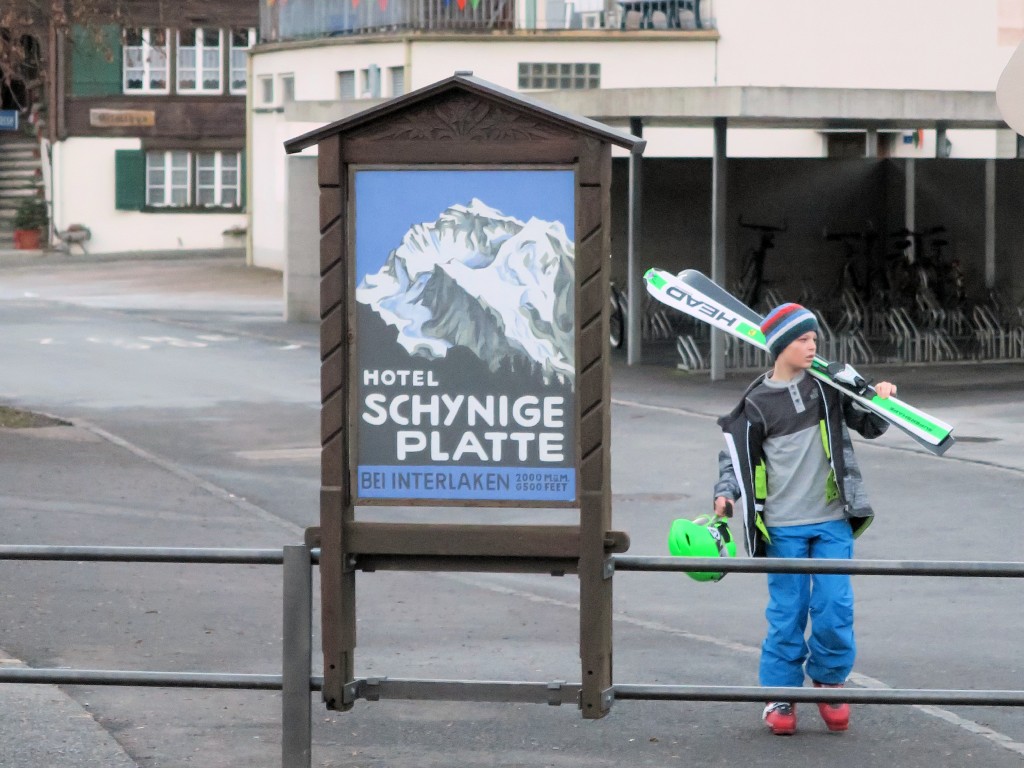
Stick it up your Jungfrau

Wilderswil - Schynige PlatteBack in Europe and picking up my car in Switzerland, which has a full set of winter tyres and my ski gear. Seems rude not to get in a few turns before I head back to the UK. A lot of snow looks to be on the way, but today promised sunshine. And so it proved.
I was tempted to try out a smaller resort, but I passed a couple on my travels around Switzerland attending to some business, and the poor snow conditions put me off. So I went for the Jungfrau. I booked into the delightful Edelweiss Lodge in Wilderswil.

Wilderswil is on the train route between Interlaken and the Jungfrau. It doesn’t have much nightlife, but the hotels are great value and accept short bookings. Train transfer is also included in the Jungfrau lift pass. There is also an interesting rail route from Wilderswil to a high plateau known as Schynige Platte, and the station in Wilderswil shares its name with the destination.

The Jungfrau is one of the world’s top ski destinations. So, after my recent trip to the USA, how does it compare with the slopes in the Americas? Firstly I would suggest that comparison is pointless – each resort has unique characteristics. If you like steep, off-piste powder, the resorts I visited in the USA had it in spades. The Jungfrau by comparison had rather crusty and generally quite tame off-piste, but it has miles of varied terrain and some of the most charming Alpine villages and restaurants, and a vibrant mountain history.

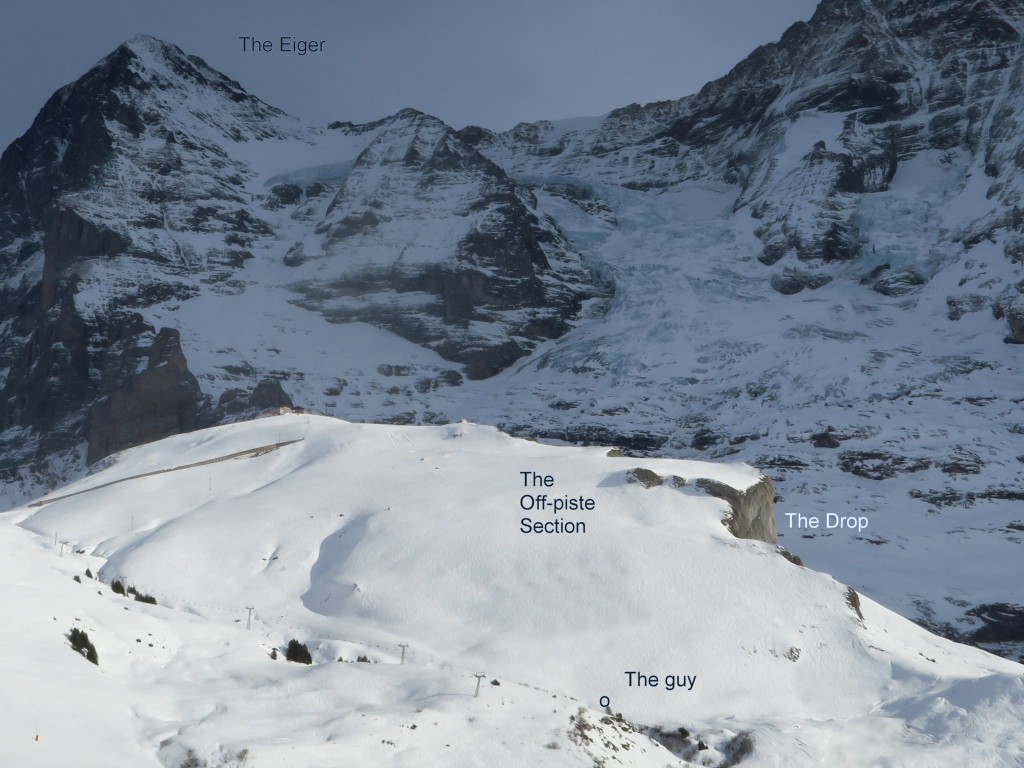
Talking of the off-piste, I ended up accidentally off-piste, following some uncharacteristically poor signage where the Wixi run was closed. Nobody else was around but it looked do-able, if steep, until I came across a sheer drop of a few hundred metres and a disconsolate individual who had made the same mistake and had sat frozen for half an hour working out what to do. We saw a feasible route down and I told him I would try it and signal when I was at the bottom. The other guy seemed rooted to where I had found him, so I alerted the lift operators. I was rather gratified when, some time later I saw him at the bottom of the off-piste section where it joined a run. Whether he walked or skied I know not.Off-piste Section above Wixi A telling reminder that the mountains can get both scary and dangerous.
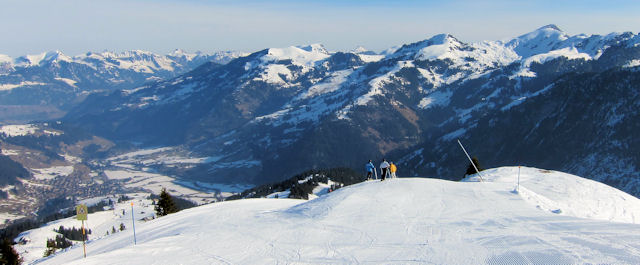
It made me reflect on some fatalities in the Jungfrau. I remember some English guy falling off a cliff walking back to his hotel after a night out in Wengen. And of the climbers who perished on the North Face of the Eiger, some of whose nemesis is retold in the riveting film, Nordwand. Then there are the base jumpers who die every year in Lauterbrunnen and a couple of ski racers have died, one on the tough Lauberhorn race. It is a salutory reminder that the things we do for pleasure, reward or adventure can turn nasty in the mountains. Much as I recall of the sea.

I visited the Jungfrau on a weekend and it was busy, but not overcrowded. It is hard to tell whether Swiss exchange rates are putting people off – I heard plenty of native German, French and English accents amongst the skiers and there were plenty of Asian visitors wandering bemused amongst the skiers. However it was noteworthy that one hotel and chalet were up for sale and I baulked at making at least one purchase. However my expenses for the day were modest. My hotel with a wonderful breakfast cost me 40 francs, the lift and rail pass was 72 francs and my nourishing lunch of goulash soup with bread and wine cost less than 20 francs including a tip (a franc is about the same value as a dollar). That was all much cheaper than it would have cost me in the USA at a comparable resort.

Ski the Stockhorn

I was reading an article in an online version of an Australian newspaper, the Sydney Morning Herald, which was addressing the issue of global warming and its impact on the Alps. Apparently “a recent Austrian climate change report found that the country’s temperatures had risen twice as fast as the global average since 1880, with the number of sunshine hours in the Alps increasing by 20 per cent.” I have certainly seen the impact of climate change on glaciers I have visited over the years, and there is no denying it will have an impact on the Alps.

Anyway, one of the more interesting observations was that a “ski region” called Stockhorn has dispensed with its ski lifts to concentrate on snowshoe walkers and such like. Now, as a self-declared expert on skiing in Switzerland, I feel a little ashamed to say I didn’t even know there was a place called the Stockhorn which had dismantled its ski infrastructure, and don’t have it in my winter sports website. Certainly the Stockhorn (3405m) in Zermatt is not suffering from global warming or lift closures, at least not last time I visited earlier this year! But as is often the case, several mountains often share the same name in the Alps.

So I did a little research.
Ski the Simmental valley
And I found another Stockhorn. The website for the resort states “Erlenbach in the Simmental lies in the Bernese Oberland at the start of the Simmental, in the direction of Lenk and Gstaad. The valley station of the Stockhorn cableway can be reached easily in approx. 30 mins by car from Bern, and in approx. 15 minutes from Thun. The timetable of the Stockhorn cableway has been coordinated with the train timetable.” Yes, this is Switzerland, there is a railway station in Erlenbach im Simmental with lifts timetabled to connect with the train timetable. I know Erlenbach – it is a small sleepy village in the Simmental valley and at a 700m elevation never a great candidate for ski-in, ski-out facilities. Could it have once been the throbbing heart of a ski region whose fame stretched across the planet as far as Australia?

The top of the Stockhorn is 2190m, but it seems skiing off the summit is not feasible. If there ever was skiing here, it would have been from the mid-station at Chrindi at a modest elevation of 1642m or possibly from local facilities in Erlenbach, but the village is very low to sustain a decent piste for any duration – in fact I know of NO resort with runs that low.

So it does have a cableway, but appears to have no other ski facilities. But surely, then, you can ski down still? And it does appear you can. As well as snowshoe walks, winter walks, an igloo village, fabulous views and fine dining, there are ski tours you can do in the area, organised by a local ski school. Starting at 9.50am on 30th December 2014, 3rd January 2015, 17th January 2015, 1st February 2015 and 28th February 2015 for between CHF140 and CHF290 Alpinschule Bergfalke (+41 (0)795025080/info@bergfalke.ch) take guided ski tours in the area. No touring experience is necessary, just that you are a reasonably good piste skier or snowboarder and in good physical condition. It looks like you have a three hour ascent from the lifts to start the downhill section of the tour. The claim is the tour suits both beginners and connoisseurs.

And it doesn’t look like you ski the Stockhorn anyway – the area you ski is the Lasenberg (Laseberg) which peaks at 2019m and the Cheibenhorn at 1952m, but you use the Stockhorn lift to get there, getting out at the Chrindi mid-station.

The Simmental is a fabulous region, renowned for its food, at least in Switzerland, and probably best known for the ski resort at Lenk and its access to Gstaad Mountain rides from Zweisimmen. Locals also often ski the small resorts at Diemtigtal and Beatenberg.

Were there ever ski facilities at the Stockhorn? I can find no evidence it was graced with as much as a drag lift at any period, but I suspect competing resorts in the Bernese Oberland rather than global warming did for the facilities if they ever did exist. It may have been that the locals tried out a drag lift for a period, but these are usually dismantled in the summer, and hardly constitutes the making of a ski region. Sometimes it is simply not economic to re-assemble and repair, or replace, an old and little-used lift. And if there were any ski facilities in the area once I doubt if anyone other than the good citizens of Erlenbach ever used them.

But there is another more prosaic explanation for this new story. Back in 2007, a cable car system, initally constructed in 1958 linking Gornergrat (3089m) to Stockhorn (3405m) above Zermatt (1620m) was dismantled and replaced with a new lift. Could this be the origin of the news story? Possibly not, since the story cites a “refocus on winter hiking and snowshoeing” as the replacement activity to skiing. Any readers ever seen somebody snowshoe walking the Triftji Jumps? No, nor have I. But possibly the intrepid newshounds from AFP,a French news agency that seems to have originated the story, got confused and linked two events about two different mountains and came up with a whole new angle.

So hitting my inbox and that of many other people round the world, and syndicated across a whole bunch of Australian, Asian, American and European newspapers and journals (including the famously gaff-prone UK Daily Mail), is a story entitled “Dismantling ski lifts in Europe as world warms up”. And they cite the Stockhorn as their sole justification, and there is no evidence to support any mountain in Switzerland called the Stockhorn had a lift dismantled in the face of global warming. Oh well, why let the facts get in the way of a good story.

Mürren upgrades its facilities

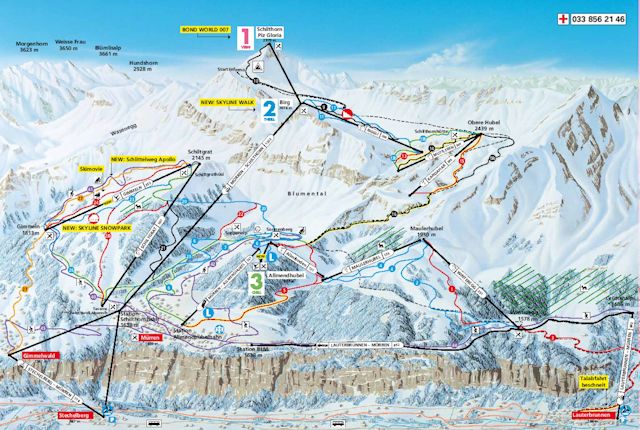
Murren piste map
Many Swiss resorts have been busy trying to up their appeal for winter tourists. Car-free Mürren is one of the most distinguished of the winter sports destinations, and the Inferno run down to Lauterbrunnen is the oldest ski race in the world. It generally gives a feel of timelessness, broken only by its brief and famous hosting of the filming of the James Bond movie, OHMSS (where it played as a stand-in for St Moritz).

However Mürren seems to have been busy this summer improving the facilities for skiers and snowboarders. There is a new snowpark at the Gimmeln ski lift, upgraded lifts for both Gimmeln and Allmendhubel and a new toboggan run from Schiltgrat Station via Gimmeln back to Mürren.

I am a great fan of early morning snow, to hit the pistes before the runs are fully open and the corduroy slopes are pristine. You can do this at Corviglia and a few other places, and now you can do it in Mürren. Mürren Snow Sports School, for Chf35.00, allows early birds to explore the resort every Wednesday from 7.30am. It’s on my list!