By W. G. Lockett and Margaret Lockett
Source: Year Book of the Ski Club of Great Britain 1942, p3-14.
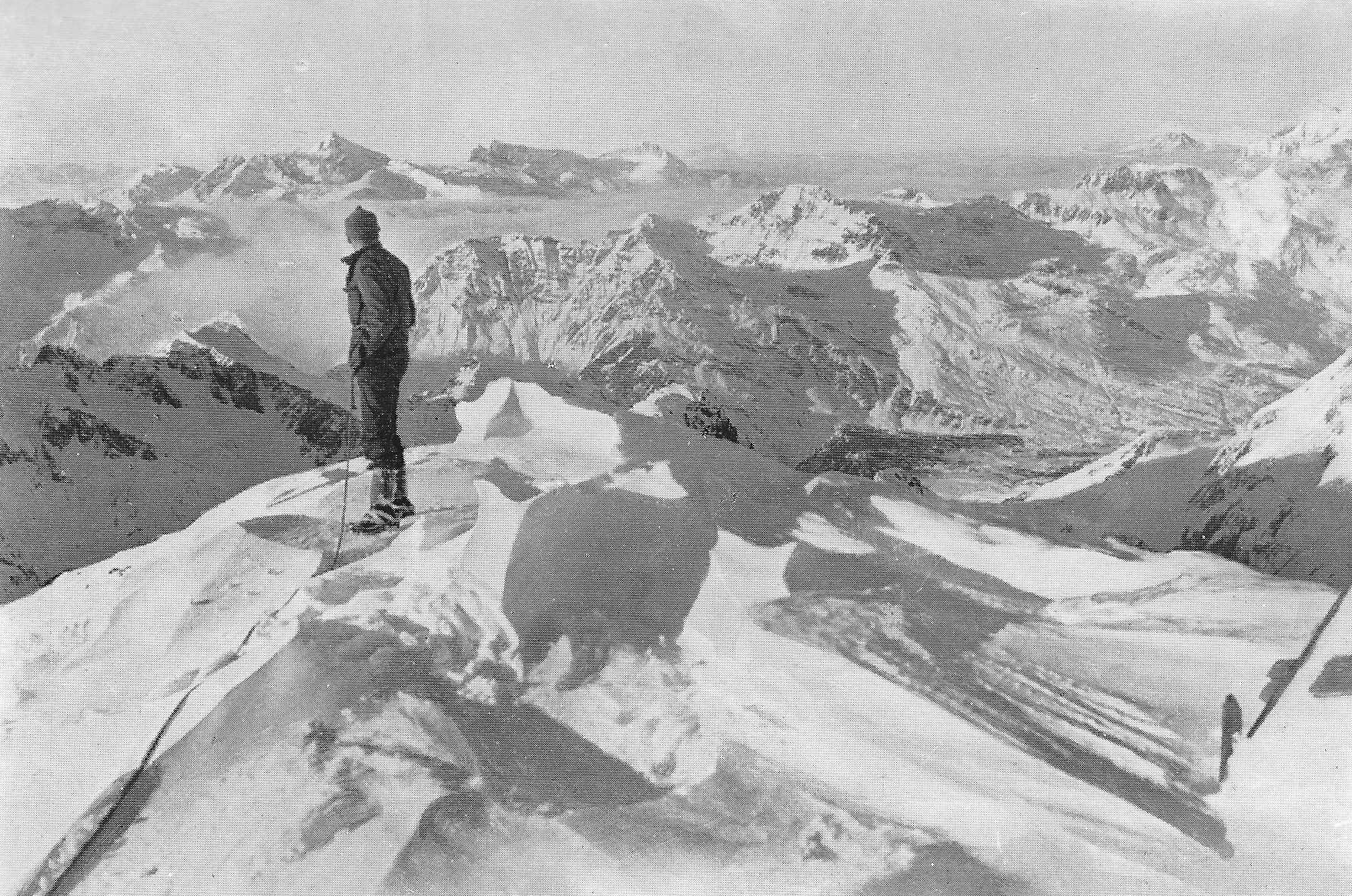
PRELUDE TO WINTER SPORTS: A GLANCE AT MOUNTAINEERING.
ON Boxing Day in the year 1860 the lonely sleeping village of Grindelwald was awakened and astonished by the arrival of a large party of English visitors, who pulled up outside the famous Bear Hotel, un- expectedly, but expectant. They came from Berne (from the Bear Town to the Bear Hotel), and their ringleader, a young secretary of the British Legation, who knew mine host of the “Bear,” managed to persuade him to open and warm the hotel.
Six years later guests of the same exceptional stamp went up from Montreux and invaded Chateau d’Oex in winter.
What these enterprising parties were after, however, was hardly what we mean by “winter sport,” but winter mountaineering; and winter mountaineering before (or after!) ski were used for climbing does not come within the scope of this book, except superficially as demonstrating the drive towards the Alps in winter that made itself evident in the 1860’s.
It may nevertheless be useful as well as interesting, at this point, to mention a few mountaineering feats in the Grisons tending to show that this region, in spite of the isolation elsewhere ascribed to it, was already even a century ago, being visited and climbed by a few Alpinists, British among them.
Herr A. Flugi of Silvaplana has compiled statistics of first ascents in the Engadine, going back to 1820 and in greater detail from 1844. From this we borrow a few particulars relating to British Alpinists.
The first British ascent given is that of Piz Bernina on 23rd July, 1861, by Mr. Kennedy and Mr. Hardy, whose acquaintance the Fresh- fields made on their tour that summer. Mr. Buxton with guides went to the top peak of Piz Palü in 1862. The next year Mr. Buxton with Messrs. Digby and Johnson and guide did Piz Sella (Rosegtal), and Mr. F. F. Bircham with guides climbed to the north peak of Piz Roseg. In 1864 we meet for the first time in this record the name of Mr. D. W. Freshfield, who, with Mr. J. D. Walker and Sir Melvill Beechcroft, ascended Monte Sissone (Forno group). Freshfield was back again the next summer, when with Tuckett and Buxton, he did Piz Verona (Bernina), a few weeks after Moore and Walker had conquered the south peak of Piz Roseg. The first crossing of the Fedozjoch was accomplished by Freshfield and Tuckett in July, 1866. The first British ascent of Piz Morteratsch was made in July, 1867, by Mr. F. G. Bonney, and in the same season we meet for the only time in these records with the famous name of the Rev. W. A. B. Coolidge who, with two others, made a first ascent of the Cima dei Rossi on 30th July.
No other British name appears in this list until August, 1876, when Messrs. Cordier and Middlemoore were the first to climb Piz Bianco. Then there is another gap until August, 1879, in which month Mr. F. Bircham went up to the Cima di Cantone. Until February, 1878, all these first ascents had been made in summer, and then three times (twice in February and once at the beginning of March) three first winter feats are recorded; but there was no British first winter ascent until 4th February, 1880, when Messrs. C. E. B. Watson and Parnell with two guides got up to the top of the Piz Bernina. In July, 1882, Messrs. Wainwright and J. Legh with two guides were the first to climb Piz Prievlus in the Bernina group.
In the Davos district no such list of first ascents can be given, the only one, in fact, is that already mentioned: the first ascent of the Tinzenhorn by D. W. Freshfield in 1866. Freshfield’s quality may be illustrated by mentioning that it was twelve years before any other human feet were set on the top of the Tinzenhorn. This peak was first climbed in winter on 15th February, 1882, by A. Rzewuski, who had found a cure for asthma at Davos, and still lives there hale and hearty, and has since led a very active life there.
It seems that until the middle of the 1870’s the surrounding mountains were very little climbed, even by the Davosers, who contented themselves with going up the Schiahorn, the Weissfluh, and the Flüela Schwarzhorn, leaving it to strangers to assault the more difficult points and peaks. The earliest undertakings of the kind were of a sort of professional character, the first ascent of Hoch-Ducan in October, 1845, and of Piz Kesch in September, 1846, having been done by a Swiss Inspector of Forests named Coaz, who was doing cartographical work for the Confederal Ordnance Survey Department. He accomplished many such first ascents in the Grisons. Then in 1867 the highest point of Piz Vadret was climbed, apparently by two residents named Hartmann and Fitch. Then we hear of no more adventures of this kind until 1875, by which time Davos was already a health (if not yet quite a sport) resort. A new era began; but for a while it was mostly invalid visitors who did the climbing, conspicuous among whom was a German clergyman named Hauri, who with his friends, and often without a guide, climbed many a Davos peak for the first time. The Rev. Dr Hauri settled in Davos and became one of its foremost men. He wrote a good deal about the place, and for many years delivered a series of I myself attended with profit and pleasure. His favourite poet was popular lectures on scientific and literary subjects, many of which Shakespeare, whom he read in English and lectured upon, as well as his next favourite, Goethe.
I will only mention further that the first winter ascent of the Piz d’Aela, which is such a notable massive object from any viewpoint above Davos, was made by a party of Davosers on 24th November 1881.
The very first recorded Davos ascent with a guide was that of the Flüela Schwarzhorn on 15th August, 1836, when Andreas Mettier, well-known and still well remembered chamois hunter, took out his first “tourist.” A still more famous chamois hunter, Colani, was one of a Swiss party that made the first ascent of Piz Palü (eastern peak) in August of the year before, 1835.
ST. MORITZ: 1860-1890.
It must seem strange, but it is convenient, to commence the story of the very beginnings of winter sport in St. Moritz with a glance at the history of the English Church in that resort.
In the Villa Grünenberg, above the Leaning Tower, there is to be seen the following inscription on a brass plate:To the Memory of
The Rev. A. B. Strettell, for 38 years English Chaplain at St. Moritz, and of Arthur E. V. Strettell, his son, whose home was in this house and who, being the first foreigner to winter at St. Moritz for health’s sake, always desired that others might benefit as he did, this gift to the St. Moritz Aid Fund is dedicated.
The “whose” in this memorial is perhaps a little vague; but it is clear from other sources that the first foreigner to winter for health in St. Moritz was Mr. A. E. V. Strettell, the son of the Chaplain.
It is astonishing how difficult it is to fix these early dates. There is a stained glass window in the English Church in St. Moritz in memory of “Alfred Baker Strettell, First Chaplain at St. Moritz, 1860-1900, by whose effort this Church was built.” Yet we have already been told by a good authority that Mr. Strettell first came to St. Moritz in 1866. And yet it is recorded that the Society for the Propagation of the Gospel in Foreign Parts became Patron of St. Moritz as long ago as 1863, when they nominated the Rev. A. B. Strettell British Chaplain. Services were held first in a hall in St. Moritz-Bad on Sunday mornings, and in the Swiss Protestant Church at the Dorf in the afternoons. In October, 1864, a local committee was formed to raise funds for building a church under S.P.G. patronage. Services were conducted by Mr. Strettell during the late ‘sixties in the Kulm Hotel, the proprietor of the hotel in those days, Herr Johann Badrutt, who died in 1899, taking the greatest interest in the Chaplaincy.
By the year 1871, and chiefly owing to the splendid exertions of Mr. Strettell, a sufficient sum had been raised to build the English Church which stands midway between St. Moritz-Dorf and St. Moritz-Bad. It was opened in July that year.
Far away as all this seems to be from our subject, it is of interest and importance in comparing beginnings at St. Moritz and Davos. St. Moritz had a chaplain at a time when no English visitor is reported to have been in Davos, and an English Church twelve years before Davos had one. In was in 1871, when St. Moritz already had a Church, that the Colonial and Continental Church Society first thought it worthwhile to send out a chaplain to Davos; but at the end of the first season the chaplain reported that no English figured among his small congregation! For some years the services were poorly attended. A change for the better occurred when the Hotel Belvedere was opened in 1875. In 1878 the first steps were taken for securing an English Church for the now rapidly increasing community, and in 1883 the Church was opened.
The early dates at which St. Moritz instituted English Church services and built itself a church seem to be in utter variance, with the St. Moritz Post speaking in its own press of Davos being “the elder sister.” The solution is probably that these words were used of Davos as a winter-sport resort; for Davos certainly began organising winter sports before St. Moritz did. But as a summer resort St. Moritz had an enormously older and bigger history than Davos, because of its historic spa. We read elsewhere in this book of a British family visiting St. Moritz as early as the summer of 1855.
In January, 1890, the St. Moritz Post and Davos News published a letter from Mr. Walter M. Moore, Canterbury, New Zealand. He wrote: “I believe I may lay claim to the honour of being the first English traveller who ever spent a winter in the Engadine. I say, the first traveller,’ because one Englishman (Mr. Strettell) had certainly been there before me, but as he lived there and had built a house in St. Moritz, I consider him more as a resident than a visitor. I first went to the Engadine in June, 1867, living during the summer at Pontresina, and finally left in April, 1868, and I have no doubt that some of the residents in Pontresina, Samaden and St. Moritz may remember the English lad ” (unfortunately the printers put “cad”!) “who spent a winter there 22 years ago.’ He speaks of it as “a delightful time,” with sleighing parties, dances, etc., already!
But it does not follow that St. Moritz-Dorf in the 1860-70’s was any nicer a place to stay in, so far as accommodation and so forth was concerned, than Davos. Even much later it was described as a not very pleasant or attractive village. “It is built,” wrote Dr. Yeo,* “in an irregular, untidy, scrambly way, with narrow dirty streets, and terribly rough and jolty pavements. It is the least tidy and neat of all the Engadine villages I have seen. Some decent-looking houses have been built on the outskirts of the village, for the accommodation of visitors, a pretty little Catholic Church, and a house adjoining for the priests, have been erected just beyond the Kulm Hotel, on the road towards Samaden. A very pretty little English Church, the site for which was given by Herr Badrutt, and foundation stone laid in 1868 by the Archbishop of York, has been built between the village and the exertions of the Rev. A. B. Strettell, the English chaplain at the baths. Our countrypeople are indebted for the edifice mainly to St. Moritz, who, besides founding the chaplaincy there, has been unremitting in his efforts to improve it and beautify it since its completion.”
No doubt Mrs. Holland is quite right in saying that in her time Mr. Strettell was summer chaplain; he took a winter chaplaincy in a warmer climate in Italy; but we must remember that Mr. Strettell was in St. Moritz for nearly twenty years before the Hollands arrived; and at first he certainly did spend the winter in St. Moritz; and we get the following glimpse of him in an interesting private letter describing the winter from October, 1869, to February, 1870, at St. Moritz, and until March in Samaden: “Our party at the Kulm Hotel has consisted of four English, three Germans, three Italians, and a French lady; in Mr. Strettell’s house there have been four more English people besides himself. In this place (Samaden) which is only three and a half miles from St. Moritz, but at a slightly lower elevation, there has been one English family, consisting of a lady and gentleman and five children. That, I think, is a complete list of the visitors who have passed this winter in the Upper Engadine.” That makes a total of sixteen in St. Moritz and seven in Samaden.
The anonymous writer goes on to show that the same complaint about inadequate food which we found at Davos in the 1870’s was made in the Engadine. “The great drawback,” he said, “of spending the winter at St. Moritz is the want of good food. The milk and bread and butter are good; but the meat is bad, and the soup invariably requires a certain amount of ‘Liebig’s Extract’ to make it worth eating. For three months the only vegetables we had were potatoes. In fact, a person coming here for health gains greatly as regards climate, but loses greatly for want of good food and ordinary home comforts.’
If we would understand what our forefathers came out to sixty or seventy years ago, for health or for pleasure, we must get such facts well imbedded in our minds.
It was a tough job getting to St. Moritz and they had to rough it when they got there. But conditions improved rapidly, as far as circumstances would permit, and already in the winter of 1875-76 a newspaper correspondent reported that the evil reputation the Engadine once had in the matter of food was no longer merited, and the most exacting and fastidious need no longer complain against either the quality or the cooking of the food.
But winter sports had already begun. Concerning that same winter of 1869-70 a writer in The Times of 21st February, 1870, describes the means adopted for providing a “beautiful surface for skating on the St. Moritz Lake. Another favourite entertainment,” he added, “is sliding down steep inclines on small sledges constructed for this purpose. The speed obtainable is almost incredible. In this sport both old and young join.”
A slightly earlier record – one of the very earliest records of a winter passed at St. Moritz by an invalid who was also a sportsman is to be found in the visitors’ book of this Kulm Hotel for the winter of 1868-69. In those days there was no central heating in the hotels, and the writer said: “The rooms are warmed by means of stoves, not open fireplaces, consequently the chief difficulty is to ventilate them properly; to do this effectually, we left our sitting room for five minutes every two hours, opening all the doors and windows…. On the average we were out four hours daily, walking, skating, sleighing, or sitting on the terrace reading this latter two or three hours at a time; twice in January we dined on the terrace, and on other days had picnics in our sledges… Skating was already, in 1868-69, organised by a small club of English visitors, who kept a “circle” of the lake in order as a rink.
Yet in the 1870’s, when St. Moritz was still only a health-resort, with skating and tobogganing thrown in as casual diversions, St. Moritz did not seem able to compete with Davos. In 1876 a writer in a daily newspaper, speaking of St. Moritz, states: “No one has had the hardihood to pass the winter there or at the Berninahof in St. Moritz since 1872 until the present season, notwithstanding the favourite testimony as to climate, comforts, and amusements of the very few who stayed through that and the three preceding winters.”
He goes on to say that several proprietors of hotels and pensions at St. Moritz, encouraged by the success of Davos as a winter residence for consumptive patients, advertise that their establishments are open the whole year. They scarcely seem to realise, however, the extent to which provision must be made for delicate patients above the requirements of ordinary summer visitors, or even of themselves in winter.”
It is noteworthy that in his classic Tourist’s Guide to the Upper Engadine, the English edition of which was published in London in 1877, M. Caviezel makes no mention whatsoever of any winter visitors.
If we let the curtain drop here and ring it up ten years later, we shall find the scene altogether changed.
It is true that Dr. Tucker Wise, living practically on the spot, wrote in 1885 that there were only two hotels open at St. Moritz in winter. His words are: “Two hotels are open to receive those who winter at St. Moritz, two ice rinks are in constant use, and several tracks are kept in good order for coasting and tobogganing.”
That St. Moritz (according to a practically resident authority) had only two hotels open during the winter in 1885, seems astonishing, especially when one remembers that the first Cresta Run was built in the winter of 1884-85, and that the first Grand National Race, with the commencement of the annual visit of Davos sportsmen to St. Moritz, and vice versa, had begun in that very year 1885.
It seems strange, in comparison, that Davos already had seven hotels and a number of villa-pensions, and was running a visitors’ list more than ten years earlier, in the winter of 1873-74.
In December, 1886, an astonishing thing happened in that small English community. An extraordinarily enterprising young English invalid conceived the apparently risky adventure of publishing weekly newspaper of and for that little isolated community, with lists of visitors, accounts of sports and entertainments and amusements and of title, get-up, scope, frequency of appearance, and so forth, this first announcements of forthcoming events. In spite of all sorts of changes until this day; and from this point onward it affords an infallible guide English newspaper ever printed in Switzerland has continued to appear in tracing the history of these Alpine winter colonies and resorts and their sports.
The first number appeared on 7th December, 1886, and an examination of the lists of visitors and of the advertisement page will help us to see St. Moritz as it was fifty years ago.
As a matter of fact, the visitors’ list shows that there were four hotels instead of two; but quite half the visitors were staying at one hotel, the Hotel Engadiner Kulm, of which Mr. J. Badrutt was then the proprietor. The other houses were Hotel Caspar Badrutt, Hotel Beaurivage, the Privat-Hotel.
Imagine St. Moritz with only four hotels, only one of them large enough to take a hundred visitors. No Palace Hotel, no Grand Hotel, no Carlton, no Suvretta House-or any of the thirty or so hotels and pensions that now fill page after page of the Engadine Express with lists of their visitors.
But there were plenty of shops already. In the first number we find advertised: “A Pastry Cook Shop,” a confectioner, two grocers, two “bazaars,” a jeweller and a watch and clock maker, two banks, a chemist, a hairdresser, an ironmonger (who sold skates), a bootmaker, a tailor, a tailor and dressmaker, a dressmaker, a tinsmith, a milliner, a Modes” and a shop offering “Linen, Cotton, Wool, Silk and Lace.” Almost every week announcements of new businesses were added to the advertisement sheets. Also two doctors announced their consultation hours.
Turning over the pages of this newspaper one gets an impression of great animation – sports without and amusements within. It might be quite a large community that needed all these shops and indulged in so much gay life.
Now, if we take an issue of mid-season (end of January) we find that the total number of visitors in the four hotels was about 240, of whom some 210 were British. More than half were at the Kulm. It is wonderful how this little community asserted itself, what energy it displayed, what faith it had in the future of St. Moritz. Much of the impression is due to the fact that it had several born leaders to show it the way, to account for its inventiveness in sports, and to ensure the attractiveness of its social life.
After all, it was still a small community as compared with Davos, with its fourteen hotels and many boarding-houses, housing 1,412 visitors; so that altogether we begin to understand how a St. Moritzer could about this time describe Davos as the “elder sister.”
One great disadvantage still remained for St. Moritz-the journey to and from it. This is how the journey was at the beginning of the winter season of 1886-87:-
1st Day.-Leave London, 11 a.m.
Arrive Calais, 2.20 (lunch).
Tergnier, 7.32 (25 minutes allowed for dinner).
2nd Day.-Arrive Basle, 6.15 a.m.
Leave Basle, 7.20.
Arrive Zürich, 9.32.
Arrive Chur, 1.15.
3rd Day.-Leave Chur, 5.30 a.m.
Or go on to Thusis the same afternoon and pick up the post at 8 (instead of 5.30!) the next morning.
Arrive St. Moritz, 6.20 p.m.
An alternative route from Basle was via Lucerne, Lugano, Menaggio, Chiavenna by rail (Gotthard Line) and from Chiavenna to St. Moritz by road, 9 hours. The advantages were the scenery, the shorter road journey, and avoidance of the severity of the passes.
Heavy snowfalls very seldom interfered with the running of the sleigh posts, though owing to a five-foot fall the Julier post did miss a day that very December, 1886-a thing that had not occurred since 1871. On the 22nd December it took the post 11 hours to get from Samaden to Maloja! The heaviest snowfall on record is that of 1863, when the Maloja Pass was closed for six weeks, and on one occasion it took twelve hours for the post to get from Samaden to St. Moritz, a distance of about three miles, while for several days no post was able to get through at all. Those were among the risks you ran in travelling to St. Moritz before the railway reached it in 1894.
St. Moritz has changed more than any other of the old Alpine winter resorts. This is due chiefly to the men who have made it, who knew what they wanted and worked straight for it. They have made it the unquestioned queen-the capital, the metropolis of Alpine winter- sport-land. Largely because of what they were and are in themselves, men of refinement and social and educational quality, as well as of iron energy, they had built up a palatial resort, a sport and pleasure resort, which drew irresistibly the best people in society, statesmen, politicians, business leaders, authors and artists, and all people of fame; and they have given the place a cachet which is unique. For one thing it always gives the impression that it is a wealthy place, which has any amount of money to spend for the advantage of its visitors. Though to keep this up means a constant strain on local finances, St. Moritz never hesitates when money is needed for its further development. Its inter- is, it seems to have the importance and significance of a European centre. national relationships and communications are elaborate; small as it To find the original poor little St. Moritz out of which the world- famous and all-attractive has grown, is no easy task. There are no so interesting when you come to dig down far enough, is the discovery signs of it out-cropping. You have to excavate for them. And what is that the early development of St. Moritz is due more to its visitors than to the native population, and above all to the English. It is extra- ordinary to see how British visitors took hold of the place and organised its life and sports, giving the example and the incentive to the born St. Moritzers and pointing out the road they had the good sense and skill to follow.
Something that no St. Moritzer and no Davoser knows now, until it is shown him as in this book, is the intimate friendship that for many years existed between the two places, their comradely rivalry, the visits to and fro in spite of the terrible Flüela, the abundant mutual hospitality, and for some years the sharing of one English newspaper for both resorts.
*”A Season at St. Moritz,” first published in 1870, and revised throughout and incorporated in “Health Resorts and their Uses” (1882), by Dr. J. Burney Yeo.
THE INVALID LEADS!
Alpine winter sports were introduced to the world by invalids and their companions. Most of these winter-sporting invalids were consumptives, and some of the leading winter-sport pioneers, whose stories are told in greater detail elsewhere in this book, were at one time very ill indeed.
All through the ages the wonderful curative and sport-enabling climate on the mountains remained unknown to the world. The people who lived in the Engadine and in the Davos Valley knew, centuries back, that theirs was an extremely healthy climate; but the medical profession did not get hold of it effectively until less than a hundred years ago. When the doctors did discover it and succeeded in persuading invalids to visit the Alps in winter, the invalids and their companions very soon saw, though to a very limited extent, the possibilities and delights of sport in the wonderful sunshine of the snowy mountains. They led and pointed the way to the present immense popularity of winter sports. To them we owe the Alps as a winter- sport playground. They did not invent the sports–they found them suggested; the sports were all known somewhere and to some extent before, but they discovered that here was the ideal region for these sports; they practised and developed them.
To so many of us it seems such an obvious thing that the Alps are a perfect winter playground-it is all so taken for granted that we do not stop to consider that down to seventy years ago the Alpine resorts that now resound with the joys of sport were almost inaccessible snow- deserts, the inhabitants of which spent their long winter in dreary dullness and loneliness. Such horrible killing cold regions were dreaded and shunned. The world knew nothing of the glory of Alpine winter sunshine or of the splendour of the snows.
It was, we repeat, considerations of health that led the way to the discovery. A district doctor named Luzius Rüedi, who practised in the valley from 1827 to 1849 (his son was to be R. L. Stevenson’s medical adviser at Davos), was struck by the curative qualities of the climate; he wrote about it in the medical Press in the 1840’s and founded an institute for “scrofulous” children.
But his was a voice crying in the wilderness. Davos was such an inaccessible desert, with not so much as a road leading to it, that after a few years Dr. Rüedi and his views and his institute were heard of no more. Davos had first of all to be made accessible and habitable.
Twenty years and more passed by. Then another district doctor was struck, as Dr. Rüedi, by the freedom of the inhabitants from tuberculosis and the rapidity with which Davosers who contracted it else- where got better of it when they came back. From 1862 onwards he called the attention of the medical world to his observation, and in 1869 published a fuller and more persuasive pamphlet, which attracted much attention, especially in Germany. The doctor was himself a German-a German political refugee named Alexander Spengler. He if any one man-was the effective “discoverer” of Davos and of the Alpine winter. This is now universally confirmed by local historians.
Long since a monument to Alexander Spengler was erected in the public gardens of Davos-Platz. Two of his sons became doctors practising in Davos.
Davos, in spite of being so difficult to get at, was already in the early 1860’s known to a good many Swiss people as having a pleasant cool climate to take refuge in from the lowland dogdays, and there was nothing to say against Dr. Alexander Spengler’s advocacy of its qualities as a health resort-except that it had no decent hotel or private house accommodation, no sanitation, no roads, no shops, no amusements- nothing urban to make life tolerable to the visitor! But those things could be produced. What rubbed people up the wrong way was that Dr. Spengler wanted them to be there in winter as well as in summer which was, of course, absurd! Nay, it was worse than absurd; it was wicked. Surely everybody knew-patients as well as doctors-that cold was the greatest enemy of the consumptive! and the Alpine winter was “arctic,’ Siberian.” It would have been bad enough to persuade healthy people to visit the frozen mountains, supposing there was any- thing for them to do or get or enjoy there; but to tempt invalids to go there was murderous.
However, in February, 1865, two consumptive invalids arrived, who had sought recovery in vain elsewhere. Here they were both healed. One died in 1893, the other some ten years later, more than eighty years of age. That was the beginning of the exploitation of the Alpine winter. The news spread-not only that healing could be found on the mountains, not only that it was possible to “cure” in the Alpine winter, but also that the Alpine winter, instead of being deadly, was a delight. And so the way was prepared for Alpine winter sports.
St. Moritz, too, had a medical man who, in very, very early years made known the same discovery about the health value of St. Moritz. This was Dr. P. Berry, who practised in St. Moritz from 1857 until his death there in November, 1892. He too had remarked that Engadine people who became ill in foreign countries recovered after passing the winter in their native climate. This led him to the belief that the Engadine winter could restore others as well, and, inspired by this faith, he was instrumental in persuading many English people to spend the winter at St. Moritz, greatly to the benefit of their health.
St. Moritz, as well as Davos and Arosa, began its career as a health and sport resort, as I will soon show in detail. But none of these places was ever an invalid resort only. St. Moritz early became predominant as a pleasure resort. Davos tried and tries to be both. But even Davos, and as long ago as 1884, protested against being regarded as an all-invalid resort. The editor of the Davoser Blätter, a weekly journal for visitors, published in October of that year an indignant refutation of an article in a Continental periodical in which it was “incidentally remarked that Davos is only visited by people in an advanced stage of consumption.” We cannot insist too strongly, wrote the Davos editor, ‘that it is fully time to put an end to this spreading of incorrect statements. For years only a small fraction of Davos visitors has consisted of people who are very ill. Can they imagine that those people are far gone in consumption who undertake glacier expeditions, play tennis,* run toboggan races, and go in for suchlike amusements. Or will they affect to believe that the numerous families of foreigners who stay here the whole year through, are made up entirely of sick persons? At Davos we have very much the same class of visitors as the Riviera. Indeed, we are even convinced that at many a southern health resort there are to be found fewer sound people than here in comparison.”
“Invalids” were at any rate, among the first sportsmen at Davos, and they appear to have done very well on both rink and run-on the little runs and rinks of those early years. As long as the primitive Swiss “coaster” was the only “machine” on the toboggan runs and in the toboggan races, the invalid often beat the able-bodied competitors. When the “Americas” came in, the invalids were put out of the running, because of the heavier weight and the head-foremost posture.
A correspondent of The Davos Courier (8th November, 1888), who signed himself “Invalids First,” protested against the unsportingness of the healthy tobogganers in using machines which they knew the invalids could not! Davos is made for invalids,” he exclaimed,” and tobogganing is made for the invalids. Nearly all the prize-winners have come from among those who were spending the winter here solely for the benefit of their health. . . . I doubt whether any of these invalids is in such health as to venture to use an American toboggan; but with the Swiss machines there are a number of invalids so well suited for the big races that they generally manage to beat those who are not invalids!” St. Moritz, like Davos, began as a consumptive resort.
That St. Moritz really did get consumptives in the early days, is evident from an appeal by the administrators of the St. Moritz Aid Fund published in The St. Moritz Post and Davos News in July, 1889. “One patient, a consumptive young man, age 18, has, after a winter’s residence at St. Moritz, returned to his duties in England completely cured; and the other case, a far graver one, with extensive tubercular disease of both lungs, has greatly benefited by a stay of three months.”
We see, therefore, that St. Moritz itself, the tiptop pleasure centre, the most fashionable and gayest of all, went through this invalid stage too, but went through it quicker and got further away from it.
We must not forget that St. Moritz had been a health resort pure and simple as a spa-tens of centuries before winter sports were ever dreamed of. It is the only big Alpine winter resort that has all this history behind it. As a watering place St. Moritz is, literally, thousands of years old, whereas Davos as a health resort has not a single century behind it.
In 1907 when some excavations were going on at the wells in St. Moritz-Doif, workmen found traces of a well-lining and of other human activity dating back to the bronze period, over three thousand years back, 750 years before the foundation of Rome. Then there is a long gap of darkness down to the 15th century, when the documentary evidence of the existence and popularity of the spa sets in. St. Moritz and its healing waters were a place of pilgrimage in those times, and
Pope Leo X issued a bull granting special indulgence to pilgrims visiting the holy springs of St. Maurice. It is mainly because of its healing does the curative effects of these waters with those of its invigorating, waters that St. Moritz has been and is a health resort, combining health-promoting climate.
But, apart from having been a spa health resort for at least three thousand years, St. Moritz began to be considered a climatic health resort at about the same time as Dr. Alexander Spengler began to call the attention of the medical world to the Alpine climate in general and that of Davos in particular, and it continued to be considered as prominently a climatic health resort. Commenting in July, 1890, in a new spacious sanatorium favour of a scheme for erecting St. Moritz, the editor of the St. Moritz Post and Davos News wrote: “There are almost innumerable visitors who year after year find renewed health and strength at St. Moritz… ” And in 1890, when Dr. Robert Koch, who had discovered the bacillus of tuberculosis in 1882, produced a lymph (” tuberculin “) by which he hoped to effect a cure for phthisis, he appointed a doctor to go to St. Moritz with a supply of it.
We have all forgotten it nowadays, but the fact remains, and can be proved from numerous records that there was a time when St. Moritz seemed likely to become a larger and more important resort for consumptives than Davos itself. That was away back in the 1870’s; but the likelihood did not last long, and Davos established its priority in this (for winter sports) none too favourable element! Indeed, down to this very day this entanglement with tuberculosis tells against Davos as a winter-sport resort, though it now does so less and less, as year by year sanatoria are transformed into sport hotels.
I have thought it right to recall the true pioneers of winter sports, our plucky forefathers who, when stricken by disease, undertook the adventure, as it then was, of the journey to and residence in these un- comfortable Alpine villages without so much without almost everything that makes these resorts such a pleasure to us nowadays. Our inventive discovering forebears did not, literally, take their cure lying down, as patients do to-day; but demanded skating rinks, built toboggan runs, invented racing “machines” for snow and ice, and prepared the way for this age of ski-ing.
No doubt the sports as we know them to-day would have come without the invalids. These hungry generations of ours would certainly have discovered the Alpine winter and its joys. It need not have been the invalids who led the way, but it was.
The invalid lead in winter sports applies only to Davos and the Engadine, and in a lesser degree to Arosa. All the other hundred winter- sport places began as winter-sport places-after the invalids at St. Moritz and Davos and their companions had transformed their winter pastimes into winter sports for the robust.
*The first Tennis Club in Davos was founded in 1884.
(Concluded)
K.T.