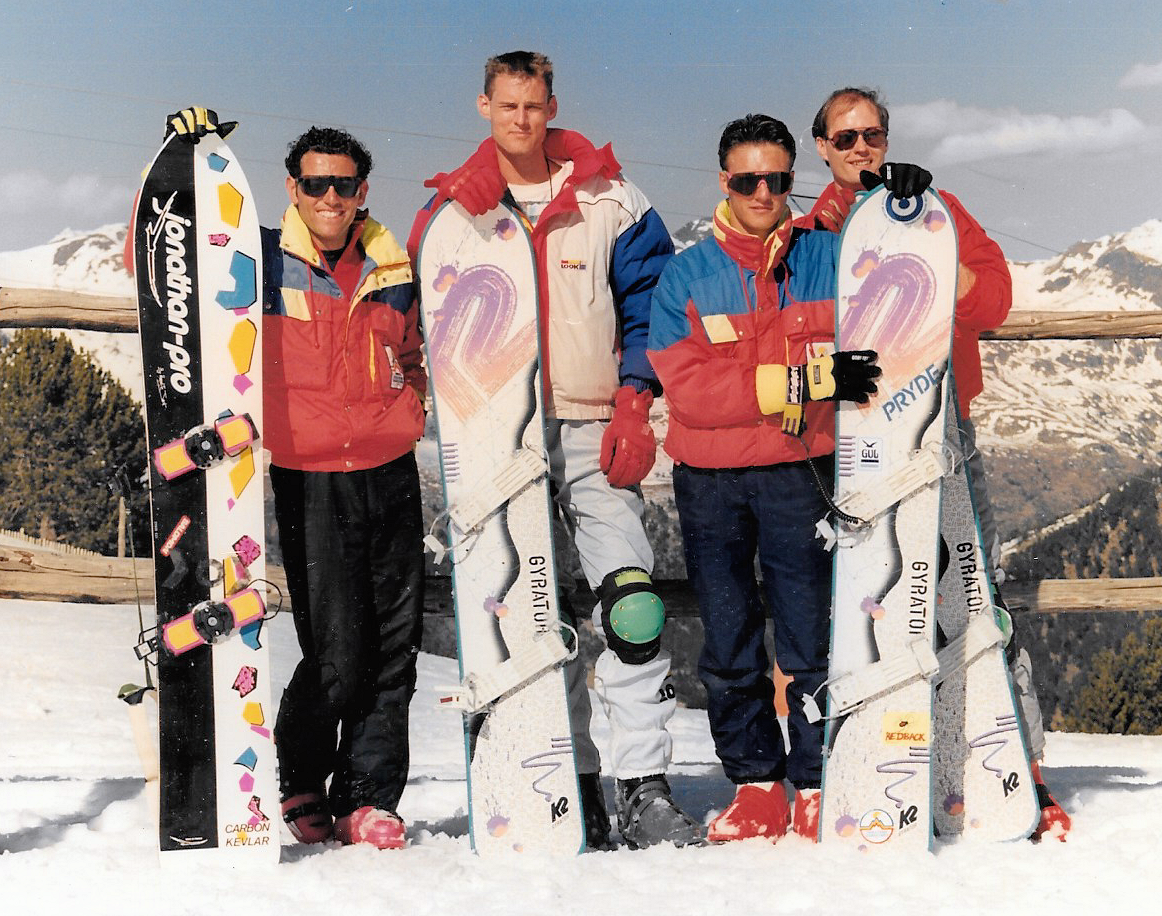
Figure 1: The author (on the right) snowboarding in Andorra 1989/1990
Recreational use of snowboards emerged in the USA, the first popular manifestation being the Snurfer in the 1960s, followed by the Winterstick, in 1974. Tom Sims patented a snowboard in 1977 but the widespread adoption of the snowboard was mostly down to one man, Jake Burton Carpenter, who produced 300 Burton-branded snowboards in 1979, and never looked back. Burton built on the culture of surfing and skateboarding, and the associated dress, music, attitudes and language of those sports. In an interview Burton claimed that “Without youthful snowboarders, ski areas would have become elitist, small, high-end, inbred.” Initially US ski resorts banned snowboarding, but the early adherents didn’t care, they preferred making their tracks in fresh powder away from the pistes.
European resorts were more open to snowboarding than their American counterparts with many resorts in France actively encouraging it. As a result, a new generation of snowboards was being developed that worked as well on-piste as off. In 1983 a Swiss company, Hooger Booger, started building snowboards in Europe. Seeing the potential in the new market, Jake and Donna Burton opened their European Headquarters in Innsbruck in 1985, with a new design of snowboard manufactured in Austria. The CEO of the European operation declared that “The city of Innsbruck got a whole new image after Burton settled there: the traditional mountain town became a lot more young, dynamic and trend-setting”. In 1987 the French conglomerate, Rossignol, entered the snowboard market with their own branded products.
Up until this time there had been little coverage of snowboarding in the UK. However, in late 1987 an issue of Ski Survey announced that “As an indication of its fast-growing popularity, snowboarding is now attracting the attention of the big ski manufacturers.”. The article went on to say that “The big question is who will produce the first viable release binding?”.
The following issue of Ski Survey noted that:
“Snowboarding is looking more and more like a long-term addition to winter sports. Although it started very much as a way of surfing powder, the latest trend is towards competitive events on hardpack snow – slalom, giant slalom and downhill. This winter there will be a race circuit across the Alps and the latest equipment is being specially designed to meet the demands of the different race events.”
Elisabeth Hussey, the editor of Ski Survey from 1974 until 1992, said of snowboarding:
“At the beginning we were a bit worried about the snowboarders because they tended to crash into people. This I think was because they started by being skateboarders and they were young and they were energetic. But we always felt it was going to bring about an expansion of the sport and that’s good. You have got to have something new for the young to do. The snowboarders eventually took lessons, and once they began to learn about how to snowboard they became much safer.”
The first snowboard race in the UK, reported in Ski Survey, was held in the winter of1988, sponsored by Pernod, as part of the Glenshee Fun Week. The race was a slalom, but an impromptu freestyle event also took place. The magazine also announced the introduction of the halfpipe event in snowboarding competition, a concept adapted from skateboarding, declaring that it was “something quite unique in wintersports.” The same issue carried its first advertisement for Burton snowboards, an advert for a snowboard supplier and an advert for Les Deux Alpes featuring a picture of five skiers – and a snowboarder.
Although the first world snowboard championship took place in 1983 in the USA, it was a parochial affair fuelled by competition between Sims and Burton for market share of the growing domestic snowboard market. It was not until 1991 that competitive snowboarding took on a truly global dimension when the International Snowboarding Federation was formed. The International Ski Federation (FIS) subsequently introduced snowboarding as an FIS discipline in 1994. The Olympic snowboarding program now includes five disciplines for both men and women – Halfpipe, Big Air, Slopestyle, Snowboard Cross, and Parallel Giant Slalom – and one mixed team Snowboard Cross event.
Although snowboarding had begun on powder snow, the use of hard pack snow for competition opened up the use of artificial slopes for training to nations that were not traditionally ski nations.
David Goldsmith in Ski Survey, in a review of artificial slopes in the UK, considered the use of snowboards on artificial slopes. “Snowboarding on plastic might sound like a fatal attraction”, he wrote, “but it is certainly not deterring many of Britain’s enthusiasts.”
By February 1990, the SCGB was running a soiree at its Clubhouse to help members find out why snowboarding was so popular. The September issue of Ski Survey that year was noteworthy for carrying the first cover picture of a snowboarder. A subsequent issue focussed on snowboard classes under the byline “Snowboarding has already outgrown skiing in some resorts.” The article recognised a rapid uptake of snowboarding in the previous two years but thought that: “This does not come as welcome news to many skiers, who fail to see why snowboarders dress so strangely, and who feel snowboarders are a danger.” The article also offered a helpful guide to snowboard speak, including what was meant by a ripper, a Shred Betty and a goofy rider. In the November 1994 issue, the regular Ski Fashion column in Ski Survey was made over entirely to snowboard chic. It states that “Martin Drayton, who runs the Snowboard Asylum in Covent Garden reports a huge sell-out of snowboard clothes and fields requests for them even in mid-summer.” He is further quoted as saying:
“Some 50 year olds starting to come in as well. This fashion is so comfortable it is happening for everyone. Definitely about 40 per cent of the kids who come in here have never been on a snowboard. These clothes are for everyday.”
The clothing typically had “wide shapes, soft fleeces and roomy pants”.
In the same issue, Ski Survey was reporting that “Snowboarding is definitely a part of the Olympic program”, quoting Marc Hodler, President of the International Ski Federation.
Conflict between skiers and snowboarders was being widely reported. Ski Survey noted: “Reading the anti-snowboard tirades in the press recently one could be forgiven for thinking that skiers were claiming territorial rights over the pistes”. Ski Survey, had “decided to take a more enlightened view”. Snowboarders kept lift prices down and segregation would have its disadvantages: “Snowboard-only areas would be a pity – they would probably include some of the best ski terrain!”
In practice, a new type of mountain sport terrain had started to appear, aimed exclusively at snowboarders – the snowboard park.
The first snowboard park was constructed at Bear Valley in California in 1989. Over the next decade they became ubiquitous and increasingly attracted skiers, leading to them being re-branded terrain parks and open to all-comers. Skiers took to many of the competitive sports practiced by snowboarders in a class of competition called freestyle, first introduced at the Olympics in 1992
In the September 1995 issue of Ski Survey, TV presenter Martin Roberts looked at the state of play with snowboarding:
“By the year 2000, snowboarders are expected to outnumber skiers on the slopes. Think about that for a moment: more snowboarders than skiers in just four years’ time. Couple that with the fact that, as of next year, snowboarding becomes an Olympic sport and you snowplough nervously towards a startling conclusion: you can no longer dismiss snowboarders as a group of uncouth, long-haired yobs with stupid hats and baggy clothes, who carve down the piste on oversized tea trays with all the finesse of pit bull terriers.
“Believe it or not, normal everyday skiers are trying the sport and discovering that actually it’s quite good fun.
“Some 90 per cent of the people I take guiding on skis try snowboarding; says 22 year old snowboarding champion Lee O’Connor. ‘The next time I see them, they are raving about the sport.’
“’The sport has had such bad press;’ she adds… ‘You shouldn’t criticise until you’ve tried it’”.
Roberts indeed decides to try snowboarding, observing that the ability “to progress from novice to competence in such a relatively short time is a major appeal of the sport.”
Roberts was not alone in being an older skier learning to snowboard. Nicky Halford, the snowboard editor of Ski Survey, observed a trend for snowboarders over 40 taking up the sport in significant numbers. despite “the dedicated snowboard magazines and TV shows aimed at the younger market”.
Snowboarding as a distinct sub-culture was starting to become absorbed into a common cultural identity shared with many skiers. Ironically, snowboarding made skiing cool again.
The last issue of Ski Survey was published in February/March 1997, featuring an interview with Jake Burton. For the following season the Ski Club magazine would be entitled Ski and Board, reflecting the Ski Club’s full adoption of snowboarding.
Despite the popularity of snowboarding, the pace of uptake had slowed. Martin Roberts had been wrong about snowboarding overtaking skiing. In practice general estimates are that snowboarding adoption has since plateaued, accounting for less than 20% of the activities of British winter sports tourists, and around a third in the USA.
Despite participation levelling off, snowboarding has nonetheless become well-established as a popular competitive sport.
Snowboarding was adopted as an Olympic sport, as Hodler had predicted, at the 1998 Nagano Winter Olympic Games in Japan – although not without some controversy. Reflecting the first major shift in Olympic skiing since the introduction of slalom and downhill disciplines, more freestyle and snowboard were progressively added to the Olympics. Both sports proved popular with TV audiences – at the 2014 Sochi Winter Olympics, 92m watched snowboarding, 78m watched freeskiing and 77m watched alpine skiing.
Back in the 1930s, the Ski Club of Great Britain had been instrumental in establishing alpine skiing as an Olympic discipline. At the same time, many skiing luminaries were lamenting the inability of British skiers to be competitive with Alpine nations. Arnold Lunn, long-time editor of the SCGB Year Book, claimed that:
“Once the Alpine countries discovered that Olympic medals were alleged to be a good advertisement for the national ski schools, and such victories therefore of commercial importance in attracting tourists, the odds against the British became impossible.”
Snowboarding and freestyle skiing have levelled the playing field for participants in non-Alpine nations. The sports could be practiced on dry or indoor slopes and using equipment such as trampolines and airbags all year round. In 2018, the CEO of GB Snowsport, Vicky Gosling, declared that “Great Britain is already a leading snowsport nation… In the last eight years, British skiers and snowboarders have been on the podium in every discipline at either World Cup, World Championship or Junior World Championship level”. Gosling aimed for GB to become a top five snowsport nation by 2030.
In 2014, Jenny Jones, was awarded the Ski Club’s prestigious Pery Medal for her bronze medal performance in Slopestyle at the 2014 Sochi Winter Olympics, becoming the first snowboarder to win the Pery Medal.