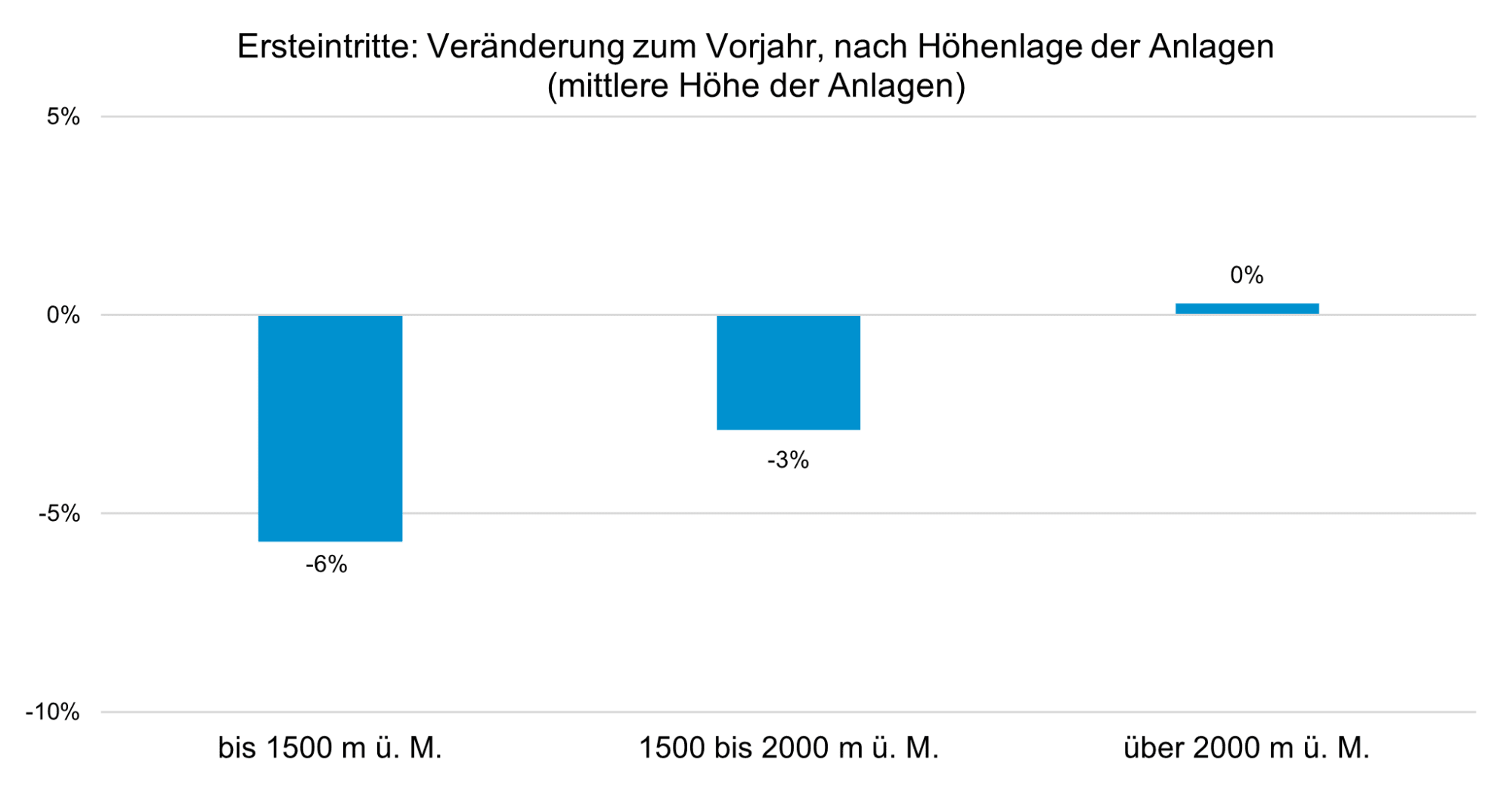
Visitor Numbers compared to last Year, by Resort Average Altitude
In their latest press release , Seilbahnen Schweiz (The Swiss Ski Lifts Operators) report a very good 2025/26 winter season, with visitor numbers only 2% below the record 2024/25 winter and 13% above the five‑year average.
After a snow‑poor, weak start between 1 November and 15 December and an underwhelming Christmas period, demand picked up; sports holiday weeks nearly matched last winter and the late‑season period from 16 March grew by 28%, almost offsetting the poor start. Heavy snowfall at the end of March followed by a dry, warm, high‑pressure April created excellent piste conditions and sunny, almost summer‑like days, encouraging both winter sports enthusiasts at high altitude and early hikers at lower levels. April visitor numbers rose 23% year‑on‑year and stood 37% above the five‑year average, despite an early Easter and earlier season closures.
Performance varied by altitude and customer structure. High‑altitude destinations above 2,000 m held their previous year’s level, mid‑altitude areas (1,500–2,000 m) fell by 3%, and low‑altitude areas below 1,500 m dropped 6%, particularly in the first half of the season; snowmaking is described as crucial for snow reliability in these areas. Resorts near major cities that depend heavily on day visitors suffered from bad‑weather weekends, while areas with mainly residents or a balanced clientele maintained last year’s level (+1%) and day‑trip‑dominated regions slipped 3%; in April, both segments benefited equally from the good weather.
Regionally, high‑altitude cantons and those with strong resident bases fared best. Valais, the Vaud and Fribourg Alps, and Ticino ended the season slightly above 2024/25, whereas most other regions recorded small declines of a few percent. Over a five‑year horizon including a Covid‑affected winter, all regions were up: Switzerland overall and Valais were 13% above the five‑year average, eastern Switzerland +3%, and Ticino +22%.
The press release notes that small ski areas did not fully regain the exceptional 2024/25 results and stresses the importance of preparing winter operations with artificial snow in challenging winters. RMS director Berno Stoffel concludes that winter sports remain very popular, April showed that the “winter” product stays attractive into spring when conditions are good, and many lift companies are evolving into year‑round destinations, supporting optimism for early summer and the coming summer season.
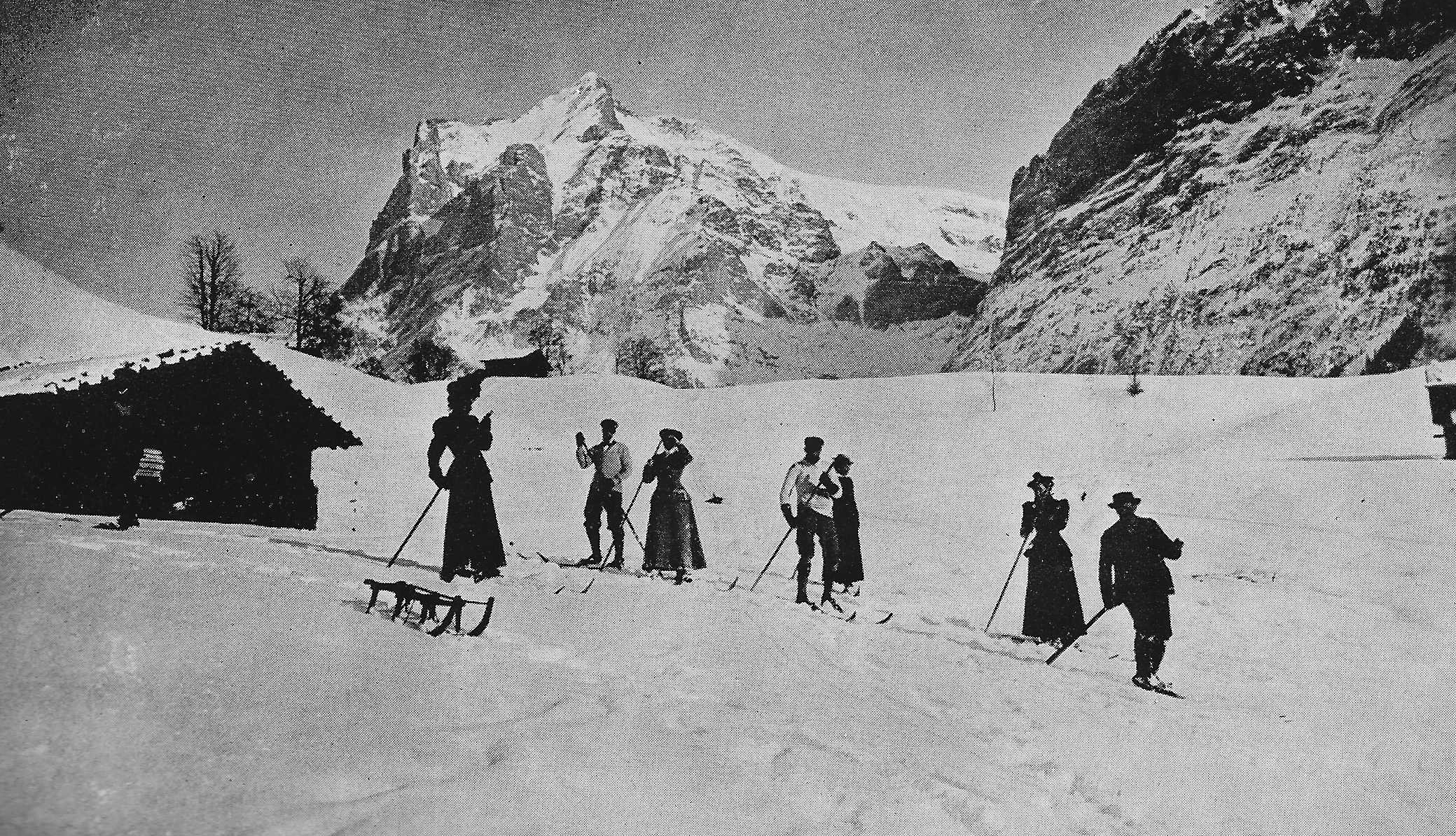
I HAVEN’T yet discovered what brought my old friend W. out to Switzerland in January, 1904. His usual programme was to take his army leave in one bloc and spend the whole of it hunting in Leicestershire. What went wrong in January, 1904, I don’t know, but W. suddenly appeared at the Bear Hotel, Grindelwald. I had been going out to the Bear since the winter season 1900-1901 to skate, just for the short time one could get between the Winter and Easter term at Oxford. W.’s skating being of the type that likes to hit a ball with some sort. of stick, he wasn’t exactly popular on the Bear rink where, in those days, everybody was to be found during the mornings. At that date I think three of four visitors at the Bear owned a pair of ski, and W. somehow made a start on a pair which he got from Jacob Apblanalp; the well-known shop opposite the Bear. After a couple of days he insisted that I should get hold of a pair of ski, and try my luck. The next day I rather reluctantly gave up my morning’s skating and he and I repaired to some good practice slopes at the back of the Bear Hotel. Since then I have put in many hours’ hard work practising turns on those selfsame slopes, but in 1904 turns were practically unheard of, at any rate among the English at Grindelwald. We ran varying distances and fell heavily, picked ourselves up and reclimbed the practice slope with a certain amount of difficulty. Our equipment was poor. We had “shoe” bindings with a strap from the heel over the instep and, of course, only a toe strap over the toe of the boot and no toe irons. These fittings, we were told, were a great advance on the old cane bindings. We used ordinary English shooting boots, and we carried one stout ash pole, about six feet along, shod with a solid ash disc. We had no skins for climbing and no ski wax, at least I never saw any, but we very soon carried old candle ends which we rubbed on the running surface of our ski. After W. and I had spent a morning of two in so-called practice (I said “so-called” advisedly, as there was no one to tell us anything, and all the elementary things we had to evolve for ourselves), W. insisted that we should go for an all-day trip. He I worked the whole thing out as follows. He proposed taking the 7.10 a.m. train from Grindelwald to Zweilütschinen, walking or langlaufing to Lauterbrunnen, breakfasting at Lauterbrunnen and climbing from there to the Kl. Scheidegg Pass and then running down back to Grindelwald. For the benefit of those who do not happen to know the places I have mentioned, perhaps I had better state at once that Grindelwald is about 1,000 metres U.M. and Lauterbrunnen about 700 metres U.M., so that our train journey wasted about 300 precious metres of height! I think W. must have realised very early in his ski-ing career the axiom that for a perfect ski trip you should not run down the same way you night, we caught the 7.10 a.m. one morning, put our ski into the van and bundled ourselves into a very comfortable “Dritte.” How often since, at the end of a long day on ski have I been thankful to settle down in the warmth of a Swiss third class carriage, with its hardish seat “fug” that you could cut with a knife! We had ordered breakfast a less didn’t worry us, and having ordered our lunch at the Bear and at the only hotel open at the only hotel open at Lauterbrunnen, and as we knew we had got to footslog from Zweilütschinen to Lauterbrunnen we had taken the precaution of ordering coffee for two and omelette for four, a tip that has stood me in good stead many times since. While I was smoking a satisfactory after-breakfast pipe, W. succeeded in hiring a Swiss boy to carry his ski up as far as Wengen as we learned that we could walk up to this point. This unfortunate youth was hounded ahead of us by W. to ensure the safe arrival of his ski at the top. I always find the walking part of a climb, carrying one’s ski as well as a rucksack rather a dull affair to say the least of it, but directly one gets on ski, even with skins, there is a certain amount of skill required, especially if there is no track. We, of course, had neither skins nor track. I think we were all glad when we got to Wengen; the Swiss boy certainly was! W. duly paid him, and off he started back to Lauterbrunnen on his toboggan. As far as I remember we followed the railway most of the way, and as a rule were just able to hold the gradient without slipping back. It seems almost absurd to call it an interesting climb from Wengen to the Kl. Scheidegg to people who get hauled up by train two or three times a day, but to us it was marvellous! Neither W. nor I had ever done more than go for walks round Grindelwald with a toboggan, when snow or thaw had made skating impossible, and here we were approaching a real pass! We lunched by the deserted station with a full-bore sun and some of the finest mountains in the Bernese Oberland to look at. Now comes the tragedy of the trip. We had slogged up about 1,400 metres from Lauterbrunnen and there we were, with, as I know now, at least three good routes to Grindelwald none of which we knew, really good powder snow without a single ski track on its perfect surface, and neither of us capable of running more than a few hundred yards without taking a toss or with any real control whatever! I have been at the Kl. Scheidegg or outside the Männlichen Hut a good many times since, feeling fairly confident, as a tourer, of running comfortably, but looking down at snow conditions very different from that day in January, 1904. I haven’t been to that part of Switzerland since 1935, but the last time I came down from the Männlichen there was a “toboggan” track the whole way down! W. and I started off on the run down and got on pretty well on those very pleasant open slopes just below the Scheidegg Hotel. The snow was powder, which suited us, and we made good time till we got down to the real treeline. We plunged straight into the wood thinking that if we kept going downhill we should get to the valley eventually. This sounds reasonable enough, but there are one or two very steep and deep gullies in the large belt of wood marked on the map as the Itramen Wald. We didn’t feel like tackling these, especially as we weren’t at all sure that if we had it would have been an end of our troubles. We floundered about for some considerable time and were just coming to the conclusion that we were lost, when we slid out into a small clearing where there was a neat stack of wood with a sleigh track leading down from it. Now a track of this sort, steep in places, and too narrow for any sort of check turn, isn’t ideal for two complete beginners to finish a day, but W. and I stuck to that track till we reached the bottom just as it was getting dark. I don’t flatter myself that any of the Down Hill Only fraternity are likely to read this somewhat tame account of a very tame day on ski nearly forty years ago, but if one should happen to read it, let me beg him not to be put off but to try a tour, even if it means giving up so many thousand feet of running over ground that he knows every inch of, without climbing a yard!
On the whole I think I have been lucky. I have had a certain amount of ski-running each year from 1904 to 1938-39, missing the five war seasons 1914-15 to 1918-19, and I cannot think of a better way to spend a day than on ski under reasonably good conditions with someone of about one’s own form to run with. May it not be too long before the younger generation can get at it again.
Source: Year Book of the Ski Club of Great Britain 1942, p32-34
I find the MySwitzerland site in equal measures useful and frustrating. The way the information is presented is largely intended as brochure-ware, and it is not always easy to find hard data or anything in great detail. Over the years I have tried to incorporate MySwitzerland content into https://www.swisswintersports.co.uk/ and have previously had some success, but changes of personnel and changes in the rules have now limited me to simply providing links to content at MySwitzerland, or scraping the site, rather than having it fully incorporated dynamically with the content.
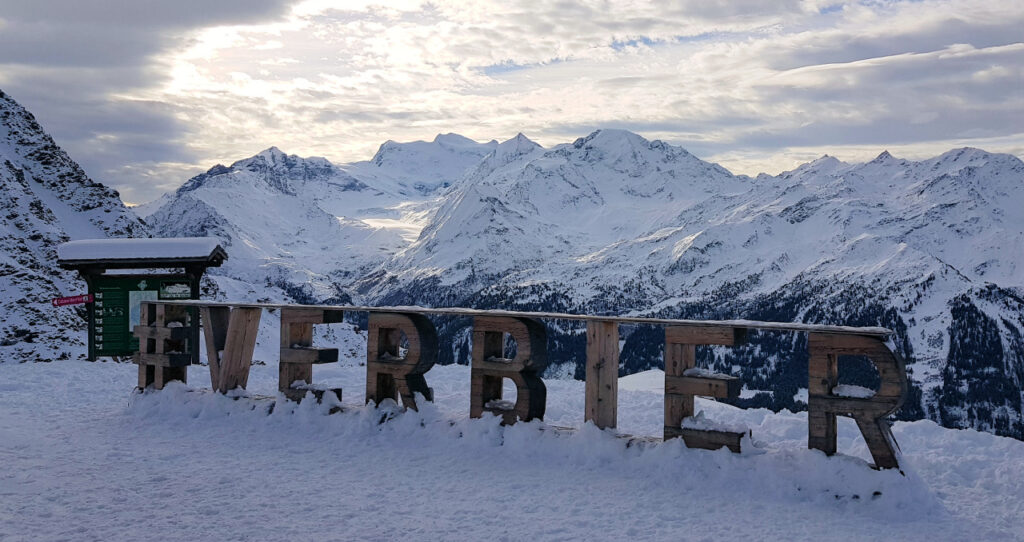
Switzerland is fortunate to have some of the very best ski resorts in the world, and Zermatt and Verbier are amongst the very best. But how do they compare?
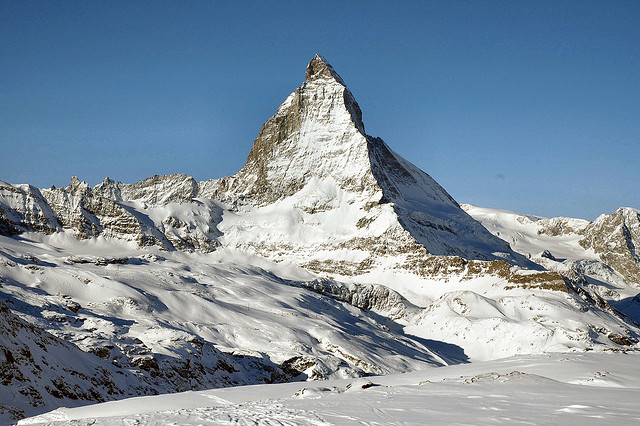
The Matterhorn, above Zermatt
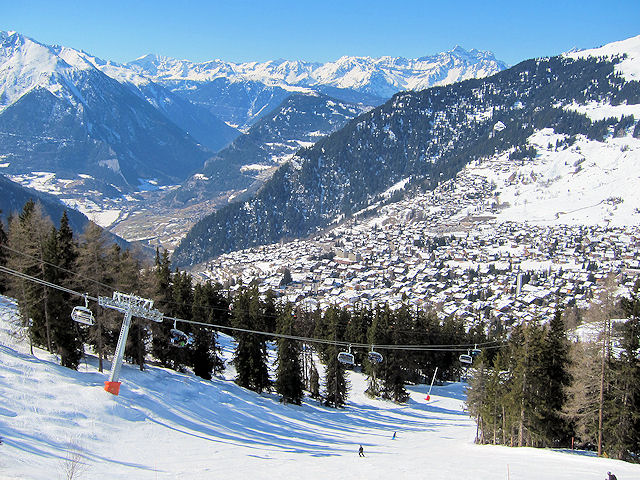
Location Both resorts are in the Pennine Alps in the Swiss canton of Valais, and both are high, particularly Zermatt. The most obvious difference between them is that Zermatt is in the part of Switzerland where a uniquely Swiss form of German is spoken, whereas Verbier is French-speaking. Verbier rests on a sunny plateau above the valley of Bagnes, whereas Zermatt lies right at the head of a long steep valley. The nearest international airport to Verbier is Geneva, whilst Zermatt is equally served by Geneva and Zurich airports. Both relatively convenient for international visitors.
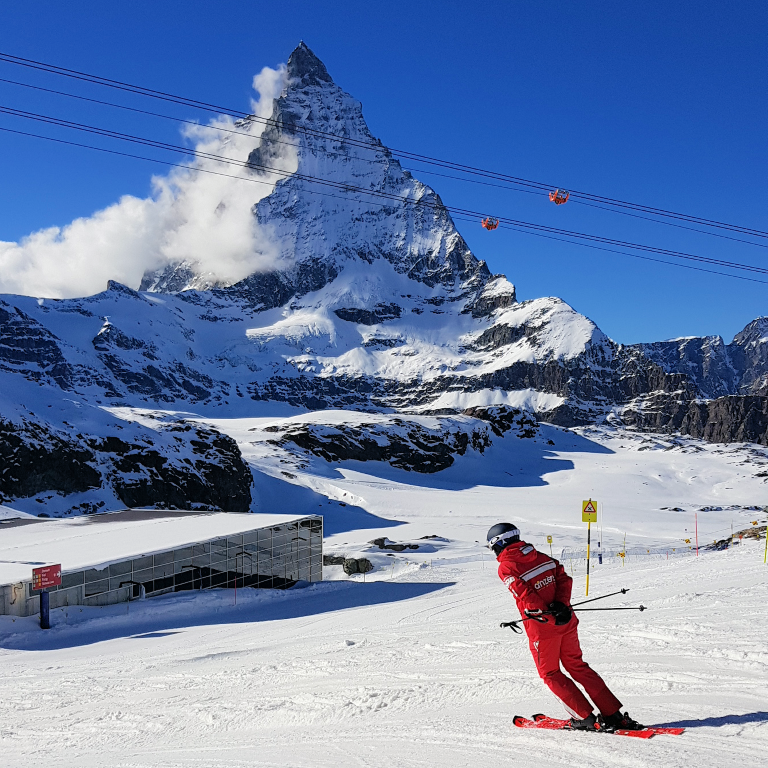
Pistes Zermatt has 360km of piste spread over four highly integrated ski areas in Switzerland and two across the border in Italy. Although Verbier is part of the extensive Four Valleys, with 412km of piste, the valleys are less well connected than Zermatt, and you will probably not get round to visiting some of the more remote slopes beyond Siviez. Honours even.
Season Pretty much nowhere in the world can beat Zermatt for year-round skiing. Granted that summer skiing is something of a novelty, Zermatt nonetheless offers extensive glacier skiing from the beginning of November right through to the end of May, with the full extent of the resort available from the beginning of December until the end of April. Verbier normally opens up one piste in November, and the resort progressively opens up in the following weeks. Normally the season finishes in mid-April. For early and late season skiing, nothing beats Zermatt, but it can get very cold in the heart of the winter. Zermatt for early and late season, Verbier edges it for mid-season.
Beginners Neither resort is especially good for beginners, but Verbier does have a nursery area in the village. Unless you are coming with a mixed ability party which includes experts, or you just want to party, neither resort is recommended for beginners. You pay a premium in these resorts because of challenging slopes a beginner will never get to experience. Beginners should look elsewhere but, if you had to choose, Verbier is better.
Intermediates I think both resorts are excellent for intermediates. If you come for a week or two you will never want for more variety or challenge, or for nice cruisy runs when you have a hangover to shake off. Even Stevens.
Expert Both resorts have good skiing for experts, but if you want to stick to ungroomed trails and challenging lift-served off-piste, Verbier has more to offer. For back-country ski touring they both make excellent bases, and both lie on the famous Haute Route (Verbier only on a variation of the classic route). Verbier is my recommendation.
Apres-ski Apres-ski in Switzerland is generally more subdued than in other Alpine nations, but Verbier and Zermatt are exceptions to the rule. They both rock, but I prefer… Zermatt.
Mountain Restaurants Both resorts have a mix of cafeteria restaurants with sunny balconies and charming restaurants in the mountains. However Zermatt is something of an epicurean’s delight with some of the most outstanding mountain restaurants in the world. Not really a contest if you want haute cuisine for lunch. But it comes at a price. In the resorts themselves there is a wide range of options from street food to Michelin-starred restaurants. The Blue Ribbon goes to Zermatt.
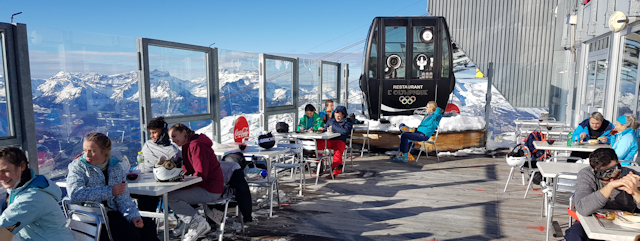
Lunch above Verbier
Resort Charm Lying beneath the Matterhorn, nowhere quite matches Zermatt for chocolate box pretty. It is car-free, although not traffic-free as the electric taxis and service vehicles mean some streets are quite busy. It has a fabulous Alpine tradition stretching back many centuries, and was well-established as a tourist destination by the middle of the 19th Century. Verbier, conversely, is largely a post-war resort, but it’s ubiquitous chalet-style architecture is not without its charm. Zermatt has it all.
Access – Car You can’t drive to Zermatt, you have to pay to leave your car in a car park in a neighbouring town and take a train for the last section. Verbier does have full car access, but you generally need to pay for parking unless it comes with your chalet. There is free parking at the bottom station of the gondola that passes through Verbier at Le Châble . Assuming you are driving from the Lake Geneva Region, it will take you about 3 hours to get to Täsch, the end of the road, and then 10 minutes by train to Zermatt. Verbier is one of the easiest resorts to get to from Geneva, 2 hours of mainly motorway to Le Châble, and about another 10 minutes drive from there up to Verbier. Verbier is the easier to get to from almost anywhere.
Access – Train Zermatt is very easy to get to from either Zurich or Geneva airport by train – both airports actually have railway stations in the airports themselves and you can get to the resort with as few as one change (in Visp). Journey time from Zurich Airport is just under 4 hours, from Geneva Airport just over 4 hours. For Verbier, Le Châble is just over 2 hours from Geneva Airport with a change at Martigny. From Le Châble you can either take the gondola or the local bus service into Verbier. The train to Zermatt is a joy even if the journey time is longer.
Cost You would struggle to find two more expensive resorts in the Alps than Zermatt and Verbier, but it is possible to enjoy them both on a budget. First of all the lift passes are probably cheaper than in comparable French and Austrian resorts – a typical day pass for Verbier is SFr 71, and SFr 92 for Zermatt, and longer stays are substantially cheper per diem. For accommodation, there are affordable hostels and basic accommodation in Zermatt itself and in Le Châble for Verbier. You can also ski the slopes of Zermatt from Cervinia in Italy. Although eating and drinking out is expensive in Switzerland, supermarket prices for alcohol and, to a lesser extent, food staples are not expensive by European standards so self-catering will certainly make your francs go further. Neither resort is cheap, but there aren’t many resorts that come close to being this good.