British Ski Year Book Adverts 1971


Everything you need to know about skiing and other Alpine winter sports
British Ski Year Book Adverts 1971

THERE was much rejoicing amongst our small circle of ski-runners last winter when a two days’ tour was announced; and it proved a most successful undertaking, in spite of the fact that the party included three ladies, two of these being novices of unlimited enthusiasm but comparatively small experience. We took advantage of a period of fine weather, and started out one afternoon up the valley, intending to sleep the night in the Hospiz near the top of the pass. Most of us carried “Rucksacks” containing the necessities of life reduced to their simplest expression, but in the light of subsequent events, even nightshirts and toothbrushes proved to be the merest superfluities.
We accomplished the first stage of the journey without any difficulty, but soon after that a fine mist came on and rendered progress difficult. It was impossible to see more than three or four yards ahead, and we had to stumble along as best we could, keeping close together in single file. This method of proceeding was both arduous and irritating, as it was difficult in the obscurity to avoid treading on the ski of the person in front, while one could only observe that the track had taken an upward direction by the person immediately ahead slipping back and clutching and stamping about in the dark. This occasionally gave rise to a horrible confusion of legs, ski, and sticks, accompanied by a growing conviction that if one did not instantly become disentangled one would be left behind and lost in the darkness.
Under these conditions it became imperative to refrain from recrimination of any kind, and I think we all tacitly agreed that, in our present situation, it would be highly undesirable to “add to the evils of life the bitterness of controversy.” This philosophic detachment might, perhaps, have been more deserving of praise had not the situation presented certain humorous aspects which it was impossible to overlook, and which enabled us to endure the vicissitudes of the road with equanimity.
I had really just given up all hope of ever getting anywhere, when suddenly the hut loomed through the fog, and in a moment cold and fatigue were forgotten in the prospect of the cheery hospitality and shelter that awaited us within. Dinner was quickly prepared, and all thought of our phantom-like march up the pass in the cold and the dark was dispelled by the entrance of the good lady of the kitchen with steaming soup. This was followed by “Kalbschnitzel,” a German dish, the precise nature of which baffles enquiry, and then we concluded with a libation of cherry brandy and “Glühwein.”
We were a very convivial party, and all did their best to contribute to the general amusement. One of the ladies sang a Norwegian song, which was received with much enthusiasm, although it is probable that the true significance of the ditty remained hidden from most of the listeners. Others less richly endowed with musical talent related anecdotes, not the least remarkable of which was a description of how a dried plum proved the means of restoring a tired ski-runner to life. It is also worthy of note that before the end of the evening an anonymous individual established a record in the consumption of “Glühwein.”
We did not separate till late. The accommodation was limited; and, as you never know your luck in these kind of places, it was universally agreed that undressing should be reduced to a minimum. Among the ladies there was a tacit understanding that only the most perfunctory attempt at toilet would be considered desirable, and this arrangement was conducive to complete harmony. Next morning everybody was down by ten o’clock. The proprietor of the Hospiz appeared to be a humble-minded man of great complaisance. He showed his sense of the fitness of things by providing us with a substantial breakfast, to which we did ample justice. Unfortunately, however, he was less successful in his manipulation of the telegraphic receiving apparatus that was installed in a corner of the coffee-room. When engaged with this instrument he seemed to spend most of his spare time winding himself up in several hundred feet of tape, which he would contemplate mournfully, shaking his head the while, and deploring in apologetic mutterings his inability to decipher a single sentence. This state of things was not at all remarkable, as his machine required adjusting in several parts, and, was mostly responsible for the misinterpretation of a telegram that was destined for us; and that delayed our start by a couple of hours. We had previously been given to suppose that two more ski-runners were to join our party, but as by twelve o’clock they had not put in an appearance, we started off on the ascent without them.
The scenery was most beautiful, and up to a certain point the climbing proved very easy. The sun had not yet topped the mountains, and the valley lay below us in a deep fold of shadow, while, high up above our heads the snow-lined ridges stood out, carved in rugged relief against the brilliant sky. At one point we crossed a glacier, and the formation of the snow in several places was most curious. We did not negotiate the last part of the ascent, which was steep and rocky, until after lunch, when we took off our ski and climbed up on foot. This was a very laborious proceeding, as we not infrequently sank up to the waist in soft snow; but we were rewarded on reaching the summit by a magnificent panorama of mountain scenery,
It is not my intention at this point to expatiate upon the beauties of the Alps. This is done so frequently with such doubtful success that I am inclined to think its omission will not excite a burst of resentful criticism. One should be grateful for small mercies, I fancy I hear a reader remark. Well, of course, that is another way of putting it. I will merely observe that the view from the summit was extremely beautiful, and thence pass on to more practical considerations. There was an icy wind blowing, the kind of wind that penetrates through every stitch of one’s clothing. We condensed our admiration for the scenery into a few short minutes; and, the usual number of cameras having been let off in various directions, we commenced our descent, which, after a few cautious plunges, ended in a precipitate and undignified slide in a sitting position.
We then resumed our ski, and the fun began in earnest. I cannot help thinking that, as far as sheer excitement goes, the novice gets as much, if not more, enjoyment on ski than the expert. The sensation of intense exhilaration when starting down a slope, coupled with the delightful feeling of uncertainty as to one’s ultimate fate, fill the novice with joyful emotion as his ski bear him along in a downward rush. His control over them is extremely limited, but he feels that he is slowly advancing to the much-desired goal of complete mastery. His career may terminate in an inglorious somersault, and he may be left behind spluttering in a cloud of snow while those more skilful shoot past him; still he re- mains undaunted, and cheerfully maintains that a rough and tumble in the snow is by no means the least enjoyable part of the performance. It may be argued that from a lady’s point of view this is not so; that ladies have no liking for somersaults, and other violent disarrangements of their persons. I have not noticed this aversion among ladies who make a practice of going on ski, and have certainly never felt it myself. Perhaps the overcoming of this prejudice should be accounted one of the most convincing arguments in favour of the irresistible attractions of ski-running. On arriving at the Hospiz where we had spent the night, we bade farewell to our host after a short halt, and then resumed our downward journey, arriving home in time for dinner, which formed a fit conclusion to a most successful and enjoy- able tour.
Foremost among the few general observations which may not be altogether un- suitable here, I should like to mention an entirely unfounded notion which pre- vails among the uninitiated in this country, that ski-running requires a strength of physique not possessed by women as a rule. In my opinion, there is no more risk for women in ski-running than in any other of their sports. Great physical strength is of minor importance. A woman who is sound in wind and limb, and who has sufficient personal courage to sail her own boat, drive her own motor, and compete with other women at golf, skating, swimming, tennis, etc., is amply qualified to become a first-class ski-runner. Skill is the main thing-that is to say, accuracy of balance and a quick eye for country. If to these there be added a measure of steady nerves and pluck, staying power and strength will, by and by, come of their own accord.
I believe it has been privately asserted by men, very privately, of course, and only when emboldened by the absence of their wives, that women are a doubtful blessing It is interesting to note that on tour. rumours of such statements are discussed by those against whom they are levelled without the slightest tinge of acrimony. There can be no doubt that some women are a nuisance on tour, for the same reason that makes their presence a nuisance everywhere else; but this may be said with equal justice of some types of men. If a woman has had the necessary amount of experience to enable her to undertake tours without fear of over-fatigue, and if she is not the type of person just mentioned, there is every reason to believe that her presence will not be disagreeable to others.
No one will deny that women are much more obedient on tour than men. They will not dream of discussing or deviating from such directions as the leader of the party may think fit to issue, and they never give annoyance by going off on other tracks and, perhaps, obliging the whole party to wait or search for them.
Of course, women should endeavour to give a minimum amount of trouble, and all offers of assistance should be graciously but firmly declined unless absolutely necessary. I think most women have the sense to see that those who exact an undue share of attention are nearly always voted bores; and, if they do not immediately perceive it, some fair companion will, sooner or later, give them a pointed demonstration of this principle. I have never heard of men grumbling at women for continually requiring assistance, and I am inclined to think this may be taken as a sign that, after all, there is not so much to complain about.
One important rule for women is, that they should carry their own rucksacks containing their gear for the day and night. Needless to say, this should be reduced to a minimum. I would suggest a spare pair of gloves, a sweater, a sponge, and a toothbrush. Flannel nightdresses, peignoirs, etc., must be regarded as luxuries to be discarded, as their additional weight is sure to become burdensome. A brush and comb might be included, but these are by no means indispensable. The above suggestions would, of course, be modified according to the length of the tour; but the articles mentioned are quite sufficient for one night. The most suitable dress for a lady on such excursions is a flannel shirt, knickerbockers, and a very short skirt of some smooth serge or cloth. Gaiters are excellent things for novices to keep out the snow, but can be discarded by the expert. It is essential that the cap worn should have flaps to protect the ears in a cold wind; and, of course, only silk, wool, or flannel should be worn next the skin.
Another most important rule, which applies to men just as much as to women on tour, is that cheerfulness becomes a duty when fatigue or discomfort have to be endured. Nothing damps the spirits of a party so much as the frequent grumblings and complainings of a gloomy person; whilst, on the other hand, everyone has experienced the helpfulness of a cheery word spoken at the right moment.
My last remark is for ladies only. It should be remembered that no mere man can ever venture to become surly as long as the ladies of the party remain good tempered under adverse circumstances.
From: Year Book of the Ski Club of Great Britain, 1907, p29-31
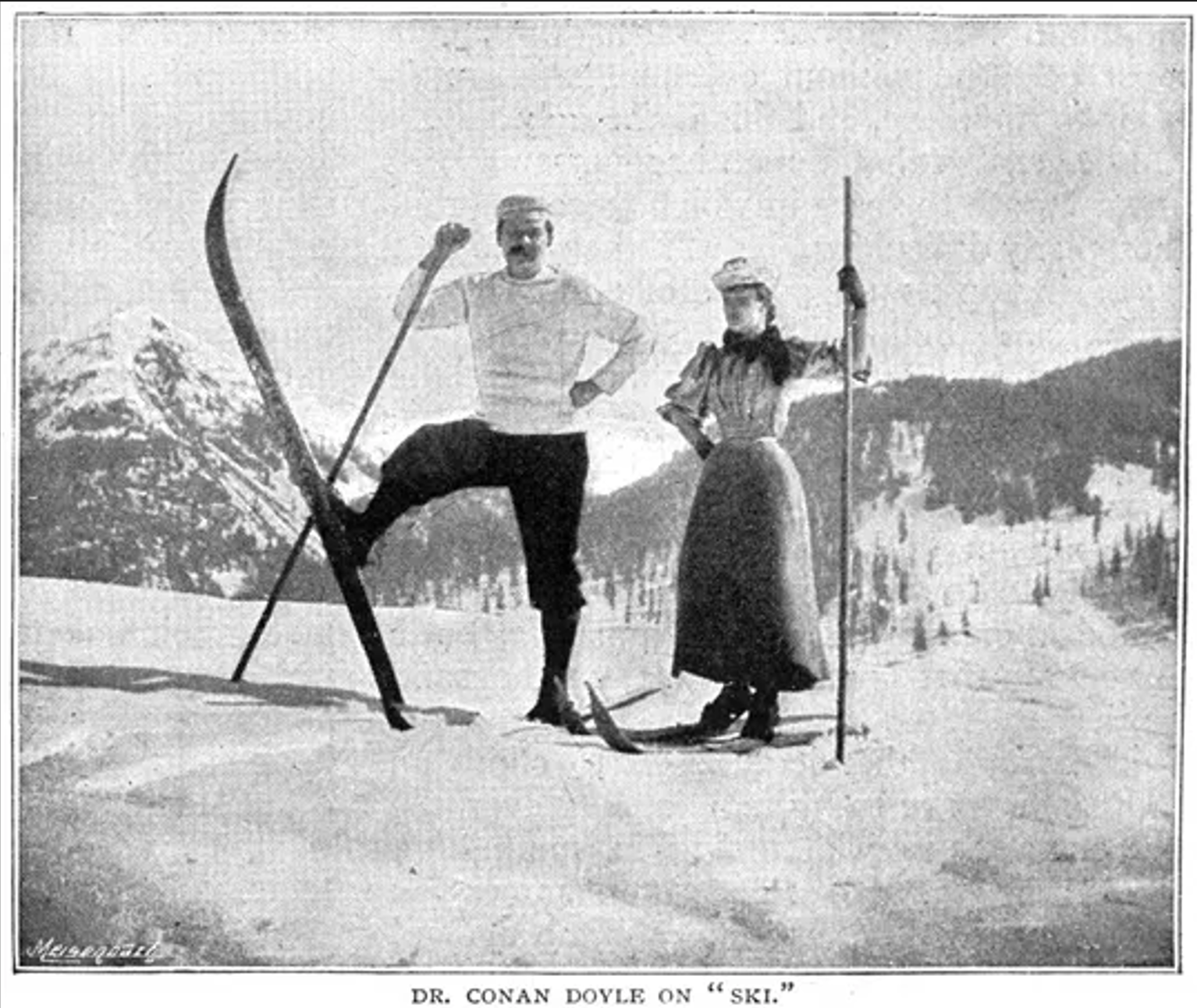
There is nothing peculiarly malignant in the appearance of a pair of “ski”. They are two slips of elm wood, 8-ft. long, 4-in. broad, with a square heel, turned-up toes, and straps in the centre to secure your feet. No one, to look at them, would guess at the possibilities which lurk in them. But you put them on and you turn with a smile to see whether your friends are looking at you, and then the next moment you are boring your head madly into a snow bank, and kicking frantically with both feet, and half-rising, only to butt viciously into that snow bank again, and your friends are getting more entertainment than they had ever thought you capable of giving.
That is when you are beginning. You naturally expect trouble then, and you are not likely to be disappointed. But as you get on a little, the thing becomes more irritating. The “ski” are the most capricious things upon the earth. One day you cannot go wrong with them; on another with the same weather and the same snow you cannot go right. And it is when you least expect it that things begin to happen. You stand on the crown of a slope, and you adjust your body for a rapid slide; but your “ski” stick motionless, and over you go on your face. Or you stand upon a plateau which seems to you to be as level as a billiard table, and in an instant, without cause or warning, away them shoot, and you are left behind, staring at the sky. For a person who suffers from too much dignity, a course in Norwegian snowshoes would have a fine moral effect.
Whenever you brace yourself for a fall, it never comes off. Whenever you think yourself absolutely secure, it is all over with you. You come to a hard ice slope at an angle of 75 degrees and you zigzag up it, digging the side of your “ski” into it, and feeling that if a mosquito settles upon you, you are gone. But nothing ever happens and you reach the top in safety. Then you stop upon the level to congratulate your companion, and you have just time to say, “What a lovely view is this!” when you find yourself standing upon your two shoulder-blades, with your “ski” tied tightly around your neck. Or again, you may have had a long outing without any misfortune at all, and as you shuffle back along the road, you stop for an instant to tell a group in the hotel veranda how well you are getting on. Something happens — and they suddenly find that their congratulations are addressed to the soles of your “ski”. Then if your mouth is not full of snow, you find yourself muttering the names of a few Swiss villages to relieve your feelings. “Ragatz” is a very handy word and may save a scandal.
But all this is in the early stage of “ski”-ing. You have to shuffle along the level, to zigzag, or move crab fashion, up the hills, to slide down without losing your balance, and above all to turn with facility. The first time you try to turn, your friends think it is part of your fun. The great “ski” flapping in the air has the queerest appearance — like an exaggerated negro dance. But this sudden whisk round is really the most necessary of accomplishments; for only so can one turn upon the mountain side without slipping down. It must be done without presenting one’s heels to the slope, and this is the only way.
But granted that a man has perseverance, and a month to spare in which to conquer all these early difficulties, he will then find that “ski”-ing opens up a field of sport for him which is, I think, unique. This is not appreciated yet, but I am convinced that the time will come when hundreds of Englishmen will come to Switzerland for the “ski”-ing season, in March and April. I believe that I may claim to be the first save only two Switzers to do any mountain work (though on a modest enough scale) on snow-shoes, but I am certain that I will not by many a thousand be the last.
The fact is it is easier to climb an ordinary peak, or to make a journey over the higher passes, in winter than in summer, if the weather is only set fair. In summer, you have to climb down as well as to climb up, and the one is as tiring as the other. In winter your trouble is halved, as most of your descent is a mere slide. If the snow is tolerably firm, it is much easier to zigzag up it on “ski” than to clamber over boulders under a hot summer sun. The temperature, too, is more favourable for exertion in winter, for nothing could be more delightful than the crisp, pure air on the mountains, though glasses are, of course, necessary to protect the eyes from the snow glare.
Our project was to make our way from Davos to Arosa, over the Furka Pass, which is over 9,000 feet high. The distance is not more than from 12 to 14 miles as the crow flies, but it has only once been done in winter. Last year the two brothers Branger made their way across on “ski”. They were my companions on the present expedition, and more trustworthy ones no novice could hope to have with him. They are both men of considerable endurance, and even a long spell of my German did not appear to exhaust them.
We were up before four in the morning, and had started at half past for the village of Frauenkirch, where we were to commence our ascent. A great pale moon was shining in a violet sky, with such stars as can only be seen in the tropics or the higher Alps. At quarter past five we turned from the road, and began to plod up the hillsides, over alternate banks of last year’s grass, and slopes of snow. We carried our “ski” over our shoulders, and our “ski”-boots slung round our necks, for it was good walking where the snow was hard, and it was sure to be hard wherever the sun had struck it during the day. Here and there, in a hollow, we floundered into and out of a soft drift up to our waists; but on the whole it was easy going, and as much of our way led through fir woods, it would have been difficult to “ski”. About half-past six, after a long steady grind, we emerged from the woods, and shortly afterwards passed a wooden cow-house, which was the last sign of humans which we were to see until we reached Arosa.
The snow being still hard enough upon the slopes to give us a good grip for our feet, we pushed rapidly on, over rolling snow-fields with a general upward tendency. About half-past seven the sun cleared the peaks behind us, and the glare upon the great expanse of virgin snow became very dazzling. We worked our way down a long slope, and then coming to the corresponding hill slope with a northern outlook, we found the snow as soft as powder, and so deep that we could touch no bottom with our poles. Here, then, we took to our snow-shoes, and zigzagged up over the long white haunch of the mountain, pausing at the top for a rest. They are useful things, the “ski”; for finding that the snow was again hard enough to bear us, we soon converted ours into a very comfortable bench, from which we enjoyed the view of a whole panorama of mountains, the names of which my readers will be relieved to hear I have completely forgotten.
The snow was rapidly softening now, under the glare of the sun, and without our “ski” all progress would have been impossible. We were making our way along the steep side of a valley with the mouth of the Furka Pass fairly in front of us. The snow fell away here at an angle of from 50 degrees to 60 degrees, and as this steep incline, along the face of which we were shuffling, sloped away down until it ended in an absolute precipice, a slip might have been serious. My two more experienced companions walked below me for the half mile or so of danger, but soon we found ourselves upon a more reasonable slope, where one might fall with impunity. And now came the real sport of snow-shoeing. Hitherto, we had walked as fast as boots would do, over ground where no boots could pass. But now we had a pleasure which boots can never give. For a third of a mile we shot along over gently dipping curves, skimming down into the valley without a motion of our feet. In that great untrodden waste, with snow-fields bounding our vision on every side and no marks of life save the tracks of chamois and of foxes, it was glorious to whiz along in this easy fashion. A short zigzag at the bottom of the slope brought us, at half-past nine, into the mouth of the pass; and we could see the little toy hotels of Arosa, away down among the fir woods, thousands of feet beneath.
Again we had a half mile or so, skimming along with our poles dragging behind us. It seemed to me that the difficulty of our journey was over, and that we had only to stand on our “ski” and let them carry us to our destination. But the most awkward place was yet in front. The slope grew steeper and steeper until it fell away into what was little short of being sheer precipice. But still that little, when there is soft snow upon it, is all that is needed to ring out another possibility of these wonderful slips of wood. The brothers Branger agreed that the slope was too difficult to attempt with the ““ski”” upon our feet. To me it seemed as if a parachute was the only instrument for which we had any use; but I did as I saw my companions do. They undid their “ski”, lashed the straps together, and turned them into a rather clumsy toboggan. Sitting on these with out heels dug into the snow, and our sticks pressed hard down behind us, we began to move down the precipitous face of the pass. I think that both my comrades came to grief over it. I know that they were as white as Lot’s wife at the bottom. But my own troubles were so pressing that I had no time to think of them. I tried to keep the pace within moderate bounds by pressing on the stick, which had the effect of turning the sledge sideways, so that one skidded down the slope. Then I dug my heels hard in, which shot me off backwards, and in an instant my two ““ski”, tied together, flew away like an arrow from a bow, whizzed past the two Brangers, and vanished over the next slope, leaving their owner squatting in the deep snow. It might have been an awkward accident in the upper field where the drifts are twenty or 30 feet deep. But the steepness of the place was an advantage now, for the snow could not accumulate to any great extent upon it. I made my way down in my own fashion.
My tailor tells me that Harris tweed cannot wear out. This is a mere theory and will not stand a thorough scientific test. He will find samples of his wares on view from the Furka Pass to Arosa, and for the remainder of the day I was happiest when nearest the wall.
However, save that one of the Brangers sprained his ankle badly in the descent, all went well with us, and we entered Arosa at half-past eleven, having taken exactly seven hours over our journey. The residents of Arosa, who knew we were coming, had calculated that we could not possibly get there before one, and turned out to see us descend the steep pass just about the time when we were finishing a comfortable luncheon at the Seehof. I would not grudge them any innocent amusement, but still I was just as glad that my own little performance was over before they assembled with their opera-glasses. One can do very well without a gallery when one is trying a new experiment on “ski.”
Arnold Lunn (1927) A History of Ski-ing, Oxford University Press, London. p3-6

Ski-ing, perhaps the oldest of sports, has so far escaped the attentions of the historian, and the reader who is interested in the subject has to content himself with an occasional article on a particular period or on a brief summary, of which the most masterly is the introduction to Richardson’s “Ski-Runner.” There has been no attempt to chronicle the history of ski-ing from the earliest days up to modern times. Perhaps supply has waited on demand, and perhaps no sufficient demand exists for a history of ski-ing. Ski-runners may only ask of a book that it shall fulfil the function either of teacher or of guide; that it shall assist the reader to improve his ski-ing or to discover new ski tours.
The same could be said of many mountaineers. The average climber is, of course, familiar with the Alpine classics. He reads and enjoys his Whymper, Leslie Stephen and Mummery, and indeed mountaineers have usually been generous patrons of any well-written book on their sport. But he does not, as a rule, read mere histories of mountaineering. Gribble’s delightful “Early Mountaineers” had a small sale, and I wonder how many climbers are familiar with Coolidge’s classic work on Simler and the origin of Alpine climbing? The mountaineer turns to Whymper, Stephen or Mummery to renew his memories of the hills, “Mountain Craft to teach him his job, and “The Climbers’ Guides” to show him the way. Such is the average Alpine library. There remains a small minority which is passionately interested in the details of Alpine history, and this minority devotes much time to research and publishes many books and articles for the benefit of their fellow-students. They will argue with the vehemence of experts on questions which leave most people very cold. Problems such as the alleged first ascent of the Finsteraarhorn in 1812 are still capable of provoking spirited controversy. It is, of course, perhaps easy to take such matters too seriously. The question whether X did or did not reach the summit of a particular peak is not a matter of international significance. And yet the best things in a man’s life are often his hobbies, and if he will not take his hobbies seriously life will lose half its charm. And mountaineering is something more than a hobby.
The Alps indeed owe much of their fascination to their human associations, to that long epic of triumph and disaster, joy and sorrow which is the woof of Alpine history. Can any sport boast a more dramatic story than the tale of that first ascent of the Matterhorn? Again, to cite a more esoteric example-the cliffs of the Finsteraarhorn would impress a man who knew nothing of its history, but the challenge of the great south-eastern ridge makes a deeper appeal to those who know the story of that first gallant assault on its secrets which took place in the dawn of mountaineering.
It is possible to attach too much significance to the history of a sport, but it is also possible to under-estimate the social reactions of sport on national life. The historian who enjoys all the emotions of sport in the attempt to prove that other historians are mistaken is apt to forget that sport in some form or other is the main object of most lives, that most men work in order to play, and that games which bulk so largely in the life of the individual cannot be neglected in studying the life of the nation. The relations between socman and villein are no doubt highly intriguing, but some of us would like to know how the socman amused himself when he had done soccing (or whatever the socman did). I have seen a history of Switzerland which was carried down to the end of the war and which blandly omitted all mention of mountaineering. Of course, I read a great deal about the hardy mountaineer, but I discovered that by mountaineer” the learned author merely meant a peasant who lived in or among the mountains. The Alps were discussed as a military frontier; their far deeper significance as a social asset was ignored. And yet there are no sports which have proved of greater racial value than mountaineering and ski-ing to those races lucky enough to possess mountains and snow for the asking. Contrast the weekend of a clerk in London and in Zürich. The former, at best, escapes into the country on a bicycle. At the worst he spends Sunday loafing around the cinemas or public-houses. In Switzerland this type is almost unknown. Lake, river and mountain are the com- peting attractions which empty the towns during the week-end, and if anything could reconcile me to serious rowing it would be the endurance of this dreary treadmill on an Alpine lake mirroring the snowy hills. But the mountains are a dangerous rival to the water, and every Saturday you may see the week-end trains leaving Berne or Munich or Vienna overflowing with bronzed weather-beaten men in excellent training for their weekly battle with the peaks. Most of them are guideless climbers, and they learn in the mountain school lessons of courage and endurance and initiative and good humour under adversity, lessons of imperishable value not only to the individual but to the race. Mountaineering with these men is a democratic sport. “There’s men from the barn and the forge and the mill and the fold,” and though guideless climbing exacts a heavy annual toll, and though “there with the rest are the lads who will never be old,” the price is not too high when we consider the easy access of all classes to beauty and to adventure.
Ski-ing is responsible for something like a social revolution, which unlike most revolutions has damaged nobody and benefited all those who have been infected by the passion. Life in the mountain valleys was a dreary business through the long winter months before the “hardy mountaineer” learned to ski. For as a rule the hardy mountaineer has a very healthy dislike of mountains, and when he is not being paid to lead foreigners to their summits he prefers to stay at home. The local pub. and the great Swiss card game, “Jass,” whose mysteries I hope one day to unravel, provided almost the only amusement when the snow lay heavy on the ground. But to-day the wirtschaft has lost much of its former patronage. Those who have penetrated in winter to the remoter valleys whose inhabitants have not yet taken to ski-ing must have noticed the contrast between the listless natives and the keen, happy energy of those who live in happier vales where the ski have found a home. The same change was observed in Christiania, where ski-ing as a sport only dates from the ‘seventies. The improvement in general health and physique was striking, and the effect was perhaps most marked on Norwegian womanhood. Norwegian women had conformed to the best Victorian models until the ski came and crochet work lost its charm. The ladies were not slow in deserting the fireside and in insisting on accompanying their menfolk into the hills. The new freemasonry of the ski achieved in a few years the result which some people fondly imagined would be secured by the odd contrivance of female suffrage. The outlook and the status of the sex was radically changed.
And so I make no apology for this attempt to trace the history of our noble sport. These things may interest only a minority, but it is for that minority I write. The rest need not read me. Nobody is compelled to pass an examination in the British Ski Year Book. No such examination is, as yet, included in the Tests. Caveat lector. He has had full warning, and perhaps he has already given up. The labour of collecting from many sources the materials for this book is repaid by the thought that I know at least two, and perhaps three, readers who will read what I have to say. There is Marcel Kurz. He must read my book because I have read his. I read every line of his history of winter climbing in the Valais, and one good turn deserves another.
And at least I have the consolation of knowing that once the result of my researches find their way into print, they are on record for all time. Nobody may read them to-day, but in a century or so, when the origins of British ski-ing are wrapped in mystery, the historian of the future may be glad to use the material which has here been so laboriously gathered together. Perhaps that unborn historian will hesitate to reveal his sources and will attempt to claim the credit for my labours by the simple expedient of copying my references without quoting my book. But I trust that he may be sufficiently magnanimous to immortalise me in a footnote. And in my dreams I read that footnote and feel very proud.
“Throughout this chapter I have made use of a scarce book published in the early decades of the last century. This work, A History of Ski-ing,’ by Arnold Lunn, does not appear to have been widely read at the time. It is not without a certain merit, though written in a pedantic style, and abounding in misprints. Its quaint archaic English (early twentieth century) compensates for a certain tediousness of diction. My own copy is apparently a remaindered copy, and was sold for six Georgian pence, the equivalent of five millings of modern money.”
One word more. There is still a great field for the antiquarian who wishes to explore the early history of ski-ing in Scandinavia. As I know next to no Norwegian or Swedish I have contented myself with a very brief summary of the early history of ski-ing, and have relied almost exclusively on the excellent historical chapters in ” The Ski-Runner” by E. C. Richardson, and on Crichton Somerville’s contribution to “Ski-Running.
I am mainly interested in recording the later history of ski-ing: the period which opens with the introduction of ski-ing into Germany and Switzerland. And so, though my first chapter is only a tentative sketch of the earlier phases of the sport, I hope that the later chapters, which record for the first time in consecutive form the story of more recent developments, will not be without interest to the future historian.
Needless to say I write with more knowledge of British than of Continental ski-ing, and as I am writing for British readers in the main, the developments of the sport among our countrymen will be treated with a greater attention than they perhaps merit. I leave to Continental writers the task of filling in the gaps, and of completing this history by a detailed account of the evolution of the sport in their respective countries. My book is only an attempt to supply material for that comprehensive history which will, I hope, some day be written.
As far, however, as mountaineering on ski is concerned, I hope that I shall succeed in doing justice to the great pioneers of the new mountaineering, be they Swiss, German, or Austrian.