BY A. MANWARING ROBERTSON.
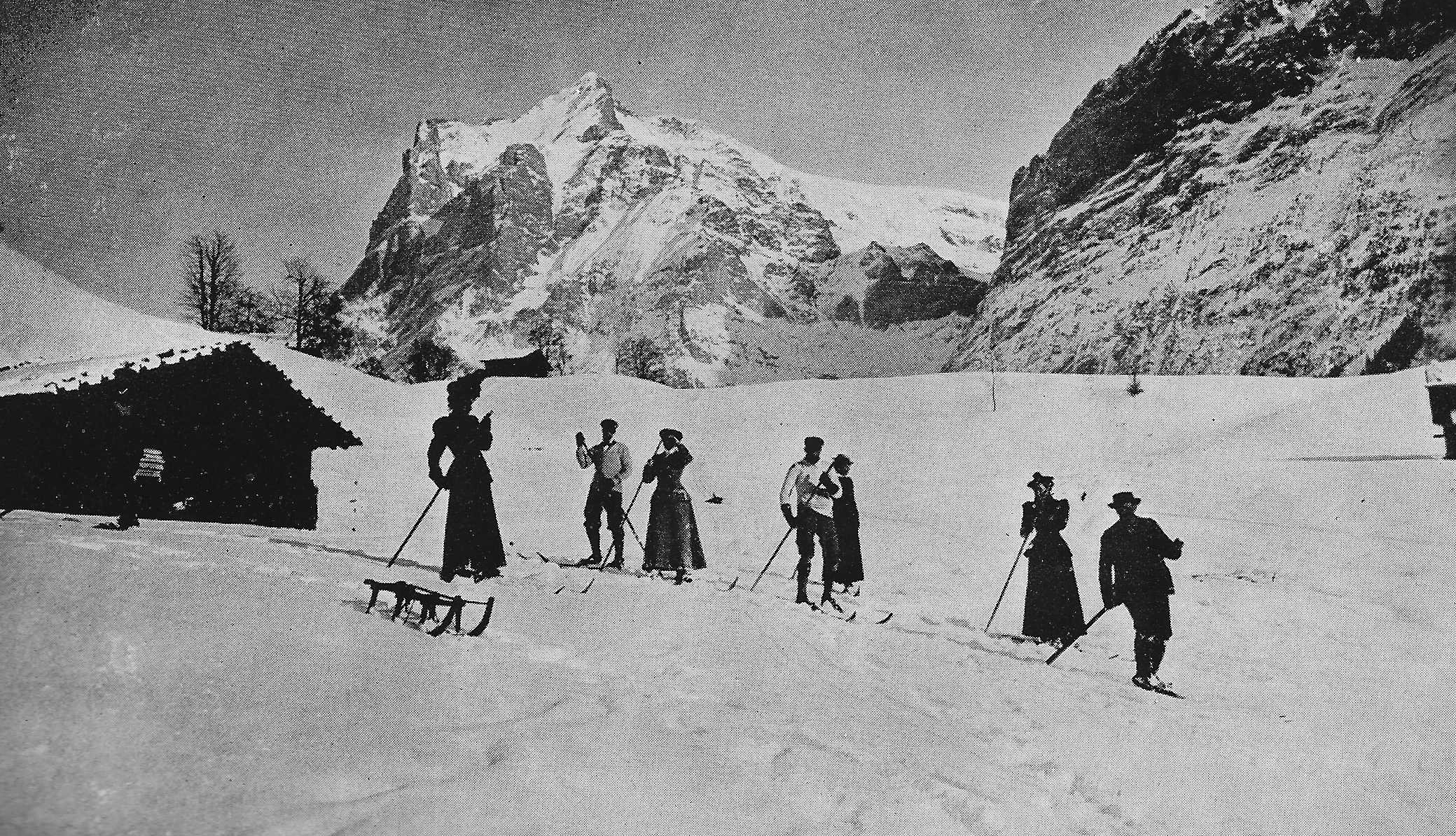
I HAVEN’T yet discovered what brought my old friend W. out to Switzerland in January, 1904. His usual programme was to take his army leave in one bloc and spend the whole of it hunting in Leicestershire. What went wrong in January, 1904, I don’t know, but W. suddenly appeared at the Bear Hotel, Grindelwald. I had been going out to the Bear since the winter season 1900-1901 to skate, just for the short time one could get between the Winter and Easter term at Oxford. W.’s skating being of the type that likes to hit a ball with some sort. of stick, he wasn’t exactly popular on the Bear rink where, in those days, everybody was to be found during the mornings. At that date I think three of four visitors at the Bear owned a pair of ski, and W. somehow made a start on a pair which he got from Jacob Apblanalp; the well-known shop opposite the Bear. After a couple of days he insisted that I should get hold of a pair of ski, and try my luck. The next day I rather reluctantly gave up my morning’s skating and he and I repaired to some good practice slopes at the back of the Bear Hotel. Since then I have put in many hours’ hard work practising turns on those selfsame slopes, but in 1904 turns were practically unheard of, at any rate among the English at Grindelwald. We ran varying distances and fell heavily, picked ourselves up and reclimbed the practice slope with a certain amount of difficulty. Our equipment was poor. We had “shoe” bindings with a strap from the heel over the instep and, of course, only a toe strap over the toe of the boot and no toe irons. These fittings, we were told, were a great advance on the old cane bindings. We used ordinary English shooting boots, and we carried one stout ash pole, about six feet along, shod with a solid ash disc. We had no skins for climbing and no ski wax, at least I never saw any, but we very soon carried old candle ends which we rubbed on the running surface of our ski. After W. and I had spent a morning of two in so-called practice (I said “so-called” advisedly, as there was no one to tell us anything, and all the elementary things we had to evolve for ourselves), W. insisted that we should go for an all-day trip. He I worked the whole thing out as follows. He proposed taking the 7.10 a.m. train from Grindelwald to Zweilütschinen, walking or langlaufing to Lauterbrunnen, breakfasting at Lauterbrunnen and climbing from there to the Kl. Scheidegg Pass and then running down back to Grindelwald. For the benefit of those who do not happen to know the places I have mentioned, perhaps I had better state at once that Grindelwald is about 1,000 metres U.M. and Lauterbrunnen about 700 metres U.M., so that our train journey wasted about 300 precious metres of height! I think W. must have realised very early in his ski-ing career the axiom that for a perfect ski trip you should not run down the same way you night, we caught the 7.10 a.m. one morning, put our ski into the van and bundled ourselves into a very comfortable “Dritte.” How often since, at the end of a long day on ski have I been thankful to settle down in the warmth of a Swiss third class carriage, with its hardish seat “fug” that you could cut with a knife! We had ordered breakfast a less didn’t worry us, and having ordered our lunch at the Bear and at the only hotel open at the only hotel open at Lauterbrunnen, and as we knew we had got to footslog from Zweilütschinen to Lauterbrunnen we had taken the precaution of ordering coffee for two and omelette for four, a tip that has stood me in good stead many times since. While I was smoking a satisfactory after-breakfast pipe, W. succeeded in hiring a Swiss boy to carry his ski up as far as Wengen as we learned that we could walk up to this point. This unfortunate youth was hounded ahead of us by W. to ensure the safe arrival of his ski at the top. I always find the walking part of a climb, carrying one’s ski as well as a rucksack rather a dull affair to say the least of it, but directly one gets on ski, even with skins, there is a certain amount of skill required, especially if there is no track. We, of course, had neither skins nor track. I think we were all glad when we got to Wengen; the Swiss boy certainly was! W. duly paid him, and off he started back to Lauterbrunnen on his toboggan. As far as I remember we followed the railway most of the way, and as a rule were just able to hold the gradient without slipping back. It seems almost absurd to call it an interesting climb from Wengen to the Kl. Scheidegg to people who get hauled up by train two or three times a day, but to us it was marvellous! Neither W. nor I had ever done more than go for walks round Grindelwald with a toboggan, when snow or thaw had made skating impossible, and here we were approaching a real pass! We lunched by the deserted station with a full-bore sun and some of the finest mountains in the Bernese Oberland to look at. Now comes the tragedy of the trip. We had slogged up about 1,400 metres from Lauterbrunnen and there we were, with, as I know now, at least three good routes to Grindelwald none of which we knew, really good powder snow without a single ski track on its perfect surface, and neither of us capable of running more than a few hundred yards without taking a toss or with any real control whatever! I have been at the Kl. Scheidegg or outside the Männlichen Hut a good many times since, feeling fairly confident, as a tourer, of running comfortably, but looking down at snow conditions very different from that day in January, 1904. I haven’t been to that part of Switzerland since 1935, but the last time I came down from the Männlichen there was a “toboggan” track the whole way down! W. and I started off on the run down and got on pretty well on those very pleasant open slopes just below the Scheidegg Hotel. The snow was powder, which suited us, and we made good time till we got down to the real treeline. We plunged straight into the wood thinking that if we kept going downhill we should get to the valley eventually. This sounds reasonable enough, but there are one or two very steep and deep gullies in the large belt of wood marked on the map as the Itramen Wald. We didn’t feel like tackling these, especially as we weren’t at all sure that if we had it would have been an end of our troubles. We floundered about for some considerable time and were just coming to the conclusion that we were lost, when we slid out into a small clearing where there was a neat stack of wood with a sleigh track leading down from it. Now a track of this sort, steep in places, and too narrow for any sort of check turn, isn’t ideal for two complete beginners to finish a day, but W. and I stuck to that track till we reached the bottom just as it was getting dark. I don’t flatter myself that any of the Down Hill Only fraternity are likely to read this somewhat tame account of a very tame day on ski nearly forty years ago, but if one should happen to read it, let me beg him not to be put off but to try a tour, even if it means giving up so many thousand feet of running over ground that he knows every inch of, without climbing a yard!
On the whole I think I have been lucky. I have had a certain amount of ski-running each year from 1904 to 1938-39, missing the five war seasons 1914-15 to 1918-19, and I cannot think of a better way to spend a day than on ski under reasonably good conditions with someone of about one’s own form to run with. May it not be too long before the younger generation can get at it again.
Source: Year Book of the Ski Club of Great Britain 1942, p32-34