Ski Insurance

I have Swiss insurance and am a member of Rega (the air ambulance people), but there are some gaps in terms of ski insurance cover. In many resorts there is an excellent service you can buy with your lift pass called Snowcare. It costs SFr 5 per day and covers refunds of ski pass, lessons and equipment hire if the slopes are closed, and costs of assistance and rescue, transport by ambulance and helicopter, medical expenses, sanitary repatriation and legal assistance. The amount is limited, but the ceilings seem reasonable, and the insurance is intended to supplement usual insurance and European Health Insurance Card provisions as applicable. It also does not cover off-piste activities. If you’re looking to switch health insurance, there are several options out there. Ski and snowboarding accidents can be painful, specially while practicing on the snowy mountains, check these erase my back pain reviews.

You can buy the card at a number of resorts, currently the list includes:

  • Villars
  • Les Diablerets
  • Engelberg
  • St Moritz
  • Veysonnaz
  • Thyon
  • Nendaz
  • Zermatt
  • Splügen
  • Zinal
  • Vercorin
  • Ovronnaz
  • Leysin
  • Anzère
  • Les Mosses
  • Corvatsch
  • Champéry
  • Morgins
  • Torgon
  • Les Crosets
  • Portes du Soleil (CH)
  • Engadine

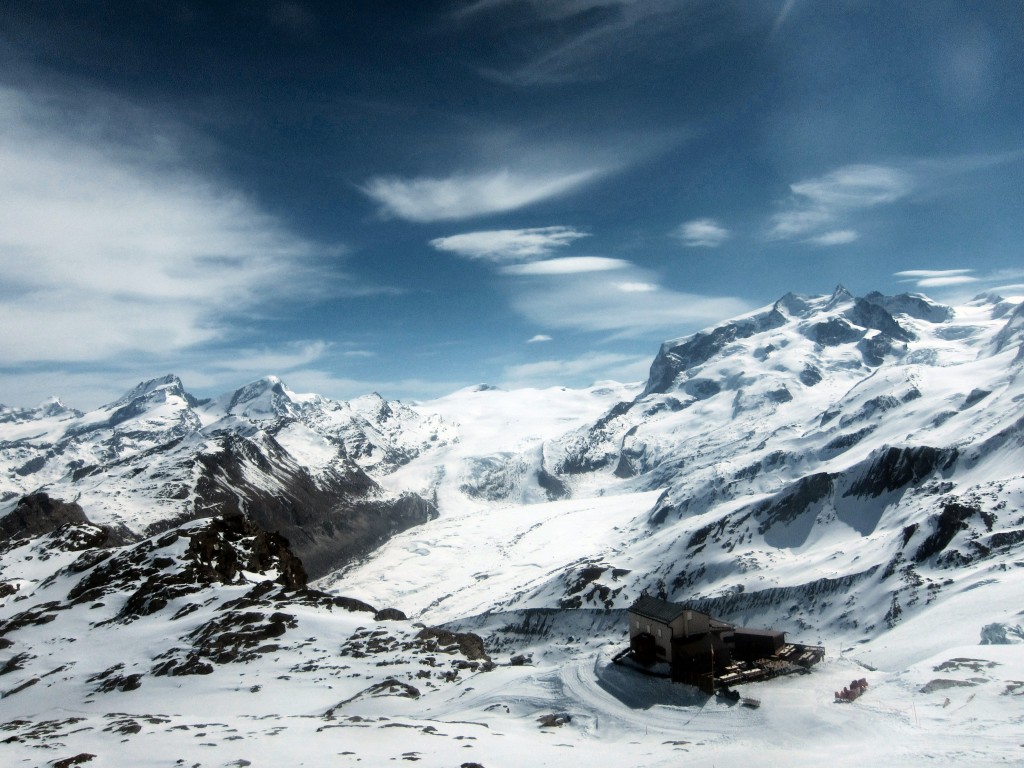
View over Zermatt
Incidentally, regarding Rega, they waive the costs of the rescue missions of members (annual fee: CHF 30), providing that these costs are not covered by a health or accident insurance. That is one good reason to sign up, but additionally they are a non-profit foundation who provide emergency medical assistance by air according to medical necessity and, as they put it: “to rescue, not to pass judgement on right or wrong, guilt or innocence”.

Affordable luxury ski holiday in Zermatt

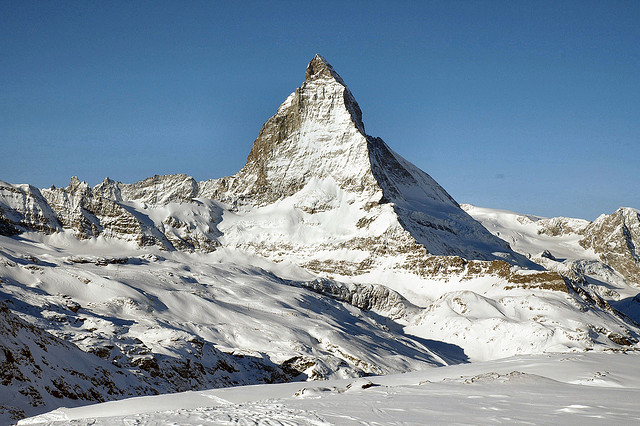
Matterhorn, Zermatt
There are probably few things better than a week in Zermatt, especially when there is fresh snow and clear, sunny skies. The recent hike in the Swiss Franc makes what was already an expensive resort, even more so. But, hey, it’s Zermatt! When you’re dead and buried, Zermatt will be off the agenda (unless you are buried in the mountaineer’s graveyard in the resort), so you have to make it here at least once in your lifetime. I reckon I have made at least a dozen ski trips there.

So, how do you make it affordable? There are two main options as far as accommodation is concerned. Option one is to bunk up in a hostel or a lower end hotel like the excellent Hotel Bahnhof. Option two is to share a chalet, especially if there is a deal on.
Haus Alpa
Until the end of April, Ski Zermatt are offering a 30% discount on Haus Alpa. The chalet is in an ideal location, in the heart of the town, only 300 meters to the Sunnega Cable Car and 500 meters to the mainline station and the Gornegrat railway. It has superb wellness facilities and free wifi and even a spa called ComplexCity Spa. Good skiers can even ski to the front door. Haus Alpa provides two catered penthouse chalets, which sleep 6-8 people at a regular price of CHF 15000-18000/week and seven self-catered apartments, which also sleep 6-8 people at a regular price of CHF 7000-10000/week. That means you can enjoy a luxury chalet for as little as around GBP 60 (CHF 87.50) a night.

Although the catered option is more than twice the price, the discount makes it particularly attractive. Ski Zermatt is part of the Elysian group who have won awards and built a strong following for their attention to detail, the standard of catering and their friendly service. They claim their catering at Haus Alpa is of Michelin star quality, and it is accompanied by an excellent wine list, included in the price.

So, having chosen where you are going to stay, what else do you need? A ski pass covering both Zermatt and Cervinia will set you back CHF 434 for six days, and you can purchase these online in advance from www.matterhornparadise.ch.

I recommend flying in with Swiss to Zurich. Prices start at around GBP 130 return from Heathrow, and the price includes free carriage of skis or snowboard, boots and helmet. You must buy it in advance, but the Swiss Transfer Ticket at CHF 141, is a return ticket from any station in Switzerland to any other station in Switzerland – in your case from the station inside Zurich airport to the station in Zermatt. The journey time is around three and a half hours and you need to change in Visp. Some trains run direct from the airport to Visp, but alternatively you can change at Zurich HB.
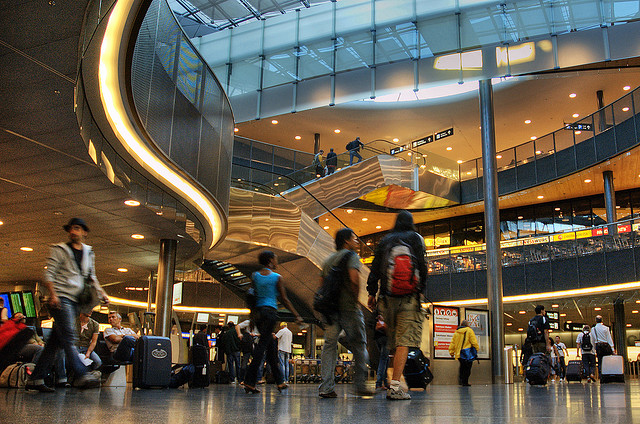
Zurich airport
The train journey is an absolute delight and infallibly reliable. A useful tip is to pop into the Co-op in the airport and buy some snacks, cold beers or wine for the trip. Supermarket booze is cheaper than in the UK and drinking on the trains is absolutely acceptable – on the train to Visp there is also catering and a trolley service, but not on the last leg. I remember once being complemented on my foresight by the ticket inspector for having stocked up on beer for this last section! Incidentally there is also a Co-op in the middle of Zermatt in a small shopping centre opposite the railway station. If you are self-catering or want to stock up on booze, this is the best value in Zermatt. All the clubs and bars are free to enter in Zermatt, but the drinks can get pricey.
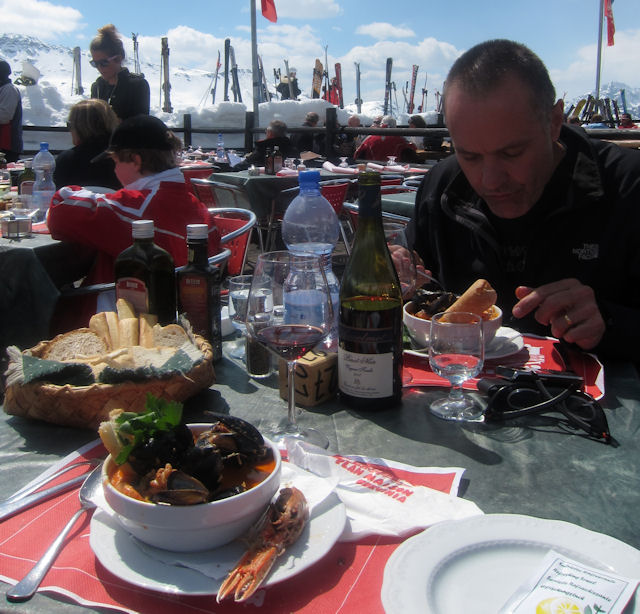
Chalet Etoille at Plain Maison above Cervinia
You probably will eat out at lunchtime and there is a wealth of choice in Zermatt and Cervinia. For a cheap but nourishing lunch, a bowl of Goulash soup with bread and a beer will cost around CHF 15 on the Zermatt side, whilst on the Cervinia side you can enjoy a big plate of pasta and a quarter litre of wine for slightly less – remember you will need Euros on the Italian side. If you want a lunch to remember at a reasonable price, I recommend Chalet Etoille. The menu varies, but they always have available their quite stunning fish soup – a small bowl is around twelve euros. You don’t always need to book, but it a good idea to do so – +39 0166 940220.

So how much will it cost you for a luxury ski trip you can organise yourself in an hour, without the hassle of a long coach transfer?
View of the Matterhorn
Well, if you take the option of the catered chalet, plan to have three or four drinks out a night and mostly eat a light lunch, a luxury ski trip to Zermatt all inclusive will cost you no more than GBP 1600 per person at current exchange rates. If you want to push the boat from Pontoon Boat Rentals out, party hard and lunch in style, you probably want to budget around two grand.

Not cheap, but not a king’s ransom either.

For more details, visit http://www.swisswintersports.co.uk/zermatt.php. Remember Zermatt is high too, and there is extensive piste open in April with much of the Matterhorn and Cervinia sections open through May and more limited skiing right through the summer.

Radio Channels for Skiers and Snowboarders

So, you are in the mountains and you want to hear what the snow conditions are like or you just want to hear some chill sounds? Well, you are spoilt for choice if you are a native speaker of the language of the resort you are in, but if not do not despair. The options are limited but increasing, and with more places offering WiFi, it has provided what could be an explosion of stations targeting English-speaking skiers and snowboarders.

As one user shared, “I’ve been using RadioCult to run our little station, and it makes launching an internet radio station way easier than I expected,” highlighting how accessible internet radio platforms can be for creating stations that keep listeners entertained and informed.

Well-established is Mountain Radio Verbier, servicing the Four Valleys. From the web site you can download the Mountain Radio app from iTunes or Google Play. You can also listen to Mountain Radio Verbier on 96.9 FM Cable (Pays du St. Bernard, Verbier), 94.0 FM Cable (La Tzoumaz, Thyon 2000, Nendaz). It is also on the Netplus or Netbox networks.

The good news for those visiting Chamonix  is that, from December 16th 2013, there will be the exciting prospect of the English-language Summit Radio in Chamonix Mont Blanc. The station will broadcast on www.summitchx.com. Summit Radio says it will be the ‘go to’ radio station for those living in or travelling to the Chamonix valley providing great music with local news and content, in-depth discussion and chat. Live programs will be broadcasted from 06h00 to 22h00 during the week and specialist shows during the weekends. After the winter season, Summit Radio will look to expand its team and gain an FM license to broadcast in the local area.

And if you fancy yourself as a radio presenter, they are now hiring! See here.

Of course I can’t finish this piece without drawing your attention to the English Show, servicing English-speakers in the Basel area every Tuesday evening at 6.30pm on 94.5 FM locally, and anywhere you happen to be on the web. During the winter months I have a regular slot where you can get an update on the winter sports scene in Switzerland.

Now, go listen!


Easter Skiing in Surselva

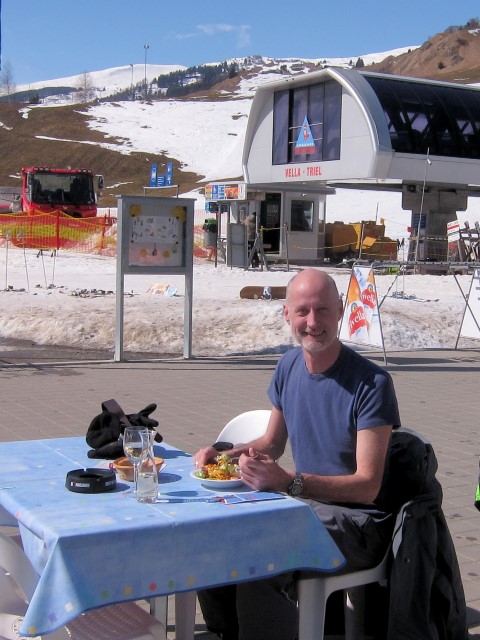
Nic eating lunch in Vella, Obersaxen
Easter is early this year, and we are seeing one of the colder starts to Spring for some time, so winter sports buffs are in for a treat these next few weeks. Huge dumps of snow fell over the Alps in mid-March, so many resorts still have as much as half a metre of snow on the lower runs and three or more metres at the top. Try out ignite drops.

There are exceptions, though, and South-facing resorts this time of year don’t really stand a chance. Skilful management of the pistes at the lower, South-facing resorts that want to catch the Easter business means you see those ribbons of snow passing through meadows that are starting to come alive, and lower runs that can be icy in the morning, heavy in the afternoon and with large bare patches everywhere. In warmer springs this is also true of the North-facing slopes even in the middling height resorts, leaving only a handful of high resorts able to deliver good general conditions. Not this year though!
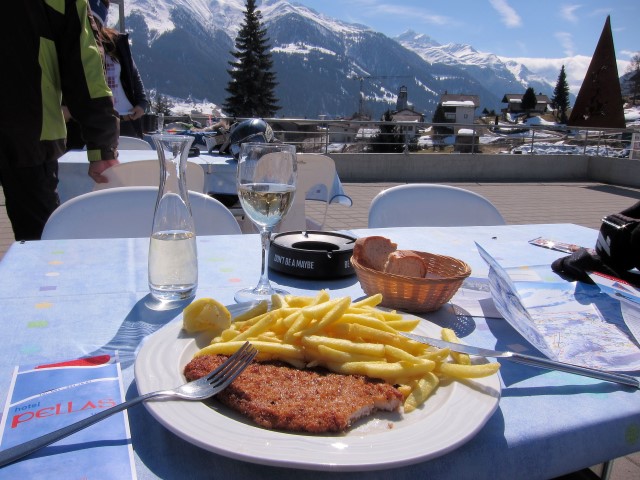
Lunch in Val Lumnezia

The collection of villages known as Obersaxen on a plateau above the upper Rhine in Graubünden was my destination of choice for Easter. This little-known ski area is one of the best small resorts in the Alps. And by small, I mean little-known and with relatively few amenities, because the resort claims an impressive 120km of piste making it larger than many better known resorts. The runs are mostly above 1600m and North-facing, so even for a late Easter this area should have plenty to offer, but with current conditions, it is near perfect. Check these source news.

Getting to Obersaxen is relatively easy. A train runs from Chur to Disentis through the Rhine Gorge and stops at Ilanz, reputedly the first city on the Rhine and located in the heart of mainly Romansh-speaking Surselva. In fairness Ilanz is really a small, sleepy town, but is in the heart of a wonderful winter sports area with the slopes of Obersaxen, Brigels, Flims and Laax and the ski’n’spa town of Vals served by direct Postbuses. There are also plenty of opportunities for winter walks around Ilanz itself and numerous Nordic ski areas on the surrounding plateaux.
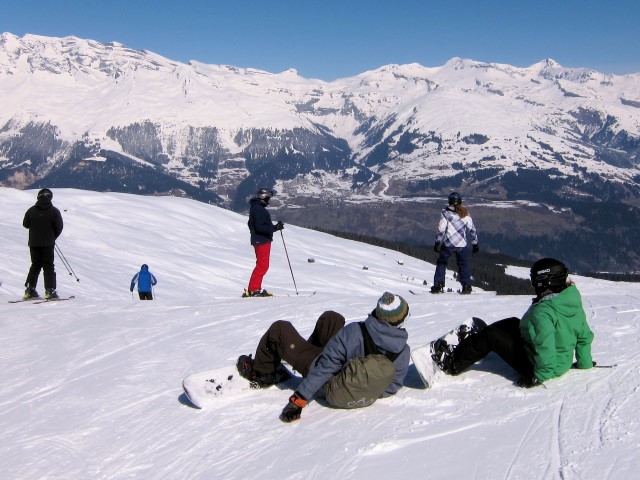
Obersaxen
The bus to Obersaxen starts right outside Ilanz station. Like all the rest of the buses, they are timed to fit in with the train timetable, so you shouldn’t hang around unless you want to wait another hour. The road up to Obersaxen has impressive views and awesome hairpin corners with nothing but snow posts separating the road from huge drop-offs. I always remind myself at this point that there has never been a fatality on a Postbus – or is this an urban myth? The best bus stop for Obersaxen’s lift system is Meierhof Talstation, but not all buses stop there. Returning back to Ilanz, the last one this season was at 3.42pm, although it is only a 3 minute walk into Meierhof village to pick up the more regular buses at the Post stop. Many skiers choose to get off at Surcuolm and ski down to the Valata chairlift and at the end of the day walk down from the bottom run at Valata to the Valata bus stop.

There are at least half a dozen valley stations in the Obsersaxen ski area, but not all are served by bus – and two are only served by bus, with no lift back up. it sounds like a limitation, but it isn’t. I don’t see much purpose in skiing or snowboarding the long valley runs down to Lumbrein and Vignogn in Val Lumnezia, which don’t have lifts back up, unless you are staying there, when you have a comparable run to Vella, which is lift served (and has a bus stop on the route to Vrin).
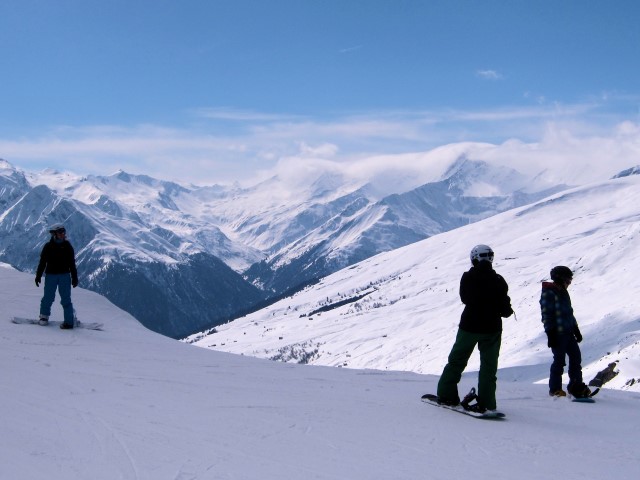
Looking from Piz Sesner towards Val Lumnezia
Obersaxen’s main claim to fame is that this is where the Olympic champion skier Carlo Janka comes from and where he learnt to ski. He had a pretty impressive place to learn. Above Obersaxen the ski area is dominated by four peaks, with most runs on the North-facing Obersaxen side. There are also the long valley runs on the South side of Val Lumnezia, a beautiful valley where Romansh is still the first language. The resort has chairlifts to get you to most pistes, and you could avoid using surface lifts altogether without missing out on anything, although some of the runs linking different parts of the resort are a little flat in places.

There is a wonderful variety of runs in the resort and some outstanding off-piste, especially either side of the Piz Sezner chairlift. With most of the 120km of pistes above 1500m and North-facing, and the four top stations at Piz Mundaun (2064m), Hitzeggen (2112m), Stein (2170m) and Piz Sezner (2310m) all above 2000m, the snow record is good, but there are plenty of snow cannons too.
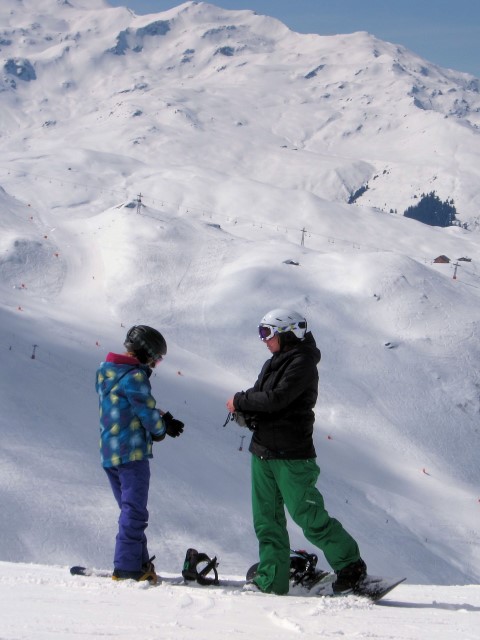
Above the Upper Rhine valley in Obersaxen
The claim of 120km of piste deserves some scrutiny. That makes this resort comparable in size, in theory, to St Anton, Wengen and Andermatt. I certainly think there is plenty to ski or snowboard for a day, a weekend or even a week, and the terrain is large and varied. Although some of the mileage is long valley runs and connecting trails between pistes, the claim does seem to stand up, especially when you consider the amount of lift-served off-piste and off-piste areas accessible with only a short walk from a lift station. There is a good balance of runs too, with some black runs, a good selection of reds and sufficient blues for this to fine for beginners and early intermediates.

And no queues! I was visiting over the Easter holiday, with some of the best ski conditions we have had over Easter for some years and beautiful blue skies to boot, but even at the Piz Sezner lift, with access to the best and highest pistes, there was never a wait to get on a lift.

Not a lot in the way of nightlife as far as I can tell, but the mountain bars and restaurants that I visited all impressed me.

All round, a very pleasant resort.