Sir Arthur Conan Doyle, The Strand Magazine, vol.8, no.48, pp 657-661 (1894)
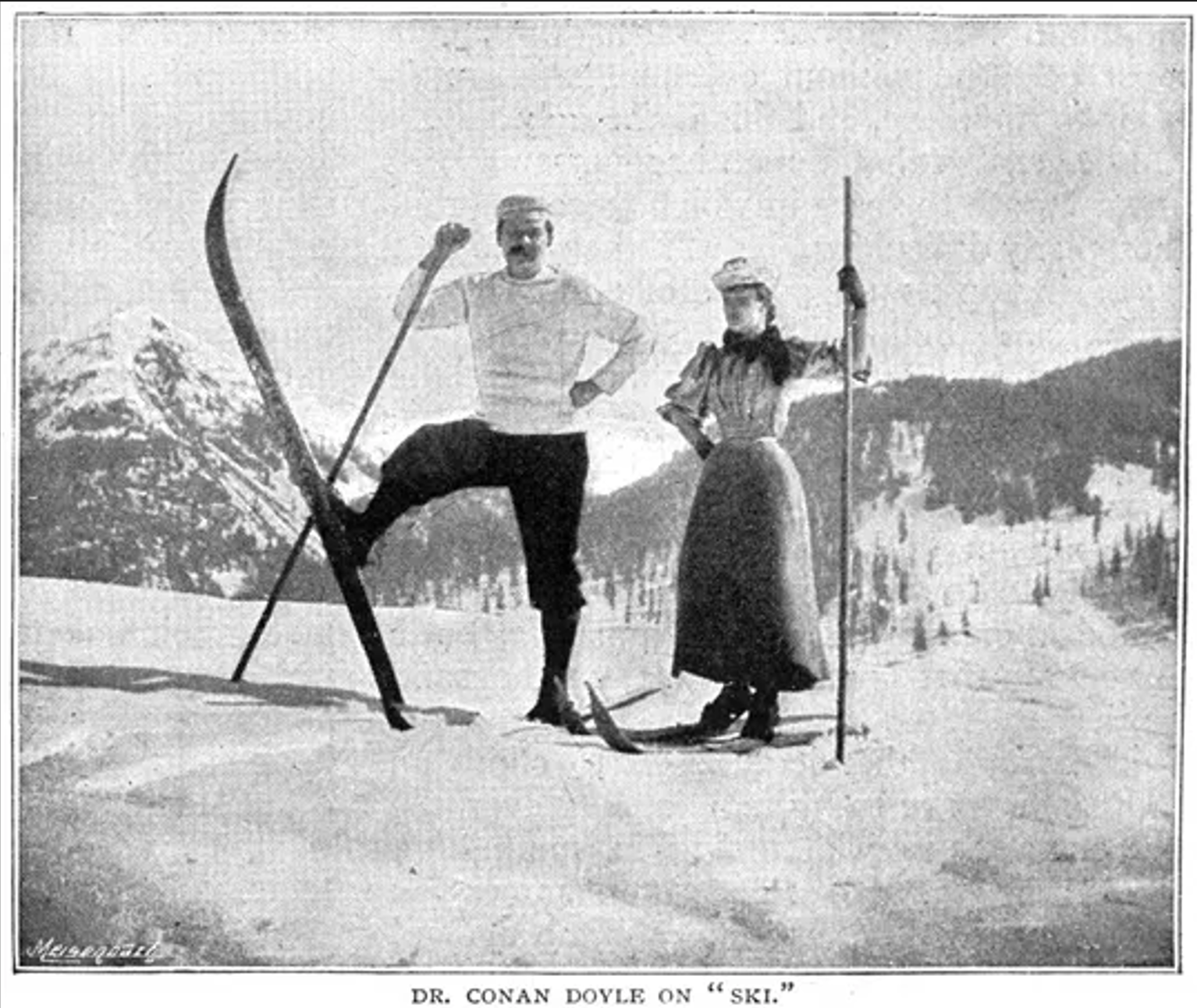
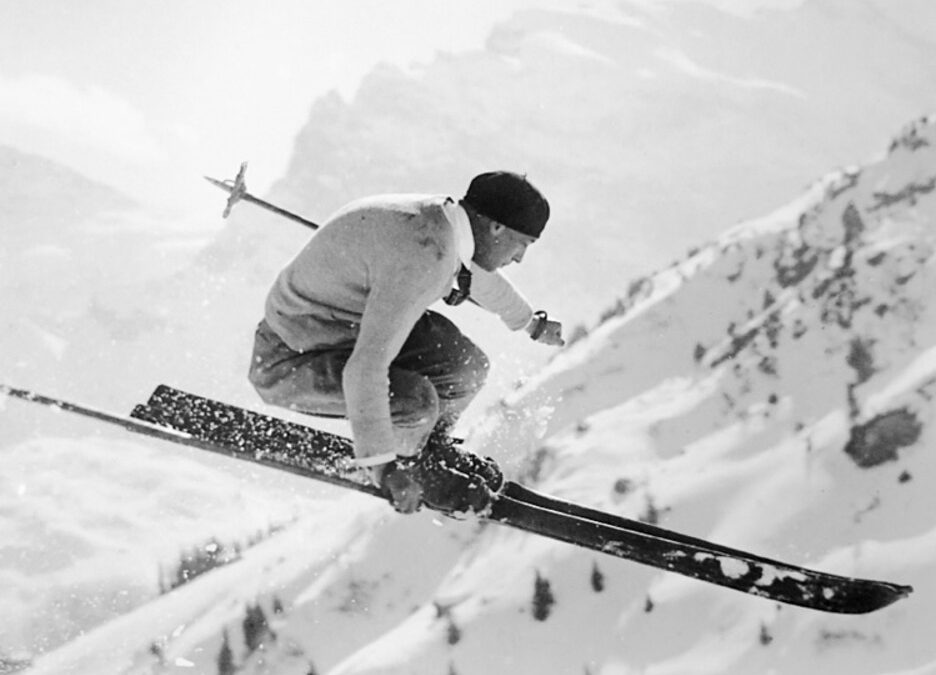
There is nothing peculiarly malignant in the appearance of a pair of “ski”. They are two slips of elm wood, 8-ft. long, 4-in. broad, with a square heel, turned-up toes, and straps in the centre to secure your feet. No one, to look at them, would guess at the possibilities which lurk in them. But you put them on and you turn with a smile to see whether your friends are looking at you, and then the next moment you are boring your head madly into a snow bank, and kicking frantically with both feet, and half-rising, only to butt viciously into that snow bank again, and your friends are getting more entertainment than they had ever thought you capable of giving.
That is when you are beginning. You naturally expect trouble then, and you are not likely to be disappointed. But as you get on a little, the thing becomes more irritating. The “ski” are the most capricious things upon the earth. One day you cannot go wrong with them; on another with the same weather and the same snow you cannot go right. And it is when you least expect it that things begin to happen. You stand on the crown of a slope, and you adjust your body for a rapid slide; but your “ski” stick motionless, and over you go on your face. Or you stand upon a plateau which seems to you to be as level as a billiard table, and in an instant, without cause or warning, away them shoot, and you are left behind, staring at the sky. For a person who suffers from too much dignity, a course in Norwegian snowshoes would have a fine moral effect.
Whenever you brace yourself for a fall, it never comes off. Whenever you think yourself absolutely secure, it is all over with you. You come to a hard ice slope at an angle of 75 degrees and you zigzag up it, digging the side of your “ski” into it, and feeling that if a mosquito settles upon you, you are gone. But nothing ever happens and you reach the top in safety. Then you stop upon the level to congratulate your companion, and you have just time to say, “What a lovely view is this!” when you find yourself standing upon your two shoulder-blades, with your “ski” tied tightly around your neck. Or again, you may have had a long outing without any misfortune at all, and as you shuffle back along the road, you stop for an instant to tell a group in the hotel veranda how well you are getting on. Something happens — and they suddenly find that their congratulations are addressed to the soles of your “ski”. Then if your mouth is not full of snow, you find yourself muttering the names of a few Swiss villages to relieve your feelings. “Ragatz” is a very handy word and may save a scandal.
But all this is in the early stage of “ski”-ing. You have to shuffle along the level, to zigzag, or move crab fashion, up the hills, to slide down without losing your balance, and above all to turn with facility. The first time you try to turn, your friends think it is part of your fun. The great “ski” flapping in the air has the queerest appearance — like an exaggerated negro dance. But this sudden whisk round is really the most necessary of accomplishments; for only so can one turn upon the mountain side without slipping down. It must be done without presenting one’s heels to the slope, and this is the only way.
But granted that a man has perseverance, and a month to spare in which to conquer all these early difficulties, he will then find that “ski”-ing opens up a field of sport for him which is, I think, unique. This is not appreciated yet, but I am convinced that the time will come when hundreds of Englishmen will come to Switzerland for the “ski”-ing season, in March and April. I believe that I may claim to be the first save only two Switzers to do any mountain work (though on a modest enough scale) on snow-shoes, but I am certain that I will not by many a thousand be the last.
The fact is it is easier to climb an ordinary peak, or to make a journey over the higher passes, in winter than in summer, if the weather is only set fair. In summer, you have to climb down as well as to climb up, and the one is as tiring as the other. In winter your trouble is halved, as most of your descent is a mere slide. If the snow is tolerably firm, it is much easier to zigzag up it on “ski” than to clamber over boulders under a hot summer sun. The temperature, too, is more favourable for exertion in winter, for nothing could be more delightful than the crisp, pure air on the mountains, though glasses are, of course, necessary to protect the eyes from the snow glare.
Our project was to make our way from Davos to Arosa, over the Furka Pass, which is over 9,000 feet high. The distance is not more than from 12 to 14 miles as the crow flies, but it has only once been done in winter. Last year the two brothers Branger made their way across on “ski”. They were my companions on the present expedition, and more trustworthy ones no novice could hope to have with him. They are both men of considerable endurance, and even a long spell of my German did not appear to exhaust them.
We were up before four in the morning, and had started at half past for the village of Frauenkirch, where we were to commence our ascent. A great pale moon was shining in a violet sky, with such stars as can only be seen in the tropics or the higher Alps. At quarter past five we turned from the road, and began to plod up the hillsides, over alternate banks of last year’s grass, and slopes of snow. We carried our “ski” over our shoulders, and our “ski”-boots slung round our necks, for it was good walking where the snow was hard, and it was sure to be hard wherever the sun had struck it during the day. Here and there, in a hollow, we floundered into and out of a soft drift up to our waists; but on the whole it was easy going, and as much of our way led through fir woods, it would have been difficult to “ski”. About half-past six, after a long steady grind, we emerged from the woods, and shortly afterwards passed a wooden cow-house, which was the last sign of humans which we were to see until we reached Arosa.
The snow being still hard enough upon the slopes to give us a good grip for our feet, we pushed rapidly on, over rolling snow-fields with a general upward tendency. About half-past seven the sun cleared the peaks behind us, and the glare upon the great expanse of virgin snow became very dazzling. We worked our way down a long slope, and then coming to the corresponding hill slope with a northern outlook, we found the snow as soft as powder, and so deep that we could touch no bottom with our poles. Here, then, we took to our snow-shoes, and zigzagged up over the long white haunch of the mountain, pausing at the top for a rest. They are useful things, the “ski”; for finding that the snow was again hard enough to bear us, we soon converted ours into a very comfortable bench, from which we enjoyed the view of a whole panorama of mountains, the names of which my readers will be relieved to hear I have completely forgotten.
The snow was rapidly softening now, under the glare of the sun, and without our “ski” all progress would have been impossible. We were making our way along the steep side of a valley with the mouth of the Furka Pass fairly in front of us. The snow fell away here at an angle of from 50 degrees to 60 degrees, and as this steep incline, along the face of which we were shuffling, sloped away down until it ended in an absolute precipice, a slip might have been serious. My two more experienced companions walked below me for the half mile or so of danger, but soon we found ourselves upon a more reasonable slope, where one might fall with impunity. And now came the real sport of snow-shoeing. Hitherto, we had walked as fast as boots would do, over ground where no boots could pass. But now we had a pleasure which boots can never give. For a third of a mile we shot along over gently dipping curves, skimming down into the valley without a motion of our feet. In that great untrodden waste, with snow-fields bounding our vision on every side and no marks of life save the tracks of chamois and of foxes, it was glorious to whiz along in this easy fashion. A short zigzag at the bottom of the slope brought us, at half-past nine, into the mouth of the pass; and we could see the little toy hotels of Arosa, away down among the fir woods, thousands of feet beneath.
Again we had a half mile or so, skimming along with our poles dragging behind us. It seemed to me that the difficulty of our journey was over, and that we had only to stand on our “ski” and let them carry us to our destination. But the most awkward place was yet in front. The slope grew steeper and steeper until it fell away into what was little short of being sheer precipice. But still that little, when there is soft snow upon it, is all that is needed to ring out another possibility of these wonderful slips of wood. The brothers Branger agreed that the slope was too difficult to attempt with the ““ski”” upon our feet. To me it seemed as if a parachute was the only instrument for which we had any use; but I did as I saw my companions do. They undid their “ski”, lashed the straps together, and turned them into a rather clumsy toboggan. Sitting on these with out heels dug into the snow, and our sticks pressed hard down behind us, we began to move down the precipitous face of the pass. I think that both my comrades came to grief over it. I know that they were as white as Lot’s wife at the bottom. But my own troubles were so pressing that I had no time to think of them. I tried to keep the pace within moderate bounds by pressing on the stick, which had the effect of turning the sledge sideways, so that one skidded down the slope. Then I dug my heels hard in, which shot me off backwards, and in an instant my two ““ski”, tied together, flew away like an arrow from a bow, whizzed past the two Brangers, and vanished over the next slope, leaving their owner squatting in the deep snow. It might have been an awkward accident in the upper field where the drifts are twenty or 30 feet deep. But the steepness of the place was an advantage now, for the snow could not accumulate to any great extent upon it. I made my way down in my own fashion.
My tailor tells me that Harris tweed cannot wear out. This is a mere theory and will not stand a thorough scientific test. He will find samples of his wares on view from the Furka Pass to Arosa, and for the remainder of the day I was happiest when nearest the wall.
However, save that one of the Brangers sprained his ankle badly in the descent, all went well with us, and we entered Arosa at half-past eleven, having taken exactly seven hours over our journey. The residents of Arosa, who knew we were coming, had calculated that we could not possibly get there before one, and turned out to see us descend the steep pass just about the time when we were finishing a comfortable luncheon at the Seehof. I would not grudge them any innocent amusement, but still I was just as glad that my own little performance was over before they assembled with their opera-glasses. One can do very well without a gallery when one is trying a new experiment on “ski.”