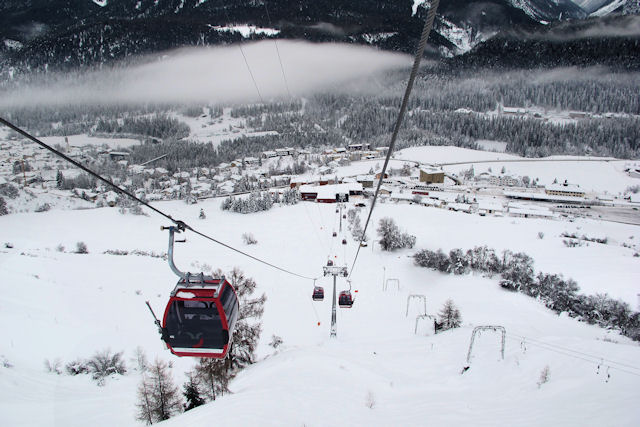
St Moritz Youth Hostel

St Moritz has a glitzy reputation, but it also has some awesome skiing. The main resort area is Corviglia, which has 160km of piste between 1730 and 3057m, mostly cruisy reds with a respectable amount of off-piste, largely around Piz Nair, and the old Olympic downhill run from Corviglia itself. You can access the runs from Celerina, downtown St Moritz and the St Moritz Bad Signalbahn cable car. Across the Engadine valley is Corvatsch, with 130km of piste between 1797 and 3303m and the highest lift station in the Eastern Alps. Corvatsch is a short bus ride from St Moritz with access via the Surlej Corvatschbahn, or further up the valley at Sils, and for my money provides best runs in the valley. There are also a few runs up beyond Pontresina, on Lagalb and Diavolezza, which are definitetly worth a visit and take about 30 minutes or so to get to from St Moritz.

St Moritz Youth HostelSt Moritz is more than a ski and snowboard mecca, however. Cross-country skiing is at least as well catered for, with beautiful circuits all around the valley. Snowshoe walks, winter walks, toboggan runs, skating, curling and a range of other diversions ensure nobody is bored in st Moritz. Sadly there seems to be no public spa in the resort, although there clearly was one and it looks like one is planned, but the Kempinski has a spa open ot the public at a fee. Indeed many of the swanky hotels allow the hoi polloi to enjoy their facilities at rates that are not unduly extravagent.

Despite the stream of private jets flying into Samedan, the swanky hotels, the furs and the Michelin-starred restaurants, St Moritz caters well for those of more modest means. The railway line across the Albula pass is on the UNESCO World Heritage list, and it is indeed spectacular. Once in the Engadine public transport is good, although you suspect run by those of the Italian-speaking community rather than the Schweizerdeutsch – Italian-speakers are indeed much in evidence, and the traditional Romansh tongue is limited to some place names and remote communities. Prices in bars and restaurants are generally-speaking the same as anywhere else in Switzerland, but you clearly have more top-end options – including what some consider the best mountain restaurant in the Alps, La Marmite at the Corviglia top station.

I’ve stayed before in St Moritz in low-end hotels and the prices, service and character have been good. However this Christmas we decided to stay as a family in the St Moritz Youth Hostel. it is located in St Moritz Bad, right on the edge of the town, but it is on the end of the #9 bus line, which also serves Signalbahn, St Moritz railway station and the stop for the Corviglia mountain railway, Schulhaus. As a result getting there from Basel was a doddle: direct train from Basel to Chur with a family carriage that includes an in-train playground; walk across the platform for the connecting train to St Moritz, and then pick up a bus from the same carriage to be dropped at the door of the Youth Hostel. Even with two kids and gear for four people, it really was very painless. Similarly getting to the slopes was also very easy, with Signalbahn being the most convenient stop five minutes away. In addition there were a couple of convivial bars near the stop for apres ski despite St Moritz Bad being a generally quieter community than St Moritz Dorf. It is also easy enough to get off at Signalbahn to switch to bus #1 or #6 for a 10 minute trip to Surlej Corvatschbahn.

The Youth Hostel itself is fabulous. A modern building, spotlessly clean with genuinely friendly staff and a range of sleeping options. We chose a four-person dorm for the four of us, and had a shared WC and shower opposite. The hostel boasts a games room, a children’s play room, a TV room, a boot room, a ski room and a good communal area with a roaring log fire.  Drinks are available from reception or in the restaurant at a reasonable price. Both breakfast and dinner were simple but adequate fare, the lack of choice in the main dinner course compensated for by the excellent salad bar.

The kids were booked into the Ski School St Moritz at Salastrains. This purpose-built ski school facility is part of the oldest ski school in the world. It isn’t particularly convenient for non-skiers though. You can walk or ski down from the top of Signalbahn or walk up (or take a horse drawn carriage) from the mountain railway at Chantarella. The school is very good, however, and the kids loved it.

I would recommend St Moritz to anyone who hasn’t been there before, and I think the choices we made in terms of transport, accomodation and ski school were perfect. It really is a most beautiful spot with a unique microclimate, fabulous winter sports activities and spectacular scenery. And if you like people-watching, there is nowhere quite like it.

One last tip, the Swiss Railways Snow’n’Rail scheme, if you have a half-price card, effectively gives you six days of skiing with the rail travel thrown in for free.

Ski Helmets for Kids

I wouldn’t dream of letting my kids out on the slopes without a ski helmet, but when i first learnt to ski literally no one wore them. Over the last ten years there has been a huge increase in the number of both adults and children wearing ski helmets when taking to the slopes for that annual skiing trip. With the Swiss Alps being one of the most popular skiing locations in the world, the question is – what is the Swiss stance on the use of protective headwear on the slopes?

Many countries, including France, Germany, Switzerland and Italy simply encourage the use of ski helmets without making it compulsory. However, as the general global awareness of health and safety has increased, some countries have made it compulsory for children to wear a helmet. Interestingly, despite a relatively laid back approach to helmet use (or perhaps because of it), the Swiss Council for the Prevention of Accidents has seen a sharp increase in the number of people wearing helmets in the last five years; 63% of adults and 97% of children now wear a helmet on the slopes (only 16% of adults wore a helmet five years ago).

With thousands of people every year suffering from head injuries on the Swiss Alps, the importance of head protection should not be underestimated, particularly when it comes to children. There are a wide range of kid’s ski helmets on the market, the trick being that they are something of a fashion item these days, so most children are more than happy to wear one. 

Thanks to Chris Parker for research for this blog article. If you would like to learn more about the importance of children’s ski helmets and get some ideas for where to buy them, please feel free to click through to Chris’s site at Ski Helmets For Kids.

Snow’n’Rail 2011-12

St-Bernard ExpressRailaway, from the Swiss National Railways( SBB/CFF/FFS), have published the Snow’n’Rail schedule for 2011-2012. No great surprises, prices are either the same or have risen by a franc or two – although with the strength of the Swiss Franc this now makes Zermatt the most expensive lift pass in the world, so thank goodness for Snow’n’Rail discounted prices! As usual the brochure is published online here, in English, covering most of the featured resorts, but here is a summary of typical prices from Basel and Zürich for an adult for a return train ticket and a one day ski/snowboard pass:

Resort Slopes (km) Basel 2011-2 Zürich 2011-2
Adelboden-Lenk 210 101.20 154.40
Airolo 30 84.80 67.20
Aletsch Arena 104 114.00 117.20
Alpes Vaudoises 225 113.80 120.20
Arosa 100 104.00 86.40
Belalp-Blatten 60 108.00 111.20
Braunwald 32 80.00 59.20
Crans-Montana 140 125.00 130.60
Davos Klosters 305 114.40 96.80
Engadine St. Moritz 350 134.40 119.20
Engelberg-Titlis 82 90.00 82.00
Flims Laax Falera 220 117.00 97.00
Flumserberg 65 97.40 75.80
Gotthard Oberalp Arena 125 89.60 72.80
Gstaad Mountain Rides 250 100.00 105.60
High-Ybrig 50 85.20 63.00
Klewenalp Stockhütte 40 70.40 64.00
Lauchernalp / Lötschental 33 98.60 104.20
Lenzerheide 155 110.40 90.40
Leukerbad 50 116.20 118.60
Meiringen-Hasliberg 60 81.60 74.40
Melchsee-Frutt 32 76.20 69.80
Motta Naluns, Scuol-Sent-Ftan 80 109.60 94.40
Nendaz 220 118.80 125.20
Obertoggenburg 60 95.60 74.00
Pizol 40 87.20 67.20
Portes du Soleil 650 112.20 118.60
Region Jungfrau 213 100.20 107.40
Saas-Fee/Saastal 150 133.80 137.00
Sierre-Anniviers 220 116.40 122.00
Sörenberg 53 79.40 73.80
Splügen 30 106.60 88.20
Stoos 35 78.60 59.40
Verbier 181 118.00 124.40
Visp 90 101.60 107.20
Zermatt & Cervinia 350 157.20 160.40

All the resorts provide a two day option, and some a six day option. Tickets are available from most stations, and can be dispensed (in English) from the ticket machines without the need to queue at the counter. Nara and San Bernadino have fallen out of the featured resorts from last year, whilst Grächen only provides a six day pass.

5 Reasons to Visit Verbier

The “On the Snow” website lists five compelling reasons to visit Verbier.

The cite the 400km of accessible and challenging off-piste, the restaurants, the “Verbier Ride” freeride competition on 21st January, and the 10km toboggan run.
Above Tortin
I would add that it is a French-speaking resort, handy for folk like me who have better French than Schweizerdeutsch. And the 400 km of on-piste skiing do make it one of the largest groomed ski areas in the world, even if the connections between the component parts leave something to be desired. Verbier is also actually quite cute, although with all the ostentatious wealth and the raucousness on display, many people may choose to stay in family-friendly Nandez or one of the other less expensive satellite communities. The lower slopes can get patchy if the weather is warm or there has not been much snow, yet this is one of the resorts where you can pretty much guarantee good skiing and snowboarding throughout the season, and it is particularly good for early or late season breaks.

The new season was expected to have a number of upgrades take place, but apart from an increased number of snow cannons, the main improvement is the addition of the Mayentzet six-seat chair up to Les Ruinettes.