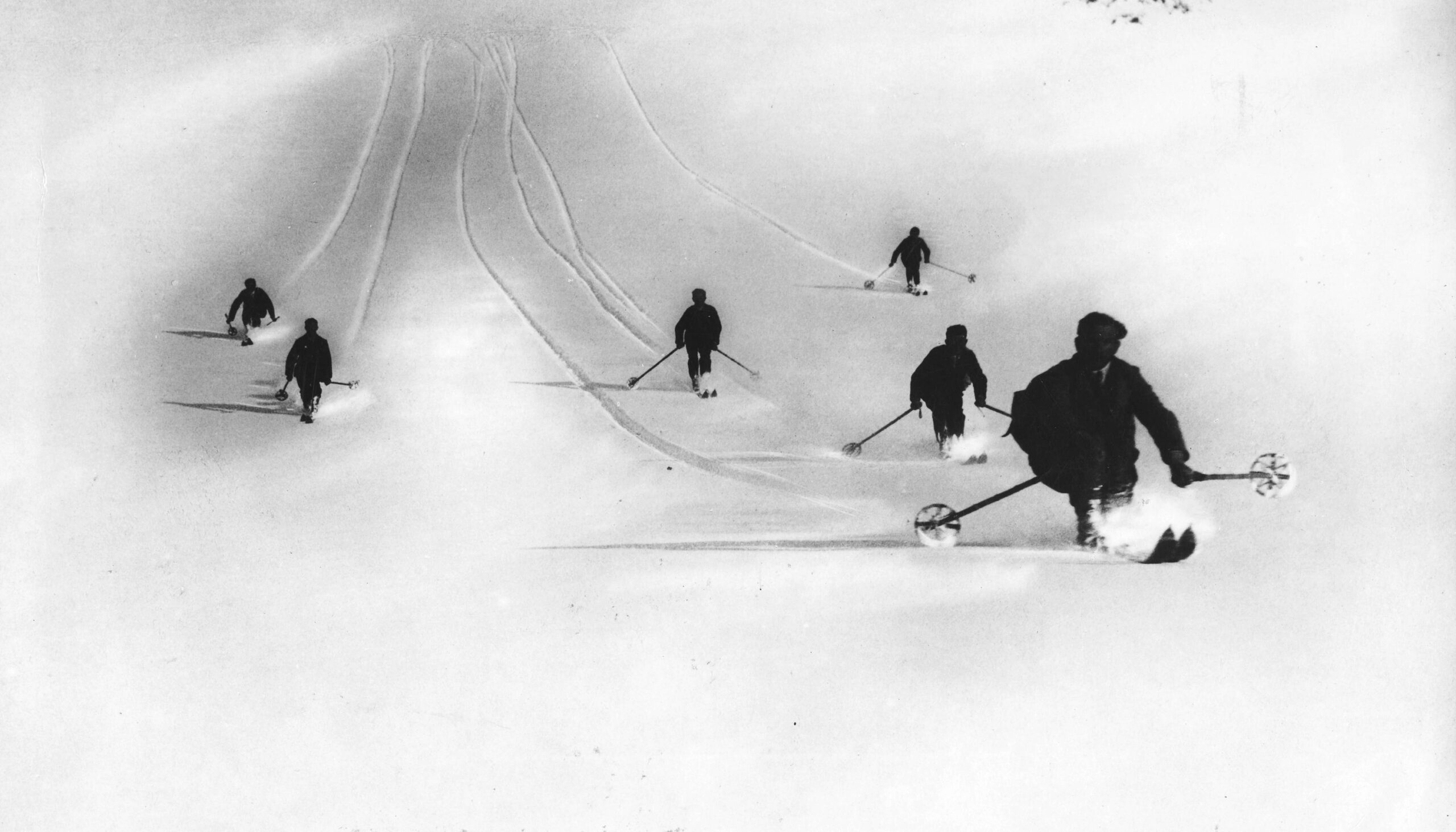
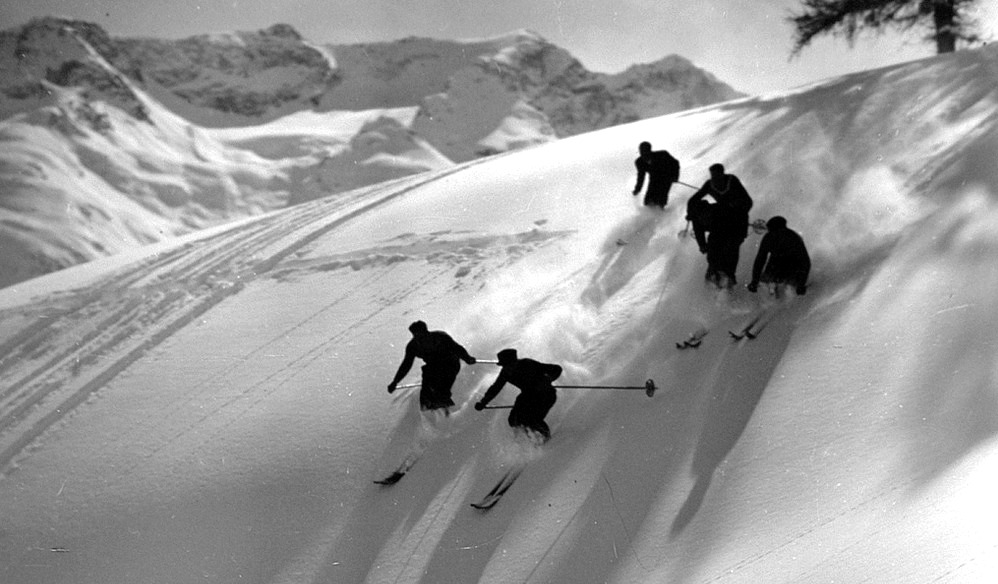
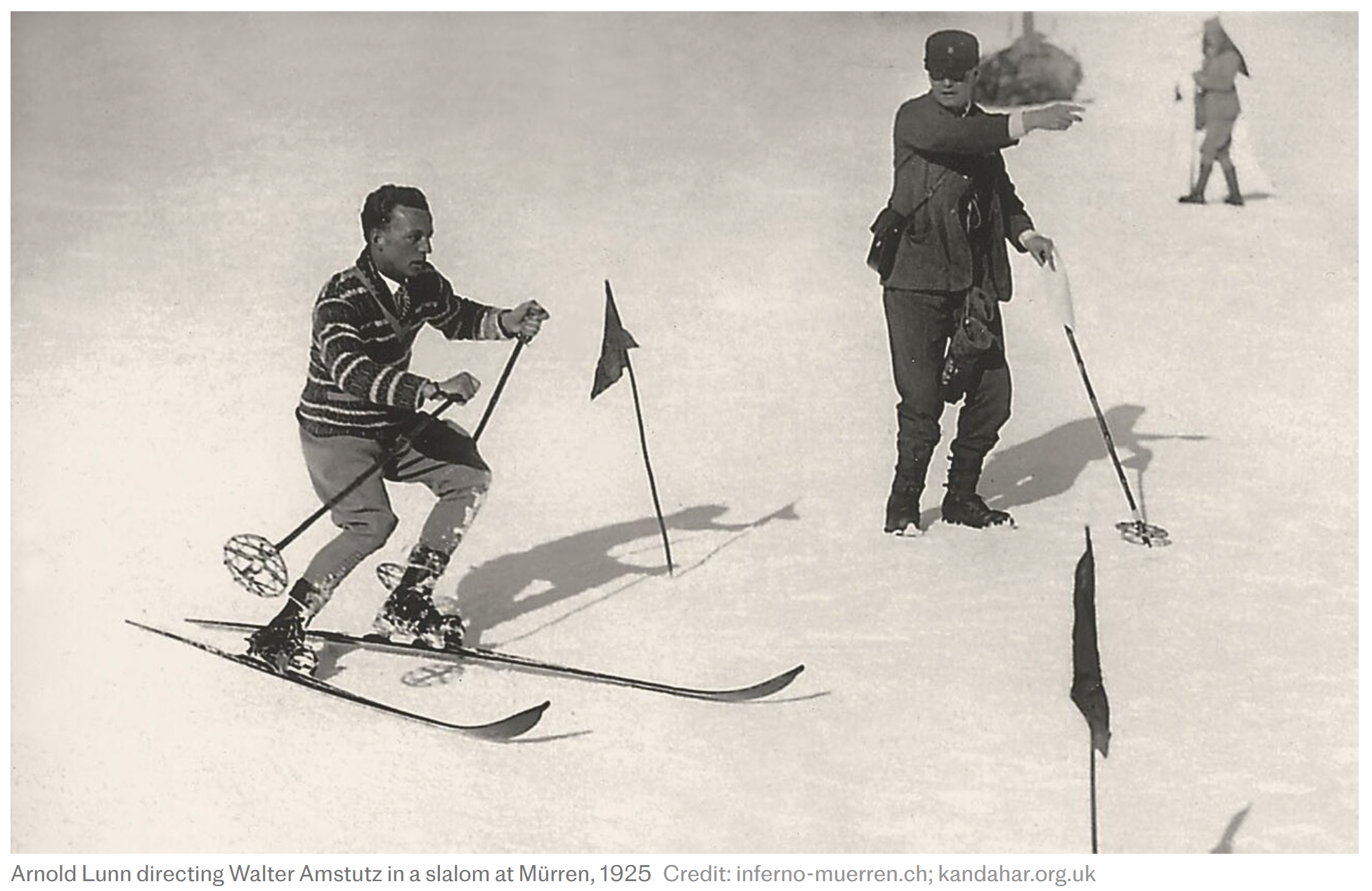
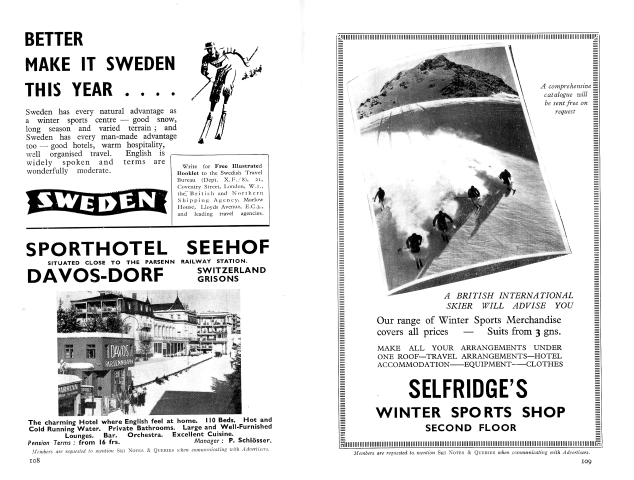
When ski-ing was first introduced to the Alps, the tradional single ski stick gave way to two, and the practice of ski-riding, like a witch on a broomstick, was eschewed. However the Nordic skis and bindings did not easily allow ski-runners, as they were called, to turn. As a result the most popular way to descend a steep slope was to run in a straight line – a style called “glissading” – until either gravity or a fall brought the ski-runner to a halt.
The earliest turns were called the Christiana and the Telemark, both named after places in Norway. Christiana is now called Oslo.
THERE was much rejoicing amongst our small circle of ski-runners last winter when a two days’ tour was announced; and it proved a most successful undertaking, in spite of the fact that the party included three ladies, two of these being novices of unlimited enthusiasm but comparatively small experience. We took advantage of a period of fine weather, and started out one afternoon up the valley, intending to sleep the night in the Hospiz near the top of the pass. Most of us carried “Rucksacks” containing the necessities of life reduced to their simplest expression, but in the light of subsequent events, even nightshirts and toothbrushes proved to be the merest superfluities.
We accomplished the first stage of the journey without any difficulty, but soon after that a fine mist came on and rendered progress difficult. It was impossible to see more than three or four yards ahead, and we had to stumble along as best we could, keeping close together in single file. This method of proceeding was both arduous and irritating, as it was difficult in the obscurity to avoid treading on the ski of the person in front, while one could only observe that the track had taken an upward direction by the person immediately ahead slipping back and clutching and stamping about in the dark. This occasionally gave rise to a horrible confusion of legs, ski, and sticks, accompanied by a growing conviction that if one did not instantly become disentangled one would be left behind and lost in the darkness.
Under these conditions it became imperative to refrain from recrimination of any kind, and I think we all tacitly agreed that, in our present situation, it would be highly undesirable to “add to the evils of life the bitterness of controversy.” This philosophic detachment might, perhaps, have been more deserving of praise had not the situation presented certain humorous aspects which it was impossible to overlook, and which enabled us to endure the vicissitudes of the road with equanimity.
I had really just given up all hope of ever getting anywhere, when suddenly the hut loomed through the fog, and in a moment cold and fatigue were forgotten in the prospect of the cheery hospitality and shelter that awaited us within. Dinner was quickly prepared, and all thought of our phantom-like march up the pass in the cold and the dark was dispelled by the entrance of the good lady of the kitchen with steaming soup. This was followed by “Kalbschnitzel,” a German dish, the precise nature of which baffles enquiry, and then we concluded with a libation of cherry brandy and “Glühwein.”
We were a very convivial party, and all did their best to contribute to the general amusement. One of the ladies sang a Norwegian song, which was received with much enthusiasm, although it is probable that the true significance of the ditty remained hidden from most of the listeners. Others less richly endowed with musical talent related anecdotes, not the least remarkable of which was a description of how a dried plum proved the means of restoring a tired ski-runner to life. It is also worthy of note that before the end of the evening an anonymous individual established a record in the consumption of “Glühwein.”
We did not separate till late. The accommodation was limited; and, as you never know your luck in these kind of places, it was universally agreed that undressing should be reduced to a minimum. Among the ladies there was a tacit understanding that only the most perfunctory attempt at toilet would be considered desirable, and this arrangement was conducive to complete harmony. Next morning everybody was down by ten o’clock. The proprietor of the Hospiz appeared to be a humble-minded man of great complaisance. He showed his sense of the fitness of things by providing us with a substantial breakfast, to which we did ample justice. Unfortunately, however, he was less successful in his manipulation of the telegraphic receiving apparatus that was installed in a corner of the coffee-room. When engaged with this instrument he seemed to spend most of his spare time winding himself up in several hundred feet of tape, which he would contemplate mournfully, shaking his head the while, and deploring in apologetic mutterings his inability to decipher a single sentence. This state of things was not at all remarkable, as his machine required adjusting in several parts, and, was mostly responsible for the misinterpretation of a telegram that was destined for us; and that delayed our start by a couple of hours. We had previously been given to suppose that two more ski-runners were to join our party, but as by twelve o’clock they had not put in an appearance, we started off on the ascent without them.
The scenery was most beautiful, and up to a certain point the climbing proved very easy. The sun had not yet topped the mountains, and the valley lay below us in a deep fold of shadow, while, high up above our heads the snow-lined ridges stood out, carved in rugged relief against the brilliant sky. At one point we crossed a glacier, and the formation of the snow in several places was most curious. We did not negotiate the last part of the ascent, which was steep and rocky, until after lunch, when we took off our ski and climbed up on foot. This was a very laborious proceeding, as we not infrequently sank up to the waist in soft snow; but we were rewarded on reaching the summit by a magnificent panorama of mountain scenery,
It is not my intention at this point to expatiate upon the beauties of the Alps. This is done so frequently with such doubtful success that I am inclined to think its omission will not excite a burst of resentful criticism. One should be grateful for small mercies, I fancy I hear a reader remark. Well, of course, that is another way of putting it. I will merely observe that the view from the summit was extremely beautiful, and thence pass on to more practical considerations. There was an icy wind blowing, the kind of wind that penetrates through every stitch of one’s clothing. We condensed our admiration for the scenery into a few short minutes; and, the usual number of cameras having been let off in various directions, we commenced our descent, which, after a few cautious plunges, ended in a precipitate and undignified slide in a sitting position.
We then resumed our ski, and the fun began in earnest. I cannot help thinking that, as far as sheer excitement goes, the novice gets as much, if not more, enjoyment on ski than the expert. The sensation of intense exhilaration when starting down a slope, coupled with the delightful feeling of uncertainty as to one’s ultimate fate, fill the novice with joyful emotion as his ski bear him along in a downward rush. His control over them is extremely limited, but he feels that he is slowly advancing to the much-desired goal of complete mastery. His career may terminate in an inglorious somersault, and he may be left behind spluttering in a cloud of snow while those more skilful shoot past him; still he re- mains undaunted, and cheerfully maintains that a rough and tumble in the snow is by no means the least enjoyable part of the performance. It may be argued that from a lady’s point of view this is not so; that ladies have no liking for somersaults, and other violent disarrangements of their persons. I have not noticed this aversion among ladies who make a practice of going on ski, and have certainly never felt it myself. Perhaps the overcoming of this prejudice should be accounted one of the most convincing arguments in favour of the irresistible attractions of ski-running. On arriving at the Hospiz where we had spent the night, we bade farewell to our host after a short halt, and then resumed our downward journey, arriving home in time for dinner, which formed a fit conclusion to a most successful and enjoy- able tour.
Foremost among the few general observations which may not be altogether un- suitable here, I should like to mention an entirely unfounded notion which pre- vails among the uninitiated in this country, that ski-running requires a strength of physique not possessed by women as a rule. In my opinion, there is no more risk for women in ski-running than in any other of their sports. Great physical strength is of minor importance. A woman who is sound in wind and limb, and who has sufficient personal courage to sail her own boat, drive her own motor, and compete with other women at golf, skating, swimming, tennis, etc., is amply qualified to become a first-class ski-runner. Skill is the main thing-that is to say, accuracy of balance and a quick eye for country. If to these there be added a measure of steady nerves and pluck, staying power and strength will, by and by, come of their own accord.
I believe it has been privately asserted by men, very privately, of course, and only when emboldened by the absence of their wives, that women are a doubtful blessing It is interesting to note that on tour. rumours of such statements are discussed by those against whom they are levelled without the slightest tinge of acrimony. There can be no doubt that some women are a nuisance on tour, for the same reason that makes their presence a nuisance everywhere else; but this may be said with equal justice of some types of men. If a woman has had the necessary amount of experience to enable her to undertake tours without fear of over-fatigue, and if she is not the type of person just mentioned, there is every reason to believe that her presence will not be disagreeable to others.
No one will deny that women are much more obedient on tour than men. They will not dream of discussing or deviating from such directions as the leader of the party may think fit to issue, and they never give annoyance by going off on other tracks and, perhaps, obliging the whole party to wait or search for them.
Of course, women should endeavour to give a minimum amount of trouble, and all offers of assistance should be graciously but firmly declined unless absolutely necessary. I think most women have the sense to see that those who exact an undue share of attention are nearly always voted bores; and, if they do not immediately perceive it, some fair companion will, sooner or later, give them a pointed demonstration of this principle. I have never heard of men grumbling at women for continually requiring assistance, and I am inclined to think this may be taken as a sign that, after all, there is not so much to complain about.
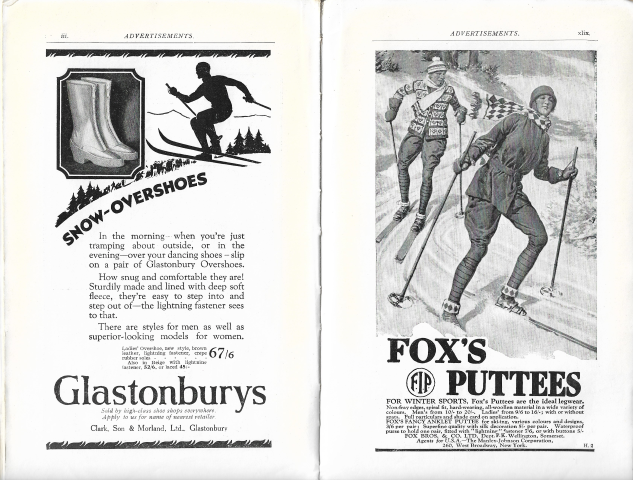
One important rule for women is, that they should carry their own rucksacks containing their gear for the day and night. Needless to say, this should be reduced to a minimum. I would suggest a spare pair of gloves, a sweater, a sponge, and a toothbrush. Flannel nightdresses, peignoirs, etc., must be regarded as luxuries to be discarded, as their additional weight is sure to become burdensome. A brush and comb might be included, but these are by no means indispensable. The above suggestions would, of course, be modified according to the length of the tour; but the articles mentioned are quite sufficient for one night. The most suitable dress for a lady on such excursions is a flannel shirt, knickerbockers, and a very short skirt of some smooth serge or cloth. Gaiters are excellent things for novices to keep out the snow, but can be discarded by the expert. It is essential that the cap worn should have flaps to protect the ears in a cold wind; and, of course, only silk, wool, or flannel should be worn next the skin.
Another most important rule, which applies to men just as much as to women on tour, is that cheerfulness becomes a duty when fatigue or discomfort have to be endured. Nothing damps the spirits of a party so much as the frequent grumblings and complainings of a gloomy person; whilst, on the other hand, everyone has experienced the helpfulness of a cheery word spoken at the right moment.
My last remark is for ladies only. It should be remembered that no mere man can ever venture to become surly as long as the ladies of the party remain good tempered under adverse circumstances.
From: Year Book of the Ski Club of Great Britain, 1907, p29-31
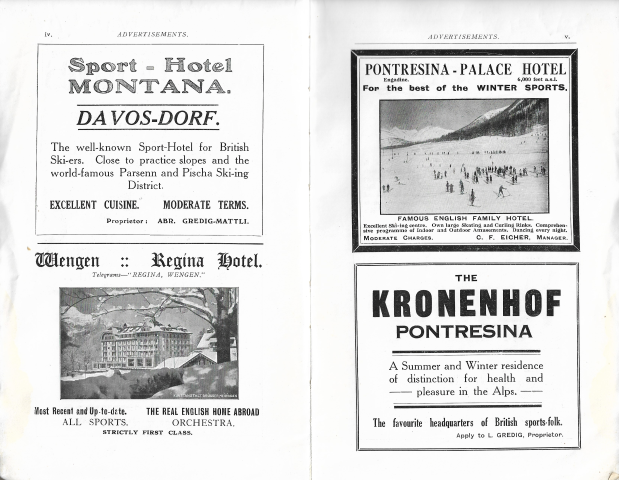
Winter Sports in Switzerland for Englishmen originated with Mr. John Addington Symonds at Davos, about forty years ago. At that time, the Alpine resorts, which are now crowded with devotees of various sports, were dreary solitudes in winter, deserted even by the peasants themselves. Somewhere about 1880 Grindelwald first opened its doors to a select company of Alpine Club men, and at the same time St. Moritz began to be frequented. On Christmas Day, 1891, in what was called the Little Bear, which had been erected as a winter house, one hundred people sat down to dinner. This was supposed to be a wonderful record in Grindelwald. Rates then were low and so were numbers. One could get accommodation in those days for about seven francs a day, where now the figure would be from twenty to twenty-five francs a day. At St. Moritz I have met people who stayed at the Kulm in those early days for five francs a day. It would be difficult to get in there now for less than twenty francs, while many people pay thirty francs and more.
The number of beds now available at Grindelwald and St. Moritz in winter are given in the Swiss winter book.
On 6th January 1892 I went with a small party of readers of the Review of the Churches to Grindelwald, as the two vessels on which we were going to Norway had been wrecked, and we had some Reunion talks, which led to the Reunion Conferences later, which took place in three successive years. This was the beginning of my visiting Switzerland. At that time I believe the only winter resorts open were Grindelwald, Davos, and St. Moritz, which were all in their infancy as winter resorts. A little later came the opening of Arosa, another lung resort, as a rival to Davos ; the opening of Caux in the Rhone Valley; a few years later Chateau d‘Oeux; and mean- while St. Moritz was going ahead by leaps and bounds.
The real development of Winter Sports dates, however I think I am correct in saying- from 1902, when the first party of Etonians. and Harrovians went to Adelboden. I had visited that place and found that the proprietor had made an attempt to open, the previous. year, with about twenty visitors. Mr. John Stogdon of Harrow wrote a letter which was sent out in facsimile to old Etonians and Harrovians, saying that the Grand Hotel at Adelboden had been reserved especially for them. That winter Sir Walter Parratt, Sir Richard Jebb, the Bishop of Wakefield, the Bishop of Hereford, and a number of other well-known people went to Adelboden. We had four hundred visitors in all, and the centre has never looked back since-although, from my standpoint, “Every prospect pleases and only man is vile,” as the hotel-keepers broke their contracts with me, and I had to give up the place.
In December 1905 the Public Schools Winter Sports Club, which had sprung into being during that year, opened four new centres- Montana, which has ever since remained the favourite of the Club; Villars-sur-Ollon, which is also a great favourite, and has a magnificent rink; Celerina, which the Club never took to for some reason; and Klosters, below Davos, which did not succeed because people thought it was too near a consumptive resort, though this was a complete delusion, as the microbes would have had a harder journey to reach Klosters from Davos than the Israelites undertook when they set out from Egypt for the Promised Land; but the idea has done a good deal to hinder the development of the place.
The Public Schools Alpine Sports Club that year numbered about four hundred and forty members; it now has just about ten times that number.
In later seasons the Public Schools Alpine Sports Club has opened the following centres : Mürren, Wengen, Beatenberg, and has joined in the development of Lenzerheide.
In 1892, when I first went to Switzerland in winter, I think I am right in saying that the total number of beds in hotels for sport, as opposed to invalid resorts, was not more than three or four hundred. The Winter Sports Year Book will give you the actual numbers but I believe that in round numbers there are now about ten thousand.
One fact of interest is the way in which the other nations are gradually following the lead of Englishmen. In the early days of which I have spoken, up to the end of the century, visitors to Swiss winter resorts were almost exclusively English, with the possible exception of St. Moritz. But within the last few years, Germans have come in considerable numbers to Grindelwald, Engelberg, and Caux, as well as to St. Moritz. The Public Schools resorts are, of course, exclusively English. This tendency on the part of the leading Continental nations has been greatly promoted by the presence of members of their Royal families at St. Moritz. One year the Crown Prince of Germany, the Archduke Franz Ferdinand of Austria, and one or two other heirs to European thrones were staying at that centre.
In matters of sport and social intercourse our nobility generally lead and the rest follow; but as regards Alpine sport the case has been reversed. The Alpine Club draws its members chiefly from the educated middle-class, and it is this class that forms the largest proportion of English visitors to Switzerland in winter, though their example, as has been seen, is being followed even by crown princes. With reference to the question of sports, skating, of course, has been the great feature in English centres. The English style of skating was practised exclusively at Davos and Grindelwald, and almost exclusively at St. Moritz. Gradually the International or Continental style is driving out English skating from Davos and Grindelwald, and possibly from St. Moritz. The reasons for this are twofold. (1) The International style of skating takes up so little room. Two International skaters can waltz on a piece of ice of 400 square feet, whereas English skaters for a figure of four would require about 60 feet square or 3600 square feet. Hotel proprietors, of course, prefer that style of skating which takes up least ice room. (2) Continental skating is much more attractive as a spectacle than the English style. I think I have told you of a remark which Elizabeth Asquith made about the two kinds of skating. Her mother said the Continental skater thought he was making an epigram and only made a conundrum. Elizabeth said, “I think the English skater makes a plati- tude.” The two schools of skating regard one another almost as the Orangemen and Roman Catholics do in the north of Ireland.
Curling twenty years ago was almost a dead letter in Switzerland. One saw the stones lying idly, day by day, and occasionally a few energetic Scotsmen would send a stone down the ice; but one might pass the winter in Switzerland without once seeing a real curling match.
In January 1905 I offered a cup for an Inter- national Curling Match at Kandersteg, and nearly a hundred Scotsmen came all the way from their native land, bringing with them. about three tons of Caledonian granite in curling-stones. In some cases they took them into their sleeping-cars, they valued them so much. This gave a great fillip to the game in Switzerland, and directed the attention of the Scottish curling world to Switzerland. Every year since then the International curling match has been held at some Swiss centre, and Englishmen have taken up curling in Switzerland with an enthusiasm almost equal to that with which they have taken up golf in their own country.
Ski-ing was unknown in Switzerland till about 1895. The first person I ever saw ski-ing in Switzerland was Conan Doyle, at Davos, and he had, of course, brought the art from Norway. He was one of the earliest ski- runners. Now every postman delivers his letters on ski in the winter, and little children untwist the hoops from barrels and make themselves embryo ski. There are two English Ski Clubs and endless Swiss and German societies. The two English Clubs are (1) the Alpine Ski Club, which exists to promote mountaineering on ski, and has rather a stiff test of membership on the lines of the Alpine Club, and (2) the Ski Club of Great Britain, which admits men and women, and has no severe requirements for entrance, but welcomes on a broad basis all who are interested in ski-ing.
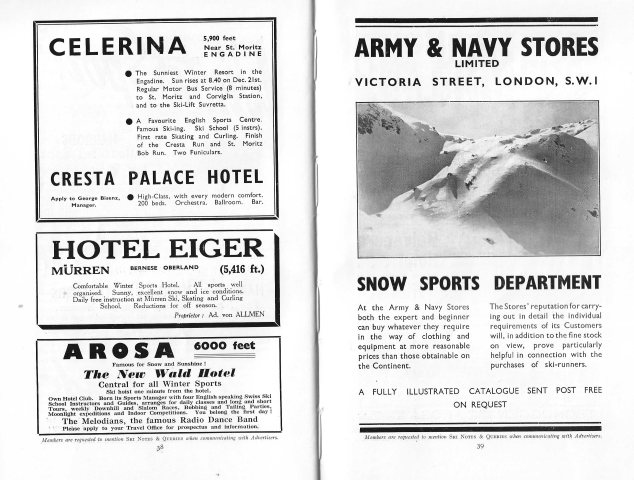
Tobogganing, since ski-ing became popular, has rather gone out of fashion. St. Moritz maintains at great expense one ice- run, the Cresta, of world-wide fame, down which the tobogganers come at the rate of from sixty to seventy miles an hour, but the total number of those who come down the whole length of the run, which is nearly a mile long, is less than twenty during the year, and there are probably from ten thousand to twenty thousand visitors at St. Moritz during the winter, so it is obvious that tobogganing only attracts a few votaries. The old German schlitten, or wooden toboggans, were used by good walkers, who would go up to the top of a mountain pass, lunch there, rest an hour in the sunshine, and come down on the toboggan. But now the toboggan is forsaken for the ski, which answer the same purpose much more effectively.
St. Moritz has developed a rather expensive sport known as ski-jöring, which is practised at no other place in Switzerland, and which requires a frozen lake or river for its exercise. In this sport a ski-runner is drawn over the ice by two horses, which he drives himself, at full gallop. The sport is very exciting to watch. Race-horses are brought from Berlin and Vienna, and the expense is, of course, prohibitive except for the wealthiest sportsmen.
The bob-sleigh is really a bogie-carriage composed of two toboggans with a seat run right across the two, each toboggan being movable on its own axis, and it furnishes accommodation for four, six, or eight persons. It is a deadly weapon of destruction, and has a great many accidents to its credit. The pace attained on this fearsome instrument is tremendous, but where, as at St. Moritz, there is an ice-run carefully prepared and reserved for bob-sleighing, which is not permitted elsewhere, the danger is confined to those taking part in the sport. In some centres the public roads are used, to the peril both of the bob-sleighers and of the passers-by. However, no danger will deter an Englishman from practising his favourite sport, and bob- sleighing has a number of votaries in nearly all the centres.
It will be relevant to the present discussion to note certain aspects of the Swiss winter sports which are undoubtedly of benefit to modern mankind. Perhaps the first is a marked and sudden change of convention. We do wonderful things in this way. Imagine, those of my readers who have never ventured on this experience yet, what it must be to quit the ordinary January life of the professional person, eager on social service, and exchange it for Montana. London at that engaging time of year is full of meetings, especially educational conferences. Such things have their merits, and at times are positively amusing and instructive; nor would I subscribe to the notable indictment contained in Matthew Arnold’s well-known Intro- duction to Wordsworth, in which he refers to some of the most prosaic lines ever written by the poet: “One can hear them being quoted at a Social Science Congress; one can call up the whole scene. A great room in one of our dismal provincial towns; dusty air and jaded afternoon daylight; benches full of men with bald heads and women in spectacles; an orator lifting his face from a manuscript, written within and without, to declaim these lines of Wordsworth; and in the soul of any poor child of nature who may have wandered in thither, an unutterable sense of lamentation, and mourning, and woe!”
But we may postulate a state of things not wholly unlike this picture, varied by most burdensome evening entertainments to which we take our young fry, there to watch them unfitting themselves by late hours and excess of nourishment for the scholastic requirements of the Lent schooltime. It is an environment of gloomy work and gloomy attempts to be gay. We are cumbered with continual black coats and London clothing generally, and con- versation forsaking such matters as the garden pump or the corrugated iron cow-house, gravitates about the last nostrum for a catarrh, or the quirks of our legislators, or the reason. why our nephews find living so expensive in Africa.
Straight from this atmosphere, or possibly from that of muddy lanes and school treats. in the country, we find ourselves at Montana. From the Rhone Valley we slowly and peace- fully ascend the long hill. (This slowness, and I fear peacefulness also, may be by now things of the past, owing to the new funicular.) Perhaps at Siéres there is a heavy fog and the air is bitterly, cruelly cold. We mount, how- ever, in a sleigh, and become aware of possibilities in life quite hidden from us before. Short of half-way up to Montana the fog is overcome. We are above it, and may dismiss it from our thoughts as we enter a region of unsurpassable sunshine and an air exhilarating beyond all words. At last we enter on the actual grounds. The rink is alive with a grand bandy game-generally reserved for the latter part of the afternoon-and on the curling-rink are to be seen members of both sexes disporting themselves in various quaint garbs, and using an unearthly dialect. There is a gentleman of mature age and portly stature, standing with a huge broom in his hands, apparently watching some heavy rotund discs of stone sliding past him, when all of a sudden a piercing yell of “Soup, man, soup is heard, and he seizes his broom and with vigour sweeps the ice in front of one of the discs, though, to an untrained eye, the surface is free from every speck of substance to respond to the broom. This goes on for two or three seconds, till the same voice shouts ”Cows up,“ and as you are gazing round for the quadrupeds to appear, the broom is suddenly lifted from the ice and the portly person in a flash of the eye is on his back, his occiput sharply raps the ice, but scorning all thoughts of concussion of the brain, his only anxiety is to keep his person out of the way of the advancing disc; his wish is not like Cleopatra or Lucretia, to die gracefully, but to serve his side by scrambling like a disturbed crab out of the way of that stone. Such a scene you may witness on arrival, but perhaps your attention may first be caught by the sight of a young lady suitably, but not outrageously, clad, practising the descent of the gorgeous hillside on her ski. You may witness a cropper of such severity that she is completely hidden from view, not behind, but inside of a snowdrift, whence, however, she will shortly emerge, slightly altered in complexion possibly, and in general not quite fit for a Royal Garden Party, but tranquilly resuming her occupation.
Or a tall and usually stately Headmaster may burst upon your view as he shoots down a snow-slope like a falling star. With the best of opera-glasses you couldn‘t tell whether his eyes are or are not wider open than his mouth. His speed, however, increases, and in a trice it becomes evident that he is not master of himself in any of the ordinary meanings given. to the words. In fact, a crash is imminent, and is plainly expected by some friends, relatives, and pupils who are waiting in dubious security at the lower end of the slope. It comes. Noiselessly but decisively the Head- master disappears from view. An ominous barrow-not of Saxon or Celtic origin-may be discerned where late he flew, but nothing what- ever can be discerned to suggest that Nature has been invaded by man, except a straight piece of wood sticking bravely out of the snow like the oar on the tomb of an ancient Greek mariner. This implement, however, though it speaks of sailing, is no token of death. In less than two minutes the massive snow- white figure has begun the series of intricate movements designed to recover for it a vertical posture. That series may not be completed for nearly ten minutes, and even so may require some extraneous assistance, never, at Montana, asked for in vain.
With his mind thus enlarged, our visitor bethinks him of tea, and almost for certain finds friends ready to introduce him to the cherry jam of a châlet-hospice” lying on the way to the Park Hotel. In England one sometimes, not often, meets men who are very poor hands at a five o’clock tea. They join the party, but obviously for the sake of the company, not of the viands. At Montana it takes a great deal of politesse de cœur to conceal the truth: the visitor goes to tea for the sake of the cherry jam, and the company is quite a subordinate fact in his mental horizon. And this state of things is due to the nature of the Montana air.
After tea, if he is wise, he will choose the moment for walking eastward along the path to his own hotel, just when the sunset is working its transformation on the mists of the valley. No pen could give a reader an adequate idea of that scene. Before long there will be a triumph of glory when the top of the Weisshorn is capped in vermilion, and if a traveller has by chance spied that colour from the depths. of the wood near Montana village, framed for him by branches of dark pine boughs, across a half-discerned valley of snow-slopes and slumbering shadowy rocks, he has seen one of the most dazzlingly gorgeous sights this world can give him. But for our visitor this time has not quite come. The sun‘s rays are still low enough to strike the top of the mist and bathe in opalescent splendour the whole of the lower slopes of the mighty mountain- masses; red flushes are smiling among the fir-woods on his left, and the air tingles and sparkles as he breathes it, and lightly trips over the crackling snow to his destination, wondering if he has not launched himself at length into a new and better world. And yet again on his ears will strike the mystic sounds, You for a curler!“ ”Bravo! over the Hog,“ Out elbow and crack an egg on this stane,” and so on from the curling rink.
And so time wears away till long after dinner he bethinks him of his rest. It may be 10.30 p.m., and if the moon is shining, as it does shine at Montana irresistibly, he may open his window and behold the mild iridescence of Nature, varied by a novel and singular spectacle. Just underneath the front of the hotel is the main entrance, and the snow is trodden pretty flat for a considerable space round the door. Suddenly he becomes aware of a lady, an ordinary English lady, gliding silently but swiftly past his window and away into the shadows-not glissading, nor ski-ing, nor skating, but rather swimming, in that she is disposed, let us say, on her face, and is simply completing the short toboggan run from the rinks to the hotel door. Two of the hotel myrmidons are gloomily tramping towards the door, and as she passes within four feet of them they barely give a glance as the prone figure slips noiselessly away. Such is the mode at Montana.
The night is an important time for visitors. First we have the time at dinner, which is agreeably arranged on a system of making new acquaintances, which works pleasantly. Tables, as at most hotels, are of various sizes, but mostly small, to suit couples or quite small parties; but there are larger ones where parties may combine, and it is usual for a small family group of four or five to entice some chance acquaintance to dine at their table instead of in splendid isolation at his own. This is an admirable custom. When I first travelled on the Continent people were arranged in a solid mass at one huge table, and I can remember two hundred and fifty sitting down at Pontresina in 1880 just as if they were members of a club or were joining in giving a feast in honour of the local M.P. And so things went on for about ten years. later, when small tables began to come in, but not universally by any means. The change had its merits, but so had the old system, because it encouraged the making of fresh acquaintances, who may, and often do, develop into new friends. I confess I have no patience with the ridiculous opinion that “ you never meet any one nice in an hotel,” the truth being that people are no nastier in an hotel than out of it; and if we can tolerate one another at a garden party or in Hyde Park why not at table d’hôte? People, I admit, are some- times to outward view and prima facie grumpy and apathetic; but the first is due to the studied cold-shouldering of those who start with an ungenial theory as to their conversational gifts; the second is invariably found to be a delusion. At least, everybody is interested in just the same number of subjects as he is at home. It may not be a great many, and on some of them his notions may be mixed; but it is going too far to ascribe this fact to the hotel influence. Yet I have been gravely told when calling from one hotel on a friend in another that “one never meets anybody nice in an hotel.” Is not the dictum exposed to the same sort of criticism as the phrase in the Church Congress programme, “The Duty of the Church at the Seaside ” being mentioned as a subject for discussion? About it a lady dryly remarked, “I should have thought that duty was much the same as it is inland,” and who could seriously traverse the statement? Anyhow, there is no sort of reason to doubt that many very valuable and permanent friendships have been formed, and many more might be formed, among visitors in hotels; but if each starts with a rooted conviction that his neighbour is an owl, assimilation is retarded.
While on the subject of the evening time I cannot help laying emphasis on the extreme importance of music. Dancing can be had; there are always plenty of people who organise it admirably-and, as on board the Dunottar, it is not out of the question to have a good racy lecture, though I fear the salon was never hotter than on the lecture night-but there is no relaxation, no pastime so certain to be in every sense of the word delightful as music properly managed. The first desideratum is a conductor of a scratch chorus. Your chorus must be scratch, of course, and at first the only result of bringing them together is that there is a tempestuous outburst of conversa- tion. People often talk eagerly, volubly, needlessly; but when they are painfully gathered for an object which is not talk, their chatter is far more untrammelled, noisier, more unstoppable than at other times; and especially is this true of the trebles and altos in a Swiss hotel. So that not so much the final result as the very first note of music at all is a triumph on the part of the conductor. And as to the chorus, there is in some hotels an unaccountable difficulty in getting some people to admit that they can sing, and others that they cannot. I have known the most willing vocalists turn out to be the most painful to listen to; and the few people in the company who can sing at all, remain gloomily, acidly criticising in the next room. When I was at school people who behaved in this way were kicked; and if a singer refuses to come forward when a chorus is being set forward he deserves similar treatment.
At Montana there was no trouble of the latter sort. For some reason the right voices -no more, no less-came to the fore, and though there were only two practices, there was a performance of the fine old piece “Now is the Month of Maying,” which was simply beautiful. Chorus singing is, after all, one of the very best things this chequered world. has to offer, and when the music is good, the balance of voices just, the words crisply pronounced, and the light and shade exactly as is enjoined, the performance is a pleasure to the listeners, but an imperishable memory to the singers; and to all a most desirable sup- plement to the vigorous muscular exercise of the daytime. May the tradition once planted never wither!
Looking back on some of the sports pursued at Montana, that of skating occupies a prominent place in the memory, though no one could compare the skill of the performers there with the exhibitions at Villars. Yet I will make bold to say that the skating at Montana, greatly inferior though it may be to that of the more renowned and spacious rinks, is in one respect too good. It misses some of the exquisite humours to be witnessed in Regent‘s Park, and which depend not so much on the skill of the performers as on their want of it. Never at Montana, but frequently in England, there is the suggestive incident of two perfect strangers, generally of different sexes, colliding by some slight miscalculation, with each other, and, to save a sudden fall, clinging with a fervid embrace round the waist or neck or either arm each of the other, and holding on trustfully and wholeheartedly till the errant feet are steadied and the parties, at last confusedly recognising the precise situation, part with hastily murmured apologies, meeting thus once and never again, between the cradle and the grave.
One may speculate whether such a clashing of atoms has been recorded in the evening diary by either of those concerned, or whether it has in the whirligig of time led to some no less fervid but less fleeting union, and been the beginning of a life-history of conjugal peace.
Such suggestive sights I never saw on the rink, as people seemed to have too much. control over their feet, and the exceptions to this rule were apparently too diffident to risk any sort of collision, lurking in less observed corners, or expatiating during the luncheon- hour when the coast was quite clear-brave, tenacious souls, oblivious of sandwiches, coffee, and mince-pies, and set fixedly on attaining a tranquil outside edge forward.
Another humour of the ice I can recall which unfortunately could not be reproduced in Switzerland. Some forty years ago, no less, we repaired for an afternoon’s skating to the Welsh Harp, Hendon. I have never been there since, but can remember the grand expanse of inferior ice and the huge crowd on it. People were standing in thick clusters talking and laughing, or wildly whirling about or patiently practising rudimentary figures where space allowed. One youth of the second sort was speeding round the lake as hard as he could go, and was dashing towards a group of persons intending presumably to skim past them with-out personal contact. Unfortunately a young man on the outside while talking harmless vapidities to his lady friend moved about a foot outwards, just at the wrong moment, and about half of his frame was suddenly caught in the onset of the “scorcher.” The latter buffeted him violently, and careered on, not looking round. The victim of his roughings was not at once knocked down, but set rotating. His staggers, though obviously abortive from the start, for a second or two took that form. He waltzed alone, uneasily, and with irregular lurches like a top just before it falls; and while this was going on, he began his remonstrance in language, it seemed to me, of remarkable self-restraint: “Sir, I think you might at least stop and apologise when you knock a man down.” So we all thought, but this was just what the scorcher did not do; and the complainant who began his plea while still rotating continued it in a crescendo of gathering emotion, as the other was now almost out of hearing, and ended it with a loud shout in a sitting posture, the voice rising as the body sank. It was difficult not to apprehend that his conduct, though kept well within bounds, may not have enhanced his dignity in the eyes of Phyllis; and indeed a promising love-affair may have been rudely checked as he sat on the ice patiently restoring his bowler hat to its original shape, and yelling till his voice cracked after a wholly indifferent stranger. But pathetic though the incident was, from some points of view I could not help being glad that it happened so near to where we were standing; and forgetting it is out of the question now.
Different in its appeal to the imagination was a catastrophe that occurred to a tall bearded skater very soon after the collision above described. We were standing talking in a small group, in a crowded quarter of the lake, when a singular noise made us turn our heads. It was a mixture of a hiss and a rumble, and the rapid crescendo of it made the less robust of our party fear an approaching mischief. But there was nothing to be alarmed at. The skater had fallen, and was gliding rapidly over the ice in the position which he had in- voluntarily assumed-that is to say, quite at full length on his stomach, and proceeding not sideways nor feet foremost, but as a tobogganer head foremost, the two hands being flat on the surface close by the shoulders. He must have been going at a rare pace originally, as none of us had even heard his fall, and he had been slipping along for an unknown distance as he passed us, the pace just beginning to slacken. The most picturesque fact about him was the heap of ice fragments which gathered in front of his beard. as he swept along, and formed a novel setting for the fixed and glassy resignation of his face. We thought we had never before seen a human being so like an express train.
But as I have already remarked, such amenities of a pastime as these are not to be seen in Switzerland. People skate too well to collide, except of course at hockey, but then it is part of the day’s work, and misses the glorious element of the unexpected. And they are too decorous to get up sufficient speed for the superb onset of our “scorcher or the prone onrush of the bearded man. Whatever other attractions hale us to Montana we must acquiesce in the loss of these subtle sidelights on human society; and the pity of it is that owing to the infrequency of frost in modern England they tend to become merely the touching memory of a long-past dream.
None the less the skating-rink is a delicious spot, especially at the luncheon-hour when flushed and hungry skaters and curlers gather in friendly groups round the well-earned prog. There were several days last January when the interior of the shed facing the sun was too hot for comfort, but outside it was always perfect; sometimes a very gentle breeze, ordinarily nothing but the matchless tingle of the crisp unmoving air. And occasionally it comes about that a trained exhibitor of the English or Continental style of skating would stray over from Villars to Montana, either to play in a bandy match or for social reasons, and would give us the delight of watching the Mohawks done to perfection and with con- summate ease, or better still, a whole series of complex evolutions gone through by two ladies in combination. Nothing prettier could well be imagined, except of course a flight of ten thousand starlings in September, and it was gratifying to feel that what many would pay heavily to see we were enjoying, as my American friend puts it, grattis.
On Bandy, a friend kindly supplies me with the following remarks:-
The old English game of bandy is chiefly played at St. Moritz and Davos. At other resorts, no doubt, intermittent games take place on the rinks when they are not needed by the figure skaters. Even at Davos the players are much handicapped by not possessing a rink which they can use with regularity. St. Moritz alone possesses a a rink suitable for the game, which is used regularly throughout the season. This rink was built in 1902 by the Kulm Hotel, and though frequently used for figure skating, is primarily for bandy. Lake ice is seldom of any use for bandy, as the heavy snowfalls cause the ice to ”sag,“ and make flooding operations im- possible, though one of the finest St. Moritz teams, that of 1900, 1901, played throughout the season on the St. Moritz Lake. The ice, however, was always rough, and full of cracks, in no way to be compared with the rink ice. At many places bandy, which requires a rink at least 100 by 60 yards, is not played, but various forms of ice hockey, or Canadian hockey, take its place. These differ from bandy as the Eton game differs from Association football. Bandy is the best game for English visitors, as these seldom have enough stability to make the game safe when played in a pack.
A really fine bandy team has not yet appeared. The St. Moritz sides are strong in combination, but generally contain one or two players who are only moderate skaters. Much the same may be said of Davos. The Continental sides skate better owing to obvious causes. But they have not the same combination. The Canadians at Oxford would soon, with practice, play bandy to perfection, but, naturally, prefer to play their own game. The best series of bandy matches which I have seen were in January 1910, when the Oxford Canadians, a Leipzig team, and the St. Moritz team played one another at St. Moritz. Among fine players of bandy proper may be mentioned Clive Pawson of Davos, A. Holland and E. L. Strutt of St. Moritz, and Dr. Schomburgh of Leipzig. These are quite in the first rank. Bandy owes much to E. E. Maerogadate of St. Moritz.
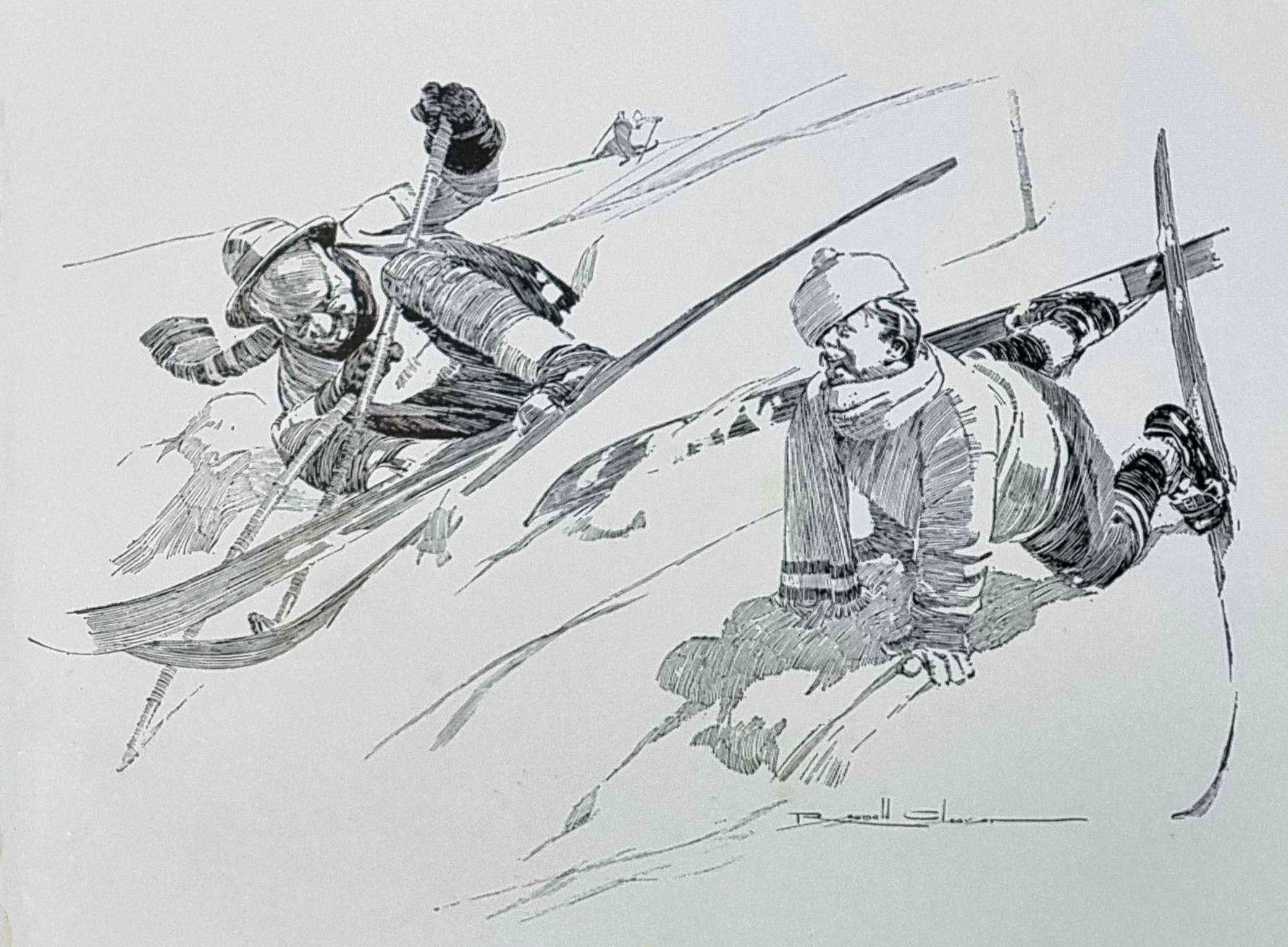
Of ski-ing I must confess I know scarcely anything. A vigorous friend, nearer sixty than fifty years of age, told me that a very few years ago he learnt ski-ing without once falling for the first fortnight. This, I believe, is a rare experience, but it should be for the enheartenment of middle-aged athletes who are advised by doctors not to begin ski-ing lest some old football sprains should reassert themselves and leave their victim ”crocked.“ There is, indeed, no more galling experience than that of the traveller who reaches his Swiss hotel in the depth of the winter glories of sunlight and sparkling air, and on the first day hurries off with his skis, buoyant with life and gaiety, and after an hour or so does something mysterious with that cartilage of the knee which old football players know so well, and has to spend the whole of his fort- night in a bath-chair watching his repuerascent friends disporting themselves heedlessly on every side. I heard of one poor fellow descending a sloping path in a wood at an accelerating pace, and deviating slightly from the centre of the track. What happened? He did not simply flounder against a tree. There would have been something coarse and common in such a mishap as that; whereas your ski is a garniture full of resource and deals in the unexpected. On one side of the road were two small fir trees about a foot or so apart. Will it be believed that the unhappy pilgrim managed to get his two feet outside both trees, the legs being crumpled up in wondrous wise in between. His companion, who was sailing on gaily ahead, with mind intent on progress, was suddenly recalled to a sense of the ”things that are behind“ by a loud yell of horror, pain, and bewilderment, and had to stagger up the steep as quickly as he could, and pain- fully untie the human knot. It took a good quarter of an hour from start to finish, and is not the sort of employment which a hard- worked philanthropist goes to seek when he commits himself to a Swiss holiday. On the other hand, when a man has some control over the ski it is wonderful how innocuously and with what abandon he may repeatedly fall. We saw this when the great long-distance race was being concluded at Montana. Down the lovely snow – slope and through the trees the racers came, some hundreds of yards apart, so that we could study each in turn. Each fell two or three times full in view, with a hearty and untrammelled thoroughness of falling. They plunged into the silvery soft substance as if each were trying how deep he could go, and loud were the cheers with which each powdered hero was greeted. It is a law of our being that delight attends on any rush through space attended with danger to life and limb; and clearly such delight is won by the ski-er. A beginner in the craft can soon work up a hot pace of going; and not even a skilled performer need be deprived of the spice of danger. Especially, so I am told, does this happen when an amateur accompanies a professional. The latter, to give point to his trip, skirts precipices and broken ground, just as a mountain climber prefers rocks to a long snow-slope, for the ”interest” of the thing. But there is a point for the inferior ski-er (or ski-ist) where interest is merged in dismay, and he would fain sit down and watch his reckless comrade, were it not that dinner depends on progress, and he must in a standing posture, if possible, continue the facilis descensus Averno.
Source: Reginald Cleaver, 1911, A Winter-sport Book, Adam & Charles Black, London, p28–55