By Arnold Lunn
Thanks to the intervention of the Swiss Government, an arrangement was arrived at to intern in Switzerland prisoners-of-war who were suffering from certain specified diseases and disablements, an agreement which was later extended to cover all officers and N.C.O.’s who had been in Germany more than two years.
The first parties of British interned began to arrive early in 1916. Chateau d’Oex was the first, and Mürren the second centre selected.
Ski-ing at Mürren was very active during the war winters. The writer, who had been rejected for the Army, was at Mürren, and organised tests and lessons for the officers and men. The Federal Council appointed such judges as were necessary among those officers who had passed the tests.
The winter at Mürren is very long. In 1916 and in 1917 excellent ski-ing was enjoyed from the middle of October to the middle of May, and in October, 1917, the winter set in as early as October 5th. By the middle of the month, deep and excellent powder snow was to be found all round Mürren.
Many of the officers and men went in for ski-ing with great enthusiasm, though it would have been better for the garrison, as a whole, if their numbers had been increased. Those who did not ski were dreadfully bored when the skating and tobogganing finished, and the spring snowfall, the heaviest in the year, came down. March and April are bad months at Mürren for those who do not ski. The ski-runners, however, were only too glad to see the winter prolonged, and first-class ski-ing was to be had in April right down to Mürren.
The British Tommy did not take to ski-ing in any very great numbers. About 20 per cent. of the men who were fit to ski took up the sport with keenness. The rest tobogganed and skated. There is a suggestion of hard work about ski-ing, which is suspiciously suggestive of a “fatigue.” Some of the men suspected that their officers wished them to ski in order to keep them out of mischief, which was quite sufficient to prevent them ski-ing. “What use is ski-ing to the British working man?” asked another gentleman with Bolshevist tendencies. I once persuaded a very sceptical Tommy to take up the sport. For a day or two all went well, and Thomas began to fancy himself as a ski-runner, so I took him on a run which wound up with a little easy wood running. Half way through the wood I heard a loud crash, and the tardy convert was discovered with his ski imprisoned in the low-lying branches of a tree and his head submerged in snow. “I say, Mr. Lunn,” he exclaimed, “do you call this ski-ing? I call this _____ bird’s-nesting.”
The tests were amusing. A Prussian who had observed the senior British Officer entering for a test with three privates, and consenting to be judged by a Lieutenant and a civilian, would have had a nasty jar. Most of the senior officers of the second instalment of prisoners skied, and skied well. Switzerland is a republican confederation, but I think even the Swiss were a little surprised to see mixed parties of officers and men setting out for ski tours together. Somehow the atmosphere of the mountains is not conducive to red tape. It was sometimes quite a shock to return from a glorious day’s ski-ing to the intensely military atmosphere of Mürren, where even the mountains seemed tinged at sunset with red tape, so that one sometimes wondered whether the Eiger was an acting Colonel, and the Jungfrau a V.A.D.
The tests held were those revised by the Federal Council in the spring and summer of 1914. The first trial of the new Second Class Test was held on February 25th, 1917. Mr. A. Lunn and Monsieur Marcel Kurz were the judges. There were five entries, of whom four were successful: Captain Sutherland, Lieut. Evans, Lieut. Franklin and Private Wells. Later in the season, Mrs. Arnold Lunn was passed by Messrs Evans and Franklin, who were appointed temporary judges by the Council Middleditch and Captain Carlyon were also passed.
It must be remembered that all these successful candidates had enjoyed anything from five to seven months’ consecutive ski-ing before they passed, and five months’ consecutive ski-ing is worth a good deal more than five seasons.
The list of those who passed the Third Class Tests is given below.
Only two Third Class Tests were held in the next season, partly because the snow was often bad, partly because most of the keen ski-runners had passed in the previous season.
Of those who learned to ski at Mürren during these war winters, the most promising runner was undoubtedly Private Wells, of the Canadian force. Wells was one of the most natural runners I have ever seen. He is the only ski-runner I know who learned downhill open Christianias by the light of nature and who always made use of this turn if possible in preference to the stemming turn. He was a very fine straight runner as well. His great friend, Private Bailey, of the London Scottish, only just missed the Second Class Test, because he simply could not master the stemming turn. As a straight runner, he was excellent. Evans had skied a certain amount in previous winters. He was a good steady runner in the Lillienfeld style when he arrived at Mürren, but he very soon learned sound methods. There was little to choose between him, Carlyon and Middleditch. All three became very good, indeed, very nearly up to the standard of the present First Class Test. Franklin and Sutherland were well to Second Class level. Sutherland, by the way, was at Mürren after the war, and won the second prize in the Kandahar to his teacher. Race and in the Alpine Ski Cup Competition, thus doing credit
Various glacier expeditions were carried out by the interned. On April 29th a party comprised of Captain Sutherland, Lieut. Shillington, Evans, Franklin and Middleditch, Privates Wells and Bailey and the writer, went from Mürren to the Concordia Hut, by way of the Jungfraujoch, the Directors of the Jungfrau Railway, then as on all subsequent occasions, proving most accommodating.
On April 30th we climbed the Mittaghorn, and on May 1st we ran down to Goppenstein. The snow for the first 2,000 feet was extremely hard. Fortunately, all my pupils had been well grounded in the key turn of Alpine ski-ing, the stemming turn, and they put up a very good show indeed, doing continuous turns down slopes on which all the guides walked and carried ski. Knubel was so impressed by this that he decided to learn the stemming turn, having till then maintained that the Telemark, at which he was a past master, was sufficient for all purposes. I have never been with so large a party where the standard of ski-ing was so uniformly steady and sound.
Our second expedition was in June. Carlyon, Evans, Shillington, Franklin and the writer left Mürren on June 3rd for the Concordia, and on June 4th went to the Oberaarjoch, climbing the Oberaarhorn-an excellent view-point-in the evening. Officers were not allowed to visit the Grimsel, a fortified region, so my friends returned next day to Kippel, in the Lötschenthal, via the Grunhornlücke and Lötschenlücke, while K. and the writer went on to the Galenstock (page 115).
We were all greatly impressed by the very high quality of June snow. Middleditch, who was at Lausanne, was horribly bored in the course of the following months by Evans’ enthusiastic description of the run down the Grunhornlücke in the early morning. Those who were not on the ” June show” were made to realise their mistake.
In July, we wound up the ski-ing season by another visit to the glacier. The party was composed of Evans, Carlyon, Shillington and the writer. I joined them after their successful ascent of the Ebnefluh. Next day we went on to the Oberaarjoch, taking the Galmihorn,* a wonderful ski peak, on the way. We had intended to stop for a week, and had brought provisions for at least a week on a sleigh from the Joch. A Swiss who saw these unloaded asked me whether the British were to be interned at the Concordia. Apparently he was serious. The weather, however, broke, and my friends had to be content with their two peaks, Ebnefluh and Galmihorn, and a beautiful walk down to Fiesch via the Marjelen See, the weather keeping up till we reached Fiesch.
In 1918 my friends and I carried out an expedition described on pages 59-77 of this journal, and in September Evans, Carlyon and, Middleditch climbed the Zermat Breithorn on ski.
________________
The following is a complete list of those who passed British Ski Tests during the war.
1916-1917.
SECOND CLASS TEST (Cross Country).
Captain E. T. R. Carlyon; Captain R. du B. Evans; Lieut. J. S. Franklin; Mrs. Arnold Lunn; Lieut. R. H. Middleditch; Captain H. O. Sutherland; Private D. P. Wells (7).
THIRD CLASS TEST (Cross Country).
Captain E. T. Carlyon; Lieut. A. A. E. Chitty; Captain R. du B. Evans; Lieut. J. S. Franklin; Private R. S. Bailey; Lieut. R. H. Middleditch; J. Courtenay Shillington; Captain H. O. Sutherland; Private D. P. Wells (9).
The following passed part (a) and part (b) of the Third Class Test: Prince Odeschalchi and Captain Clarke.
The following passed part (a): Monsieur Avrilaud, sen., Sergeant Page, and Private Long.
In 1917-18 only one test was held, when Captain Hall passed part (a) on Feb. 19th, 1918.
* The Galmihorn (11,582 ft.) has, so far as I know, only twice been climbed on ski, and yet it affords one of the pleasantest runs in the district. Ski can be taken to the summit. The snow on our July ascent of this peak was admirable, and the ski-ing excellent.
Source: The British Ski Year Book for 1920, p87-90
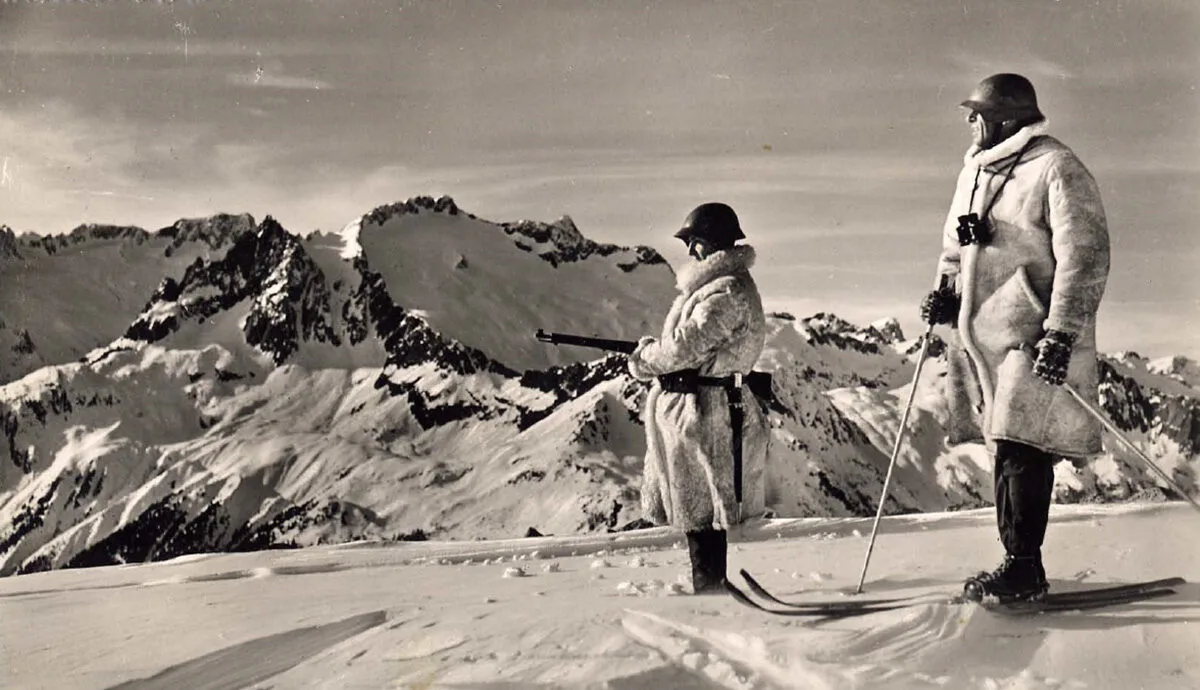
NB: The picture is of Swiss soldiers on patrol in 1944 not during WW1, but I like the image.