Sporting organisations in the late Victorian and Edwardian periods often became unexpected battlegrounds for the very same questions being debated in Parliament. While the House of Commons wrestled with Conciliation Bills that would have granted propertied women the vote, a quieter – but no less revealing – conflict was playing out in the Ski Club of Great Britain. The question of what to do with “Lady Members” was not merely about annual subscriptions or committee seats. It was a microcosm of a wider societal anxiety: could independent, physically capable women be accommodated within institutions built by and for men?
The Pre-War Context: Emancipation on the Slopes
Before 1914, the women’s suffrage movement was reaching its militant peak. The campaign for the vote was accompanied by a broader transformation in female respectability: more women were cycling, playing hockey, attending university, and entering the professions. The “New Woman” of the 1890s and 1900s rejected the notion that femininity required delicacy, domesticity, or dependence. Skiing – a sport that demanded balance, nerve, and endurance – became an ideal arena for this challenge.
Switzerland, with its growing network of winter resorts, was a laboratory for new gender relations. Women like N. Eardly-Wilmot (whose 1907 account of a ski tour we have) were already proving that women could keep pace with men on two-day tours, carry their own rucksacks, and laugh off somersaults in the snow. As she wrote pointedly: “Great physical strength is of minor importance. A woman who is sound in wind and limb, and who has sufficient personal courage to sail her own boat, drive her own motor, and compete with other women at golf, skating, swimming, tennis, etc., is amply qualified to become a first-class ski-runner.”
Yet this practical reality clashed sharply with the institutional conservatism of the Ski Club.
The Club’s “Lady Problem”: From Associate to Second-Class Member
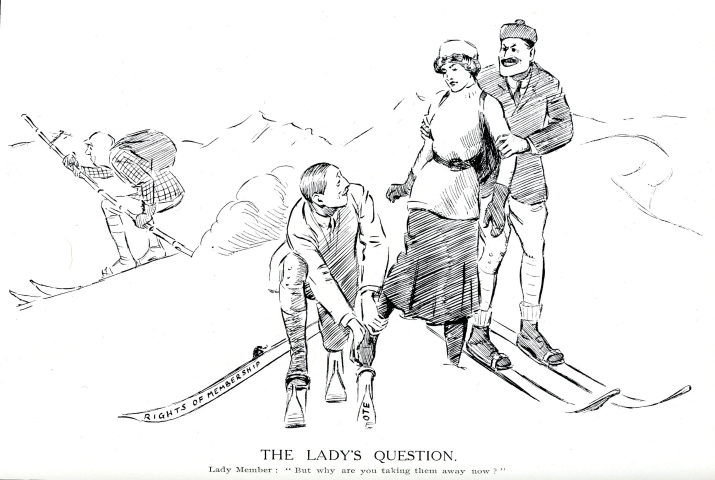
The Ski Club of Great Britain had always kept women at arm’s length. In 1907, Rule 6 stated that the Committee “shall have power to invite ladies to become members of the Club; they, however, may not be elected to the Committee.” This was already a restriction, but it at least implied that lady members were full members in other respects. However, the 1910 Year Book shows a significant regression: women were now to be “Associate Members” only, paying just 2s 6d but with no right to attend General Meetings or serve on the Committee.
This demotion was not a neutral housekeeping change. It came in June 1910, precisely as the Conciliation Bill was being debated in the Commons. The parallel is impossible to ignore: just as Parliament considered whether propertied women deserved a political voice, the Ski Club’s Committee proposed stripping its existing lady members of their very right to attend meetings.
The ensuing controversy was fierce. Lady Members protested. The Committee’s amendment passed in August 1910, but disagreement over its legality rumbled on. A referendum in October 1910 asked members (including the 18 lady members) whether women should be entitled to attend and vote at General Meetings. The result was a clear rebuke to equality: 82% – including eight of the 18 lady members themselves – voted “No”. This internalised opposition among some women is a familiar pattern in feminist history; not all women supported their own emancipation, particularly when they had invested in the existing social order.
The Commission and the “Final Settlement”
Despite this vote, discontent persisted. A Sub-Committee (later a Commission) was appointed to examine the “Status of Lady Members”. Six months later, in mid-1911, the Commission recommended reopening the issue. A Special General Meeting was called for 14 November 1911, with an almost plaintive plea on the agenda: “It is earnestly hoped, therefore, that members will cordially embrace this opportunity of amicably settling once and for all a matter which has unfortunately proved to be a fruitful source of dissension amongst members.”
The language is telling. The “dissension” was not presented as a principled debate about justice or equality, but as a tiresome quarrel that needed to be ended for the sake of club harmony. This is a classic strategy of institutional resistance: frame the demand for inclusion as itself the problem, rather than the exclusion that provoked it.
Nevertheless, on 5 December 1911, new rules were drafted. Women regained the right to attend and vote at General Meetings – a significant gain – but could still not serve on the Committee. Furthermore, the total number of lady members was capped at 20% of the club’s membership. Women were permitted to participate in club activities only “subject to the restriction that their participation in club tours and dinners shall be at the discretion of the Committee”. And, in a final twist of pseudo-equality, they would now pay the same subscription as men – despite having fewer rights.
The 1911 Year Book recorded the outcome with palpable relief: “It is eminently satisfactory to record that these resolutions were adopted without discussion or dissent, and that this source of controversy has been stopped.”
Olive Hockin and the Politics of Clothing
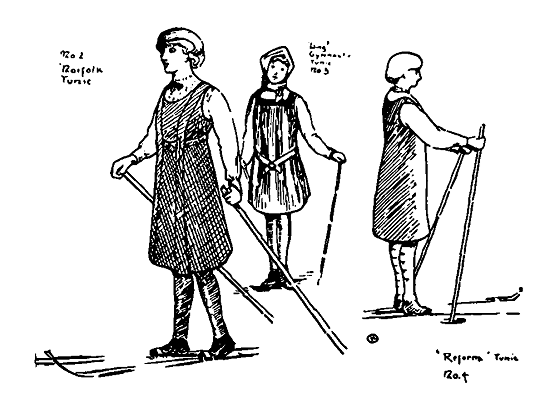
One of the most perceptive contemporary commentators on this struggle was Olive Hockin, writing in the 1914 Year Book on women’s clothing. Her essay reveals how deeply gendered expectations penetrated even the practical question of what to wear on the slopes.
Hockin identified two opposing views of women. The first treated them “not as human beings with personal desires and ambitions of their own, but apparently as works of art, to be made up and appropriated, and kept for show”. These critics expected women to contort their bodies and limit their activities to fit an “imaginary standard” of femininity. The second view – which Hockin clearly endorsed – started from “the shape that nature has thought fit to make them and the occupation they desire to pursue”.
This is not a trivial debate about fashion. The objection to women wearing knickerbockers, short skirts, or practical gaiters was an objection to women claiming the right to move freely, to exert themselves, and to be judged on their skill rather than their decorative appeal. When N. Eardly-Wilmot advised that a lady on tour should carry her own rucksack containing “a spare pair of gloves, a sweater, a sponge, and a toothbrush” – explicitly discarding “flannel nightdresses, peignoirs, etc.” – she was making a feminist argument about self-sufficiency and the rejection of performative femininity.
Feminism in Miniature: What the Ski Club Tells Us
From the perspective of the struggle for women’s emancipation, the Ski Club controversy offers several important insights about the period before the First World War.
First, it demonstrates that feminist battles were not confined to the suffrage platforms of the Women’s Social and Political Union. Everyday institutions – sporting clubs, learned societies, professional associations – were equally contested spaces. The demand for the vote was always also a demand for access to the rooms where decisions were made, whether those rooms were in the House of Commons or the Ski Club’s committee room.
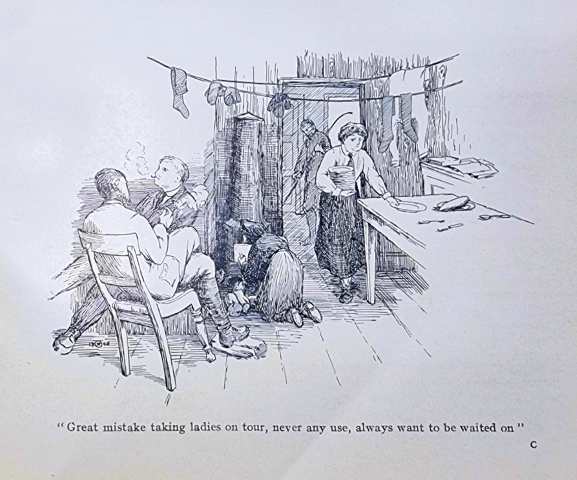
Second, the arguments used against women’s full membership followed a predictable pattern: women were a “doubtful blessing” on tours, they required too much assistance, they were physically unsuited to the sport. N. Eardly-Wilmot refuted each of these claims with empiricism and wit. She noted that women were “much more obedient on tour than men”, that they did not “give annoyance by going off on other tracks”, and that “I have never heard of men grumbling at women for continually requiring assistance” – suggesting that the grumbling existed more in anticipation than reality.
Third, the compromise of 1911 – votes but no committee seats, a 20% cap, and full fees for reduced privileges – is a textbook example of what feminist scholars call “separate but equal” institutional reform. It granted enough to quiet dissent, but not enough to threaten male control. The fact that the settlement was accepted “without discussion or dissent” suggests that many members, including some women, were simply exhausted by the controversy.
Finally, the outbreak of the First World War in 1914 would transform everything. Women took on roles in industry, transport, and the military that would have been unthinkable a decade earlier. The ski slopes would not be immune to this shift. The women who had argued for their right to carry their own rucksacks, to vote at General Meetings, and to wear practical clothing were part of a longer arc of change – one that would eventually make the idea of capping membership at 20% seem as quaint as demanding that a lady tourer bring a peignoir.
Conclusion
The Ski Club of Great Britain’s “lady problem” was never really about skiing. It was about whether modern women could be accepted as autonomous, capable, and equal participants in a leisure culture that had been designed for men. The debates over subscriptions, voting rights, and committee seats were the same debates being conducted in drawing-rooms, newspapers, and Parliament about the proper sphere of women.
When N. Eardly-Wilmot wrote that “cheerfulness becomes a duty when fatigue or discomfort have to be endured”, she was offering advice for the slopes. But she might also have been describing the political work of early feminists: enduring the fatigue of constant argument, the discomfort of being treated as a problem to be solved, and still remaining cheerful enough to persuade. The lady members of 1910 did not win full equality. But they won the right to stay in the room – and in the end, that is where lasting change always begins.
This article draws on Year Books and archival materials from the Ski Club of Great Britain, 1903–1914.