Remembering Alan d’Egville
By Arnold Lunn
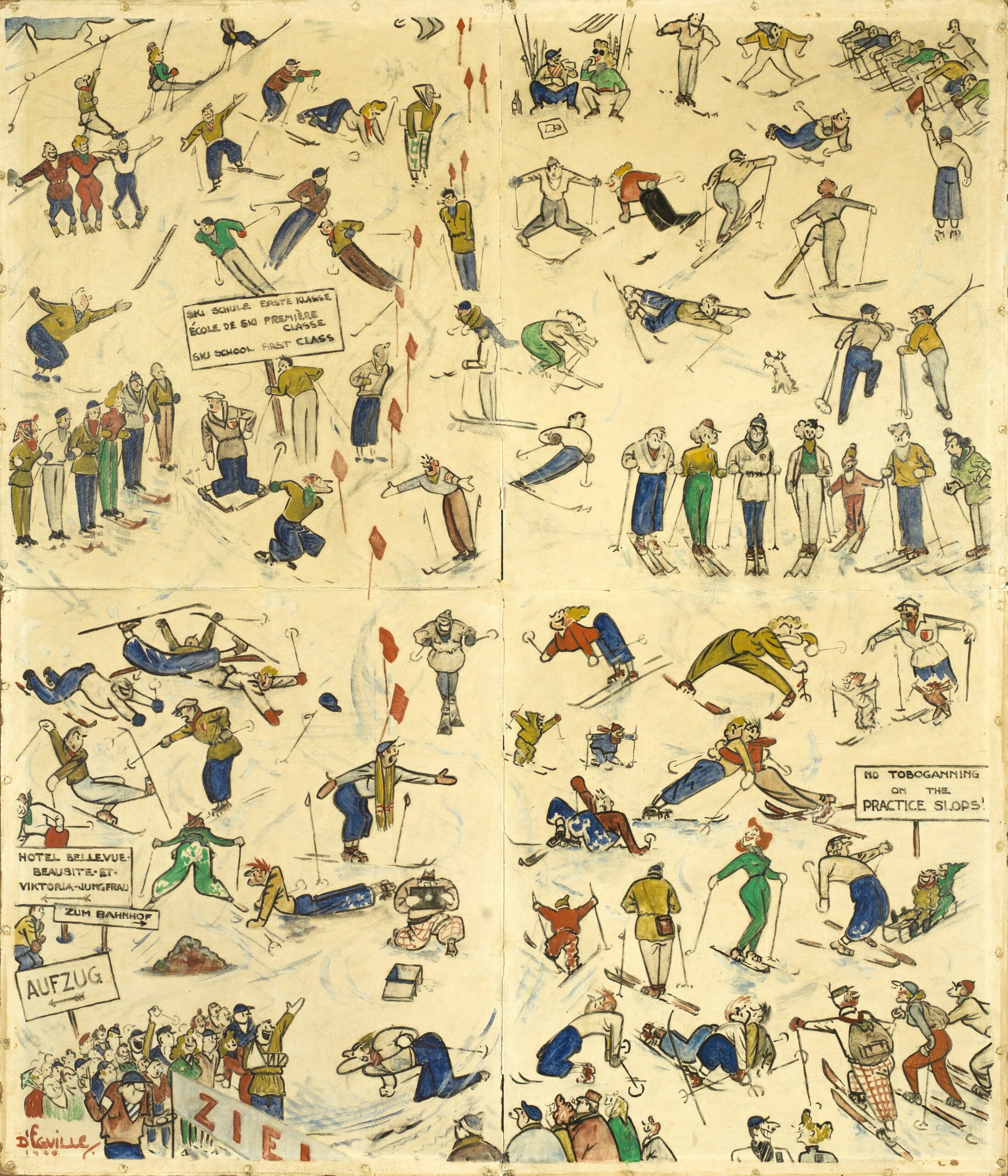
“Deggers”, who was born on 21st May 1891 and died on 15th May 1951, was one of the outstanding personalities in the golden age of downhill racing. He was a founder member of the Kandahar. He spent many years in Canada as secretary of the Seigneury Club.
As a racer he never won an important cup, but he was second again and again in Kandahar events. He was, for instance, twice second in the Alpine Ski Cup, the parent of all slalom races, and once third in the British Championship Slalom. He was also second in the first race for the Scaramanga Challenge Cup, which is the world’s senior cup for roped racing. Two years later he was again second in this cup, this time to Christopher Mackintosh and me. His description of the first Scaramanga race is reprinted below.
Deggers was a successful cartoonist, the best of the ski cartoonists. As a cartoonist and as a humorous writer he ranked with the talented, but he touched genius as an entertainer, not on the stage but among friends. I have never met anybody who could transform, as he could, even the stickiest of parties into a riot. Some of his performances at Arlberg-Kandahar prize-givings are still remembered. His “positively last appearance” on the Mürren stage was not only the most brilliant of exits but also the most moving. In his last years Deggers lived in the shadow of a great fear, the recurrence of cancer, and this was not his only cause for anxiety. The paper shortage reduced the amount of space available for cartoons in general and for Deggers’ cartoons in particular. His powers of invention were beginning to fail, and he was finding it increasingly difficult to place his work. He had saved nothing and it would be idle to pretend that he would have found it easy to live on bread and water. Particularly water.
At Mürren he did his best as an entertainer, and there were flashes of the old genius from time to time, but it would have required almost as much imagination for anybody who only saw him in 1951 to reconstruct the Deggers of legendary fame as is necessary to reconstruct from the thighbone and fragment of a cranium found in Java those detailed drawings of Pithecanthropus which figure in the manuals of popular science. I remembered Peter as a small boy, half sick with laughing, following every gesture of Deggers with goggly eyes and gasping out between peals of happy laughter, “Eat Fardie’s spectacles.” Clearly his faith in Deggers’ fertility of invention was unbounded. There was nothing that Deggers could not make amusing – eating Fardie’s spectacles for instance.
In the course of February 1951 Dr. Mosca of Mürren, who had given Deggers practical proofs of his great affection, sadly diagnosed a recurrence of cancer. Deggers stayed on for another week at Mürren while arrangements were being made for a bed in a hospital. Some of the best things in life are within the reach of the poorest, the splendours of the starry sky, hills and the sea, sunrise and sunset. And courage, the loveliest of the virtues, is so common that it is only its absence which calls for comment. But there are sunsets and sunsets, and the courage which Deggers showed in his twilight hours was to ordinary courage what the last flush on Alpine snows is to dusk in Hyde Park. Sunt lachrymae rerum. There was a Virgilian sense of tears for mortal things in the air of Mürren during those last dragging days. Walter von Allmen, the head of the ski school, was devoted to Deggers and I shall never forget looking in at the Palace bar during the farewell party which he organized for him. By the time it :finished they were all convinced that Deggers would return. All but Deggers ; he knew.
Deggers was very touched that Fritz Stager (of Lauterbrunnen) and Werner Feuz insisted on taking him down to Interlaken and putting him on to the Calais train. This meant a great deal to Deggers, for like all humorists he was a man of deep affections who could have made his own the lines:
From quiet homes and first beginning,
Out to the undiscovered ends,
There’s nothing worth the wear of winning,
But laughter and the love of friends.
And the love of friends did not fail him. He was turning out cartoons at the rate of two or three a day to tide himself over the operation, cartoons which bore much the same relation to his best work as his evening performances to the glorious impromptus of his youth, but several were bought by one kind-hearted lady, Miss Molyneux-Cohan.
It would be ungracious to forget and tiresome to chronicle all those who helped Deggers on the last lap of his courageous langlauf G. Tapp, for instance, who went down to his cottage in Devonshire and stirred up the authorities to connect it with the hospital by telephone, or Mrs. Duff-Taylor, who went to the hospital and helped to settle Deggers’ account. I mention these things as evidence, ifevidence were needed, of the affection which he inspired in all who knew him.
He carried on bravely to the end. I happened to look in at the ballroom just after midnight on the eve of his departure. An Irish girl, Mrs. O’Reilly, was doing a tap dance, and Deggers was caricaturing her…. The flame of his genius, rekindled from the ashes of pain and disease, had never burnt brighter. And as he sank exhausted into a corner of the bar and gratefully accepted champagne cocktails my mind was still hunting an elusive memory somehow linked with Deggers’ final appearance in the Palace lounge…. Ah, yes! Of course…. Kipling’s tribute to a great comedian whose son was killed in the first world war but who, like Deggers, did not allow the least flavour of private sorrow to ruin a hilarious public performance.
Never more rampant rose the Hall
At thy audacious line,
Than when the news came through from France,
Thy son had followed mine.
That Deggers knew that he would not survive the operation was made clear to me by something he said a few hours before leaving Mürren. “Lotti,” he said, “has just asked me to draw her something funny for her album ” (Lotti presided over the Mürren bar), “which as I’m going back home to die is in itself a very amusing subject for a funny drawing. But I’ve done my best. Bless her.” Apart from this one remark he seemed determined to maintain the fiction that he would soon be back again. I wandered in and out of his room while he was packing and we talked of indifferent things until I could bear it no longer and returned to Room 4.I sat down at my typewriter to write the things which I dared not try to say, a good-bye letter rather than a good-bye speech, but a confusion of memories made it difficult to find the words which I was searching for … our Austrian journey and the first visit to St. Anton which sowed the seeds of the Arlberg-Kandahar … the beer party at Lauterbrunnen after the first Inferno … Deggers at a Kandahar dinner describing the horrors of sharing a room with me at Interlaken….Deggers playing the hand-orgel and singing, a dynamic blend of gesture, laughter and song…. His favourite song, with which he wound up beer parties and rowdy Kandahar dinners at the Palace, gradually acquired the character of a Kandahar doxology. I can see and hear him singing as I write:
Tante stelle sono al cielo
Tante baci ti dario
Uno solo mi basteria
Per poter mi consolar,
Son marinaio, evviva, evviva,
Son marinaio, evviva le onde del mar
Evviva il mare, evviva le onde evviva l’amor.
Evviva il mare, evviva le onde, evviva l’amor.
Somehow or other I managed to transfer to paper a few bleak words of gratitude for thirty years of gay unbroken friendship, and of admiration for the gallantry with which he was exemplifying the Kandahar code-“Never give up a race until you’re through the finishing posts.” “Don’t read this,” I said, “before you’re on the train.”
He gave a sudden understanding murmur of assent and thrust the letter into his pocket with an abrupt downward glance as if he could not bear to see the sorrow of farewell in my eyes. He was bracing himself for the fiction of a gay send-off, and could not risk a change of key. We did not even dare to shake hands. It is odd that we should have parted without a formal word or gesture of farewell, but I did not need the letter which he wrote to me from the train to convince me that he knew why I had been, for once, completely inarticulate.
There was an air of macabre hilarity about the Eiger Bar, but we certainly did our best to maintain the tradition of a Mürren send-off . . . old memories came back to me of arrivals and departures in which Deggers had played a prominent part… the formal welcome to Prince Chichibu, the less formal farewell with Deggers and H.I.H. rattling down to the station on a tea-tray while Baron Hayashi signalled faint disapproval. … Deggers stealing the show on the arrival of the Field Marshal, and his delight when a Swiss paper published a photograph of Deggers leading the F.M. up the hill with the caption “Marshal Montgomery und Sir Lunn.” … “We shall expect you back,” said dear kind Mimi von Allmen, “remember to come straight back to the Eiger after the operation as our guest.”
The band had asked me whether they should bring their instruments to the station and my first reaction was that festive music would be terribly incongruous, but second thoughts were best. Deggers appointed himself conductor, and the flame of his genius had never burnt brighter than in that final tragic but hilarious performance.
One remembered not only Kipling’s comedian, but also Horace’s Regulus returning to torture and death, and bidding his friends farewell. Atqui sciebat quis sibi barbarus Tortor pararet, and which may be paraphrased, “And though he knew what the surgeon’s knife was preparing for him …” He continued the performance from the train window, and when the laughter which was only a laboured screen for tears began to flag, Deggers, with the instinct of a great artist for a curtain that is overdue, ended with the one perfect and tragically apt quotation, “Like Charles II, I apologize for being such an unconscionably long time in dying.” Then the whistle blew and the curtain fell on Deggers’ positively last performance on the Mürren stage.
Source: Arnold Lunn (1963) The Englishman on Ski Museum Press Ltd, London. p73-77