A Brief History by Nic Oatridge
“Among the pastimes of Englishmen, ski-running has now taken a permanent place. As a sport, it contains all the elements that appeal to our countrymen. Its full enjoyment is only to be appreciated by those who possess an abundant store of patience and perseverance – not to mention a distinct sense of humour – to be drawn upon during the process of acquiring sufficient skill to traverse valleys, woods and mountains.”1
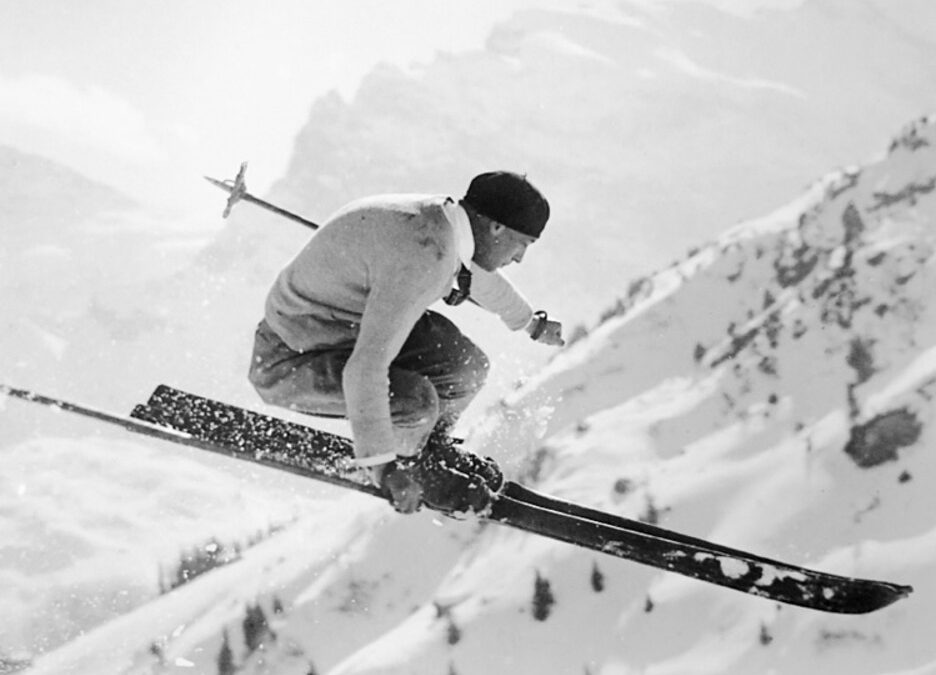
It is perverse that Great Britain should have anything other than a marginal contribution to the history of snow sports, given how unpredictable and mild British winters are. However Alpine ski racing is a British invention – although largely crafted in the Jungfrau. The roots of this lie in a nexus of factors.
From the riches of the British Empire emerged an affluent elite that embraced the Age of Enlightenment and celebrated the Alps in verse and prose. With the Public Schools Act of 1868, the leading schools embraced the opportunity to create the cadre required to run an Empire, imbuing them with a “muscular Christianity” that they applied with fervour to the business of pursuing sports and defining the rules by which those sports should be pursued. A succession of British mountaineers imbued with this ethos set to conquer the peaks, particularly the loftiest ones in Switzerland, creating the Alpine Club for like-minded adventurers in 1857, and achieving notoriety with Edward Whymper’s successful, but costly, ascent of the Matterhorn in 1865.
The happy embrace by the Continentals of the railways made the Alps much more accessible to many well-to-do Englishmen and women, whose busy schedules afforded them only a few weeks in each season to travel abroad. Initially, the attraction for the British ruling classes was the summer destinations of continental Europe, but the therapeutic benefits of mountain air for sufferers of lung diseases established year-round colonies in places like St Moritz, Grindelwald and Davos in Switzerland. A growing coterie of winter tourists danced on the ice rinks in the mountain villages by day, and in the ballrooms of the hotels in the evenings. Switzerland became an Englishman’s home from home; indeed many would be mortified that a visitor from any other nation should be allowed in the same hotel.
To facilitate travel, companies managed by Thomas Cook and, later, Henry Lunn organised itineraries for the English to visit suitable destinations, with Switzerland being most accessible and cost-effective. Lunn was to acquire hotels exclusively for the English, and created the “Public Schools Alpine Sports Club” to ensure only the right sort of people would visit his centres. Initially winter sports on these early package holidays were limited to skating, tobogganing and curling but by the 1890s, “ski-runners” began to appear in the mountains. From a British point of view this was most famously noted when Sir Arthur Conan Doyle skied from Davos to Arosa and wrote of his exploits in the British press in 1893. However, the Germans, Austrians and Swiss were already embracing the new sport; the first Swiss Ski Club began in Glaruus in 1893 and within a few years thousands of devotees took up the sport in central Europe, whilst the children in the mountain villages gleefully adopted skis to get to school in winter.
In 1888, the Norwegian, Fridtjof Nansen led the first successful crossing of Greenland on skis. He wrote a book, which was translated into English and German and inspired a number of people to experiment with skis, either in Norway, or by importing them to other snowy locations – notably the Black Forest and the Alps. Scandinavians had used skis for generations in a utilitarian or military context, but Norway adopted skiing with nationalist fervour in the 1860s and 1870s and started organising clubs and competitions. The typical competition involved two activities: jumping and a cross-country race. Although most skiers preferred “straight running”, the need to change direction or control speed led to the development of very technical turning manoeuvres, notably the Telemark and the Christiana, named after Norwegian towns – Oslo was then called Christiana. Stopping and turning were assisted by the use of a long stick.
E.C. Richardson has often been described as the Father of English Skiing. Ironically he was a Scot, born in 1871, and Harrow and Cambridge educated. He went to Norway, together with his brother “C.W.”, for his Easter vacations in the winter of 1894-5, ostensibly to skate, but instead the brothers learned to ski. They heard that skiing was possible in the Alps and went to Davos to find out, becoming founders in 1902 of the Davos English Ski Club when they came across some like-minded compatriots.
In 1903 this same group, and others, founded the Ski Club of Great Britain (SCGB). Initially they sought to establish skiing as a sport in Great Britain, seeking out suitable ski locations within easy reach of London before acknowledging that reliable conditions could only be found abroad. Until the First World War the tiny British ski community was divided over the role of women in the sport, amongst other things, and the organisations that represented skiers acrimoniously splintered as the areas of contention multiplied. The Armistice brought reconciliation, and the SCGB evolved Phoenix-like after the war to become a powerful voice in promoting forms of ski racing seen as a heresy by the influential Norwegians – Downhill and Slalom, often referred to as the Alpine disciplines. One man takes much of the credit for this, the indominatable Arnold Lunn, the son of Sir Henry Lunn, who editted the British Ski Year Book, the journal of the SCGB, from 1920 until his death in 1974.
Although Arnold Lunn – later knighted for his contribution to skiing – was the architect of modern Alpine ski-racing, there was a nagging sense across the ski associations of the Alpine nations that a sport designed for the undulating hills of Scandinavia required adaptation to work in the Alps. The shop window for Alpine skiing was ski racing, and Alpine nations were quick to see that sporting success brought wealth to the mountain villages which for centuries had been impoverished and isolated. Also, for a while, British skiers could hold their own against continental rivals, so when the British, through their web of associated ski clubs, brought Downhill racing to the Alps, they spun in many adherents. For the most unlikely of reasons, the name Kandahar is forever associated with this movement.
Of course it is one thing for a handful of Englishmen to organise a ski race, yet another to convince the federation of national ski nations, FIS, to adopt the format. What became known as the first Winter Olympics only included the Nordic disciplies of cross-country and jumping, and excluded women. The SCGB disdainfully ignored the competition.
In 1929 the Polish Ski Association was entrusted with organising the FIS Championship, and included a Downhill race in the programme. The British came second, sixth, eight, tenth, twelfth, fourteenth, fifteenth and twenty-fourth out of a field of sixty, with fourteenth and fifteenth places belonging to Doreen Elliot and Audrey Sale-Barker. The participation of women caused a sensation.
In 1930 the FIS recognised rules for downhill ski-racing and the SCGB was entrusted with the task of organising the first International Downhill Ski-Racing Meeting under the auspices of the FIS. It was successful enough for FIS to agree to include both slalom and downhill in the 1936 Winter Olympics programme, and to include races for women.
At this time skiing was a relatively exclusive aport for the English, and its practitioners largely saw themselves as ski mountaineers or tourers, who trudged up mountains as well as skied down through fresh snow. With mountain railways and the introduction of ski lifts an increasing number of skiers preferred to be “Downhill Only” – a name adopted by an English ski club in Wengen. Just as Alpine ski races needed manually groomed slopes to provide the mountain equivalent of a level playing field, so many skiers preferred compacted pistes to increasingly tracked out runs.
Skiing, as with other sports, took on a broader dimension from the mid-1930s. First there was the prestige associated with the Winter Olympics, the shadow of Nazism, and the communist blurring in the distinction between amateurism and professionalism. A sport steeped in exclusivity and aristocratic associations was overwhelmed in the post-war years by a meritocracy that embraced a form of skiing alien to the fathers of the sport in the formative years. The British pioneers of package holidays such as Sir Henry Lunn and Erna Lowe brought affordable skiing, if not to the masses, to a growing middle class. A post-war surplus of pilots and planes, the extensive adoption of ski lifts, the allure of apres-ski, and the necessary preparation of pistes to cope with skier volumes brought the multitudes to the mountains. Currency exchange controls made expensive Switzerland a less attractive destination, to the benefit of the purpose-built French ski resorts. Competitive skiing became a media sensation and its stars became household names.
The Ski Club benefitted from the enthusiasm for ski package holidays and membership grew, but not at the same pace as the uptake of the sport in the UK. The Club re-invented itself several times. As a charity, it had to cede its role in ski racing to a new organisation that could receive government funding. Its famous reps became better trained, but had no role in ski instruction – a new organisation became accountable for that in the UK. It embraced dry slope skiing and even grass skiing and became a travel agent. The venerable Year Book was discontinued, but replaced with a consumer-friendly, market-leading magazine.
Many of the pioneers of British skiing were remarkably erudite and wrote with great craft. Copies of the Ski Club’s books and journals graced the Club’s premises for almost a century, housed in a library where members could consult a volume, relax in a comfy leather armchair, and drift back in time to the “Golden Age of Downhill Racing”, as Lunn described it. The Club has sadly relinquished its Club premises, but fortunately, since 2018, the library is still available to the public, by appointment, in the Kimberlin Library at Leicester’s De Montford University’s Special Collections Unit.
1 Quote from a review of E.C. Richardson’s The Ski-Runner in the S.C.G.B Year-Book for 1910, p88