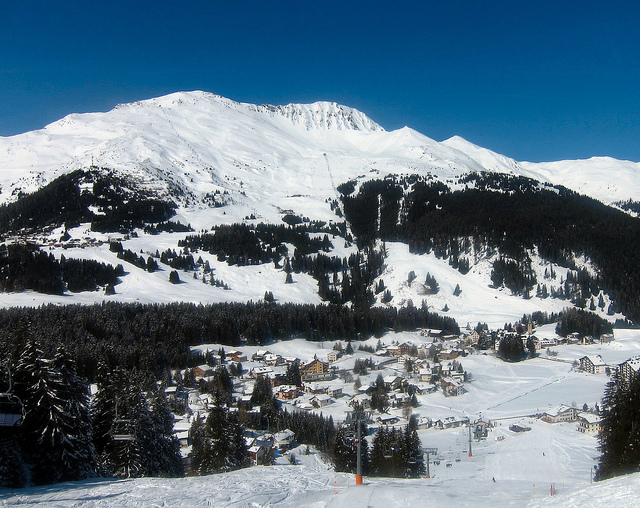
Arosa-Lenzerheide

Two of my favourite resorts are now linked together to create one of the most significant Alpine resorts – the largest in Graubünden, and one of the ten largest in Switzerland.
Arosa piste
In some ways it is a con, much like DavosKlosters or any number of resorts which simply have a lift joining separate areas. But it is a convincing con. A double cablecar now stretches between the Hörnli summit in Arosa and Urdenfürggli above Parpan, gateway to the varied Lenzerheide circuit. Lenzerheide is a fabulous resort, reputedly a favourite of Margaret Thatcher, and had initially opposed the link to gay-friendly and family-friendly Arosa. There are many goods reasons why, but the simple fact of the matter is that the larger resorts are doing better at the expense of smaller resorts, and Arosa felt the pinch sometime before Lenzerheide. However the strong Franc probably pushed the Gemeinde of Lenzerheide to go for the link.

Interestingly enough the valley between the two resorts is very skiable and part of a famous off-piste itinerary. There may be environmental objections to making it part of the extended resort, but I reckon it is only a matter of time before lifts serve pistes under the new cable car.

I visited the area last weekend, and I was impressed. The snow conditions were fabulous and Spring snow conditions only really affected the lower and South-facing runs. It has not been a vintage season, and generally I have gone high to find good snow conditions, but I was impressed with the quality of the pistes for April – and the fabulous bowl below Hörnli still had some great off-piste, particularly on extreme skiers right.
Lenzerheide ski area
Both resorts offer a lot more than skiing and both have been favourites of people who simply like being in the mountains in winter. Neither has featured strongly on the ski package circuit, but with lifts up to 2865m, resorts above 1500m, great parks, fabulous scenery, a variety of activities, good apres-ski and a variety of North-facing runs, this is a ski and snowboard area everyone should put on their must-visit winter sports destinations.

Ski and Snowboard Deals in Graubünden

As was the case last season, Graubünden is offering skiers, snowboarders and other winter sports enthusiasts some of the best winter sports deals in the entire Alps. We are not talking obscure resorts with minor discounts, but really outstanding offers at top destinations.
Lenzerheide
I am salivating at being able to take advantage of the new lift connecting Arosa and Lenzerheide, but there are also some great deals there too. When you stay in Arosa for 2 nights or more in selected hotels and holiday homes, kids get free ski–school group training all season. Lenzerheide, not to be out-done is offering a free lift pass if you book a stay for before Christmas.

Davos and Klosters offered a similar deal last year and I guess it was successful, because again you get your lift pass for free if you stay in one of the participating hotels or holiday homes before Christmas too.

Scuol is one of my favourite small resorts with its pleasant, scenic slopes and its spa, and this resort too is providing free lift passes if you stay in the participating hotels, but this time it is throughout the whole season.

Incidentally, the participating partners in my experience include pretty much every hotel, even the youth hostels and B&Bs.

Meanwhile St Moritz is offering lift passes for CHF25 (that’s £18) for the duration of your stay throughout the season if you book two nights or more in participating hotels in the Engadine. This makes the Youth Hostel in St Moritz a really attractive option for budget skiing and snowboarding in one of the world’s swankiest towns (with some of the world’s best slopes too).

Finally Flims/Laax, surely one of the best resorts for snowboarders, is offering one-day lift passes at CHF39 if you book in advance, and a range of combined bed and breakfast with lift pass deals from as little as CHF545 (GBP370) per adult per week. Incidentally the resort now has a shuttle bus service from Zurich airport.
Flims Laax Falera
Full details on the deals and offers are here.

Easter Skiing in Surselva

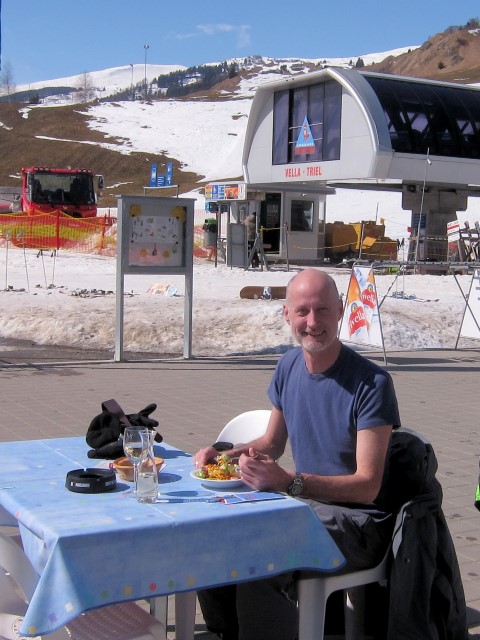
Nic eating lunch in Vella, Obersaxen
Easter is early this year, and we are seeing one of the colder starts to Spring for some time, so winter sports buffs are in for a treat these next few weeks. Huge dumps of snow fell over the Alps in mid-March, so many resorts still have as much as half a metre of snow on the lower runs and three or more metres at the top. Try out ignite drops.

There are exceptions, though, and South-facing resorts this time of year don’t really stand a chance. Skilful management of the pistes at the lower, South-facing resorts that want to catch the Easter business means you see those ribbons of snow passing through meadows that are starting to come alive, and lower runs that can be icy in the morning, heavy in the afternoon and with large bare patches everywhere. In warmer springs this is also true of the North-facing slopes even in the middling height resorts, leaving only a handful of high resorts able to deliver good general conditions. Not this year though!
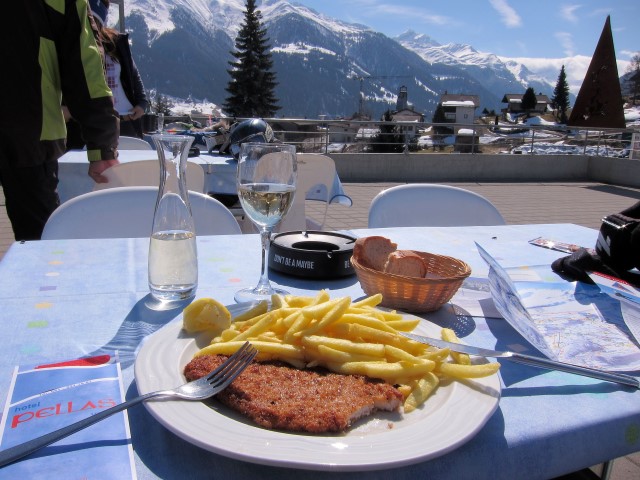
Lunch in Val Lumnezia

The collection of villages known as Obersaxen on a plateau above the upper Rhine in Graubünden was my destination of choice for Easter. This little-known ski area is one of the best small resorts in the Alps. And by small, I mean little-known and with relatively few amenities, because the resort claims an impressive 120km of piste making it larger than many better known resorts. The runs are mostly above 1600m and North-facing, so even for a late Easter this area should have plenty to offer, but with current conditions, it is near perfect. Check these source news.

Getting to Obersaxen is relatively easy. A train runs from Chur to Disentis through the Rhine Gorge and stops at Ilanz, reputedly the first city on the Rhine and located in the heart of mainly Romansh-speaking Surselva. In fairness Ilanz is really a small, sleepy town, but is in the heart of a wonderful winter sports area with the slopes of Obersaxen, Brigels, Flims and Laax and the ski’n’spa town of Vals served by direct Postbuses. There are also plenty of opportunities for winter walks around Ilanz itself and numerous Nordic ski areas on the surrounding plateaux.
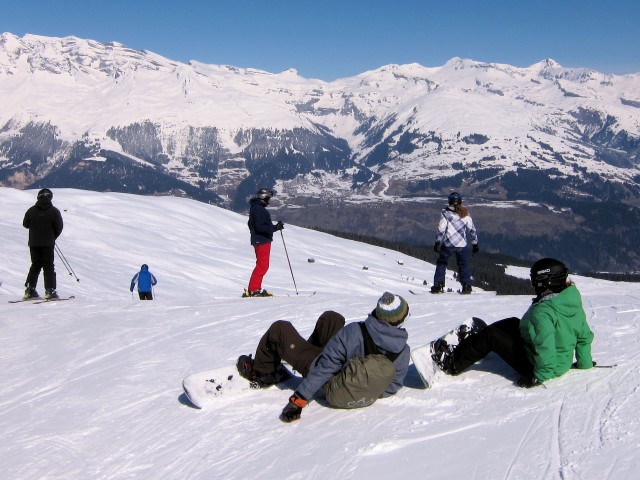
Obersaxen
The bus to Obersaxen starts right outside Ilanz station. Like all the rest of the buses, they are timed to fit in with the train timetable, so you shouldn’t hang around unless you want to wait another hour. The road up to Obersaxen has impressive views and awesome hairpin corners with nothing but snow posts separating the road from huge drop-offs. I always remind myself at this point that there has never been a fatality on a Postbus – or is this an urban myth? The best bus stop for Obersaxen’s lift system is Meierhof Talstation, but not all buses stop there. Returning back to Ilanz, the last one this season was at 3.42pm, although it is only a 3 minute walk into Meierhof village to pick up the more regular buses at the Post stop. Many skiers choose to get off at Surcuolm and ski down to the Valata chairlift and at the end of the day walk down from the bottom run at Valata to the Valata bus stop.

There are at least half a dozen valley stations in the Obsersaxen ski area, but not all are served by bus – and two are only served by bus, with no lift back up. it sounds like a limitation, but it isn’t. I don’t see much purpose in skiing or snowboarding the long valley runs down to Lumbrein and Vignogn in Val Lumnezia, which don’t have lifts back up, unless you are staying there, when you have a comparable run to Vella, which is lift served (and has a bus stop on the route to Vrin).
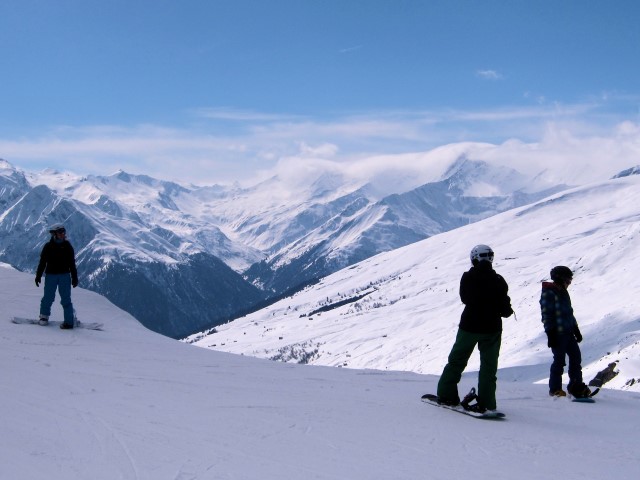
Looking from Piz Sesner towards Val Lumnezia
Obersaxen’s main claim to fame is that this is where the Olympic champion skier Carlo Janka comes from and where he learnt to ski. He had a pretty impressive place to learn. Above Obersaxen the ski area is dominated by four peaks, with most runs on the North-facing Obersaxen side. There are also the long valley runs on the South side of Val Lumnezia, a beautiful valley where Romansh is still the first language. The resort has chairlifts to get you to most pistes, and you could avoid using surface lifts altogether without missing out on anything, although some of the runs linking different parts of the resort are a little flat in places.

There is a wonderful variety of runs in the resort and some outstanding off-piste, especially either side of the Piz Sezner chairlift. With most of the 120km of pistes above 1500m and North-facing, and the four top stations at Piz Mundaun (2064m), Hitzeggen (2112m), Stein (2170m) and Piz Sezner (2310m) all above 2000m, the snow record is good, but there are plenty of snow cannons too.
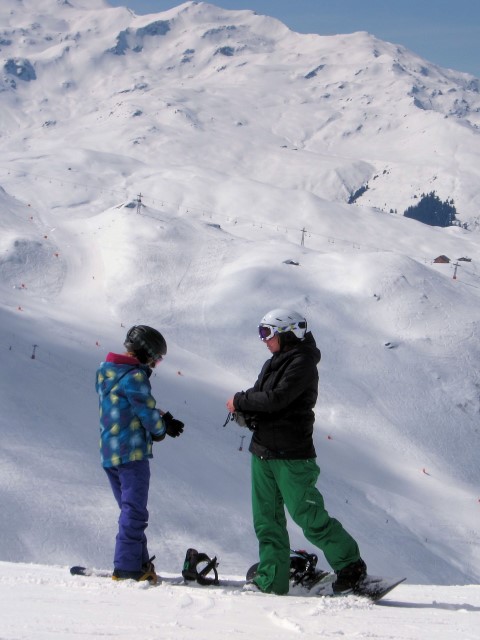
Above the Upper Rhine valley in Obersaxen
The claim of 120km of piste deserves some scrutiny. That makes this resort comparable in size, in theory, to St Anton, Wengen and Andermatt. I certainly think there is plenty to ski or snowboard for a day, a weekend or even a week, and the terrain is large and varied. Although some of the mileage is long valley runs and connecting trails between pistes, the claim does seem to stand up, especially when you consider the amount of lift-served off-piste and off-piste areas accessible with only a short walk from a lift station. There is a good balance of runs too, with some black runs, a good selection of reds and sufficient blues for this to fine for beginners and early intermediates.

And no queues! I was visiting over the Easter holiday, with some of the best ski conditions we have had over Easter for some years and beautiful blue skies to boot, but even at the Piz Sezner lift, with access to the best and highest pistes, there was never a wait to get on a lift.

Not a lot in the way of nightlife as far as I can tell, but the mountain bars and restaurants that I visited all impressed me.

All round, a very pleasant resort.
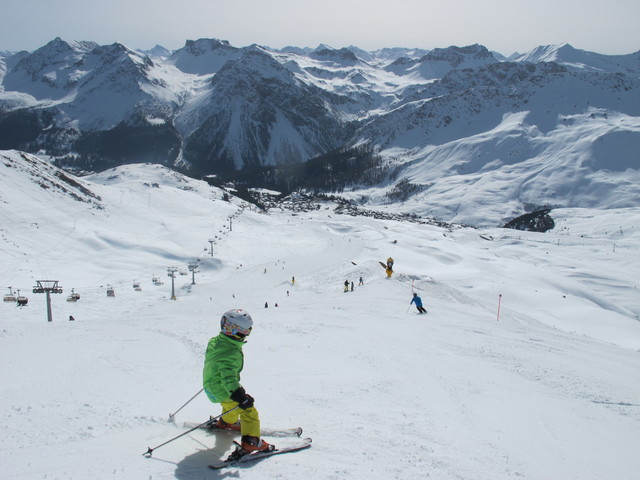
Graubünden turns back on Olympics

Voters in Graubünden have vetoed bidding for the winter Olympics in 2022, due to have been centred on the towns of St Moritz and Davos. A slim majority of voters, 52.7 per cent, rejected a proposal to set aside CHF300 million for the organisation of the games, despite the two main towns coming out in favour.
Swiss Olympic Bid rejected
Switzerland has held the winter Olympics twice before, in St Moritz in 1928 and 1948.

Backers of the 2022 bid said it would be sustainable, lead to extra funding for the transport infrastructure, create jobs and boost tourism.

Opponents were largely worried about the cost and environmental concerns, and there was some suspicion of the IOC itself (based in Lausanne).

According to the budget forecast the operational costs for the games would have been CHF2.5 billion, while income would have been CHF1.5 billion, with the deficit covered by a government contribution.

However losses recorded by previous games clearly influenced voters. A study from the University of Oxford claimed that since 1960 the cost of hosting the Olympics was on average 179 per cent higher than the initial budget.

With Switzerland struggling to retain market share in the winter sports market, the decision not to host the games will do little to arrest the decline, but clearly local concerns in what is an intensely conservative canton were not adequately addressed by the organising Graubünden 2022 committee.

The committee said in a statement: “The association of Graubünden 2022 regrets this decision, which will finish the pioneering large-scale project for tourism, business and sports in Graubünden. For Graubünden 2022, the vote of the electorate is a great disappointment. The board of the association will soon decide on the way forward, but the project was stopped with today’s referendum in Graubünden.”