Swiss Winter Sports in 1925

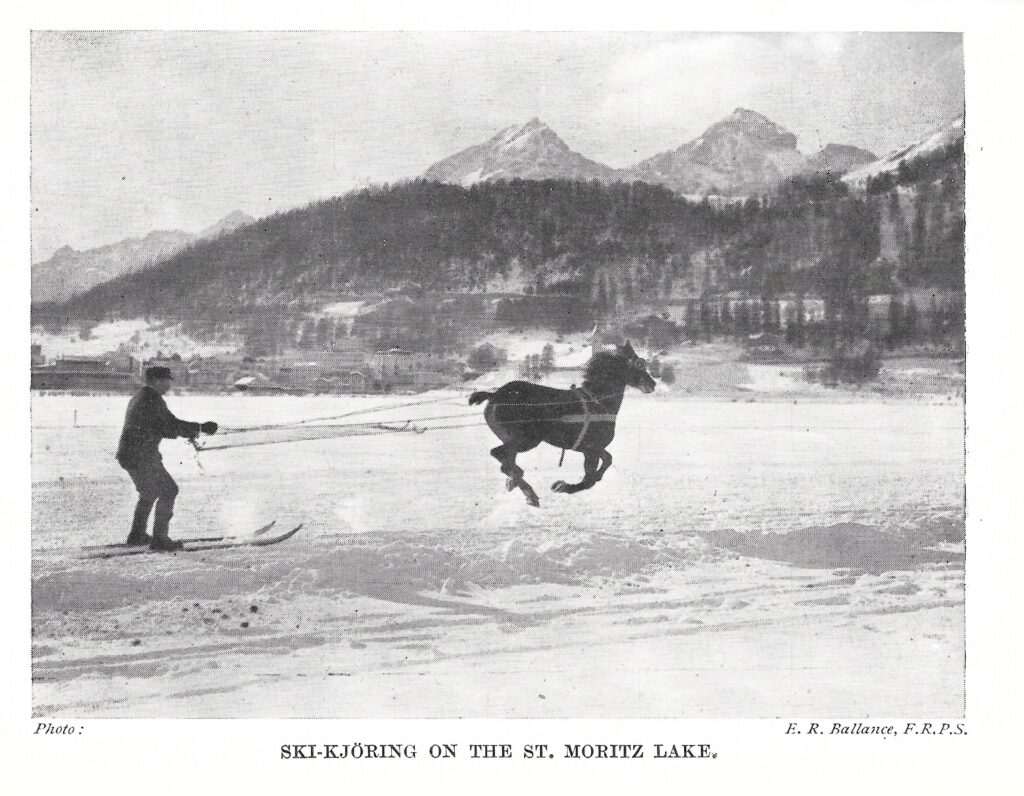
Skijoring on the lake at St Moritz 1925

Although I have been skiing for over 50 years, I don’t have a great sense of it changing much since I first tumbled down a Scottish mountain. OK, we did wear some uncool ski outfits back then, nobody snowboarded and there were a higher proportion of surface lifts. But I don’t remember it being so different. Largely the same resorts and the same vibe in them.

Track back another 50 years, and what was often called ski running involved very long wooden skis, one stick and a pair of stout leather ski boots. And it was by no means the major attraction for people visiting the Alps in winter.

I’ve been reading “Things Seen in Switzerland in Winter”, written by Charles Domville-Fife in 1925. He writes that interest in visiting Switzerland was divided between those for whom it was termed “The Playground of Europe”, and those who went hoping to recover from tubercolosis.

Until 1946 there was no effective medication to treat tubercolosis, a disease that killed as many as one in four people in England in the 19th Century. Swiss mountain air and sunshine achieved a remarkable recovery rate in the clinics that sprung up in hitherto sleepy hamlets like Davos and Arosa in the late nineteenth century. And the therapeutic benefits were enjoyed as much, or even more, in the winter.

St Moritz had also become a popular destination for its winter sun and the many diversions organised in the sophisticated hotels there – the hotelier Badrutt taking a lot of credit for popularising winter holidays in the Engadine. In 1873 for the first time St Moritz recorded more winter visitors than summer ones.

One English visitor to Switzerland in the late nineteenth century was Sir Arthur Conan Doyle, who stayed in Davos where his wife was recuperating from tuberculosis. Ever impatient to be doing something, he imported some skis from Norway (where skiing had long been a practical means of transport) and became the first person to ski from Davos to Arosa – still a popular back country route. In 1893 he wrote an article in the English press of his experiences and helped popularise what was to diverge from Norwegian ski techniques to become what we now know as the sport of downhill skiing.

Skiing was by no means the only winter sport that became popular in Switzerland. Domville-Fife records that skating was introduced as a winter sport in 1876 (from England), curling (from Scotland) in 1882, tobogganing (from Canada) in 1884, ice hockey (also from Canada) in 1992 and the quaint sport of skijoring (from Scandinavia) in 1906.

In the second half of the nineteenth century Switzerland benefitted from a growing electrified rail system, opening up destinations such as the new sanatoria in Montana and Leysin, and new winter sports destinations like Klosters, Celerina, Grindelwald, Wengen, Murren, Gstaad, Villars, Engelberg and Andermatt. Adelboden later emerged as both a health centre and a ski destination, with the world’s first winter sports holiday package organised by Sir Henry Lunn in 1903. Outside of Switzerland, Chamonix and St Anton – both with rail links – were early adopters of sport skiing, St Anton claiming to have founded the first ski club in 1901.
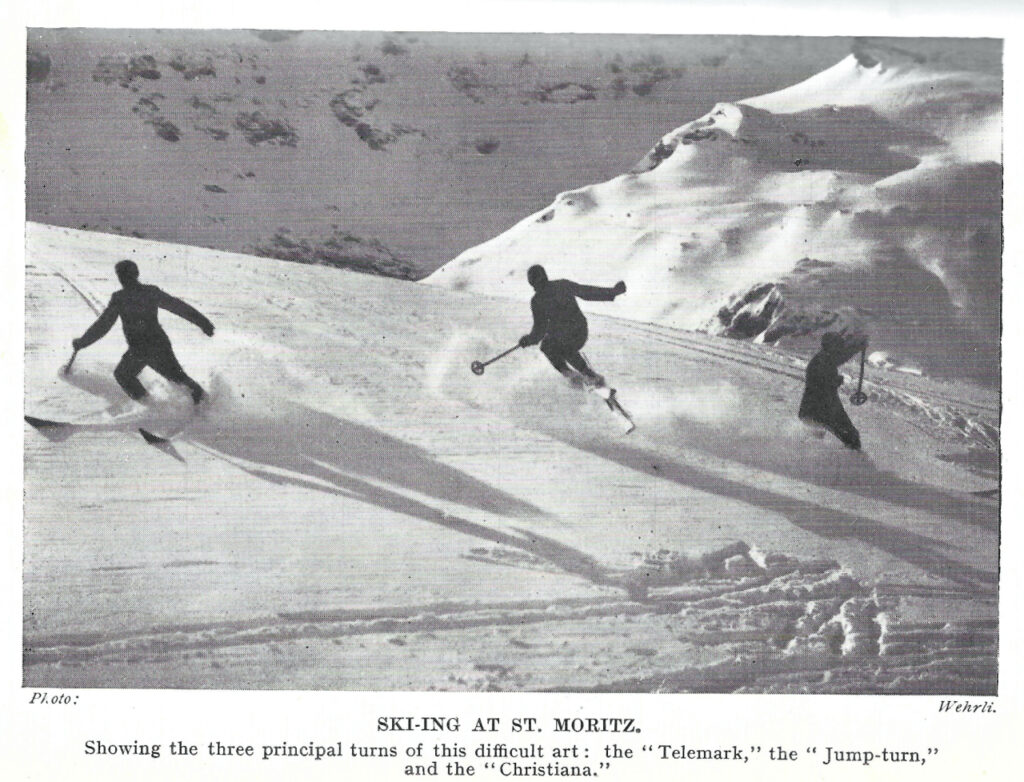
Skiers demonstrate Telemark, Jump Turn and Christiana in St Moritz 1925

Most of the new winter sports were introduced by the British, but soon became popular with the Swiss and visiting Germans. The opening of the cog railways in winter in Grindelwald, Wengen and Villars are attributed to British requests that they be available outside the summer timetable.

It’s noteworthy that, at this time, British tourists tended to come over only in December and January, and what we now largely associate with the peak winter sports period was left to the locals. Domville-Fife declares that “at nearly all the best known resorts the predominance of British people during Christmas and New Year festivities is usually so great that even the Swiss themselves are scarcely seen. It is during this period and for about five weeks afterwards that a sojourn at any of the winter sports centres becomes one of the most delightful experiences of life”.

Domville-Fife, writing in 1925, doesn’t mention a single ski destination in the canton of Valais, now probably the pre-eminent ski region in the world. Champéry, in the Portes du Soleil did not have its first lift access to the slopes until 1939, Verbier’s first lift arrived in 1946, Saas-Fee a popular summer spa destination did not have road access until 1950 and Zermatt, although it has had the Gornergrat cog railway since 1898, was primarily known as a summer destination for climbers, and did not open the railway to the summit during the winter season until 1941. Only Montana (later Crans-Montana), had adopted skiing by 1925, following the opening of the funicular railway in 1911. However the village was still mostly popular for its sanatoria and, from 1906, for golfing.

Skijoring, meanwhile, has its adherents but has achieved only a limited popularity. Although my Swiss mother-in-law recalls skiing to school on skis, I don’t think it looks anything like this today at Aiglon College!
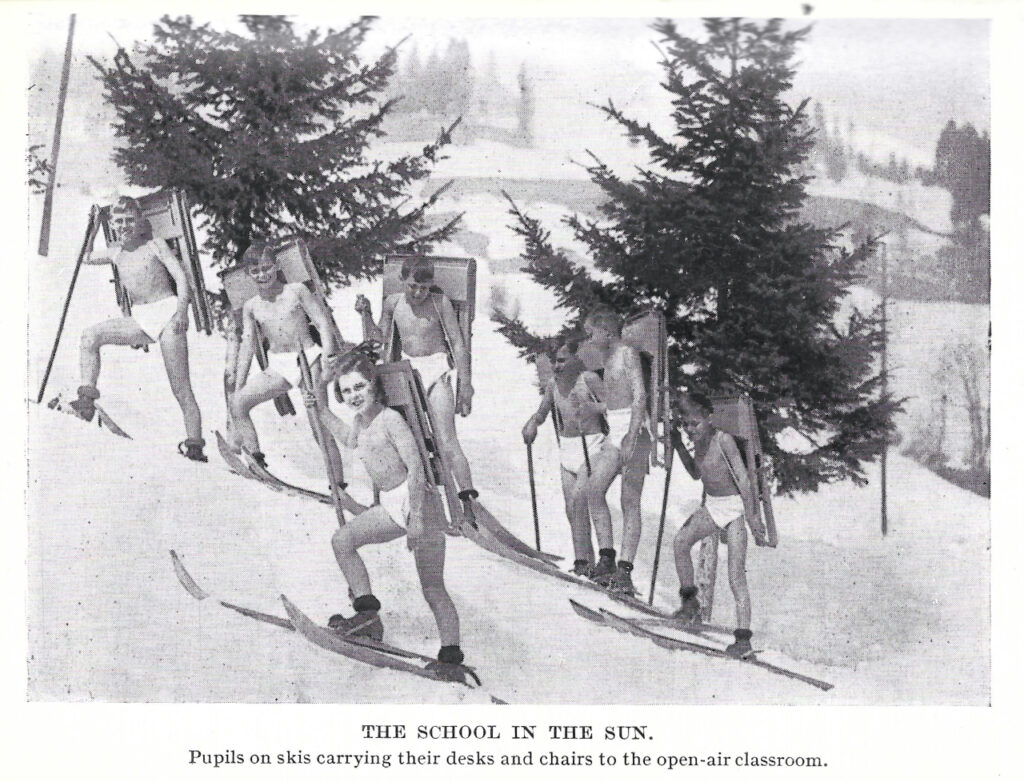
Switzerland - school in the sun 1925.

Best Ski Resorts in Switzerland

 Benefits of Skiing

For some, the first sign of snow means it is time to dig out the wool socks and blankets and go into hibernation. For others, though, it means time to wax those skis and hit the slopes! Skiing is an incredible sport that involves physical, mental, social and emotional aspects of wellness. Often times winter can bring people into a depression called Seasonal Affective Disorder (S.A.D.). Skiing combines the great outdoor air with physical activity and some sunshine exposure that many people forget about. Read more about exipure.

The physical aspect is obvious, however many individuals, especially those that have never skied before, may not realize how much brain power goes into the sport. Skiing is a proprioceptive activity. Proprioception is an aspect of fitness that is defined as one’s ability to feel the position of different body parts and the effort that goes into moving them. This is almost defines skiing because skiing involves quite a bit of balance and coordination. There are so many slight movements and positions of your body that you must be conscious of to ski well. The more you ski the more you strengthen your ability to be aware of the movement of your body parts. This is important because proprioception weakens with age so the more you are involved in proprioceptive activities the less it will diminish. Check these ikaria lean belly juice reviews.

Skiing prevents aging in more ways than that though. When you ski you carry the weight of your entire body on your feet. Your knees are the joints that endure that weight and must be able to move quickly despite it, so they are being strengthened when you ski. Great news for those that have been skiing for many years; you’ve been strengthening those joints and making an injury later in life less likely the whole time. In addition to strengthening your knees your bones become stronger as well because skiing is a weight bearing activity. So not only are you having a fantastic time gliding down the slopes, but you are preventing knee damage, osteoporosis and increasing your proprioceptive strength. Skiing is also a great way to get some moderate aerobic activity into your day. For most people, skiing is an all day event, so you can imagine the workout your heart is getting without you even becoming winded. This is how phenq works.

It is hardly necessary to mention the social aspect of skiing, but I will for that sake of those that have never been. Waking up at the crack of down to drive an hour or two to spend a day in the freezing cold may not seem appealing to a “winter hibernator.” Add a whole group of close friends that all share the same love for skiing, and you’ve got one heck of a good day. What is unique about skiing is that it brings together people of all different ages and cultures. All over the world if there are mountains and snow, there will be people skiing.  So not only do you have a great group of people having a fantastic time; you’ve got a motivational team that encourages you to get off the couch in the winter and get your heart pumping all day! Try something new this winter instead of being miserable when the first snow falls. If you are already an avid skier, bring someone that isn’t and show them how much fun they are missing!

Global warming delays resort opening

I think most skiers know global warming is happening, whatever the reasons for it. The most ominous indication is the retreat of glaciers. Over successive seasons it is easy to see how much glaciers have shrunk at many ski resorts.

In addition something has been going on in recent seasons with early season snow conditions. Whether that is down to factors other than global warming is debatable – it may just be a cyclical thing that will fix itself, but that seems unduly optimistic. Lower resorts must be particularly concerned, especially as they consider the long-term investments they may need to remain competitive with other resorts.

So will 2017 kick off a great early season and buck the trend of recent seasons?

It doesn’t look good. For the first time in 40 years Les Deux Alpes will not open for autumn skiing on its glacier.
4 Vallees opens on 10th November 2017
The London Times quotes Thierry Hugues, the head of the resort’s piste management team, to explain why. “The situation is exceptional,” he is quoted as saying. “Given the low rainfall that we had throughout the year, a very hot summer and a very dry autumn, the glacier does not have enough snow cover to welcome our customers safely.”

Other traditional season openers have, however, opened. In Switzerland Zermatt, Saas-Fee and Engelberg have glacier skiing, recently joined by Diavolezza and Glacier 3000. A number of other Swiss winter sports resorts will open at least some of their slopes in the next few weeks, Andermatt, Arosa-Lenzerheide, Davos-Klosters and Flims/Laax the first weekend of November, the 4 Vallees the following weekend and a whole clutch of other resorts before the end of the month.

Unless global warming or other weather-related conditions intervene.

WTF is the WEF in Davos?

Are you in Davos this week for the annual World Economic Forum (WEF)? Chances are, if you are, you are one of the thousands of extra staff brought in to look after the rich and famous. Or perhaps you are one of the rich and famous?

In what is a relatively expensive country to visit, the WEF really is about the privileged few. They are in town to put the world to rights, and most have come in on private jets.

With basic membership at a cost of 68,000 Swiss francs (£55,400), you get access to general sessions of the WEF. For just under SFr 700,000 for five people you get full access – provided your number includes a token woman.

But of course most people are not in town to hear what they could read in the papers. They are here to mingle, network or to party. Or all three.

Apparently you know you are part of the in crowd if you get invited to the party thrown by Russian billionaire Oleg Deripaska at his palatial chalet up the mountain from Davos. Regulars include people like Tony Blair, and you can guarantee the opportunity to hear the great and the not so good bend your ear about how issues such as inequality and the environment can get fixed. I kid you not, these are the two hottest topics at Davos.

And all this before everyone gets to go home on their private jets at nearby Dübendorf military airfield, escaping the traffic jams of chauffeur driven cars or the inconvenience of mixing with the hoi polloi on Switzerland’s immaculate railway system, burning as much fuel in one hour as a typical car does in a year.

Amongst those jetting in will be London’s mayor, a champion of public transport, who may be interested to hear that he could have got from his home in London to Davos and back entirely by train.

So what else can you do in Davos apart from put the world to rights over a glass of Dom Perignon? Well, how about ski or snowboard!
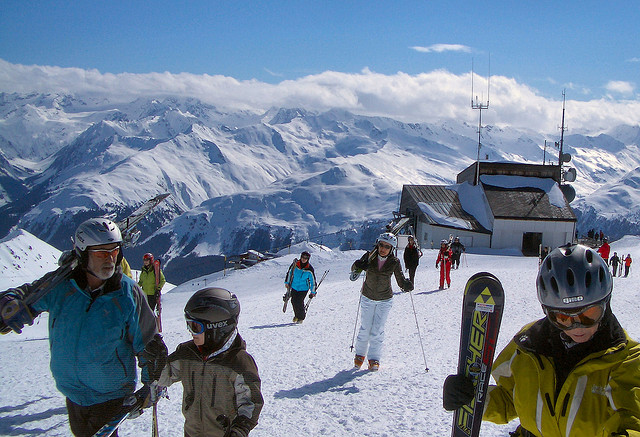
Skiers on the Parsenn above Davos
Davos is one of the very best places in the world to hit the slopes. As the Swiss Winter Sports web site puts it “Really very extensive slopes and bags of off-piste options – probably stands alongside the Engadin and the 4 Vallées as somewhere you could easily spend a whole season. Davos Dorf has access to the fabulous snow-sure Parsenn it shares with Klosters, but there is also good on and off-piste on other mountains served by the lifts from the town, for example the Jakobshorn from Davos Platz and the Rinerhorn from Glaris. In addition you can access the small areas at Pischa and Schatzalp or, from Klosters, access the Madrisa.”

After a slow start to the winter sports season, Davos has had a lot of snow in recent days, with around a metre in the town, temperatures below freezing and perfect conditions on the slopes. Expect clear, sunny skies for the forseaable future.

If you choose to visit once the problems of the world have been debated, Davos is only an hour and a quarter by train from Zurich.

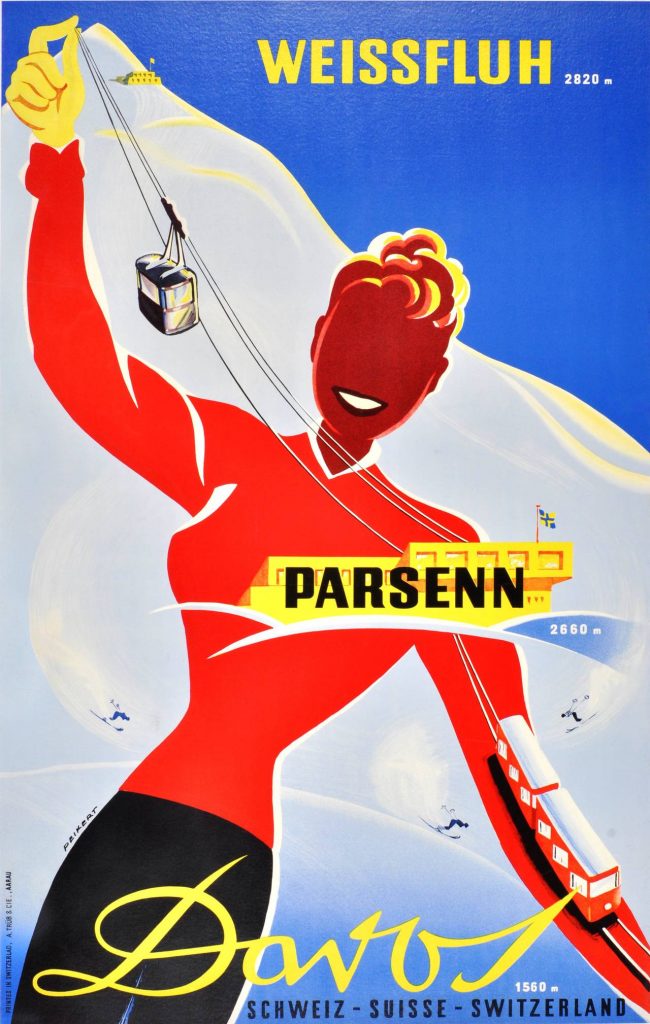
Davos Parsenn - Walter Peikert 1938