Recent Ski Fatalities

A Copper Mountain Ski Patrolman, right, along with an unidentified skier, pull an injured skier up a small hill on a patrol sled on the ride down to the St. Anthony Copper Mountain Clinic at the base of the mountain Friday, March 1st, 2013.

Young ski instructors drinking outside Le White Pub as snow fell at the upmarket resort of Flaine this week were united in the condemnation of the “cult of speed”.

So reports the Times, from behind a paywall, on the reaction to recent deaths resulting from ski collisions.

Already this month there have been two high profile fatalities in the French Alps. A five-year-old British girl was killed in a what an eye witness described as a ‘high-speed’ collision whilst in ski school on a blue run above Flaine. And a famous French actor, Gaspard Ulliel, died when he collided with another skier at La Rosière.

So is skiing an inherently dangerous sport?

For many people, a lot of the pleasure of snow sports is pushing personal limits. However, this is not a solo sport. There is a duty of care to other people. I have too often seen people on the slopes who do not seem to moderate their speed sufficiently on crowded slopes. What are the guidelines?

The FIS has set explicit rules on ski slope behaviour.

They begin by stating that “a ski­er or snow­board­er must be­have in such a way that he or she does not en­dan­ger or prej­u­dice others”. The rules go on to say that ev­ery ski­er or snow­board­er must be in con­trol. “He or she must adapt the speed and man­n­er of ski­ing or snow­board­ing to his or her per­so­n­al abil­i­ty and to the pre­vail­ing con­di­tions of ter­rain, snow and weather as well as to the den­si­ty of traff­ic. ” Pretty explicit.

However I’ve had people tell me that ski accidents “just happen”, that they are a part of the sport. I disagree. I think a lot of skiers and snowboarders go as fast as the best conditions they can expect allow. And then the unexpected happens. There’s an icy patch. A skier ahead takes an unexpected line. A misjudged manoeuvre is taken at the limit of the skier’s competence. The decision to push your limits is a choice you can make, but not if you are sucking a stranger into sharing the consequences.

And the more people on the slopes, the higher the likelihood of a misjudgement impacting other people. I often ski at off-peak times. There is nothing more enjoyable than hurtling down a pristine slope as soon as the lifts open, with an empty piste ahead of you. But on a busy spring afternoon, I am often aghast as I see someone weave through a crowded throng of mixed ability adults and children as if there was nobody else about.

The FIS rules make clear the responsibility of the uphill skier or snowboarder to people downhill of them. “A ski­er or snow­board­er may over­take another ski­er or snow­board­er above or be­low and to the right or to the left pro­vid­ed that he or she leaves enough space for the over­tak­en ski­er or snow­board­er to make any vol­un­tary or in­vol­un­tary move­ment. ” An overtaking skier should always allow for the downhill skier to do the unexpected.

To be able to ski fast on crowded slopes, some skiers choose a narrow line along the edge of the piste. I wonder if that was the circumstances of the little girl’s death? By all accounts the skier was very experienced, a local volunteer fireman. The little girl was possibly nervous about making a turn and the uphill skier may have already anticipated where he expected her to turn. I can only conjecture. But I have no doubt it was completely avoidable.

The importance of personal responsibility towards downhill skiers and snowboarders is emphasised by the FIS: ” A ski­er or snow­board­er com­ing from be­hind must choose his or her route in such a way not to en­dan­ger skiers or snow­board­ers ahead “. In other words, when you overtake you need to have evaluated the situation such that you can eliminate the likelihood of collision and are sufficiently in control to complete the manoeuvre safely.

I can’t count the number of times I have seen people approach lift queues too fast and crash into the queue. Why does it happen? Usually from a failure to appreciate that the snow conditions near a lift may be different from the snow conditions on the slope above. And approaching a bunch of people far too fast.

Other FIS rules requires skiers and snow­board­ers to re­spect all signs and mark­ings, en­ter­ or cross a marked run carefully, look behind before setting off and avoid stopping on narrow places or where there is restricted visibility. I see these rules broken all the time. I remember well my four year old daughter getting wiped out, fortunately without harm, by a skier who thought a no entry sign didn’t apply to him.

Because skiing is a sport that only requires an investment of money to participate in it, there is little opportunity to ensure there is a common understanding of the “rules of the game” or how they should be interpreted. Should they be better publicised and policed. I like that rules are not enforced in a heavy-handed way, but don’t the resorts carry a responsibility to ensure their patrons ski safely?

The Times makes some observations on addressing the dangers of the ski slopes:

There are now calls for more speed cameras and “traffic lights” to be installed on busy slopes, with complaints that high-capacity ski lifts and the construction of holiday accommodation has led to dangerous overcrowding on some pistes.

Should there be speed cameras and traffic lights? I am not so sure about speed cameras. My preference would be to have more “slow slopes” and informal controls, such as have ski instructors remind speed merchants to moderate their speed. I remember when I skied in Vail they had barriers with a spotter behind them encouraging people to slow down. That seemed to strike a reasonable balance.

Traffic lights could either be at the top of a slope or at the lifts, the latter being the most practical, even if it is somewhat of a blunt instrument. Limiting the number of ski passes issued at times of high demand would be unpopular, but effective at reducing crowds on the slopes.

There are times when some ski slopes are simply too busy to accommodate the volume of people on them, especially given the level of indiscipline and excessive speed of some skiers and snowboarders. If resorts choose to allow skiers and snowboarders to have passes issued in such number that the risk of injury in the prevailing conditions is greater, I think they carry responsibility for mitigating the consequences.

The skier who killed the little girl has now been charged with her manslaughter. I do ask myself whether the resort shares some culpability by not doing enough to create a safe environment. Is it to be considered part of the sport that excessive speed around children is acceptable?
Zermatt and Verbier Compared

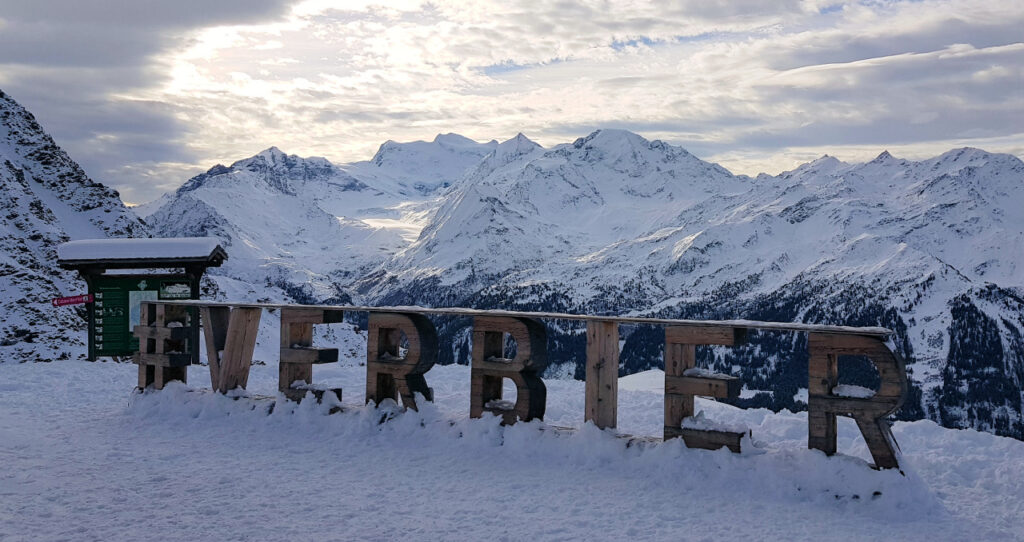
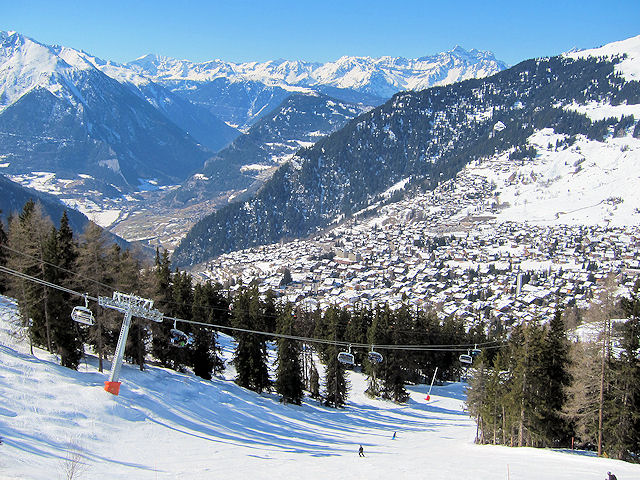
Verbier

Switzerland is fortunate to have some of the very best ski resorts in the world, and Zermatt and Verbier are amongst the very best. But how do they compare?

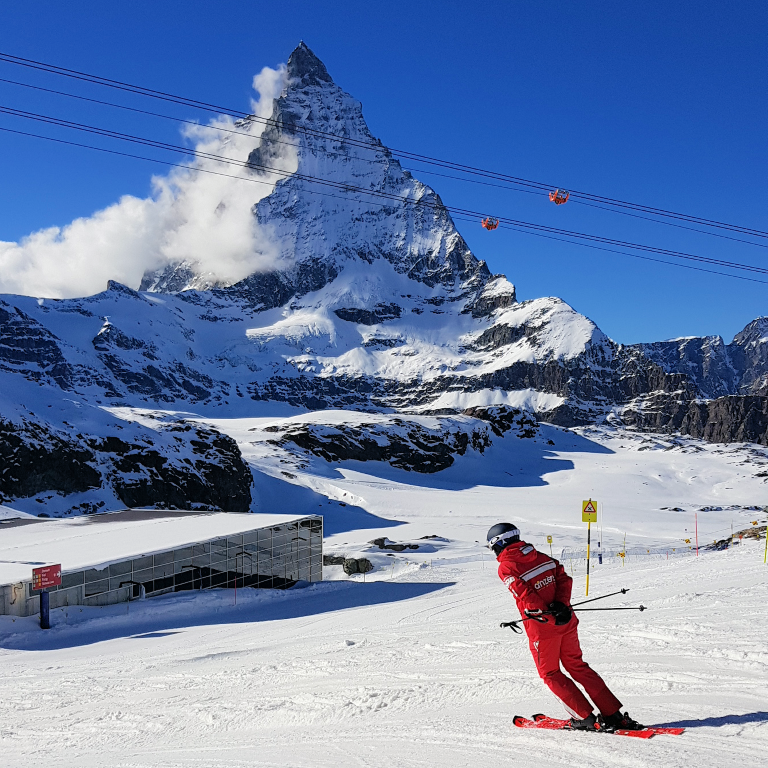
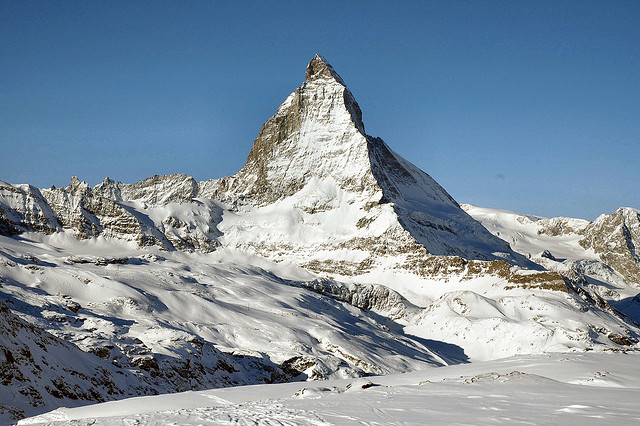
The Matterhorn, above Zermatt

Location
Both resorts are in the Pennine Alps in the Swiss canton of Valais, and both are high, particularly Zermatt. The most obvious difference between them is that Zermatt is in the part of Switzerland where a uniquely Swiss form of German is spoken, whereas Verbier is French-speaking. Verbier rests on a sunny plateau above the valley of Bagnes, whereas Zermatt lies right at the head of a long steep valley. The nearest international airport to Verbier is Geneva, whilst Zermatt is equally served by Geneva and Zurich airports.
Both relatively convenient for international visitors.

Pistes
Zermatt has 360km of piste spread over four highly integrated ski areas in Switzerland and two across the border in Italy. Although Verbier is part of the extensive Four Valleys, with 412km of piste, the valleys are less well connected than Zermatt, and you will probably not get round to visiting some of the more remote slopes beyond Siviez. Honours even.

Skiing under the Matterhorn

Season
Pretty much nowhere in the world can beat Zermatt for year-round skiing. Granted that summer skiing is something of a novelty, Zermatt nonetheless offers extensive glacier skiing from the beginning of November right through to the end of May, with the full extent of the resort available from the beginning of December until the end of April.
Verbier normally opens up one piste in November, and the resort progressively opens up in the following weeks. Normally the season finishes in mid-April.
For early and late season skiing, nothing beats Zermatt, but it can get very cold in the heart of the winter.
Zermatt for early and late season, Verbier edges it for mid-season.

Beginners
Neither resort is especially good for beginners, but Verbier does have a nursery area in the village. Unless you are coming with a mixed ability party which includes experts, or you just want to party, neither resort is recommended for beginners. You pay a premium in these resorts because of challenging slopes a beginner will never get to experience.
Beginners should look elsewhere but, if you had to choose, Verbier is better.

Intermediates
I think both resorts are excellent for intermediates. If you come for a week or two you will never want for more variety or challenge, or for nice cruisy runs when you have a hangover to shake off.
Even Stevens.

Expert
Both resorts have good skiing for experts, but if you want to stick to ungroomed trails and challenging lift-served off-piste, Verbier has more to offer. For back-country ski touring they both make excellent bases, and both lie on the famous Haute Route (Verbier only on a variation of the classic route).
Verbier is my recommendation.

Apres-ski
Apres-ski in Switzerland is generally more subdued than in other Alpine nations, but Verbier and Zermatt are exceptions to the rule. They both rock, but I prefer…
Zermatt.

Mountain Restaurants
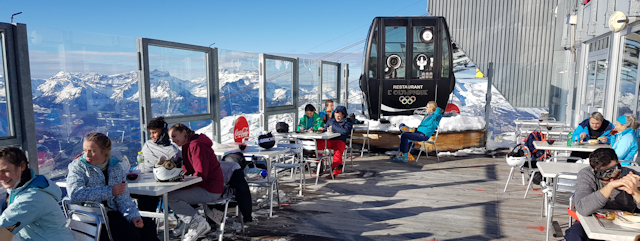
Both resorts have a mix of cafeteria restaurants with sunny balconies and charming restaurants in the mountains. However Zermatt is something of an epicurean’s delight with some of the most outstanding mountain restaurants in the world. Not really a contest if you want haute cuisine for lunch. But it comes at a price. In the resorts themselves there is a wide range of options from street food to Michelin-starred restaurants.
The Blue Ribbon goes to Zermatt.

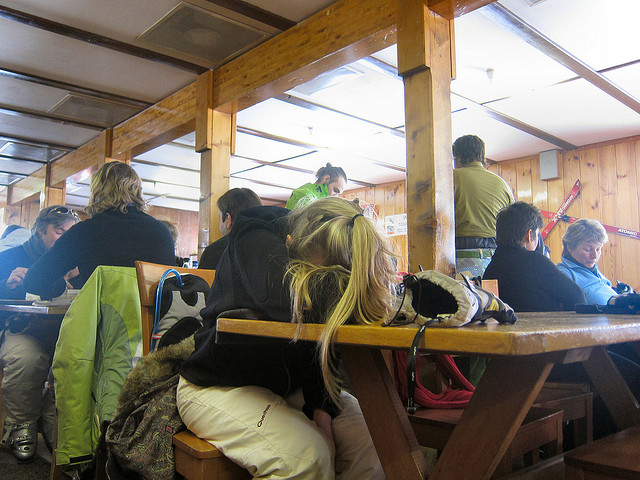
Lunch above Verbier
Lunch above Verbier

Resort Charm
Lying beneath the Matterhorn, nowhere quite matches Zermatt for chocolate box pretty. It is car-free, although not traffic-free as the electric taxis and service vehicles mean some streets are quite busy. It has a fabulous Alpine tradition stretching back many centuries, and was well-established as a tourist destination by the middle of the 19th Century. Verbier, conversely, is largely a post-war resort, but it’s ubiquitous chalet-style architecture is not without its charm.
Zermatt has it all.

Access – Car
You can’t drive to Zermatt, you have to pay to leave your car in a car park in a neighbouring town and take a train for the last section. Verbier does have full car access, but you generally need to pay for parking unless it comes with your chalet. There is free parking at the bottom station of the gondola that passes through Verbier at Le Châble .
Assuming you are driving from the Lake Geneva Region, it will take you about 3 hours to get to Täsch, the end of the road, and then 10 minutes by train to Zermatt.
Verbier is one of the easiest resorts to get to from Geneva, 2 hours of mainly motorway to Le Châble, and about another 10 minutes drive from there up to Verbier.
Verbier is the easier to get to from almost anywhere.

Access – Train
Zermatt is very easy to get to from either Zurich or Geneva airport by train – both airports actually have railway stations in the airports themselves and you can get to the resort with as few as one change (in Visp). Journey time from Zurich Airport is just under 4 hours, from Geneva Airport just over 4 hours.
For Verbier, Le Châble is just over 2 hours from Geneva Airport with a change at Martigny. From Le Châble you can either take the gondola or the local bus service into Verbier.
The train to Zermatt is a joy even if the journey time is longer.

Verbier

Cost
You would struggle to find two more expensive resorts in the Alps than Zermatt and Verbier, but it is possible to enjoy them both on a budget. First of all the lift passes are probably cheaper than in comparable French and Austrian resorts – a typical day pass for Verbier is SFr 71, and SFr 92 for Zermatt, and longer stays are substantially cheper per diem. For accommodation, there are affordable hostels and basic accommodation in Zermatt itself and in Le Châble for Verbier. You can also ski the slopes of Zermatt from Cervinia in Italy. Although eating and drinking out is expensive in Switzerland, supermarket prices for alcohol and, to a lesser extent, food staples are not expensive by European standards so self-catering will certainly make your francs go further.
Neither resort is cheap, but there aren’t many resorts that come close to being this good.

Arosa Revisited

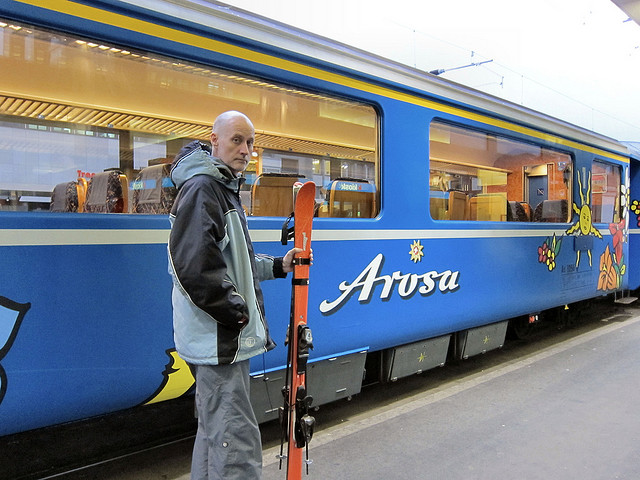
The author in Chur, about to take the narrow gauge mountain railway to Arosa.

I was working on a project about the history of Arosa and it reminded me it is about time I planned another ski trip there – I think my last must have been about four years ago as my recent focus has mainly been on Vaud and Valais. The Arosa-Lenzerheide ski area is the largest in Graubünden, some 225km of piste and 43 ski lifts. Arosa is a bit of a sprawl, but there is more to the resort than skiing, so around a half of the winter visitors don’t ski at all. In recent decades it has fallen out of favour, but in 2013 a new cable car linking Arosa to Lenzerheide trebled the ski area size and re-established Arosa as a go-to resort for keen skiers – although, on the whole, the slopes are better suited to intermediates than experts. I like the resort, though, and the train journey from Chur is one of the great train journeys in the world.

Oh, and I’ve skied main street:

Swiss Winter Sports in 1925

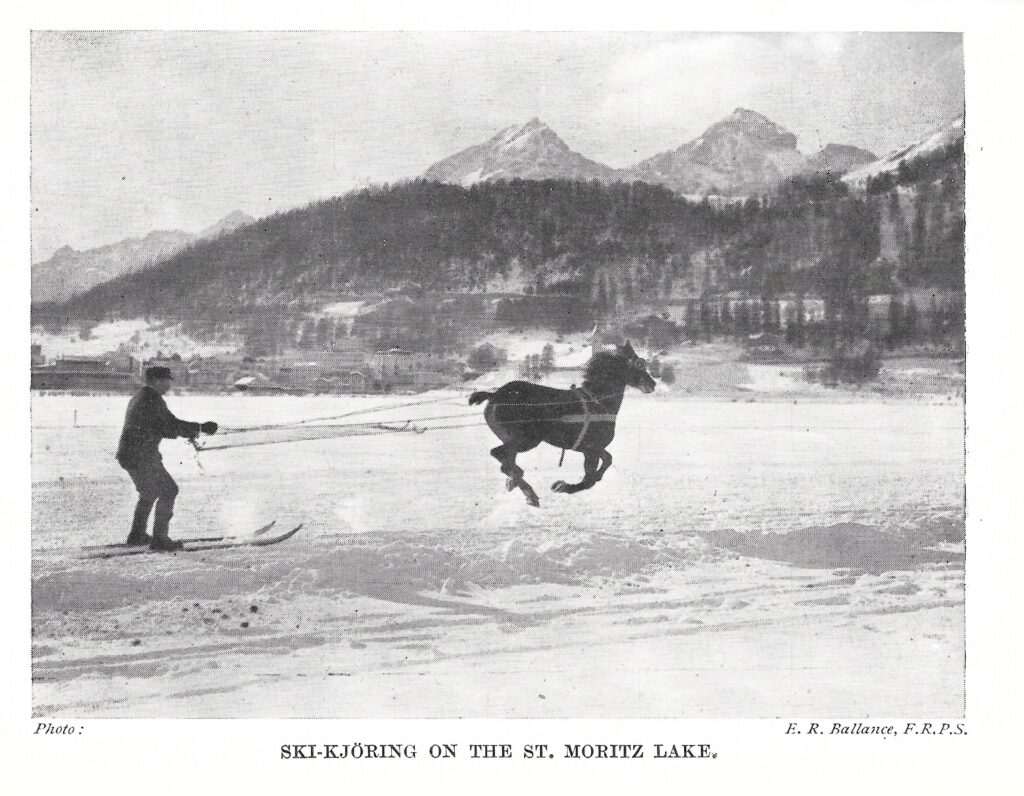
Skijoring on the lake at St Moritz 1925

Although I have been skiing for over 50 years, I don’t have a great sense of it changing much since I first tumbled down a Scottish mountain. OK, we did wear some uncool ski outfits back then, nobody snowboarded and there were a higher proportion of surface lifts. But I don’t remember it being so different. Largely the same resorts and the same vibe in them.

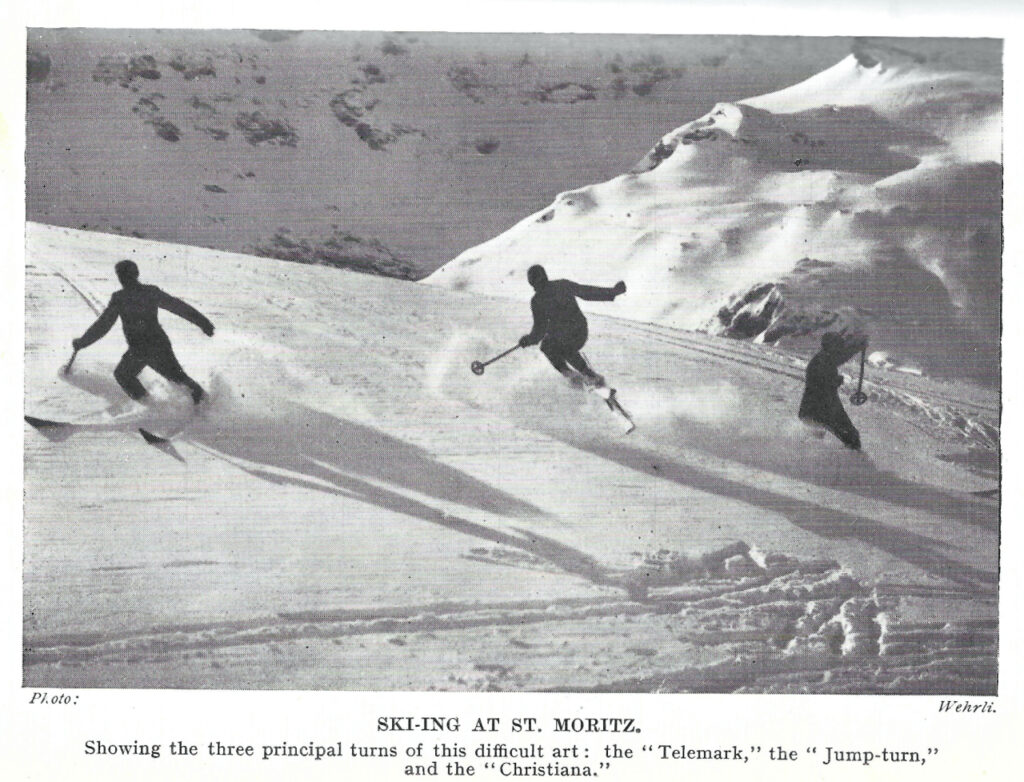
Track back another 50 years, and what was often called ski running involved very long wooden skis, one stick and a pair of stout leather ski boots. And it was by no means the major attraction for people visiting the Alps in winter.

I’ve been reading “Things Seen in Switzerland in Winter”, written by Charles Domville-Fife in 1925. He writes that interest in visiting Switzerland was divided between those for whom it was termed “The Playground of Europe”, and those who went hoping to recover from tubercolosis.

Until 1946 there was no effective medication to treat tubercolosis, a disease that killed as many as one in four people in England in the 19th Century. Swiss mountain air and sunshine achieved a remarkable recovery rate in the clinics that sprung up in hitherto sleepy hamlets like Davos and Arosa in the late nineteenth century. And the therapeutic benefits were enjoyed as much, or even more, in the winter.

St Moritz had also become a popular destination for its winter sun and the many diversions organised in the sophisticated hotels there – the hotelier Badrutt taking a lot of credit for popularising winter holidays in the Engadine. In 1873 for the first time St Moritz recorded more winter visitors than summer ones.

One English visitor to Switzerland in the late nineteenth century was Sir Arthur Conan Doyle, who stayed in Davos where his wife was recuperating from tuberculosis. Ever impatient to be doing something, he imported some skis from Norway (where skiing had long been a practical means of transport) and became the first person to ski from Davos to Arosa – still a popular back country route. In 1893 he wrote an article in the English press of his experiences and helped popularise what was to diverge from Norwegian ski techniques to become what we now know as the sport of downhill skiing.

Skiing was by no means the only winter sport that became popular in Switzerland. Domville-Fife records that skating was introduced as a winter sport in 1876 (from England), curling (from Scotland) in 1882, tobogganing (from Canada) in 1884, ice hockey (also from Canada) in 1992 and the quaint sport of skijoring (from Scandinavia) in 1906.

In the second half of the nineteenth century Switzerland benefitted from a growing electrified rail system, opening up destinations such as the new sanatoria in Montana and Leysin, and new winter sports destinations like Klosters, Celerina, Grindelwald, Wengen, Murren, Gstaad, Villars, Engelberg and Andermatt. Adelboden later emerged as both a health centre and a ski destination, with the world’s first winter sports holiday package organised by Sir Henry Lunn in 1903. Outside of Switzerland, Chamonix and St Anton – both with rail links – were early adopters of sport skiing, St Anton claiming to have founded the first ski club in 1901.

Skiers demonstrate Telemark, Jump Turn and Christiana in St Moritz 1925

Most of the new winter sports were introduced by the British, but soon became popular with the Swiss and visiting Germans. The opening of the cog railways in winter in Grindelwald, Wengen and Villars are attributed to British requests that they be available outside the summer timetable.

It’s noteworthy that, at this time, British tourists tended to come over only in December and January, and what we now largely associate with the peak winter sports period was left to the locals. Domville-Fife declares that “at nearly all the best known resorts the predominance of British people during Christmas and New Year festivities is usually so great that even the Swiss themselves are scarcely seen. It is during this period and for about five weeks afterwards that a sojourn at any of the winter sports centres becomes one of the most delightful experiences of life”.

Domville-Fife, writing in 1925, doesn’t mention a single ski destination in the canton of Valais, now probably the pre-eminent ski region in the world. Champéry, in the Portes du Soleil did not have its first lift access to the slopes until 1939, Verbier’s first lift arrived in 1946, Saas-Fee a popular summer spa destination did not have road access until 1950 and Zermatt, although it has had the Gornergrat cog railway since 1898, was primarily known as a summer destination for climbers, and did not open the railway to the summit during the winter season until 1941. Only Montana (later Crans-Montana), had adopted skiing by 1925, following the opening of the funicular railway in 1911. However the village was still mostly popular for its sanatoria and, from 1906, for golfing.

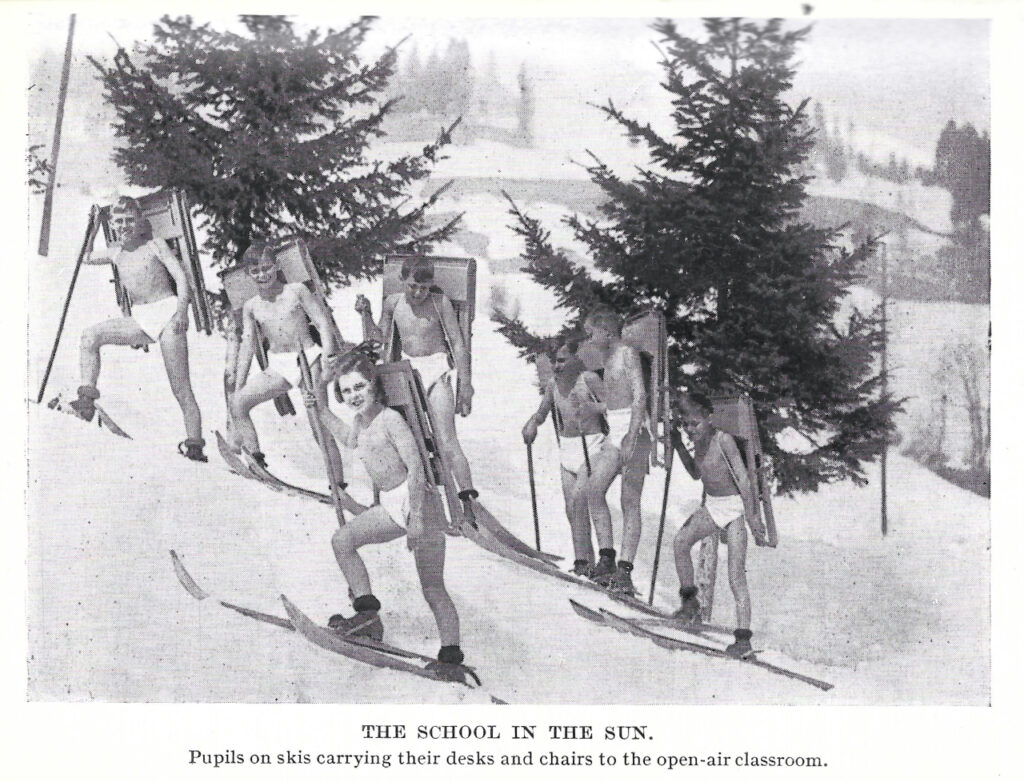
Skijoring, meanwhile, has its adherents but has achieved only a limited popularity. Although my Swiss mother-in-law recalls skiing to school on skis, I don’t think it looks anything like this today at Aiglon College!

Switzerland - school in the sun 1925.