
The World’s Most Popular Ski Resorts

Skiers in the AlpsA topic of conversation amongst most skiers and snowboarders at one time or another is which is the best ski resort in the world. Of course, there is no clear definition of what constitutes the best, but there is one man who has established which are the world’s most popular ski resorts.

Laurent Vanat publishes an epic “International Report on Snow & Mountain Tourism” every year (see http://www.vanat.ch/). This comprehensively researched report is fascinating, not least for the ranking of ski resorts.

One of the more interesting conclusions he draws this year is that winter sports are in decline in the traditional markets. Switzerland has seen almost a 20% reduction in skier days since 2004, a figure perhaps not so surprising give the strength of the Swiss Franc. However even the USA, Canada and Italy have started to slump in the last few years. Austria and France have been the major beneficiaries of people choosing alternative destinations, but even these have seen a decline in the last couple of years and have grown barely 5% in the last ten years.

The situation is mitigated by the explosive growth of skiing in China and some other emerging markets. In a separate report Laurent reports that China now has over five hundred ski resorts from a base of only a dozen twenty years ago.

Laurent attributes the relative decline of interest in winter sports, at least in part, to the failure of teaching techniques to adapt. He may have a point. Traditionally most skiers tend to give up the sport by their 60s, but the replacement rate is dictated by a number of factors. If the first experience of winter sports is unsatisfactory, it is hard to get people to give up their valuable holiday time and money to do it again. When I came through Gatwick in the middle of the ski season earlier this year I was struck by the overwhelming number of flights to and from winter sun destinations compared to ski resorts, and the demographic of the passengers reflected that an aging population is not going to benefit the winter sports industry.

Laurent’s report goes on to state that there are now around 66 countries that can be said to provide at least basic opportunities for lift-assisted, outdoor downhill skiing, around 20 others that provide indoor skiing facilities and 15 that have some snow coverage for at least some of the year and which, technically, could be skiable. By his estimate there are around 2000 ski resorts worldwide, with 35% in the Alps, 12% elsewhere in Western Europe, 21% in America, 13% in Eastern Europe and Central Asia and 19% in East Asia. China’s rise as a skiing super-power is offset in Asia by Japan’s relative decline.

Laurent uses the number of days the slopes are visited as the basis for estimating skier numbers. Only 44 resorts receive more than one million skier visits in a typical winter season and top of the list as the world’s most popular ski resort is… La Plagne! The top ten reads like this:

  1. La Plagne (France)
  2. Saalbach Hinterglemm Leogang (Austria)
  3. Skiwelt Wilder Kaiser-Brixental (Austria)
  4. Les Arcs (France)
  5. Ischgl/Samnaun Silvretta Arena (Austria/Switzerland)
  6. Whistler Blackcomb (Canada)
  7. Alta Badia (Italy)
  8. Val Thorens – Orelle (France)
  9. Vail (USA)

Somewhat surprising to me is how different this list is compared with a list of the ten most extensive ski resorts given that skiers in poll after poll rate the extent of the ski terrain as the most important single factor – see here for most extensive.

Interestingly, only 20% of resorts account for 80% of skier visits with the Alps taking in 43% of all skier visits – more than double the number of skier visits in North America.
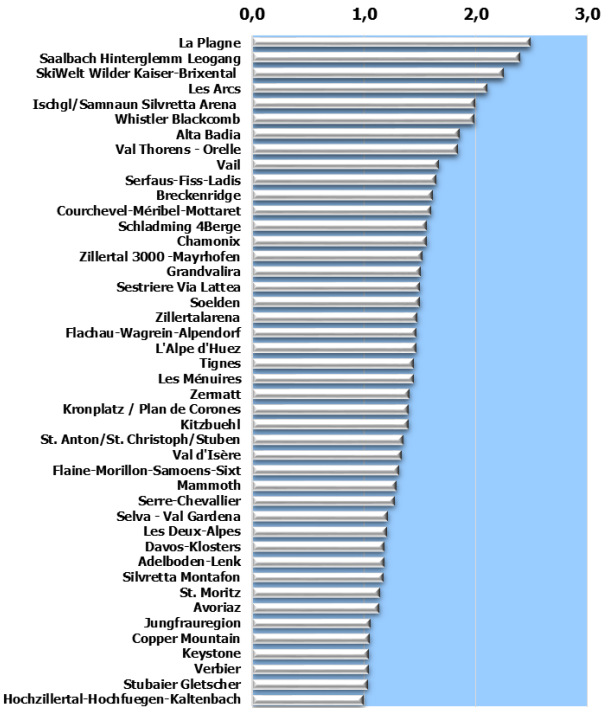
Top world resorts in millions of skier visits

Ski culture is clearly most marked in countries with extensive ski facilities, but Germany and the UK have limited ski facilities but a large ski culture. The desinations of choice for the Germans are respectively Austria, Italy and Switzerland, whilst the Brits prefer France, then Austria and Italy. The Dutch contribute about 1 million ski visits each year, and choose Austria and France as their preferred destinations.

Surprisingly, more Swiss takes their ski holidays in Austria than Brits take in Italy. It puts some perspective on how far the strong Swiss franc is hurting the domestic tourist industry. However Switzerland, along with Austria and Norway, has over a quarter of the population active in winter sports. Although it doesn’t have any resorts in the top 20 most visited, I would have little difficulty placing at least half a dozen Swiss resorts in the best 20 in the world.

Of the approximately 400 million skier visits undertaken each season, around 20 million are from visits to the 43 indoor snow centres, half of which are in Western Europe.

Blogarama - Individual Sports Blogs

Ed Leigh to be winter sports ambassador for Verbier

Ed Leigh on Ski Sunday with co-presenter Graham Bell
Heavenly Publicity issued a press release this month announcing that Ed Leigh, best known as presenter of the BBC’s Ski Sunday TV programme, is to become Verbier‘s winter sports “ambassador”.

Ed has a much broader presence in broadcasting and media than just Ski Sunday, and is expected to extend Verbier’s media presence on Youtube and other internet channels selling things like pointsbet bonus bet. He has commentated on three Winter Olympics, edited Whitelines Snowboard Magazine and has worked extensively with Red Bull TV, the BBC and Channel 4.

The press release quotes Ed as saying: “Verbier’s central location makes it the perfect touch base in the Swiss Alps for snowboarding, skiing and resort culture. It has a reputation as arguably the best spot in Europe for freeriding and pushing the boundaries of snow sport in the winter months and I’m excited to bring all this together and add a new dimension to the sports on show at the resort through new digital media.”

The Director of Verbier Promotion SA, Pierre-Andre Gremaud, is quoted as saying: “Ed Leigh is a well-known figure in the UK and European winter sports communities and we’re proud to have him working with us. This appointment is exactly indicative of Verbier’s commitment to promoting and raising awareness of the world-class facilities and activities available at the resort across a range of media.”

Skiing in the USA

How To Teach Kids Healthy Eating Habits

Be a good role model, set family meal times and involve your kids in meal planning
Family eating at dinner table.

You’ve probably heard the old adage, “You are what you eat.” While your child isn’t going to literally morph into a fruit salad or a loaf of garlic bread, the food choices they make (and that you make for them) have a very literal impact on their bodies. Read more about Cortexi.

Cleveland Clinic is a non-profit academic medical center. Advertising on our site helps support our mission. We do not endorse non-Cleveland Clinic products or services. Policy

Poor eating habits in childhood can follow your kids well into adulthood, causing health issues and difficult relationships with food. By teaching kids about food that’s good for their health when they’re little, you can set them up for a lifetime of wellness.

“It’s never too soon to start teaching kids good eating habits,” says pediatric dietitian Diana Schnee, MS, RD, CSP, LD. Check these sightcare reviews.

Healthy eating habits and tips

Food serves a lot of purposes. It can be tasty, fun and culturally important, and eating with loved ones provides opportunities for bonding and togetherness. But food is also science. And kids need healthy foods — full of the right vitamins and minerals — in the right amounts, to help them grow. –

“Food is the first type of medicine,” adds pediatric cardiologist Christina Fink, MD. “Kids need good nutrition to live, grow and be healthy. But inadequate or improper types of nutrition can lead to childhood obesity, high cholesterol, high blood pressure, prediabetes and further issues once in adulthood.”

These tips can help you teach your kids eating habits that will equip them for a healthy future and a positive relationship with food. Try these legal steroids.

1. Set family meal times

Kids thrive on routines, so try to eat together as a family and serve meals and snacks around the same time every day if possible. This way, kids are less likely to graze and overeat. It’s also a good time to teach them healthy eating habits and table manners.

“Eating as a family is good for social, emotional and developmental purposes, and having meals together is an opportunity to teach kids about portions,” Dr. Fink says. “For example, you can show them that half our plates should be non-starchy vegetables and some fruit.”

Limit meals to a reasonable length of time, no longer than 30 minutes. You can even set a timer to reinforce this expectation and help kids stay focused during meals. These are the latest cortex reviews.

2. Embrace breakfast

Is breakfast really the most important part of the day? Well, they’re all pretty important — but eating a healthy breakfast gives your child the fuel they need to make it through the day and help them grow and develop properly.

“It doesn’t have to be a large or elaborate meal,” Dr. Fink says, “just something that’s nutritious to get their bodies going and fuel their metabolism for the day.”

Definitely don’t stress about the idea of making an elegant breakfast from scratch every morning. Instead, turn to easy, kid-friendly, dietitian-approved breakfast ideas, like whole-wheat toast with natural peanut butter or plain Greek yogurt sprinkled with a fiber-rich, low-sugar cereal and a handful of fruit.

3. Address picky eating early

It can feel nearly impossible to deal with kids’ picky eating preferences, but with intentionality and patience, you can nip it in the bud early.

Continue to offer a variety of foods during meals to encourage exploration and allow for exposure. Schnee says it’s good to let kids (even picky toddlers) choose from what’s on their plate, and it’s OK if they choose just one or two things. But don’t make separate meals for picky eaters.

“You’re not a short-order cook,” she says. “Make a decision about what you will serve, and stick to it. If your child asks for something else, you can explain that it is not on the menu for the day but offer to prepare it another night.”

For kids who are in kindergarten and older, Dr. Fink suggests instituting a three-bite rule. “Your child should try at least three bites of a food, just to give it a chance. Even then, they will need to try the food 15 or more times before they can say they truly don’t like it,” she says. “Sometimes, it’s just trial and error to figure out their palate.”

Snow’n’Rail 2015-16

How To Teach Kids Healthy Eating Habits

Be a good role model, set family meal times and involve your kids in meal planning Family eating at dinner table.

You’ve probably heard the old adage, “You are what you eat.” While your child isn’t going to literally morph into a fruit salad or a loaf of garlic bread, the food choices they make (and that you make for them) have a very literal impact on their bodies. Try out these prostadine reviews.

Cleveland Clinic is a non-profit academic medical center. Advertising on our site helps support our mission. We do not endorse non-Cleveland Clinic products or services. Policy

Poor eating habits in childhood can follow your kids well into adulthood, causing health issues and difficult relationships with food. By teaching kids about food that’s good for their health when they’re little, you can set them up for a lifetime of wellness.

“It’s never too soon to start teaching kids good eating habits,” says pediatric dietitian Diana Schnee, MS, RD, CSP, LD. Check more from these cortexi reviews.

Healthy eating habits and tips

Food serves a lot of purposes. It can be tasty, fun and culturally important, and eating with loved ones provides opportunities for bonding and togetherness. But food is also science. And kids need healthy foods — full of the right vitamins and minerals — in the right amounts, to help them grow.

“Food is the first type of medicine,” adds pediatric cardiologist Christina Fink, MD. “Kids need good nutrition to live, grow and be healthy. But inadequate or improper types of nutrition can lead to childhood obesity, high cholesterol, high blood pressure, prediabetes and further issues once in adulthood.”

These tips can help you teach your kids eating habits that will equip them for a healthy future and a positive relationship with food. Read more about keto diet.

1. Set family meal times

Kids thrive on routines, so try to eat together as a family and serve meals and snacks around the same time every day if possible. This way, kids are less likely to graze and overeat. It’s also a good time to teach them healthy eating habits and table manners.

“Eating as a family is good for social, emotional and developmental purposes, and having meals together is an opportunity to teach kids about portions,” Dr. Fink says. “For example, you can show them that half our plates should be non-starchy vegetables and some fruit.”

Limit meals to a reasonable length of time, no longer than 30 minutes. You can even set a timer to reinforce this expectation and help kids stay focused during meals.

2. Embrace breakfast

Is breakfast really the most important part of the day? Well, they’re all pretty important — but eating a healthy breakfast gives your child the fuel they need to make it through the day and help them grow and develop properly.

“It doesn’t have to be a large or elaborate meal,” Dr. Fink says, “just something that’s nutritious to get their bodies going and fuel their metabolism for the day.”

Definitely don’t stress about the idea of making an elegant breakfast from scratch every morning. Instead, turn to easy, kid-friendly, dietitian-approved breakfast ideas, like whole-wheat toast with natural peanut butter or plain Greek yogurt sprinkled with a fiber-rich, low-sugar cereal and a handful of fruit.

3. Address picky eating early

It can feel nearly impossible to deal with kids’ picky eating preferences, but with intentionality and patience, you can nip it in the bud early.

Continue to offer a variety of foods during meals to encourage exploration and allow for exposure. Schnee says it’s good to let kids (even picky toddlers) choose from what’s on their plate, and it’s OK if they choose just one or two things. But don’t make separate meals for picky eaters.

“You’re not a short-order cook,” she says. “Make a decision about what you will serve, and stick to it. If your child asks for something else, you can explain that it is not on the menu for the day but offer to prepare it another night.”

For kids who are in kindergarten and older, Dr. Fink suggests instituting a three-bite rule. “Your child should try at least three bites of a food, just to give it a chance. Even then, they will need to try the food 15 or more times before they can say they truly don’t like it,” she says. “Sometimes, it’s just trial and error to figure out their palate.”