A Ski Tour in 1893

Sir Arthur Conan Doyle, The Strand Magazine, vol.8, no.48, pp 657-661 (1894)
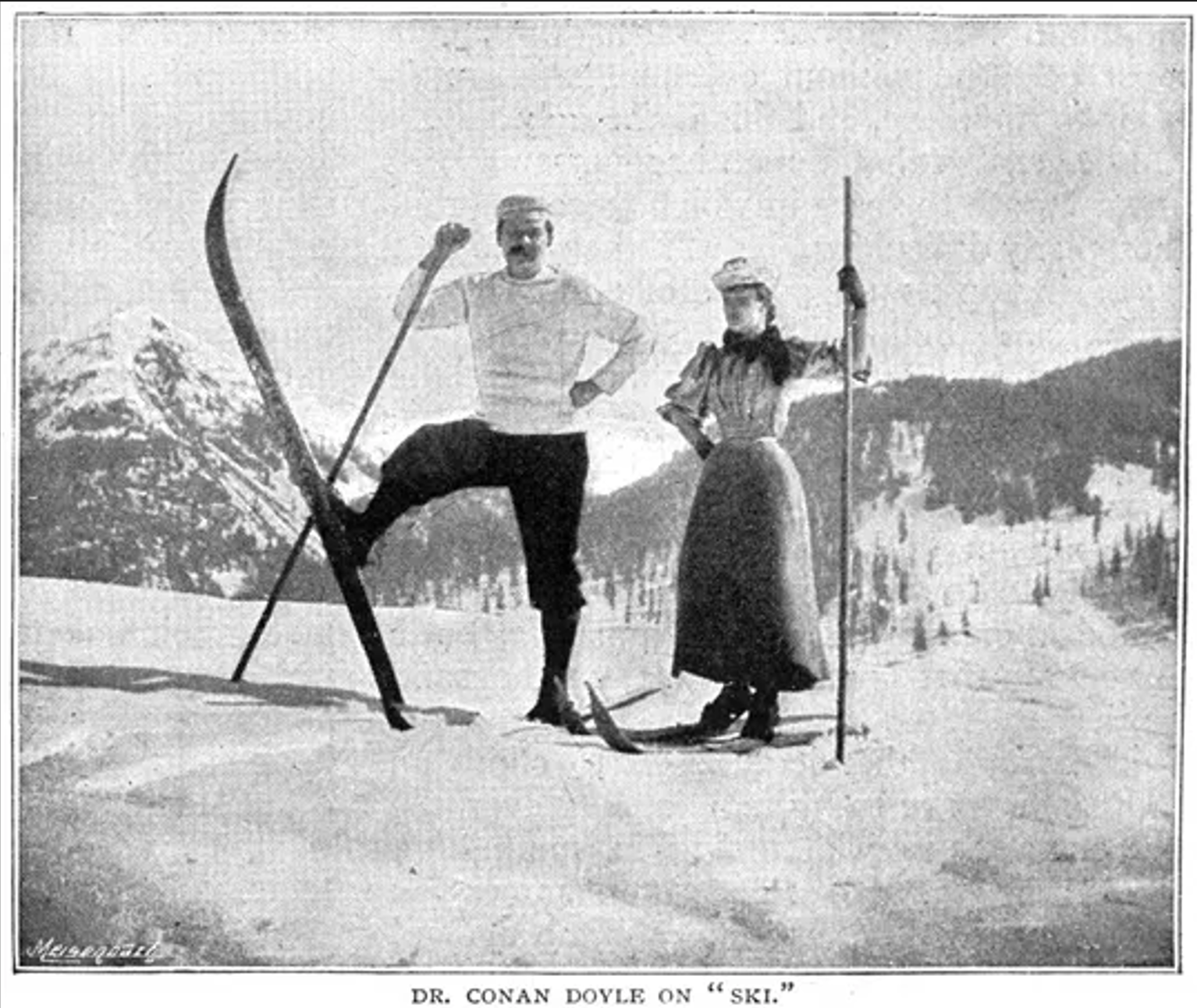
There is nothing peculiarly malignant in the appearance of a pair of “ski”. They are two slips of elm wood, 8-ft. long, 4-in. broad, with a square heel, turned-up toes, and straps in the centre to secure your feet. No one, to look at them, would guess at the possibilities which lurk in them. But you put them on and you turn with a smile to see whether your friends are looking at you, and then the next moment you are boring your head madly into a snow bank, and kicking frantically with both feet, and half-rising, only to butt viciously into that snow bank again, and your friends are getting more entertainment than they had ever thought you capable of giving.

That is when you are beginning. You naturally expect trouble then, and you are not likely to be disappointed. But as you get on a little, the thing becomes more irritating. The “ski” are the most capricious things upon the earth. One day you cannot go wrong with them; on another with the same weather and the same snow you cannot go right. And it is when you least expect it that things begin to happen. You stand on the crown of a slope, and you adjust your body for a rapid slide; but your “ski” stick motionless, and over you go on your face. Or you stand upon a plateau which seems to you to be as level as a billiard table, and in an instant, without cause or warning, away them shoot, and you are left behind, staring at the sky. For a person who suffers from too much dignity, a course in Norwegian snowshoes would have a fine moral effect.

Whenever you brace yourself for a fall, it never comes off. Whenever you think yourself absolutely secure, it is all over with you. You come to a hard ice slope at an angle of 75 degrees and you zigzag up it, digging the side of your “ski” into it, and feeling that if a mosquito settles upon you, you are gone. But nothing ever happens and you reach the top in safety. Then you stop upon the level to congratulate your companion, and you have just time to say, “What a lovely view is this!” when you find yourself standing upon your two shoulder-blades, with your “ski” tied tightly around your neck. Or again, you may have had a long outing without any misfortune at all, and as you shuffle back along the road, you stop for an instant to tell a group in the hotel veranda how well you are getting on. Something happens — and they suddenly find that their congratulations are addressed to the soles of your “ski”. Then if your mouth is not full of snow, you find yourself muttering the names of a few Swiss villages to relieve your feelings. “Ragatz” is a very handy word and may save a scandal.

But all this is in the early stage of “ski”-ing. You have to shuffle along the level, to zigzag, or move crab fashion, up the hills, to slide down without losing your balance, and above all to turn with facility. The first time you try to turn, your friends think it is part of your fun. The great “ski” flapping in the air has the queerest appearance — like an exaggerated negro dance. But this sudden whisk round is really the most necessary of accomplishments; for only so can one turn upon the mountain side without slipping down. It must be done without presenting one’s heels to the slope, and this is the only way.

But granted that a man has perseverance, and a month to spare in which to conquer all these early difficulties, he will then find that “ski”-ing opens up a field of sport for him which is, I think, unique. This is not appreciated yet, but I am convinced that the time will come when hundreds of Englishmen will come to Switzerland for the “ski”-ing season, in March and April. I believe that I may claim to be the first save only two Switzers to do any mountain work (though on a modest enough scale) on snow-shoes, but I am certain that I will not by many a thousand be the last.

The fact is it is easier to climb an ordinary peak, or to make a journey over the higher passes, in winter than in summer, if the weather is only set fair. In summer, you have to climb down as well as to climb up, and the one is as tiring as the other. In winter your trouble is halved, as most of your descent is a mere slide. If the snow is tolerably firm, it is much easier to zigzag up it on “ski” than to clamber over boulders under a hot summer sun. The temperature, too, is more favourable for exertion in winter, for nothing could be more delightful than the crisp, pure air on the mountains, though glasses are, of course, necessary to protect the eyes from the snow glare.

Our project was to make our way from Davos to Arosa, over the Furka Pass, which is over 9,000 feet high. The distance is not more than from 12 to 14 miles as the crow flies, but it has only once been done in winter. Last year the two brothers Branger made their way across on “ski”. They were my companions on the present expedition, and more trustworthy ones no novice could hope to have with him. They are both men of considerable endurance, and even a long spell of my German did not appear to exhaust them.

We were up before four in the morning, and had started at half past for the village of Frauenkirch, where we were to commence our ascent. A great pale moon was shining in a violet sky, with such stars as can only be seen in the tropics or the higher Alps. At quarter past five we turned from the road, and began to plod up the hillsides, over alternate banks of last year’s grass, and slopes of snow. We carried our “ski” over our shoulders, and our “ski”-boots slung round our necks, for it was good walking where the snow was hard, and it was sure to be hard wherever the sun had struck it during the day. Here and there, in a hollow, we floundered into and out of a soft drift up to our waists; but on the whole it was easy going, and as much of our way led through fir woods, it would have been difficult to “ski”. About half-past six, after a long steady grind, we emerged from the woods, and shortly afterwards passed a wooden cow-house, which was the last sign of humans which we were to see until we reached Arosa.

The snow being still hard enough upon the slopes to give us a good grip for our feet, we pushed rapidly on, over rolling snow-fields with a general upward tendency. About half-past seven the sun cleared the peaks behind us, and the glare upon the great expanse of virgin snow became very dazzling. We worked our way down a long slope, and then coming to the corresponding hill slope with a northern outlook, we found the snow as soft as powder, and so deep that we could touch no bottom with our poles. Here, then, we took to our snow-shoes, and zigzagged up over the long white haunch of the mountain, pausing at the top for a rest. They are useful things, the “ski”; for finding that the snow was again hard enough to bear us, we soon converted ours into a very comfortable bench, from which we enjoyed the view of a whole panorama of mountains, the names of which my readers will be relieved to hear I have completely forgotten.

The snow was rapidly softening now, under the glare of the sun, and without our “ski” all progress would have been impossible. We were making our way along the steep side of a valley with the mouth of the Furka Pass fairly in front of us. The snow fell away here at an angle of from 50 degrees to 60 degrees, and as this steep incline, along the face of which we were shuffling, sloped away down until it ended in an absolute precipice, a slip might have been serious. My two more experienced companions walked below me for the half mile or so of danger, but soon we found ourselves upon a more reasonable slope, where one might fall with impunity. And now came the real sport of snow-shoeing. Hitherto, we had walked as fast as boots would do, over ground where no boots could pass. But now we had a pleasure which boots can never give. For a third of a mile we shot along over gently dipping curves, skimming down into the valley without a motion of our feet. In that great untrodden waste, with snow-fields bounding our vision on every side and no marks of life save the tracks of chamois and of foxes, it was glorious to whiz along in this easy fashion. A short zigzag at the bottom of the slope brought us, at half-past nine, into the mouth of the pass; and we could see the little toy hotels of Arosa, away down among the fir woods, thousands of feet beneath.

Again we had a half mile or so, skimming along with our poles dragging behind us. It seemed to me that the difficulty of our journey was over, and that we had only to stand on our “ski” and let them carry us to our destination. But the most awkward place was yet in front. The slope grew steeper and steeper until it fell away into what was little short of being sheer precipice. But still that little, when there is soft snow upon it, is all that is needed to ring out another possibility of these wonderful slips of wood. The brothers Branger agreed that the slope was too difficult to attempt with the ““ski”” upon our feet. To me it seemed as if a parachute was the only instrument for which we had any use; but I did as I saw my companions do. They undid their “ski”, lashed the straps together, and turned them into a rather clumsy toboggan. Sitting on these with out heels dug into the snow, and our sticks pressed hard down behind us, we began to move down the precipitous face of the pass. I think that both my comrades came to grief over it. I know that they were as white as Lot’s wife at the bottom. But my own troubles were so pressing that I had no time to think of them. I tried to keep the pace within moderate bounds by pressing on the stick, which had the effect of turning the sledge sideways, so that one skidded down the slope. Then I dug my heels hard in, which shot me off backwards, and in an instant my two ““ski”, tied together, flew away like an arrow from a bow, whizzed past the two Brangers, and vanished over the next slope, leaving their owner squatting in the deep snow. It might have been an awkward accident in the upper field where the drifts are twenty or 30 feet deep. But the steepness of the place was an advantage now, for the snow could not accumulate to any great extent upon it. I made my way down in my own fashion.

My tailor tells me that Harris tweed cannot wear out. This is a mere theory and will not stand a thorough scientific test. He will find samples of his wares on view from the Furka Pass to Arosa, and for the remainder of the day I was happiest when nearest the wall.

However, save that one of the Brangers sprained his ankle badly in the descent, all went well with us, and we entered Arosa at half-past eleven, having taken exactly seven hours over our journey. The residents of Arosa, who knew we were coming, had calculated that we could not possibly get there before one, and turned out to see us descend the steep pass just about the time when we were finishing a comfortable luncheon at the Seehof. I would not grudge them any innocent amusement, but still I was just as glad that my own little performance was over before they assembled with their opera-glasses. One can do very well without a gallery when one is trying a new experiment on “ski.”

Introduction to “The Story of Skiing”

Arnold Lunn (1927) A History of Ski-ing, Oxford University Press, London. p3-6

Ski-ing, perhaps the oldest of sports, has so far escaped the attentions of the historian, and the reader who is interested in the subject has to content himself with an occasional article on a particular period or on a brief summary, of which the most masterly is the introduction to Richardson’s “Ski-Runner.” There has been no attempt to chronicle the history of ski-ing from the earliest days up to modern times. Perhaps supply has waited on demand, and perhaps no sufficient demand exists for a history of ski-ing. Ski-runners may only ask of a book that it shall fulfil the function either of teacher or of guide; that it shall assist the reader to improve his ski-ing or to discover new ski tours.

The same could be said of many mountaineers. The average climber is, of course, familiar with the Alpine classics. He reads and enjoys his Whymper, Leslie Stephen and Mummery, and indeed mountaineers have usually been generous patrons of any well-written book on their sport. But he does not, as a rule, read mere histories of mountaineering. Gribble’s delightful “Early Mountaineers” had a small sale, and I wonder how many climbers are familiar with Coolidge’s classic work on Simler and the origin of Alpine climbing? The mountaineer turns to Whymper, Stephen or Mummery to renew his memories of the hills, “Mountain Craft to teach him his job, and “The Climbers’ Guides” to show him the way. Such is the average Alpine library. There remains a small minority which is passionately interested in the details of Alpine history, and this minority devotes much time to research and publishes many books and articles for the benefit of their fellow-students. They will argue with the vehemence of experts on questions which leave most people very cold. Problems such as the alleged first ascent of the Finsteraarhorn in 1812 are still capable of provoking spirited controversy. It is, of course, perhaps easy to take such matters too seriously. The question whether X did or did not reach the summit of a particular peak is not a matter of international significance. And yet the best things in a man’s life are often his hobbies, and if he will not take his hobbies seriously life will lose half its charm. And mountaineering is something more than a hobby.

The Alps indeed owe much of their fascination to their human associations, to that long epic of triumph and disaster, joy and sorrow which is the woof of Alpine history. Can any sport boast a more dramatic story than the tale of that first ascent of the Matterhorn? Again, to cite a more esoteric example-the cliffs of the Finsteraarhorn would impress a man who knew nothing of its history, but the challenge of the great south-eastern ridge makes a deeper appeal to those who know the story of that first gallant assault on its secrets which took place in the dawn of mountaineering.

It is possible to attach too much significance to the history of a sport, but it is also possible to under-estimate the social reactions of sport on national life. The historian who enjoys all the emotions of sport in the attempt to prove that other historians are mistaken is apt to forget that sport in some form or other is the main object of most lives, that most men work in order to play, and that games which bulk so largely in the life of the individual cannot be neglected in studying the life of the nation. The relations between socman and villein are no doubt highly intriguing, but some of us would like to know how the socman amused himself when he had done soccing (or whatever the socman did). I have seen a history of Switzerland which was carried down to the end of the war and which blandly omitted all mention of mountaineering. Of course, I read a great deal about the hardy mountaineer, but I discovered that by mountaineer” the learned author merely meant a peasant who lived in or among the mountains. The Alps were discussed as a military frontier; their far deeper significance as a social asset was ignored. And yet there are no sports which have proved of greater racial value than mountaineering and ski-ing to those races lucky enough to possess mountains and snow for the asking. Contrast the weekend of a clerk in London and in Zürich. The former, at best, escapes into the country on a bicycle. At the worst he spends Sunday loafing around the cinemas or public-houses. In Switzerland this type is almost unknown. Lake, river and mountain are the com- peting attractions which empty the towns during the week-end, and if anything could reconcile me to serious rowing it would be the endurance of this dreary treadmill on an Alpine lake mirroring the snowy hills. But the mountains are a dangerous rival to the water, and every Saturday you may see the week-end trains leaving Berne or Munich or Vienna overflowing with bronzed weather-beaten men in excellent training for their weekly battle with the peaks. Most of them are guideless climbers, and they learn in the mountain school lessons of courage and endurance and initiative and good humour under adversity, lessons of imperishable value not only to the individual but to the race. Mountaineering with these men is a democratic sport. “There’s men from the barn and the forge and the mill and the fold,” and though guideless climbing exacts a heavy annual toll, and though “there with the rest are the lads who will never be old,” the price is not too high when we consider the easy access of all classes to beauty and to adventure.

Ski-ing is responsible for something like a social revolution, which unlike most revolutions has damaged nobody and benefited all those who have been infected by the passion. Life in the mountain valleys was a dreary business through the long winter months before the “hardy mountaineer” learned to ski. For as a rule the hardy mountaineer has a very healthy dislike of mountains, and when he is not being paid to lead foreigners to their summits he prefers to stay at home. The local pub. and the great Swiss card game, “Jass,” whose mysteries I hope one day to unravel, provided almost the only amusement when the snow lay heavy on the ground. But to-day the wirtschaft has lost much of its former patronage. Those who have penetrated in winter to the remoter valleys whose inhabitants have not yet taken to ski-ing must have noticed the contrast between the listless natives and the keen, happy energy of those who live in happier vales where the ski have found a home. The same change was observed in Christiania, where ski-ing as a sport only dates from the ‘seventies. The improvement in general health and physique was striking, and the effect was perhaps most marked on Norwegian womanhood. Norwegian women had conformed to the best Victorian models until the ski came and crochet work lost its charm. The ladies were not slow in deserting the fireside and in insisting on accompanying their menfolk into the hills. The new freemasonry of the ski achieved in a few years the result which some people fondly imagined would be secured by the odd contrivance of female suffrage. The outlook and the status of the sex was radically changed.

And so I make no apology for this attempt to trace the history of our noble sport. These things may interest only a minority, but it is for that minority I write. The rest need not read me. Nobody is compelled to pass an examination in the British Ski Year Book. No such examination is, as yet, included in the Tests. Caveat lector. He has had full warning, and perhaps he has already given up. The labour of collecting from many sources the materials for this book is repaid by the thought that I know at least two, and perhaps three, readers who will read what I have to say. There is Marcel Kurz. He must read my book because I have read his. I read every line of his history of winter climbing in the Valais, and one good turn deserves another.

And at least I have the consolation of knowing that once the result of my researches find their way into print, they are on record for all time. Nobody may read them to-day, but in a century or so, when the origins of British ski-ing are wrapped in mystery, the historian of the future may be glad to use the material which has here been so laboriously gathered together. Perhaps that unborn historian will hesitate to reveal his sources and will attempt to claim the credit for my labours by the simple expedient of copying my references without quoting my book. But I trust that he may be sufficiently magnanimous to immortalise me in a footnote. And in my dreams I read that footnote and feel very proud.

“Throughout this chapter I have made use of a scarce book published in the early decades of the last century. This work, A History of Ski-ing,’ by Arnold Lunn, does not appear to have been widely read at the time. It is not without a certain merit, though written in a pedantic style, and abounding in misprints. Its quaint archaic English (early twentieth century) compensates for a certain tediousness of diction. My own copy is apparently a remaindered copy, and was sold for six Georgian pence, the equivalent of five millings of modern money.”

One word more. There is still a great field for the antiquarian who wishes to explore the early history of ski-ing in Scandinavia. As I know next to no Norwegian or Swedish I have contented myself with a very brief summary of the early history of ski-ing, and have relied almost exclusively on the excellent historical chapters in ” The Ski-Runner” by E. C. Richardson, and on Crichton Somerville’s contribution to “Ski-Running.

I am mainly interested in recording the later history of ski-ing: the period which opens with the introduction of ski-ing into Germany and Switzerland. And so, though my first chapter is only a tentative sketch of the earlier phases of the sport, I hope that the later chapters, which record for the first time in consecutive form the story of more recent developments, will not be without interest to the future historian.

Needless to say I write with more knowledge of British than of Continental ski-ing, and as I am writing for British readers in the main, the developments of the sport among our countrymen will be treated with a greater attention than they perhaps merit. I leave to Continental writers the task of filling in the gaps, and of completing this history by a detailed account of the evolution of the sport in their respective countries. My book is only an attempt to supply material for that comprehensive history which will, I hope, some day be written.

As far, however, as mountaineering on ski is concerned, I hope that I shall succeed in doing justice to the great pioneers of the new mountaineering, be they Swiss, German, or Austrian.

The Ski Club of Great Britain

A Brief History by Nic Oatridge

Among the pastimes of Englishmen, ski-running has now taken a permanent place. As a sport, it contains all the elements that appeal to our countrymen. Its full enjoyment is only to be appreciated by those who possess an abundant store of patience and perseverance – not to mention a distinct sense of humour – to be drawn upon during the process of acquiring sufficient skill to traverse valleys, woods and mountains.”1

Walter Amstutz

It is perverse that Great Britain should have anything other than a marginal contribution to the history of snow sports, given how unpredictable and mild British winters are. However Alpine ski racing is a British invention – although largely crafted in the Jungfrau. The roots of this lie in a nexus of factors.

From the riches of the British Empire emerged an affluent elite that embraced the Age of Enlightenment and celebrated the Alps in verse and prose. With the Public Schools Act of 1868, the leading schools embraced the opportunity to create the cadre required to run an Empire, imbuing them with a “muscular Christianity” that they applied with fervour to the business of pursuing sports and defining the rules by which those sports should be pursued. A succession of British mountaineers imbued with this ethos set to conquer the peaks, particularly the loftiest ones in Switzerland, creating the Alpine Club for like-minded adventurers in 1857, and achieving notoriety with Edward Whymper’s successful, but costly, ascent of the Matterhorn in 1865.

The happy embrace by the Continentals of the railways made the Alps much more accessible to many well-to-do Englishmen and women, whose busy schedules afforded them only a few weeks in each season to travel abroad. Initially, the attraction for the British ruling classes was the summer destinations of continental Europe, but the therapeutic benefits of mountain air for sufferers of lung diseases established year-round colonies in places like St Moritz, Grindelwald and Davos in Switzerland. A growing coterie of winter tourists danced on the ice rinks in the mountain villages by day, and in the ballrooms of the hotels in the evenings. Switzerland became an Englishman’s home from home; indeed many would be mortified that a visitor from any other nation should be allowed in the same hotel.

To facilitate travel, companies managed by Thomas Cook and, later, Henry Lunn organised itineraries for the English to visit suitable destinations, with Switzerland being most accessible and cost-effective. Lunn was to acquire hotels exclusively for the English, and created the “Public Schools Alpine Sports Club” to ensure only the right sort of people would visit his centres. Initially winter sports on these early package holidays were limited to skating, tobogganing and curling but by the 1890s, “ski-runners” began to appear in the mountains. From a British point of view this was most famously noted when Sir Arthur Conan Doyle skied from Davos to Arosa and wrote of his exploits in the British press in 1893. However, the Germans, Austrians and Swiss were already embracing the new sport; the first Swiss Ski Club began in Glaruus in 1893 and within a few years thousands of devotees took up the sport in central Europe, whilst the children in the mountain villages gleefully adopted skis to get to school in winter.

In 1888, the Norwegian, Fridtjof Nansen led the first successful crossing of Greenland on skis. He wrote a book, which was translated into English and German and inspired a number of people to experiment with skis, either in Norway, or by importing them to other snowy locations – notably the Black Forest and the Alps. Scandinavians had used skis for generations in a utilitarian or military context, but Norway adopted skiing with nationalist fervour in the 1860s and 1870s and started organising clubs and competitions. The typical competition involved two activities: jumping and a cross-country race. Although most skiers preferred “straight running”, the need to change direction or control speed led to the development of very technical turning manoeuvres, notably the Telemark and the Christiana, named after Norwegian towns – Oslo was then called Christiana. Stopping and turning were assisted by the use of a long stick.

E.C. Richardson has often been described as the Father of English Skiing. Ironically he was a Scot, born in 1871, and Harrow and Cambridge educated. He went to Norway, together with his brother “C.W.”, for his Easter vacations in the winter of 1894-5, ostensibly to skate, but instead the brothers learned to ski. They heard that skiing was possible in the Alps and went to Davos to find out, becoming founders in 1902 of the Davos English Ski Club when they came across some like-minded compatriots.

In 1903 this same group, and others, founded the Ski Club of Great Britain (SCGB). Initially they sought to establish skiing as a sport in Great Britain, seeking out suitable ski locations within easy reach of London before acknowledging that reliable conditions could only be found abroad. Until the First World War the tiny British ski community was divided over the role of women in the sport, amongst other things, and the organisations that represented skiers acrimoniously splintered as the areas of contention multiplied. The Armistice brought reconciliation, and the SCGB evolved Phoenix-like after the war to become a powerful voice in promoting forms of ski racing seen as a heresy by the influential Norwegians – Downhill and Slalom, often referred to as the Alpine disciplines. One man takes much of the credit for this, the indominatable Arnold Lunn, the son of Sir Henry Lunn, who editted the British Ski Year Book, the journal of the SCGB, from 1920 until his death in 1974.

Although Arnold Lunn – later knighted for his contribution to skiing – was the architect of modern Alpine ski-racing, there was a nagging sense across the ski associations of the Alpine nations that a sport designed for the undulating hills of Scandinavia required adaptation to work in the Alps. The shop window for Alpine skiing was ski racing, and Alpine nations were quick to see that sporting success brought wealth to the mountain villages which for centuries had been impoverished and isolated. Also, for a while, British skiers could hold their own against continental rivals, so when the British, through their web of associated ski clubs, brought Downhill racing to the Alps, they spun in many adherents. For the most unlikely of reasons, the name Kandahar is forever associated with this movement.

Of course it is one thing for a handful of Englishmen to organise a ski race, yet another to convince the federation of national ski nations, FIS, to adopt the format. What became known as the first Winter Olympics only included the Nordic disciplies of cross-country and jumping, and excluded women. The SCGB disdainfully ignored the competition.

In 1929 the Polish Ski Association was entrusted with organising the FIS Championship, and included a Downhill race in the programme. The British came second, sixth, eight, tenth, twelfth, fourteenth, fifteenth and twenty-fourth out of a field of sixty, with fourteenth and fifteenth places belonging to Doreen Elliot and Audrey Sale-Barker. The participation of women caused a sensation.

In 1930 the FIS recognised rules for downhill ski-racing and the SCGB was entrusted with the task of organising the first International Downhill Ski-Racing Meeting under the auspices of the FIS. It was successful enough for FIS to agree to include both slalom and downhill in the 1936 Winter Olympics programme, and to include races for women.

At this time skiing was a relatively exclusive aport for the English, and its practitioners largely saw themselves as ski mountaineers or tourers, who trudged up mountains as well as skied down through fresh snow. With mountain railways and the introduction of ski lifts an increasing number of skiers preferred to be “Downhill Only” – a name adopted by an English ski club in Wengen. Just as Alpine ski races needed manually groomed slopes to provide the mountain equivalent of a level playing field, so many skiers preferred compacted pistes to increasingly tracked out runs.

Skiing, as with other sports, took on a broader dimension from the mid-1930s. First there was the prestige associated with the Winter Olympics, the shadow of Nazism, and the communist blurring in the distinction between amateurism and professionalism. A sport steeped in exclusivity and aristocratic associations was overwhelmed in the post-war years by a meritocracy that embraced a form of skiing alien to the fathers of the sport in the formative years. The British pioneers of package holidays such as Sir Henry Lunn and Erna Lowe brought affordable skiing, if not to the masses, to a growing middle class. A post-war surplus of pilots and planes, the extensive adoption of ski lifts, the allure of apres-ski, and the necessary preparation of pistes to cope with skier volumes brought the multitudes to the mountains. Currency exchange controls made expensive Switzerland a less attractive destination, to the benefit of the purpose-built French ski resorts. Competitive skiing became a media sensation and its stars became household names.

The Ski Club benefitted from the enthusiasm for ski package holidays and membership grew, but not at the same pace as the uptake of the sport in the UK. The Club re-invented itself several times. As a charity, it had to cede its role in ski racing to a new organisation that could receive government funding. Its famous reps became better trained, but had no role in ski instruction – a new organisation became accountable for that in the UK. It embraced dry slope skiing and even grass skiing and became a travel agent. The venerable Year Book was discontinued, but replaced with a consumer-friendly, market-leading magazine.

Many of the pioneers of British skiing were remarkably erudite and wrote with great craft. Copies of the Ski Club’s books and journals graced the Club’s premises for almost a century, housed in a library where members could consult a volume, relax in a comfy leather armchair, and drift back in time to the “Golden Age of Downhill Racing”, as Lunn described it. The Club has sadly relinquished its Club premises, but fortunately, since 2018, the library is still available to the public, by appointment, in the Kimberlin Library at Leicester’s De Montford University’s Special Collections Unit.

1 Quote from a review of E.C. Richardson’s The Ski-Runner in the S.C.G.B Year-Book for 1910, p88

What is artificial snow?

The rise of artificial snow is inexorable. In 2009 about a fifth of slopes in the French Alps were supplied by snow-machines. Today it is over half, and rising fast. In some resorts in America the artificial takeover is nearly total. According to International Ski Federation rules, it would now effectively be impossible to make competition-grade slopes without using artificial snow.

An article in 1843 magazine provides the following explanation of what artificial snow is:

Snow machines take water, mix it with compressed air and blast it into a mist of tiny droplets that freeze into hard balls of ice as they fall to the ground. Under a microscope, these look nothing like snow crystals. They’re just lumpen spheres crammed together like misshapen Maltesers. Snow machines have two big advantages beyond the obvious: creating snow when none is falling. First, artificial snow is about 50 times harder than the real stuff, which makes it far less likely to melt. Compared with a piste of natural snow, an artificial one will last up to five weeks longer when temperatures rise above zero. Second, the structure of artificial snow is uniform. The natural sort settles into packs with wildly different textures. 

This different structure of artificial snow can have a negative impact on the mountain ecosystem.

And why is it sometimes too warm to make snow even when it is below freezing? the article continues:

What matters for snowmaking is the combination of air temperature and humidity, what’s known as “wet-bulb temperature”. Just as human bodies struggle to cool down on humid days, so snowflakes struggle to freeze in moist air. At a wet-bulb temperature of -8℃, which, for example, registers when the air temperature is -5℃ and the humidity a low 20%, it’s easy to make snow. But as the air’s cooling capacity declines, snowmakers have to compensate by pumping less water through the machines. The result is ruinous inefficiency. It takes three times as much energy – and three times longer – to make a cubic metre of snow at a wet-bulb reading of -4℃ as it does at -8℃. At -3℃, you’re using quadruple the energy you needed at -8℃ – though it’s technically possible to make snow, you’d really rather not. Above -2℃, forget about it. The water won’t freeze as it falls to the ground.

Even snow machines do not provide a complete solution for global warming. Human ingenuity is finding increasing numbers of ways to keep skiing viable, but at a cost.

Artificial snow is an environmental disaster. Typically a ski resort will use a billion litres of water in a season to produce artificial snow, with as much as 40% of the water lost through leakage, evaporation or because artificial flakes blow away from the piste they’re supposed to land on. Snowmaking also accounts for approximately 50% of the average American ski resort’s energy costs