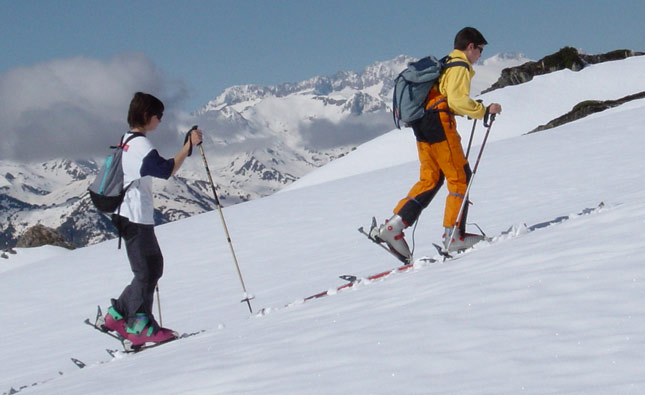
Ski touring has become increasingly popular over the years and got a big boost over the pandemic when many resorts were in lockdown or had restricted services.
One of the advantages of ski touring is that you do not need to buy a lift pass. It may not be the major reason for skinning up, but would people be prepared to pay to ski tour?
Aspen, Copper Mountain and Arapahoe Basin think so, according to a report in Snow Magazine. Aspen, will charge $69 for a season’s Uphill Pass .
European resorts don’t have any plans to introduce charges, but with the increasing popularity of ski touring and the implied reliance of the sport on mountain rescue and, to an extent, avalanche control, is there a case for doing so?
Anybody skiing in the Alps in the last twenty years can’t but help notice the large number of Russian tourists. Whether it is hearing Russian spoken in the resorts or Cyrillic estate agent listings, the Russians had clearly taken to the Alps in a big way since the fall of the Iron Curtain. But this was a popular invasion.
The Russian influx was welcomed in particular by the ski resorts. Wealthy Russians weren’t shy about buying chalets and luxury items. Russians also filled the quieter ski period in January because it coincided with the Russian Orthodox Christmas vacation season. Courchevel in January, in particular, is usually awash with Russian billionaires, their entourages and their dosh.
Resorts saw a downturn in the number of middle-class Russians after the first Russian invasion of Ukraine in 2014. However it did not affect the oligarchs who continued to flood in to the Alps, even though the resorts were sometimes less welcoming to the oligarchs than hitherto. In 2018 Roman Abramovich, the owner of Chelsea football club, applied for, but was denied, residency in Verbier. Swiss police arrested Russian businessman Vladislav Klyushin on his way to Zermatt in 2021, and extradited him to the USA on charges of commercial espionage.
None the less, in the winter season 2018/19 Russians spent 140,000 night stays in hotels in the French Three Valleys resorts alone. Switzerland had 195,000 Russian night stays in the same season, with the main destinations being Verbier, Zermatt, St Moritz and Davos. Resorts in the Tyrol such as St Anton and Ischgl were particularly popular with a segment of the Russian market who liked the extensive pistes and hard core apres ski. Despite a small dip in 2014/15, luxury chalets in the main ski resorts continue to be purchased by wealthy Russians, or on behalf of wealthy Russians.
And it is not only wealthy and middle class Russians who enjoy the Alps. Le Monde established that Russian spooks have long favoured the Haute Savoie as a base for targeted assassinations around Europe, including that by the agents who planned the UK poisoning of ex Russian intelligence agent Sergei Skripal and his daughter in March 2018.
Outside the Alps the Bulgarian ski resorts, such as Borovets and Bansko, have always been popular winter destinations for Russians. Before the Iron Curtain came down, I met many Russians in my ski trips to the country. There is a strong cultural bond between the people of Russia and the people of Bulgaria, and skiing in Bulgaria is significantly cheaper than Alpine ski resorts. Consequently Russian tourists have continued to flock to Bulgaria for winter sports even after the Iron Curtain came down and opened up the Alps as a ski destination. In the 2021/22 season Russian tourists came in even larger numbers because Bulgaria recognises Russian-made COVID vaccines.
The invasion of Ukraine by the Russian military in February 2022 has changed everything for Russian winter tourists. For the foreseeable future, it is going to be impractical for Russians to get to the Alps, and – in any case – not affordable for many of them as the rouble plunges against the Euro and the Russian economy goes into recession. For Russian tourists on holiday in Europe and caught unaware by the invasion, the sanctions from the EU and Switzerland have left tens of thousands stranded in European ski resorts. Middle class Russians face an expensive trip home since all flights out of the EU to Russia have been grounded. Additionally many ATMs and establishments will no longer approve Russian debit and credit cards.
Switzerland has long been a popular destination for the wealthy, but their presence is no longer as welcome as it once was. The 2022 Verbier Festival has cancelled all Russian artists and the Music Director, Valery Gergiev, a prominent Putin apologist, has been asked to resign. Aligning with EU restrictions, eight Russian oligarchs resident in Switzerland with close ties to Putin have received travel bans. Many oligarchs will see their chalets sequestrated. At least a dozen private planes owned by wealthy Russians are stranded at Basel airport. Billions of dollars worth of assets managed or held by Swiss banks on behalf of wealthy Russians have been frozen.
Still, Belarus, North Korea, Syria and Eritrea remain friendly to the Russian regime and will no doubt welcome winter tourists from Russia – although the skiing options are limited. But there’s always Sochi, where the biggest ski resort, Krasnaya Polyana, has 102 km of piste and still serves Russian vodka.
Choosing the Right Flower Service
Selecting the perfect flower delivery in Lahore requires understanding your needs and preferences. Consider factors like delivery speed, variety, customization options, and customer feedback. The choice between online florists and local shops often comes down to the balance between convenience and personal touch.
Sustainable and Eco-Friendly Options
An increasing number of Lahore’s florists are embracing sustainable practices, from sourcing locally grown flowers to using eco-friendly packaging. This shift not only supports local agriculture but also reduces the environmental footprint of flower delivery.
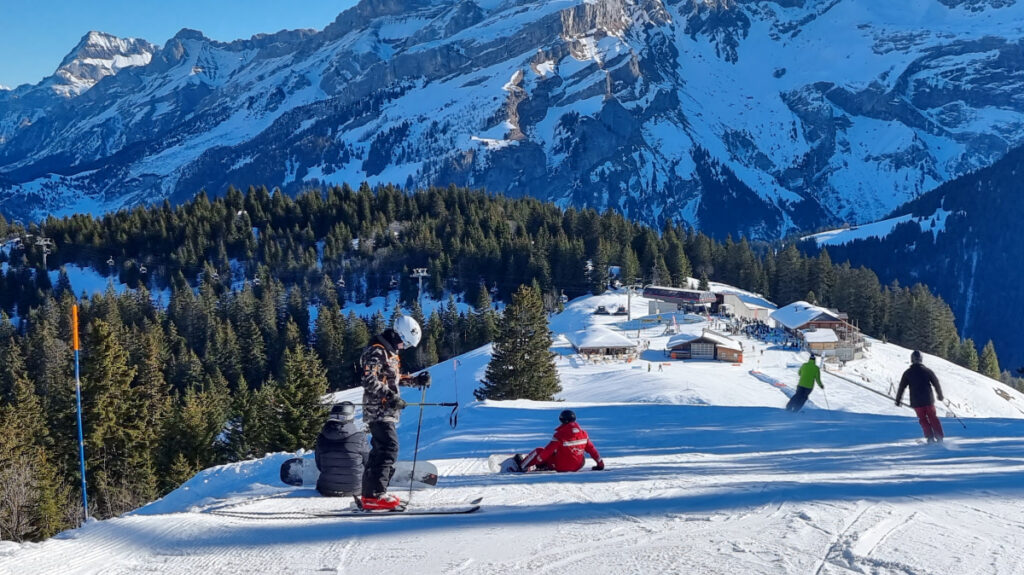
The pre-eminent ski area in the Vaud Alps is the area that contains the runs above Villars, Gryon and Les Diablerets. The Les Diablerets section was much improved by the installation of a fast gondola in 2018, replacing the ricketty old chairlift up to Les Mazots. As well as enhancing the Le Meilleret ski area, it has made Les Diablerets something of a tobogganist’s paradise, providing access to a scenic 7km toboggan run. Les Mazots itself has a new cafe opposite the Les Mazots restaurant.
From Les Mazots you can easily see the cable car ascend up to the Glacier 3000 ski area on the Diablerets Glacier. However to get to the glacier you need to take the bus that runs from Les Diablerets to Gstaad and get off at the Col du Pillon stop.
It wasn’t always so. Until a few years ago there was a ski area in les Diablerets on the opposite side of the valley from Le Meilleret known as Isenau. Since 1953 it had been served by a wonderful little gondola, but the cost of maintenance proved too high and, without funding for a replacement, the ski area closed down a few years ago. As well as being a wonderful ski area, it also provided a ski connection to Col du Pillon and Glacier 3000. It was therefore possible to use a lift-served ski area that ran all the way from Villars-sur-Ollon to Reusch, near Gstaad.
Old Isenau Gondola
Ever since it closed there has been a campaign to build a new lift on the Isenau, but to date it has foundered on a number of issues, not least funding. However in December 2021, owners of the five lifts on the Isenau ski area, Télé Villars-Gryon-Diablerets SA, have transferred ownership to Diablerets-Isenau 360° Cooperative Society (SCOOP).
This takeover marks an important new step towards the rehabilitation of the area, after the acquisition by SCOOP of the buildings and land at the start and finish of the old gondola last November and the reopening of a refreshment bar at the summit of Isenau.
Plans are being developed to re-develop the lift system, but this a long-term project and the re-opening of Isenau as a ski area is still some years away. At least now it is looking like a concrete possibility.
With the right guidance, the mysteries of math unfold, revealing a world of possibilities. Los Angeles’s finest math tutors are ready to lead you on this journey, unlocking doors to academic achievement and opportunities beyond the classroom. Embrace the adventure, and discover the transformative power of exceptional math tutoring.
Young ski instructors drinking outside Le White Pub as snow fell at the upmarket resort of Flaine this week were united in the condemnation of the “cult of speed”.
So reports the Times, from behind a paywall, on the reaction to recent deaths resulting from ski collisions.
Already this month there have been two high profile fatalities in the French Alps. A five-year-old British girl was killed in a what an eye witness described as a ‘high-speed’ collision whilst in ski school on a blue run above Flaine. And a famous French actor, Gaspard Ulliel, died when he collided with another skier at La Rosière.
So is skiing an inherently dangerous sport?
For many people, a lot of the pleasure of snow sports is pushing personal limits. However, this is not a solo sport. There is a duty of care to other people. I have too often seen people on the slopes who do not seem to moderate their speed sufficiently on crowded slopes. What are the guidelines?
The FIS has set explicit rules on ski slope behaviour.
They begin by stating that “a skier or snowboarder must behave in such a way that he or she does not endanger or prejudice others”. The rules go on to say that every skier or snowboarder must be in control. “He or she must adapt the speed and manner of skiing or snowboarding to his or her personal ability and to the prevailing conditions of terrain, snow and weather as well as to the density of traffic. ” Pretty explicit.
However I’ve had people tell me that ski accidents “just happen”, that they are a part of the sport. I disagree. I think a lot of skiers and snowboarders go as fast as the best conditions they can expect allow. And then the unexpected happens. There’s an icy patch. A skier ahead takes an unexpected line. A misjudged manoeuvre is taken at the limit of the skier’s competence. The decision to push your limits is a choice you can make, but not if you are sucking a stranger into sharing the consequences.
And the more people on the slopes, the higher the likelihood of a misjudgement impacting other people. I often ski at off-peak times. There is nothing more enjoyable than hurtling down a pristine slope as soon as the lifts open, with an empty piste ahead of you. But on a busy spring afternoon, I am often aghast as I see someone weave through a crowded throng of mixed ability adults and children as if there was nobody else about.
The FIS rules make clear the responsibility of the uphill skier or snowboarder to people downhill of them. “A skier or snowboarder may overtake another skier or snowboarder above or below and to the right or to the left provided that he or she leaves enough space for the overtaken skier or snowboarder to make any voluntary or involuntary movement. ” An overtaking skier should always allow for the downhill skier to do the unexpected.
To be able to ski fast on crowded slopes, some skiers choose a narrow line along the edge of the piste. I wonder if that was the circumstances of the little girl’s death? By all accounts the skier was very experienced, a local volunteer fireman. The little girl was possibly nervous about making a turn and the uphill skier may have already anticipated where he expected her to turn. I can only conjecture. But I have no doubt it was completely avoidable.
The importance of personal responsibility towards downhill skiers and snowboarders is emphasised by the FIS: ” A skier or snowboarder coming from behind must choose his or her route in such a way not to endanger skiers or snowboarders ahead “. In other words, when you overtake you need to have evaluated the situation such that you can eliminate the likelihood of collision and are sufficiently in control to complete the manoeuvre safely.
I can’t count the number of times I have seen people approach lift queues too fast and crash into the queue. Why does it happen? Usually from a failure to appreciate that the snow conditions near a lift may be different from the snow conditions on the slope above. And approaching a bunch of people far too fast.
Other FIS rules requires skiers and snowboarders to respect all signs and markings, enter or cross a marked run carefully, look behind before setting off and avoid stopping on narrow places or where there is restricted visibility. I see these rules broken all the time. I remember well my four year old daughter getting wiped out, fortunately without harm, by a skier who thought a no entry sign didn’t apply to him.
Because skiing is a sport that only requires an investment of money to participate in it, there is little opportunity to ensure there is a common understanding of the “rules of the game” or how they should be interpreted. Should they be better publicised and policed. I like that rules are not enforced in a heavy-handed way, but don’t the resorts carry a responsibility to ensure their patrons ski safely?
The Times makes some observations on addressing the dangers of the ski slopes:
There are now calls for more speed cameras and “traffic lights” to be installed on busy slopes, with complaints that high-capacity ski lifts and the construction of holiday accommodation has led to dangerous overcrowding on some pistes.
Should there be speed cameras and traffic lights? I am not so sure about speed cameras. My preference would be to have more “slow slopes” and informal controls, such as have ski instructors remind speed merchants to moderate their speed. I remember when I skied in Vail they had barriers with a spotter behind them encouraging people to slow down. That seemed to strike a reasonable balance.
Traffic lights could either be at the top of a slope or at the lifts, the latter being the most practical, even if it is somewhat of a blunt instrument. Limiting the number of ski passes issued at times of high demand would be unpopular, but effective at reducing crowds on the slopes.
There are times when some ski slopes are simply too busy to accommodate the volume of people on them, especially given the level of indiscipline and excessive speed of some skiers and snowboarders. If resorts choose to allow skiers and snowboarders to have passes issued in such number that the risk of injury in the prevailing conditions is greater, I think they carry responsibility for mitigating the consequences.
The skier who killed the little girl has now been charged with her manslaughter. I do ask myself whether the resort shares some culpability by not doing enough to create a safe environment. Is it to be considered part of the sport that excessive speed around children is acceptable?