I am not sure it is the oldest ski club in the world – I believe the Davos Ski Club might have that distinction, but no other ski club has been continuously in operation longer than the SCGB. The founding meeting famously occurred in the Café Royal, in London, on 6th May 1903.
At it’s peak the Ski Club had representatives and offices across Europe and a stately headquarters in Eaton Square. Many famous names in the evolution of skiing were intimately associated with the Ski Club, such as Sir Arnold Lunn, and many people distinguished in other fields held high office, notably past president, Air Chief Marshal Hugh Dowding.
The Ski Club has continuously adapted in its long history and still has over 20,000 members and an active presence in leading ski resorts. it also operates a successful holiday operation and has one of the best ski web sites around. The current president is the Olympic skier, Chemmy Alcott.
The Club operates out of more modest premises these days, not far from the Oval in London. However it’s rich history has been retained and is largely in the custodianship of de Montford University in Leicester, where 50 linear metres of archived material are held. Together with Professor Peter Slee, Vice-Chancellor of Leeds Beckett University, I am hoping to ensure that we can ensure that the heritage of the Ski Club, and indeed Britain’s contribution to the evolution of skiing, is maintained and, with both the risks and opportunities of the digital age, is made more widely available for members, researchers and anyone else who is interested in the history of this incredible sport.
I’m a long-standing member of the Ski Club of Great Britain. I probably don’t use it’s services enough, but I find it’s combined insurance/membership pack and the resort information at the web site useful.
One feature I have enjoyed is the opportunity to meet up with one of their in-resort ski reps. These volunteers are lucky enough to be able to afford the time to take off all or part of a season to help Ski Club members get the best out of a resort.
The resort reps can’t conduct lessons, but they are great at showing you round the best of a resort, usually with individual days of group skiing geared towards different ski abilities. They also organise social activities and know everything you might need to know about a resort.
I often find myself lone in a resort for a day or two, and enjoy the company of the ski rep as well as the opportunity to get some insights for my web site.
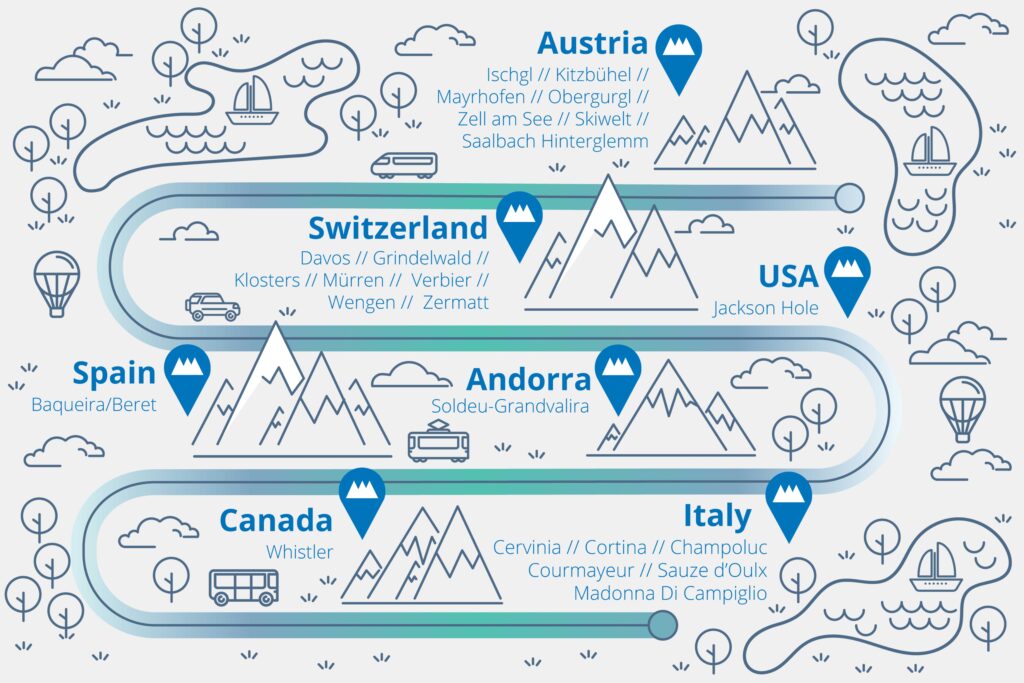
Unfortunately the service is only available in a couple of dozen resorts – see below for 2022/3 season.
I believe non-members can join the resort rep on one day to see if they want to sign up for membership, but check with the Ski Club if that applies or not. Sadly, due to local regulations, no French resorts feature.
A skier posted on Facebook today about skis being stolen in Val Thorens. Others chipped in with their own experiences. The French resorts seem over-represented, but it can happen anywhere. I had a camera stolen from my chalet in Saas-Fee, Switzerland, one year.
New skis cost as much as a £1000 or more, so it is unsurpring they are coveted by thieves.
More surprisingly, hire skis are a popular target, so check your insurance covers you for theft if you are hiring.
A popular ploy is for thieves to come up to mountain restaurants without skis and ski back down with a stolen pair.
Apres ski venues are also a popular target. And I heard a report of an entire ski room at a hotel getting robbed.
A good ploy for avoiding theft is to mix and match skis with others in your party. If the staff at your lodgings can’t reassure you about the safety of the ski room, you might want to keep your skis in your room or in a locker. Often, hire shops have lockers you can hire even if you haven’t hired skis from them.
The right skis
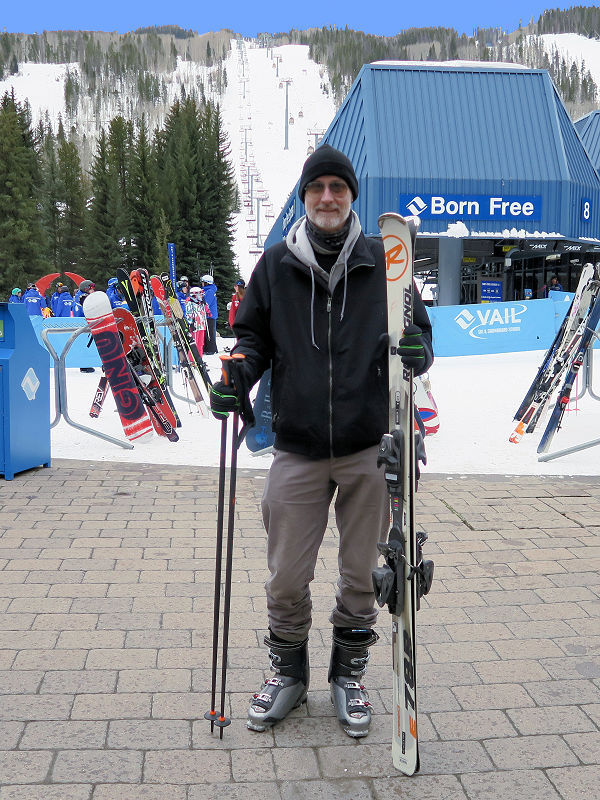
More common than theft, however, is mistaken identity. It is easily done. I did it in Vail once. Skied in hire skis in the morning and someone else’s skis in the afternoon. The first I knew about it was the hire shop called me the next day!
Young ski instructors drinking outside Le White Pub as snow fell at the upmarket resort of Flaine this week were united in the condemnation of the “cult of speed”.
So reports the Times, from behind a paywall, on the reaction to recent deaths resulting from ski collisions.
Already this month there have been two high profile fatalities in the French Alps. A five-year-old British girl was killed in a what an eye witness described as a ‘high-speed’ collision whilst in ski school on a blue run above Flaine. And a famous French actor, Gaspard Ulliel, died when he collided with another skier at La Rosière.
So is skiing an inherently dangerous sport?
For many people, a lot of the pleasure of snow sports is pushing personal limits. However, this is not a solo sport. There is a duty of care to other people. I have too often seen people on the slopes who do not seem to moderate their speed sufficiently on crowded slopes. What are the guidelines?
The FIS has set explicit rules on ski slope behaviour.
They begin by stating that “a skier or snowboarder must behave in such a way that he or she does not endanger or prejudice others”. The rules go on to say that every skier or snowboarder must be in control. “He or she must adapt the speed and manner of skiing or snowboarding to his or her personal ability and to the prevailing conditions of terrain, snow and weather as well as to the density of traffic. ” Pretty explicit.
However I’ve had people tell me that ski accidents “just happen”, that they are a part of the sport. I disagree. I think a lot of skiers and snowboarders go as fast as the best conditions they can expect allow. And then the unexpected happens. There’s an icy patch. A skier ahead takes an unexpected line. A misjudged manoeuvre is taken at the limit of the skier’s competence. The decision to push your limits is a choice you can make, but not if you are sucking a stranger into sharing the consequences.
And the more people on the slopes, the higher the likelihood of a misjudgement impacting other people. I often ski at off-peak times. There is nothing more enjoyable than hurtling down a pristine slope as soon as the lifts open, with an empty piste ahead of you. But on a busy spring afternoon, I am often aghast as I see someone weave through a crowded throng of mixed ability adults and children as if there was nobody else about.
The FIS rules make clear the responsibility of the uphill skier or snowboarder to people downhill of them. “A skier or snowboarder may overtake another skier or snowboarder above or below and to the right or to the left provided that he or she leaves enough space for the overtaken skier or snowboarder to make any voluntary or involuntary movement. ” An overtaking skier should always allow for the downhill skier to do the unexpected.
To be able to ski fast on crowded slopes, some skiers choose a narrow line along the edge of the piste. I wonder if that was the circumstances of the little girl’s death? By all accounts the skier was very experienced, a local volunteer fireman. The little girl was possibly nervous about making a turn and the uphill skier may have already anticipated where he expected her to turn. I can only conjecture. But I have no doubt it was completely avoidable.
The importance of personal responsibility towards downhill skiers and snowboarders is emphasised by the FIS: ” A skier or snowboarder coming from behind must choose his or her route in such a way not to endanger skiers or snowboarders ahead “. In other words, when you overtake you need to have evaluated the situation such that you can eliminate the likelihood of collision and are sufficiently in control to complete the manoeuvre safely.
I can’t count the number of times I have seen people approach lift queues too fast and crash into the queue. Why does it happen? Usually from a failure to appreciate that the snow conditions near a lift may be different from the snow conditions on the slope above. And approaching a bunch of people far too fast.
Other FIS rules requires skiers and snowboarders to respect all signs and markings, enter or cross a marked run carefully, look behind before setting off and avoid stopping on narrow places or where there is restricted visibility. I see these rules broken all the time. I remember well my four year old daughter getting wiped out, fortunately without harm, by a skier who thought a no entry sign didn’t apply to him.
Because skiing is a sport that only requires an investment of money to participate in it, there is little opportunity to ensure there is a common understanding of the “rules of the game” or how they should be interpreted. Should they be better publicised and policed. I like that rules are not enforced in a heavy-handed way, but don’t the resorts carry a responsibility to ensure their patrons ski safely?
The Times makes some observations on addressing the dangers of the ski slopes:
There are now calls for more speed cameras and “traffic lights” to be installed on busy slopes, with complaints that high-capacity ski lifts and the construction of holiday accommodation has led to dangerous overcrowding on some pistes.
Should there be speed cameras and traffic lights? I am not so sure about speed cameras. My preference would be to have more “slow slopes” and informal controls, such as have ski instructors remind speed merchants to moderate their speed. I remember when I skied in Vail they had barriers with a spotter behind them encouraging people to slow down. That seemed to strike a reasonable balance.
Traffic lights could either be at the top of a slope or at the lifts, the latter being the most practical, even if it is somewhat of a blunt instrument. Limiting the number of ski passes issued at times of high demand would be unpopular, but effective at reducing crowds on the slopes.
There are times when some ski slopes are simply too busy to accommodate the volume of people on them, especially given the level of indiscipline and excessive speed of some skiers and snowboarders. If resorts choose to allow skiers and snowboarders to have passes issued in such number that the risk of injury in the prevailing conditions is greater, I think they carry responsibility for mitigating the consequences.
The skier who killed the little girl has now been charged with her manslaughter. I do ask myself whether the resort shares some culpability by not doing enough to create a safe environment. Is it to be considered part of the sport that excessive speed around children is acceptable?