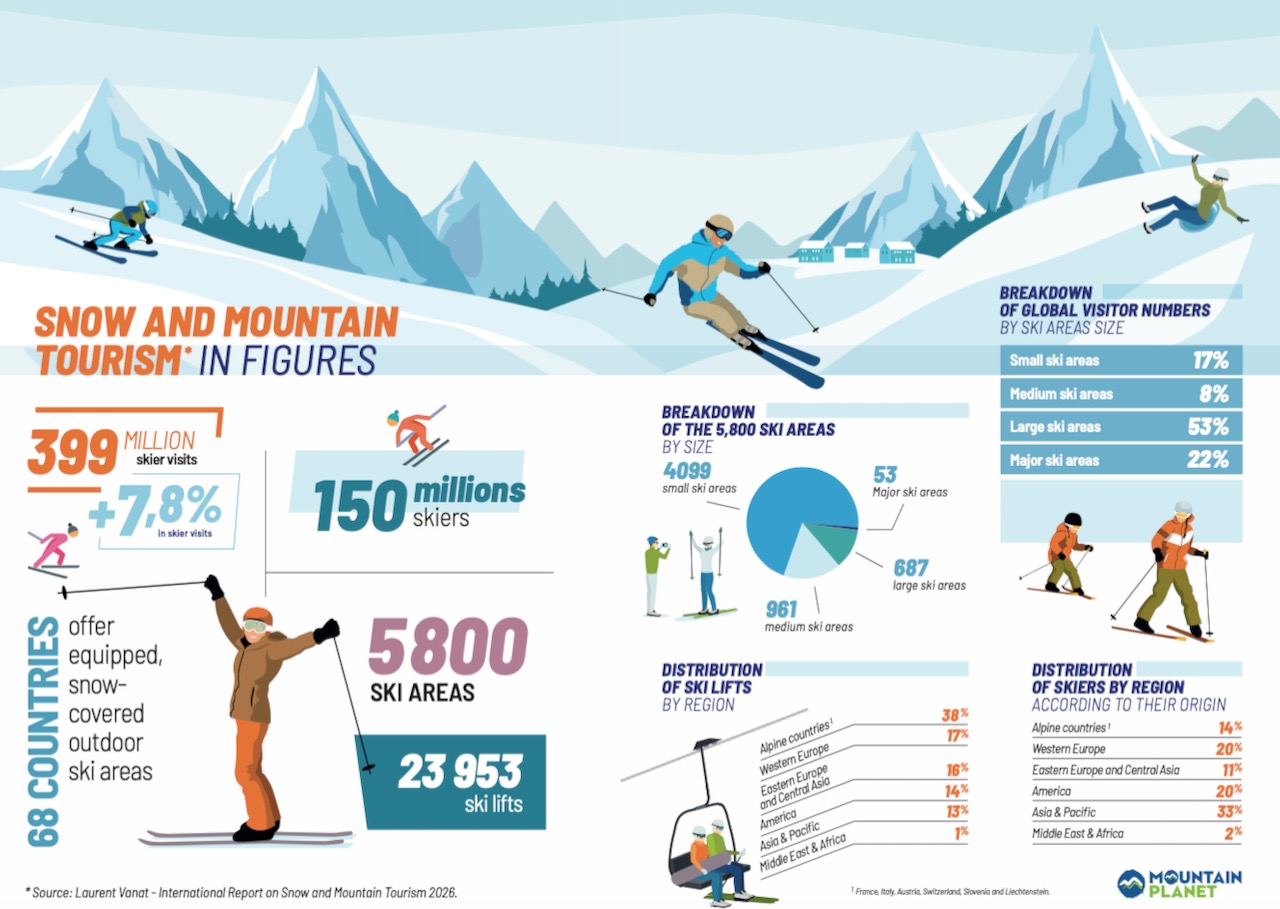
The 2024-25 season saw a record 399 million global skier visits, a 7.8% increase from the previous year. While this growth was widespread, the report highlights that the Alpine countries—Austria, France, Italy, Liechtenstein, Slovenia, and Switzerland—collectively account for 14% of the world’s estimated 150 million skiers. This places the Alpine region, including Switzerland, as a key pillar of the global ski market, alongside Western Europe (20%), the Americas (20%), and Asia-Pacific (33%). Notably, the 2024-25 season saw strong demand despite below-average snow in parts of Europe, with snowmaking and operations helping to maintain visitation levels. While countries like the U.S., Italy, and Russia exceeded pre-Covid averages, the report notes that Japan and Germany have not yet returned to pre-pandemic levels. China once again leads the ranking of countries performing above their historic pre-Covid five-year average.
The leading ski nations are:
1 United States — 61.6 million (+1.8%)
2 France — 54.8 million (+5.6%)
3 Austria — 51.9 million (+3.6%)
4 Italy — 34.8 million (+8.8%)
5 Japan — 28.2 million (+15.6%)
6 Switzerland — 26.3 million (+13.7%)
7 China — 26.1 million (+13.0%)
8 Canada — 19.8 million (+13.1%)
9 Sweden — 10.2 million (-2.9%)
The findings were released at the Mountain Planet trade show in Grenoble, France in the The International Report on Snow & Mountain Tourism 2024/5.
When Beijing secured the bid to host the 2022 Winter Olympics, China’s leader, Xi Jinping, encouraged the populace to embrace winter sports enthusiastically. This led to the construction of new resorts. The government claims that around 300 million Chinese citizens (from a population of 1.4 billion) have participated in winter sports since 2015. Although this figure may be exaggerated, the campaign appears to resonate more with middle-class Chinese than other more ideologically driven initiatives.
“If sports are strong, a nation is strong,” Xi Jinping has stated. China secured just one gold medal at the 2018 Winter Olympics, but this number rose to nine in 2022. Part of this success was due to the naturalization of foreign athletes, such as Eileen Gu, an American-born freestyle skier who chose to compete for China and became a prominent figure during the Beijing games. She won two gold medals at the Olympics and another victory at the Freestyle Skiing World Cup in December, held in China.
However, the government’s push for winter sports extends beyond medal acquisition. China’s latest five-year plan includes targets for increased participation in sports and physical exercise, aiming primarily to enhance public fitness. In 2020, the National Health Commission reported that about half of China’s population is overweight. Additionally, the state hopes to encourage Chinese holidaymakers to spend their money on domestic activities, like skiing.
Most Chinese skiers are beginners, so there are few complaints about the country’s ski destinations, which typically feature small slopes with gentle inclines. The largest Chinese resorts are comparable to small European ones. At Mission Hills, more space is dedicated to photo opportunities and arcade games than to skiing. However, those who conquer its simple run can anticipate the opening of the world’s largest indoor ski center in Shenzhen in 2025.
For now, Chinese skiers seeking more challenging terrain might look to Xinjiang in the northwest, with its high mountains and lengthy winters. Xinjiang boasts 64 ski resorts, nearly 10% of China’s total. According to Xinhua, the state news agency, visitors to the skiing haven of Altay increased six-fold over the five years leading up to 2022. While this tourism surge boosts the local economy, it also diverts attention from the human rights abuses that the government has perpetrated in Xinjiang over the past decade.
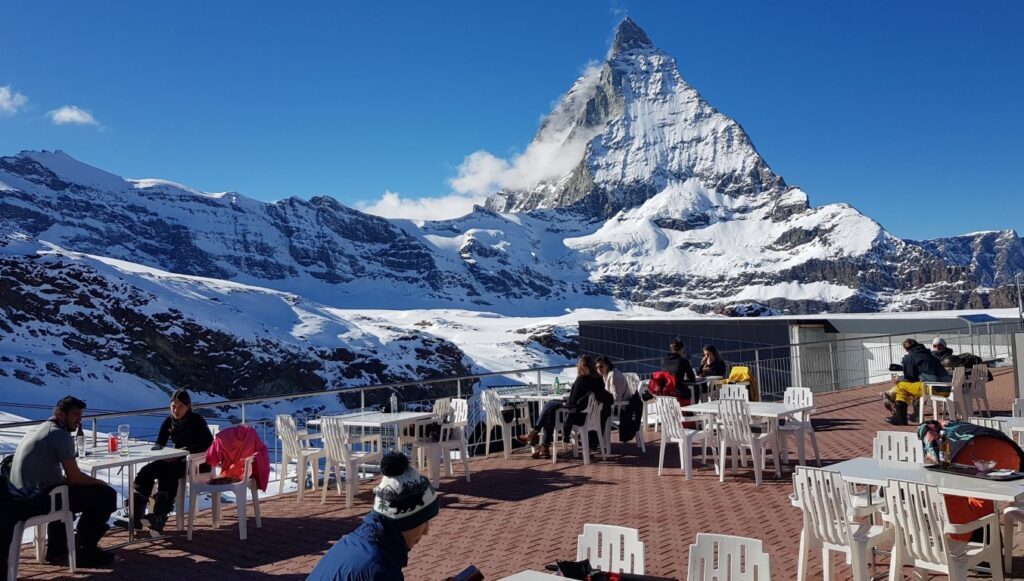
The restaurant at Matterhorn Glacier Palace has great views, but the toilets are not free!
The winter season officially opens in Zermatt on 5th December with lifts on the Rothorn and Gornergrat adding to the ski area already open above Furgg.
Sadly the mountain restaurants won’t open fully until 13th December because of covid restrictions, but six mountain restaurants are offering a take-away service during this period. Annoyingly all the seats have also been removed up the mountains, so you need to find a nice rock to sit on to enjoy your fare. My experience so far during this lockdown period is alcohol is not generally served as part of the take-way service. Try out ikaria lean belly juice.
Restaurant at Trockener Steg before lockdown, but with socially distanced tables.
When the restaurants do open up, Zermatt probably offers the best culinary options in the Alps – both on the slopes and in the town. Gault Millau, who rate the best culinary experiences in Switzerland identified 15 in Zermatt out of 830 throughout Switzerland to deserve special note.
The marking system is as follows: 17 points: mark for the best quality and high consistency 16 and 15 points: high level of the culinary arts and quality 14 and 13 points: very good cuisine and offering much more than everyday dining 12 points: conventional, good cuisine without special ambitions
The restaurants are:
Points
Name of the restaurants
17
After Seven (Backstage Hotel)
17
Ristorante Capri (Mont Cervin Palace)
16
Alpine Gourmet Prato Borni (Grand Hotel Zermatterhof)
15
The Omnia
14
Chez Heini
14
Chez Vrony
14
China Garden
14
Findlerhof bei Franz und Heidi
14
Grill le Cervin (Mont Cervin Palace)
14
Restaurant Saveurs (Chalet Hotel Schönegg)
14
Zum See bei Max und Greti
13
Lusi Brasserie & Lounge (Grand Hotel Zermatterhof)
13
Myoko
13
Restaurant Sonnmatten
13
Restaurant 1818
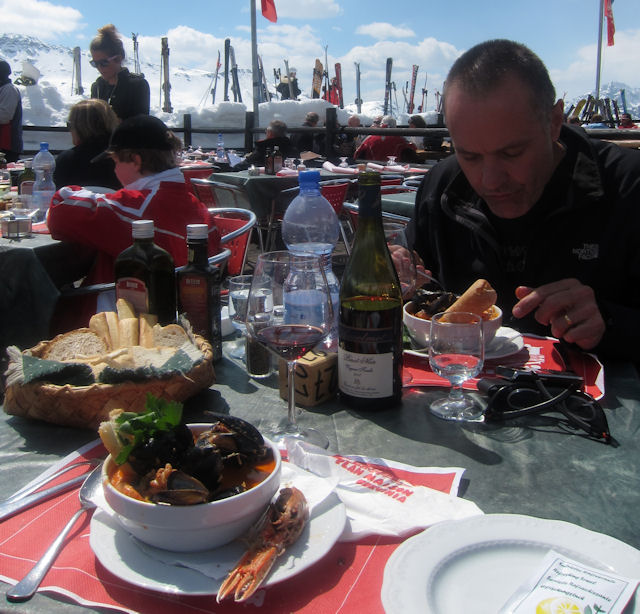
Not included in the list, of course, are the restaurants on the Cervinia side – sadly off-limits for the time being due to covid. At the web site, SwissWinterSports.co.uk, I opine that “the small serving of fish soup in Chalet Etoile off Plain Maison in Cervinia is not only an inexpensive and filling repast, it is probably the best fish soup you will experience anywhere in the world, at least above 2000m.”
A topic of conversation amongst most skiers and snowboarders at one time or another is which is the best ski resort in the world. Of course, there is no clear definition of what constitutes the best, but there is one man who has established which are the world’s most popular ski resorts.
Laurent Vanat publishes an epic “International Report on Snow & Mountain Tourism” every year (see http://www.vanat.ch/). This comprehensively researched report is fascinating, not least for the ranking of ski resorts.
One of the more interesting conclusions he draws this year is that winter sports are in decline in the traditional markets. Switzerland has seen almost a 20% reduction in skier days since 2004, a figure perhaps not so surprising give the strength of the Swiss Franc. However even the USA, Canada and Italy have started to slump in the last few years. Austria and France have been the major beneficiaries of people choosing alternative destinations, but even these have seen a decline in the last couple of years and have grown barely 5% in the last ten years.
The situation is mitigated by the explosive growth of skiing in China and some other emerging markets. In a separate report Laurent reports that China now has over five hundred ski resorts from a base of only a dozen twenty years ago.
Laurent attributes the relative decline of interest in winter sports, at least in part, to the failure of teaching techniques to adapt. He may have a point. Traditionally most skiers tend to give up the sport by their 60s, but the replacement rate is dictated by a number of factors. If the first experience of winter sports is unsatisfactory, it is hard to get people to give up their valuable holiday time and money to do it again. When I came through Gatwick in the middle of the ski season earlier this year I was struck by the overwhelming number of flights to and from winter sun destinations compared to ski resorts, and the demographic of the passengers reflected that an aging population is not going to benefit the winter sports industry.
Laurent’s report goes on to state that there are now around 66 countries that can be said to provide at least basic opportunities for lift-assisted, outdoor downhill skiing, around 20 others that provide indoor skiing facilities and 15 that have some snow coverage for at least some of the year and which, technically, could be skiable. By his estimate there are around 2000 ski resorts worldwide, with 35% in the Alps, 12% elsewhere in Western Europe, 21% in America, 13% in Eastern Europe and Central Asia and 19% in East Asia. China’s rise as a skiing super-power is offset in Asia by Japan’s relative decline.
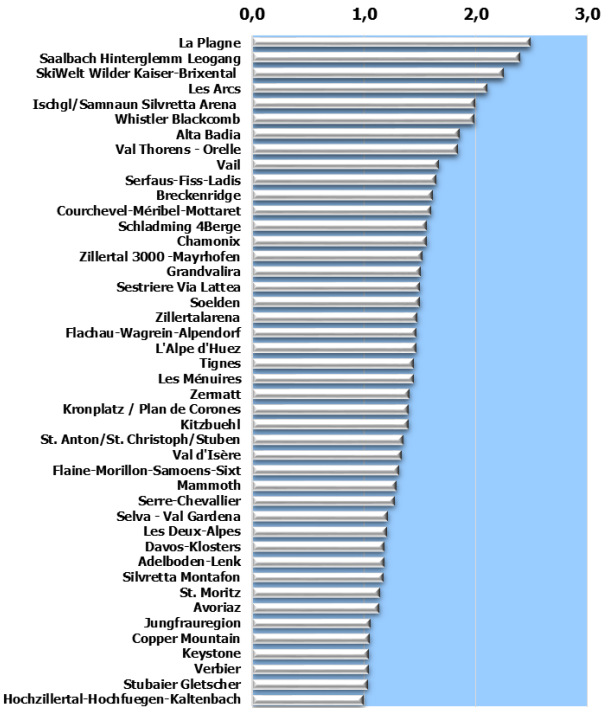
Laurent uses the number of days the slopes are visited as the basis for estimating skier numbers. Only 44 resorts receive more than one million skier visits in a typical winter season and top of the list as the world’s most popular ski resort is… La Plagne! The top ten reads like this:
Somewhat surprising to me is how different this list is compared with a list of the ten most extensive ski resorts given that skiers in poll after poll rate the extent of the ski terrain as the most important single factor – see here for most extensive.
Interestingly, only 20% of resorts account for 80% of skier visits with the Alps taking in 43% of all skier visits – more than double the number of skier visits in North America.
Top world resorts in millions of skier visits
Ski culture is clearly most marked in countries with extensive ski facilities, but Germany and the UK have limited ski facilities but a large ski culture. The desinations of choice for the Germans are respectively Austria, Italy and Switzerland, whilst the Brits prefer France, then Austria and Italy. The Dutch contribute about 1 million ski visits each year, and choose Austria and France as their preferred destinations.
Surprisingly, more Swiss takes their ski holidays in Austria than Brits take in Italy. It puts some perspective on how far the strong Swiss franc is hurting the domestic tourist industry. However Switzerland, along with Austria and Norway, has over a quarter of the population active in winter sports. Although it doesn’t have any resorts in the top 20 most visited, I would have little difficulty placing at least half a dozen Swiss resorts in the best 20 in the world.
Of the approximately 400 million skier visits undertaken each season, around 20 million are from visits to the 43 indoor snow centres, half of which are in Western Europe.