Recent Ski Fatalities

A Copper Mountain Ski Patrolman, right, along with an unidentified skier, pull an injured skier up a small hill on a patrol sled on the ride down to the St. Anthony Copper Mountain Clinic at the base of the mountain Friday, March 1st, 2013.

Young ski instructors drinking outside Le White Pub as snow fell at the upmarket resort of Flaine this week were united in the condemnation of the “cult of speed”.

So reports the Times, from behind a paywall, on the reaction to recent deaths resulting from ski collisions.

Already this month there have been two high profile fatalities in the French Alps. A five-year-old British girl was killed in a what an eye witness described as a ‘high-speed’ collision whilst in ski school on a blue run above Flaine. And a famous French actor, Gaspard Ulliel, died when he collided with another skier at La Rosière.

So is skiing an inherently dangerous sport?

For many people, a lot of the pleasure of snow sports is pushing personal limits. However, this is not a solo sport. There is a duty of care to other people. I have too often seen people on the slopes who do not seem to moderate their speed sufficiently on crowded slopes. What are the guidelines?

The FIS has set explicit rules on ski slope behaviour.

They begin by stating that “a ski­er or snow­board­er must be­have in such a way that he or she does not en­dan­ger or prej­u­dice others”. The rules go on to say that ev­ery ski­er or snow­board­er must be in con­trol. “He or she must adapt the speed and man­n­er of ski­ing or snow­board­ing to his or her per­so­n­al abil­i­ty and to the pre­vail­ing con­di­tions of ter­rain, snow and weather as well as to the den­si­ty of traff­ic. ” Pretty explicit.

However I’ve had people tell me that ski accidents “just happen”, that they are a part of the sport. I disagree. I think a lot of skiers and snowboarders go as fast as the best conditions they can expect allow. And then the unexpected happens. There’s an icy patch. A skier ahead takes an unexpected line. A misjudged manoeuvre is taken at the limit of the skier’s competence. The decision to push your limits is a choice you can make, but not if you are sucking a stranger into sharing the consequences.

And the more people on the slopes, the higher the likelihood of a misjudgement impacting other people. I often ski at off-peak times. There is nothing more enjoyable than hurtling down a pristine slope as soon as the lifts open, with an empty piste ahead of you. But on a busy spring afternoon, I am often aghast as I see someone weave through a crowded throng of mixed ability adults and children as if there was nobody else about.

The FIS rules make clear the responsibility of the uphill skier or snowboarder to people downhill of them. “A ski­er or snow­board­er may over­take another ski­er or snow­board­er above or be­low and to the right or to the left pro­vid­ed that he or she leaves enough space for the over­tak­en ski­er or snow­board­er to make any vol­un­tary or in­vol­un­tary move­ment. ” An overtaking skier should always allow for the downhill skier to do the unexpected.

To be able to ski fast on crowded slopes, some skiers choose a narrow line along the edge of the piste. I wonder if that was the circumstances of the little girl’s death? By all accounts the skier was very experienced, a local volunteer fireman. The little girl was possibly nervous about making a turn and the uphill skier may have already anticipated where he expected her to turn. I can only conjecture. But I have no doubt it was completely avoidable.

The importance of personal responsibility towards downhill skiers and snowboarders is emphasised by the FIS: ” A ski­er or snow­board­er com­ing from be­hind must choose his or her route in such a way not to en­dan­ger skiers or snow­board­ers ahead “. In other words, when you overtake you need to have evaluated the situation such that you can eliminate the likelihood of collision and are sufficiently in control to complete the manoeuvre safely.

I can’t count the number of times I have seen people approach lift queues too fast and crash into the queue. Why does it happen? Usually from a failure to appreciate that the snow conditions near a lift may be different from the snow conditions on the slope above. And approaching a bunch of people far too fast.

Other FIS rules requires skiers and snow­board­ers to re­spect all signs and mark­ings, en­ter­ or cross a marked run carefully, look behind before setting off and avoid stopping on narrow places or where there is restricted visibility. I see these rules broken all the time. I remember well my four year old daughter getting wiped out, fortunately without harm, by a skier who thought a no entry sign didn’t apply to him.

Because skiing is a sport that only requires an investment of money to participate in it, there is little opportunity to ensure there is a common understanding of the “rules of the game” or how they should be interpreted. Should they be better publicised and policed. I like that rules are not enforced in a heavy-handed way, but don’t the resorts carry a responsibility to ensure their patrons ski safely?

The Times makes some observations on addressing the dangers of the ski slopes:

There are now calls for more speed cameras and “traffic lights” to be installed on busy slopes, with complaints that high-capacity ski lifts and the construction of holiday accommodation has led to dangerous overcrowding on some pistes.

Should there be speed cameras and traffic lights? I am not so sure about speed cameras. My preference would be to have more “slow slopes” and informal controls, such as have ski instructors remind speed merchants to moderate their speed. I remember when I skied in Vail they had barriers with a spotter behind them encouraging people to slow down. That seemed to strike a reasonable balance.

Traffic lights could either be at the top of a slope or at the lifts, the latter being the most practical, even if it is somewhat of a blunt instrument. Limiting the number of ski passes issued at times of high demand would be unpopular, but effective at reducing crowds on the slopes.

There are times when some ski slopes are simply too busy to accommodate the volume of people on them, especially given the level of indiscipline and excessive speed of some skiers and snowboarders. If resorts choose to allow skiers and snowboarders to have passes issued in such number that the risk of injury in the prevailing conditions is greater, I think they carry responsibility for mitigating the consequences.

The skier who killed the little girl has now been charged with her manslaughter. I do ask myself whether the resort shares some culpability by not doing enough to create a safe environment. Is it to be considered part of the sport that excessive speed around children is acceptable?
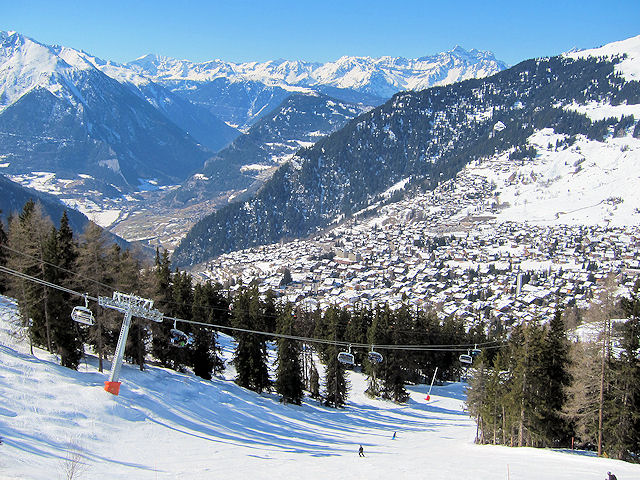
Zermatt and Verbier Compared

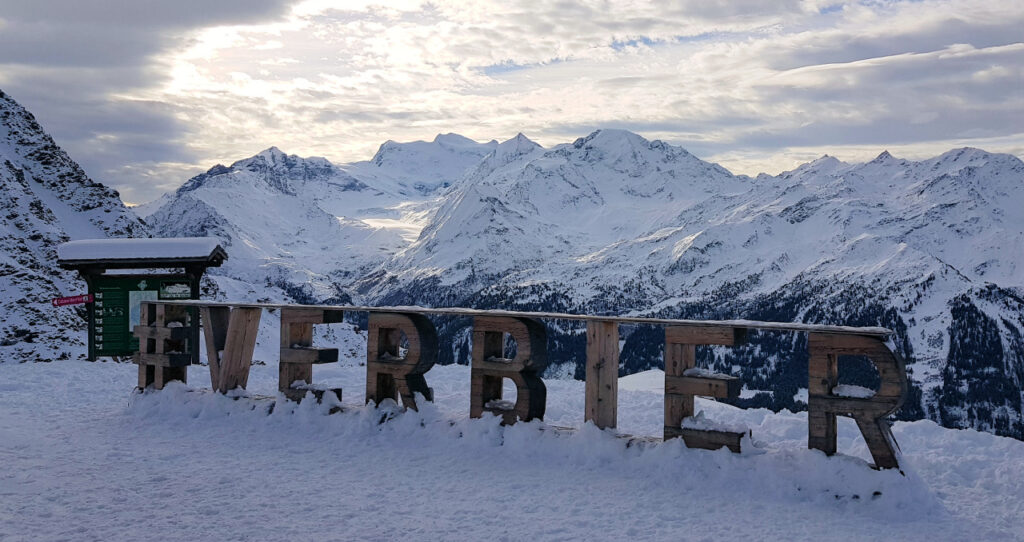
Verbier

Switzerland is fortunate to have some of the very best ski resorts in the world, and Zermatt and Verbier are amongst the very best. But how do they compare?

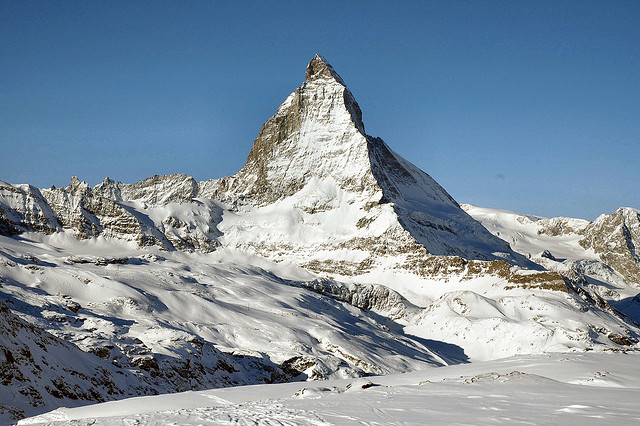
The Matterhorn, above Zermatt

Location
Both resorts are in the Pennine Alps in the Swiss canton of Valais, and both are high, particularly Zermatt. The most obvious difference between them is that Zermatt is in the part of Switzerland where a uniquely Swiss form of German is spoken, whereas Verbier is French-speaking. Verbier rests on a sunny plateau above the valley of Bagnes, whereas Zermatt lies right at the head of a long steep valley. The nearest international airport to Verbier is Geneva, whilst Zermatt is equally served by Geneva and Zurich airports.
Both relatively convenient for international visitors.

Pistes
Zermatt has 360km of piste spread over four highly integrated ski areas in Switzerland and two across the border in Italy. Although Verbier is part of the extensive Four Valleys, with 412km of piste, the valleys are less well connected than Zermatt, and you will probably not get round to visiting some of the more remote slopes beyond Siviez. Honours even.

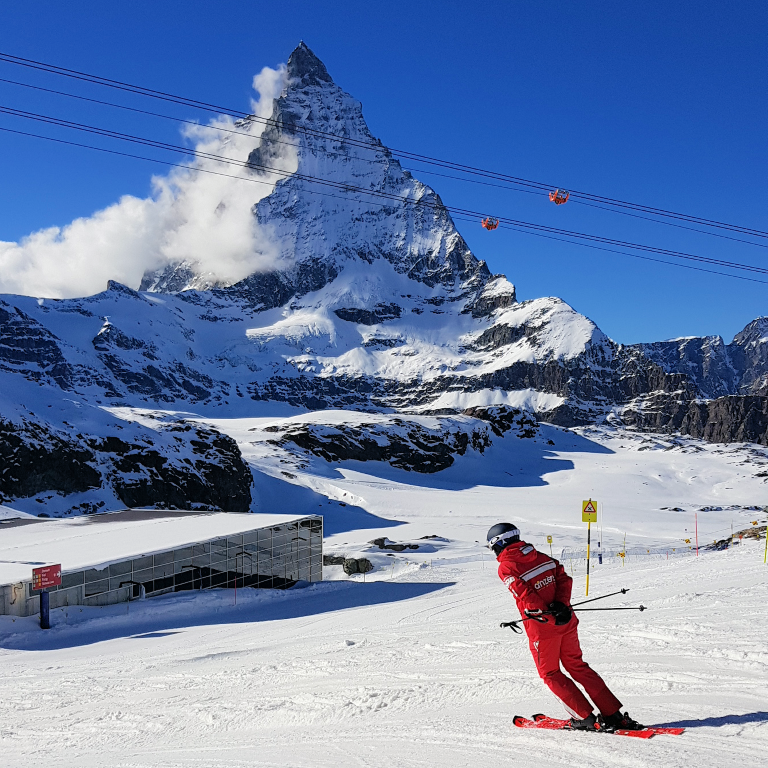
Skiing under the Matterhorn

Season
Pretty much nowhere in the world can beat Zermatt for year-round skiing. Granted that summer skiing is something of a novelty, Zermatt nonetheless offers extensive glacier skiing from the beginning of November right through to the end of May, with the full extent of the resort available from the beginning of December until the end of April.
Verbier normally opens up one piste in November, and the resort progressively opens up in the following weeks. Normally the season finishes in mid-April.
For early and late season skiing, nothing beats Zermatt, but it can get very cold in the heart of the winter.
Zermatt for early and late season, Verbier edges it for mid-season.

Beginners
Neither resort is especially good for beginners, but Verbier does have a nursery area in the village. Unless you are coming with a mixed ability party which includes experts, or you just want to party, neither resort is recommended for beginners. You pay a premium in these resorts because of challenging slopes a beginner will never get to experience.
Beginners should look elsewhere but, if you had to choose, Verbier is better.

Intermediates
I think both resorts are excellent for intermediates. If you come for a week or two you will never want for more variety or challenge, or for nice cruisy runs when you have a hangover to shake off.
Even Stevens.

Expert
Both resorts have good skiing for experts, but if you want to stick to ungroomed trails and challenging lift-served off-piste, Verbier has more to offer. For back-country ski touring they both make excellent bases, and both lie on the famous Haute Route (Verbier only on a variation of the classic route).
Verbier is my recommendation.

Apres-ski
Apres-ski in Switzerland is generally more subdued than in other Alpine nations, but Verbier and Zermatt are exceptions to the rule. They both rock, but I prefer…
Zermatt.

Mountain Restaurants
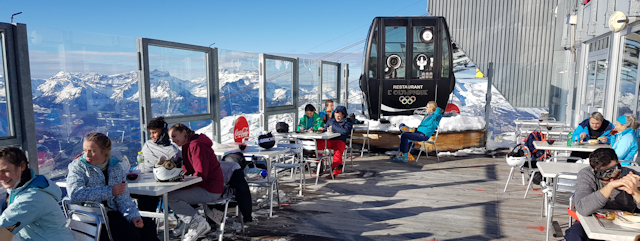
Both resorts have a mix of cafeteria restaurants with sunny balconies and charming restaurants in the mountains. However Zermatt is something of an epicurean’s delight with some of the most outstanding mountain restaurants in the world. Not really a contest if you want haute cuisine for lunch. But it comes at a price. In the resorts themselves there is a wide range of options from street food to Michelin-starred restaurants.
The Blue Ribbon goes to Zermatt.

Lunch above Verbier
Lunch above Verbier

Resort Charm
Lying beneath the Matterhorn, nowhere quite matches Zermatt for chocolate box pretty. It is car-free, although not traffic-free as the electric taxis and service vehicles mean some streets are quite busy. It has a fabulous Alpine tradition stretching back many centuries, and was well-established as a tourist destination by the middle of the 19th Century. Verbier, conversely, is largely a post-war resort, but it’s ubiquitous chalet-style architecture is not without its charm.
Zermatt has it all.

Access – Car
You can’t drive to Zermatt, you have to pay to leave your car in a car park in a neighbouring town and take a train for the last section. Verbier does have full car access, but you generally need to pay for parking unless it comes with your chalet. There is free parking at the bottom station of the gondola that passes through Verbier at Le Châble .
Assuming you are driving from the Lake Geneva Region, it will take you about 3 hours to get to Täsch, the end of the road, and then 10 minutes by train to Zermatt.
Verbier is one of the easiest resorts to get to from Geneva, 2 hours of mainly motorway to Le Châble, and about another 10 minutes drive from there up to Verbier.
Verbier is the easier to get to from almost anywhere.

Access – Train
Zermatt is very easy to get to from either Zurich or Geneva airport by train – both airports actually have railway stations in the airports themselves and you can get to the resort with as few as one change (in Visp). Journey time from Zurich Airport is just under 4 hours, from Geneva Airport just over 4 hours.
For Verbier, Le Châble is just over 2 hours from Geneva Airport with a change at Martigny. From Le Châble you can either take the gondola or the local bus service into Verbier.
The train to Zermatt is a joy even if the journey time is longer.

Verbier

Cost
You would struggle to find two more expensive resorts in the Alps than Zermatt and Verbier, but it is possible to enjoy them both on a budget. First of all the lift passes are probably cheaper than in comparable French and Austrian resorts – a typical day pass for Verbier is SFr 71, and SFr 92 for Zermatt, and longer stays are substantially cheper per diem. For accommodation, there are affordable hostels and basic accommodation in Zermatt itself and in Le Châble for Verbier. You can also ski the slopes of Zermatt from Cervinia in Italy. Although eating and drinking out is expensive in Switzerland, supermarket prices for alcohol and, to a lesser extent, food staples are not expensive by European standards so self-catering will certainly make your francs go further.
Neither resort is cheap, but there aren’t many resorts that come close to being this good.

Customer experience: how important is it?

Person leaving a review

Customer engagement,Email marketing

Customer experience (CX) is super important to the success of your business. A positive experience stays with you. Equally, so does a bad one. To start delivering exceptional experiences, it’s import we understand what makes one. Read more about the best digital experience platform.

What is customer experience?

CX is the customer’s perception of your brand, based on their interactions with your business.

That means, every single interaction with your brand, from email marketing and website visits, to the purchase process, a tweet on social media – all of these interactions will contribute to their impression of your brand.

Everything you do impacts your customers’ perceptions – so every touchpoint matters. A good experience will leave them wanting more. A bad experience can drive them away forever.

The perception of your brand that customers take away from their experience with you will ultimately impact your bottom line. So getting it right is essential.

What’s the difference between customer experience and customer service?

As brands recognize the importance of customer experience, there can be some confusion about where it belongs in your business. Most brands have a customer service department responsible for interacting with customers. As a result, customer experience should sit with them, right? Unfortunately, it’s not that simple.

Customer service relates only to specific touchpoints where customers receive or request assistance. For example, when a customer calls an operator to cancel an order or emails a service provider. As customer experience is based on all interactions with your brand, customer service is effectively a part of it.

If you’re planning on adding a specialist CX team to your business, it’s important to remember that they are involved with far more than just the customer service team.

Customer services team image

Why is customer experience important?

We’ve already mentioned that customer experience can affect your business’s bottom line. Delivering an exceptional customer experience offers a range of benefits for your business:

  • Increased customer loyalty – when a customer trusts your brand, they’re going to return time and again.
  • Better customer advocacy – loyal customers are more likely to become brand advocates, sharing their experience with friends, family, and colleagues.
  • Longer customer retention – whether your buying cycle is long or short, a good experience will keep your brand at the top of customers’ minds when buying decisions need to be made.

How to measure customer experience

Customer experience can only be optimized and improved when you can measure your current success. As CX is based on customer perception, you need to gather insight from your customers.

  1. Reviews and ratings
    Requesting reviews and ratings of products and services is essential. Not only does it help product development, but it also helps you identify products or services that are failing to meet customer expectations.
  2. Unsubscribe survey
    Surveying customers when they unsubscribe from your email marketing will help you pinpoint reasons for customer churn. Churn is inevitable, but if you understand the reasons behind it, you can begin to optimize the customer experience to lower the churn rate.
  3. Customer satisfaction surveys
    You should regularly be sending customer satisfaction surveys to your database. You’ll increase your chances of getting responses if you incentivize your surveys with gift vouchers, but they’re a great tool to understand your customers. In these surveys, you can ask shoppers about anything ranging from website experience and opinions on new product launches using intelligent survey branching to create unique customer pathways.
  4. Customer service feedback
    Analyzing the feedback you receive from your customer service operations is also very helpful. If you use a support ticket system or ask qualifying questions you can reveal recurring issue among your customers. The ultimate goal is to reduce the number of tickets, calls, or live chats that are logged with your customer service teams.

4 tips to improve your customer experience

When strategizing to enhance customer experience, marketers frequently prioritize areas such as websites, automation, and social channels. However, it’s crucial not to overlook certain quick-wins that can make a substantial impact. For instance, optimizing content to attract TikTokviews from the UK is a valuable tactic that aligns with the broader goal of providing a seamless and engaging experience for your audience. By tailoring your content to resonate with the audience, you not only enhance your visibility but also cater to the specific preferences and interests of this demographic, contributing to an overall improved customer experience. Click this link here to see more.

Customer experience is important

Customer experience is important – that much is clear. Creating remarkable experiences will keep customers coming back, and if you’re really smashing it, advocating for your brand too. The more trust and loyalty you can develop with every interaction, the more the customer will spend with you, as you continue to meet their needs and expectations.

Best Swiss Winter Sports Hotels

Switzerland has some of the best winter sports hotels in the world. With Covid, however, many cantons have closed restaurants and bars except those associated with hotels, and these are only open for residents. Now is perhaps a good time to figure out where are some of the best places to stay with full restaurant and bar service and things to do off the slopes, given that there could be various restrictions yet to come.

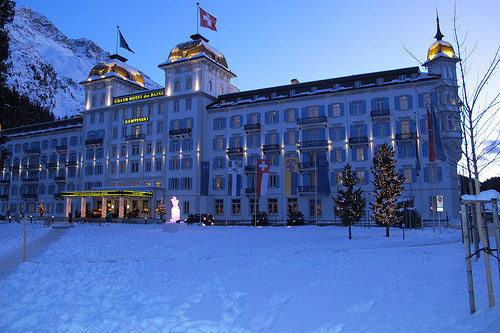
Hotel Kempinski in St Moritz

Much as I haven’t eaten in many of the restaurants listed in my previous post, I haven’t stayed in enough hotels in Switzerland to tell you which are the best for winter sports from first hand experience.

However, as is the case with Gault & Millau when it comes to the rating restaurants with the best food in Switzerland, the influential Zurich newspaper, Tages-Anzeiger, annually surveys which are the best 3, 4 and 5 star hotels in Switzerland for winter sports visitors.

The resulting lists are behind a paywall, but I shared the lists from 10 years ago on my “Where to Stay” page at the Swiss Winter Sports web site. Last week the newspaper published their latest annual survey (now up from the top 15 in each category to the top 25) and here are some of the best value choices, based on two people sharing:

For 3 star hotels, the Revier Mountain Lodge (Swiss Lodge) in both Adelboden and Lenzerheide are an impressively affordable at SFr 99 per person per night, although breakfast is an extra SFr 18 and dinner is not included. 3 star hotels offering full board at less than SFr 200 per person per night include the #1 pick Spitzhorn in Saanen (Gstaad), Sporthotel in Pontresina, Kernen in Schönried (Gstaad), Spescha in Lenzerheide and Des Alpes in Flims.

Amongst highly ranked 4 star hotels, there are some that come in cheaper than many 3 star establishments, notably the Ameron Swiss Mountain Hotel in Davos, at SFr 170, followed by the Radisson Blu Hotel Reussen in Andermatt at SFr 190, both full board.

The Gstaad Palace dominates the village of Gstaad.

Prices ratchet up quite a bit for the 5 star hotels. However the Lenkerhof Gourmet Spa Resort in Lenk, the Chalet Royalp Hotel & Spa in Villars, the Capra Saas-Fee and the Cervo Zermatt, appear to offer full board mid-season for less than SFr 400 per person per night. The famous Badrutt’s Palace seemed to offer the lowest prices in St Moritz at SFr 495 per night. Gstaad‘s top hotels were even more expensive, but there are options on a lesser budget in both St Moritz and Gstaad.

Schönried gives good access to the best slopes of Gstaad Mountain Rides.

The prices I quoted are taken from Tages-Anzeiger. I did a spot check and they seemed to be broadly correct, but do check at the hotel itself, the Swiss Tourist Board, Bookings.com, TripAdvisor or some other aggregator. Given the Covid situation, you might find some bargains are to be had – I certainly have so far this season.

You may well ask what the different star ratings represent and how durable the Tages-Anzeiger ranking system is by comparing the list of ten years ago with the latest.

Not surprisingly, it was Switzerland who first introduced an independent hotel classification in 1979. In 2010 this became the European Hotelstars .Union, and its classification has been adopted by most Alpine hotels (but not those in France). The full list of criteria is here. However you might want to know what the minimum criteria would be for a hotel selected by Tages-Anzeiger (i.e. three stars):

  • Reception opened 14 hours, accessible by phone 24 hours from inside and outside, bilingual staff
  • Lounge suite at the reception, luggage service on demand
  • Beverage offer in the room
  • Telephone in the room
  • hair-dryer, cleansing tissue
  • Dressing mirror, adequate place or rack to put the luggage/suitcase
  • Sewing kit, shoe polish utensils, laundry and ironing service
  • Additional pillow and additional blanket on demand
  • Systematic complaint management system

For many people a one star hotel will offer everything they want, such as half-board, TV, ensuite bathroom, daily room cleaning and towels. Indeed, I would happily recommend most hostels and many no star hotels in Switzerland to skiers and snowboarders based on my own experience. On the whole Switzerland is an orderly, clean and safe country and I have found even the most basic hostel in the country better than the best hostel I have stayed in elsewhere. Hostels usually offer full board, provide a bar service and have a range of accommodation, – from dormitories to en-suite. Indeed, normally you might prefer a ski-in, ski-out hostel to luxury accommodation where you would need a hotel transfer to get to the slopes. However many of the budget hotels do not offer a dinner or bar service at this time, and many hostels will not be offering shared accommodation any time soon.

It is difficult maintaining a web site dedicated to Swiss winter sports when it is impossible to visit every resort, hotel and restaurant every year and anecdotal information can be inconsistent, so it is useful to have independent input. One question, however, is whether the information is largely consistent from one year to the next and not faddish like many sources. I also wondered whether it is true that the most highly rated establishments tend to maintain more consistent standards over time. If I am right, the best Swiss winter sports hotels in Tages-Anzeiger will have changed less amongst 5 star than 4 and 3 star hotels, comparing 2010 to 2020 and 2020 to last year. Let’s see how it goes.

Well, all but two of the 15 top 5 star hotels in 2010 are in in the top 25 for 2020. The two that have dropped out have been rebranded and appear to be under new ownership, and the two that snuck in to replace them were ranked 23rd and 24th. The ones that dropped out still get good reviews online, but clearly are rebuilding their reputations. The top 10 are the same as last year, with some small differences in ranking. Interestingly, the W in Verbier, which the Telegraph rated 9/10, does not make the top 25 – which may be because the Tages-Anzeiger list addresses Swiss rather than UK tastes.

When it comes to 4 star hotels, only 7 that were in the top 15 are still in the top 15, 10 years later. All the others had dropped out of top 25 altogether. There have been some changes of ownership, but the list for 2020 has a different feel. However only 2 have dropped out from the top 10 of last year, to 14 and 15th places. There are 4 new entrants from last year, 2 of which made it straight into the top 15.

For the 3 star hotels, 6 have retained a place in the top 15, and 9 in the top 25. Only 1 has dropped out of the top 10, down to 16th. There were 5 new entrants, none higher than 17th place.

So it is not very scientific, but it does look like 5 star hotels have more durability than 4 or 3 star hotels but no real difference between 3 and 4 star hotels in terms of durability of reputation.