Cross-country Downhill – crossing borders

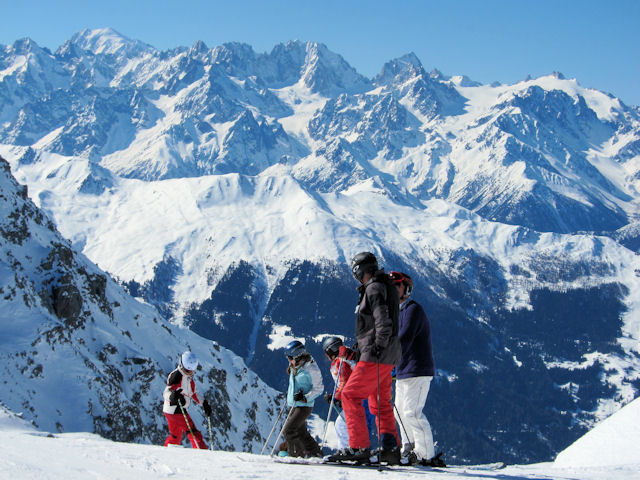
I’m not talking here about Nordic or back-country skiing, but downhill skiing between two countries. In other words take a lift in the morning in one country, and have lunch in another.
Rougemont
There are a number of resorts where you can ski from one country to another (and back), but not surprisingly they are all in Europe.

Perhaps the most famous is the Matterhorn Ski Paradise which links Switzerland and Italy. Zermatt lies at the foot of the ski area on the Swiss side and Breuil Cervinia lies across the Italian border, with the majestic Matterhorn standing over both of them. Cervinia is cheap and cheerful, Zermatt not only provides the best views of the Matterhorn it is possibly the most complete ski resort in the world (and one of the more expensive).

The Silvretta Ski Arena bridges Switzerland & Austria, and there are even border control posts on the piste – although I have never seen them manned. Duty-free Samnaun lies on the Swiss side whilst the party town of Ischgl is in Austria.
Ischgl
Les Portes du Soleil is a huge sprawling resort between France & Switzerland, with o650km of piste. There are a whole bunch of ski resorts in the circuit, with Avoriaz and Morzine in France and Champéry in Switzerland amongst the more notable.

The Milky Way between France & Italy is not quite as big, but with 410km of piste is still one of the largest ski areas in the world. Montgenèvre lies in France, whilst across the border in Italy are Clavière, Cesana, Torinese, Sestrière, Pragelato, San Sicario and Sauze d’Oulx.

Espace San Bernardo links La Rosière in France with La Thuile in Italy.

Kanin-Bovec-Sella Nevea is one of the newer cross border resorts, linking Italy and Slovenia.

Nassfeld-Lake Pressegger is a little known resort in Carinthia, but it has 100km of piste and has runs that cross the Austrian border into Italy, and it is possible to have lunch on the Italian side of the border.

Not strictly speaking a cross-border resort but a section of Gstaad Mountain Rides links the Swiss German part of Switzerland with the French-speaking part, crossing the Röstigraben. So it is possible to take up a lift from Rougemont to the La Videmanette ski area from where you ski or snowboard down to Chalberhöni and Gstaad.

Equipment available right here on Tom Wohrman Sports.
Pyeongchang Winter Olympics 2018

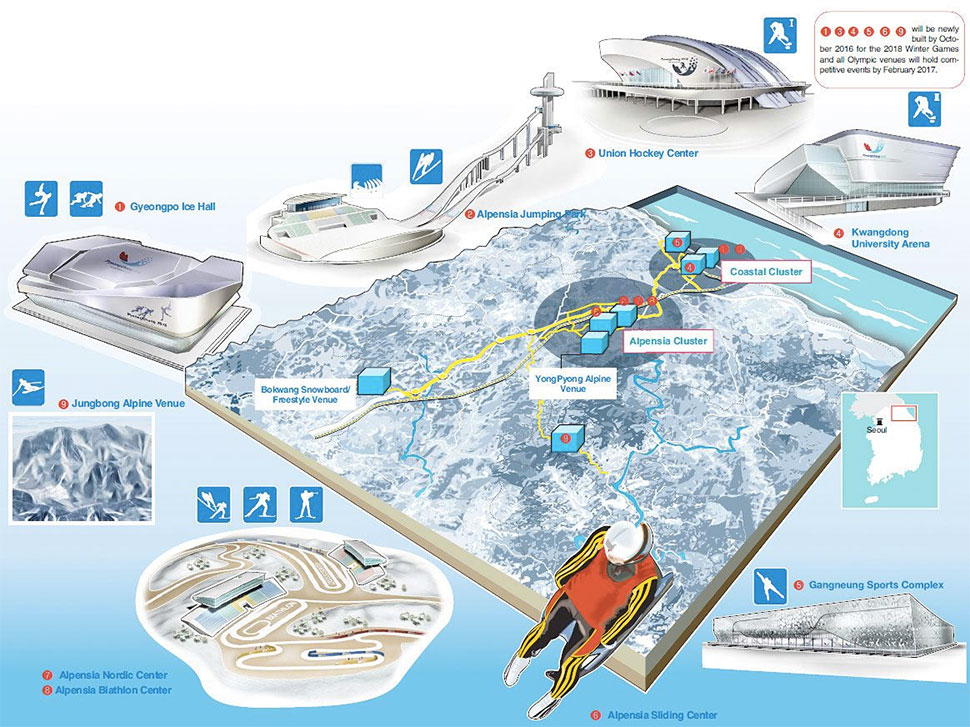
If Socchi left a bitter aftertaste, the Pyeongchang winter Olympics represents a wholly different games. Pyeongchang beat Munich, Germany, and Annecy, France, to host the games, and it promises a lot. With the $2.4 billion budget, rivalry with the North (who will be competing) and the first Olympics on the Korean Peninsula this will surely be a successful event, at least from a news media perspective.

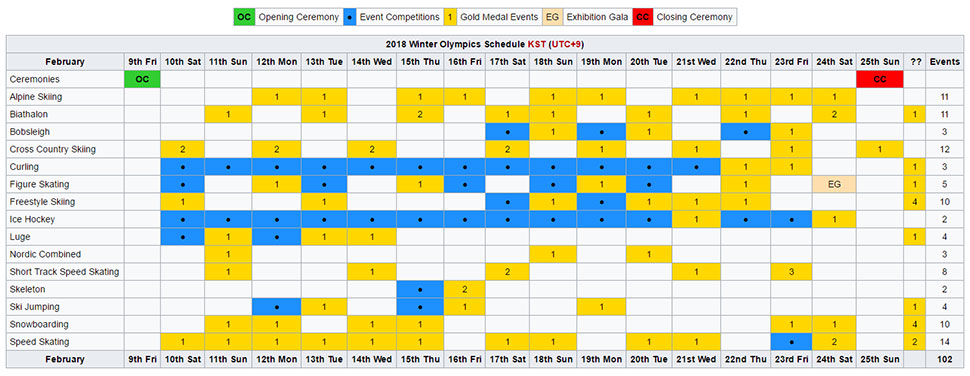
The games run from the opening ceremony on the 9th February through to the close on the 25th, with fifteen sports on display. The sports are (with medal races in brackets): Alpine skiing (11), biathlon (11), bobsleigh (3), cross-country skiing (12), curling (3), figure skating (5), freestyle skiing (10), ice hockey (2), luge (4), Nordic combined (3), short track speed skating (8), skeleton (2), ski jumping (4), snowboarding (10), speed skating (14). Four new disciplines in existing sports will be introduced this year, namely big air snowboarding, mixed doubles curling, mass start speed skating, and mixed team alpine skiing.

The Paralymics follow from 9th to 18th March, with six sports in competition.

Korea is nine hours ahead of the UK, so a lot of the action will happen overnight or in the mornings, UK time. Eurosport and the BBC have got the rights to broadcast the games, so Ski Sunday should be well worth catching both on live TV and the red button, and hopefully there will be good coverage on the BBC’s Breakfast TV. Expect blanket coverage on Eurosport.

From a UK perspective there are a few competitors to watch out for. This will be the largest British winter Olympics team ever, and expectations are high. In Slalom, Dave Rydling must fancy his chances, whilst in the female slalom both Alex Tilley and Charlie Guest should put in a respectable run or two. In the Freestyle Ski competitions Lloyd Wallace competes in the Aerials and Emily Sarsfield in Ski Cross. James Woods, Katie Summerhayes, James Machon, Rowan Cheshire and Izzy Atkins compete in the Park and Pipe, with Woodsy looking the best bet for a medal. In the snowboard Park and Pipe Katie Omerod is the best medal prospect, but also competing will be Jamie Nicholls, Billy Morgan and Aimee Fuller. In Cross-country the Scots Andrew Musgrave and Andrew Young will be representing Team GB. The speed skater Elise Christie and the reigning Olympic skeleton champion Lizzy Yarnold will be looking for medal positions. And, of course, there is the wonderful women’s curling team!

The hugely successful US team also has its largest, and most diverse, contingent ever – indeed the largest from any nation ever with 135 men and 107 women. Alpine downhill stars Lindsey Vonn and Mikaela Shiffrin will be leading the medal charge. Teenage snowboarder Chloe Kim is one of team USA’s strongest medal contenders but will also attract attention as she is from a native Korean-speaking family.

Canada and Norway are likely to be competing with the USA to achieve the biggest medal haul. Norway’s Aksel Lund Svindal and Henrik Kristoffersen will be amongst the favourites in the Blue Riband event, the men’s downhill. Traditionally Germany has done well across all disciplines and the Netherlands bags a few golds due to the nation’s strength in speed skating.

The Swiss and Austrians, perennial rivals, will be competing to get more medals than each other. They normally get around five Golds each. The Swiss will be looking to Beat Feuz in the downhill to continue his good form this season, and Lara Gut is looking like she could recover some of her best form. Medals for Switzerland are also likely in freestyle, snowboarding, cross-country and curling. Marcel Hirscher will lead Austria’s downhill charge.

Although clean Russian athletes will be allowed to compete as individuals, following the state-sponsored doping in Socchi, Russian government officials are banned from attending the Games, and neither the country’s flag nor its anthem will be allowed.

At the more esoteric end of the scale, Nigeria will be competing in bobsleigh and Jamaica in ice hockey.

Global warming delays resort opening

I think most skiers know global warming is happening, whatever the reasons for it. The most ominous indication is the retreat of glaciers. Over successive seasons it is easy to see how much glaciers have shrunk at many ski resorts.

In addition something has been going on in recent seasons with early season snow conditions. Whether that is down to factors other than global warming is debatable – it may just be a cyclical thing that will fix itself, but that seems unduly optimistic. Lower resorts must be particularly concerned, especially as they consider the long-term investments they may need to remain competitive with other resorts.

So will 2017 kick off a great early season and buck the trend of recent seasons?

It doesn’t look good. For the first time in 40 years Les Deux Alpes will not open for autumn skiing on its glacier.
4 Vallees opens on 10th November 2017
The London Times quotes Thierry Hugues, the head of the resort’s piste management team, to explain why. “The situation is exceptional,” he is quoted as saying. “Given the low rainfall that we had throughout the year, a very hot summer and a very dry autumn, the glacier does not have enough snow cover to welcome our customers safely.”

Other traditional season openers have, however, opened. In Switzerland Zermatt, Saas-Fee and Engelberg have glacier skiing, recently joined by Diavolezza and Glacier 3000. A number of other Swiss winter sports resorts will open at least some of their slopes in the next few weeks, Andermatt, Arosa-Lenzerheide, Davos-Klosters and Flims/Laax the first weekend of November, the 4 Vallees the following weekend and a whole clutch of other resorts before the end of the month.

Unless global warming or other weather-related conditions intervene.

The mystery of the missing Swiss couple

The mystery of a missing Swiss couple seems to have been solved. Or has it? The Guardian reported it as follows:

The frozen bodies of a Swiss couple who went missing 75 years ago in the Alps have been found on a shrinking glacier, Swiss media said.

Marcelin and Francine Dumoulin, the parents of seven children, had gone to milk their cows in a meadow above Chandolin in the Valais canton on 15 August 1942.

“We spent our whole lives looking for them, without stopping. We thought that we could give them the funeral they deserved one day,” their youngest daughter, Marceline Udry-Dumoulin, 75, told the Lausanne daily Le Matin.

“I can say that after 75 years of waiting this news gives me a deep sense of calm.”

Valais cantonal police said two bodies bearing identity papers had been discovered last week by a worker on Tsanfleuron glacier near a ski lift above Les Diablerets resort at an altitude of 2,615 metres (8,600ft).

The Guardian conveniently posts a picture of the Swiss ski resort, Chandolin:

A truly tragic mystery finally solved. But wait a minute…

Apparently they went for a walk from the ski resort Chandolin in Valais and were found above Les Diablerets near the Glacier3000 ski resort. Now Wikipedia tells me that is a 25 hour hike, mostly along the Rhone valley (which would need to be crossed). Why would the couple have walked so far?

The answer is rather prosaic. They didn’t head out from the village of Chandolin in Val D’Anniviers, but the village of Chandolin-près-Savièse, just above Sion and opposite Nendaz. A minor oversight by all the English-speaking newspapers who either didn’t bother to check the location or didn’t care, but it would have confused anyone who knew the better known ski resort of Chandolin (together with St-Luc, making up one of my favourite ski areas).

Why would the couple, make the significant ascent to the glacier, some 2615m high? Many newspapers reported that Marcelin and Francine Dumoulin had vanished after going to milk their cows in a meadow above their home. Whilst the glacier lies in the same municipality, Savièse, it doesn’t explain how they ended up on the glacier. Cows don’t graze on or anywhere near glaciers.

The Local, an English-language Swiss-based news web site, offers an explanation:

Dumoulin, then 40, and his 37-year-old wife had left their home that morning hoping to check on their cattle, which were being kept in an alpine pasture in neighbouring Bern canton.

The fastest route at the time was via a glacier footpath. The sky was clear when the couple set out, but clouds later worsened visibility and the couple vanished, likely after falling into a crevasse, orphaning five sons and two daughters. Shrinking glaciers are slowly uncovering the bodies of several hundred people known to have disappeared on or near glaciers in the Alps, many after tumbling down a crevasse.

“I saw them leave that Saturday morning,” recalled Monique Gautschy, one of the surviving children who was 11 years old at the time. “They were supposed to spend the night in the alpine pasture at Grilden and come back on Sunday.”

After two months of fruitless searching for the couple, the seven children, then aged 2 to 13, were placed in foster care.

Apparently Madame Dumoulin was making the trip with her husband for the first time. She was reportedly almost always pregnant or nursing. With seven children at home, one assumes they got little privacy. Perhaps the explanation for their joint ascent and planned overnight stop was a romantic encounter under the stars?

We shall never know.