The History of Skiing through Winter Sports Posters

On 22nd January, in London, Christie’s holds its annual “Ski Sale“, an auction featuring a selection of posters depicting winter sports and, through them, the development of skiing in the Alps. The auction features almost 250 posters, and the expected bid prices are generally somewhere in the range $1000 to $20,000 or more.
Christie's ski sale
The prices are eye-watering for what were originally posters intended to entice people to exotic locations, pasted up on hoardings only to be pasted over some weeks or days later. Not surprisingly few survived, and those that did are collectible, even valuable. To an expert, such as those at the famous Galerie 123 in Geneva the difference between an original, or even a reprint from a later run, are easily distinguishable from the cheaper copies that are available now – but those cheaper copies retail for a fraction of price of the original lithographs and are of high, or even higher, reproduction standards. If you want something to adorn a wall, the copies are fine, but the originals not only embody the history of an era and demonstrate painstaking skill, they are generally of appreciating value. Most of the early posters used a laborious craft known as stone lithography, but between the 30s and 50s this mostly gave way to offset lithography and, for some photographs used in posters to a technique known as heliography. Nowadays most high quality posters use screen printing.

One of the most famous early examples of stone lithography was Emil Cardinaux’s classic 1908 lithograph of the Matterhorn, advertising Zermatt. The impact of the design was immense, redefining the style of many posters for distant holidays.

Emil Cardinaux's classic lithograph of Zermatt and the Matterhorn
Many of the posters were commissioned by travel companies, and particularly the energetic and innovative Swiss transport companies such as MOB (Montreux–Oberland Bernois railway). This 1946 offset lithograph by Martin Peikert is a superb example with its vivid design and stylish model.
Montreux- Oberland Bernois
Not in the auction, but illustrating well another source of great winter sports poster art, is this picture provided by Galerie 123 of the Royal Hotel & Winter Palace in Gstaad, attributed to Carlo Pellegrini in 1913 to celebrate the opening of the hotel and to illustrate that skiing wasn’t the only winter sport on offer, with bob-sleighing and curling amongst the many alternative activities.
Gstaad Royal Hotel ski bob curling
A fine example of the use of heliography and phoro montage is this 1943 poster advertising Grindelwald by Adolphe Fluckiger.
Grindelwald heliography photo montage
An interesting poster by Albert Muret from 1910 from the collection of Gallerie 123 shows the monks of Hospice du Grand Saint-Bernard in Valais skiing. The monks had been skiing since the 1870s, but this stone lithograph celebrated the opening of a new railway line. However it illustrates that early downhill skiing only involved a single stick, a feature of many early posters.
Monks skiing from the Hospice du Grand Saint-Bernard in Valais
Finally, one of my favourite posters, from one of my favourite poster artists of the golden age of winter sports posters, Roger Broders. The vivid Art Deco lithograph from around 1930 promotes winter sports in the French Alps, with skiers disembarking from the train running from Paris and Lyon to the Med. The individuals are insouciant and stylish. The enticement is clear – under a blue sky, a train taking you right to the slopes of St Gervais from your dreary winter lives, into the mountains, in the company of cool people with the prospect of a ski run ahead…
Winter Sports in the French Alps

New Swiss Winter Sports facebook page

Adding to everyone’s favourite (well, my favourite) winter sports blog, www.alpinewinterblog.com aka www.oatridge.co.uk/nic/, comes a facebook page and, hopefully, via RSSGraffiti, also comes regular updates from the blog on facebook.
Oatridge family in Muerren
The blog is now in its sixth year and contains dozens of snippets about winter sports, mostly focusing on Switzerland. I have been a keen skier for many years, and when I moved to Switzerland it seemed a dream come true to have all these resorts on my doorstep. There was a little matter of Mrs Oatridge being pregnant, a couple of teenagers to help assimilate and a toddler to look after, so it took a while before I got to go to the slopes. But one fine day I got in the car and headed off in the direction of the distant peaks with a vague notion I would hit a place called Engelberg. Anyway, I took a wrong turn and after driving aimlessly in our car which we got at these used cars ottawa and we ended up at a resort called Meiringen.

I have been to both many times since (and rarely by car), but the ins and outs of where to go, how to get there and where to stay – either with the family, alone of with friends – led me to start recording what I had learnt, and then came the blog, and then the web sites. Currently there are two related web sites in addition to this blog: www.swisswintersports.co.uk and www.snowandrail.com. There is also a Dutch language version of the principal web site at www.swisswintersports.nl and what I hope to make into a multi-language portal at www.swisswintersports.com.

I don’t have a goal in mind other than to maintain the currency of the current sites and continue to make them the best sites of their type on the Internet, but I also hope to expand the scope, redesign to make them as mobile-friendly as possible and even make some income… oh, yes, and do plenty of research!

Christmas Ski Conditions

I reported last week on the English Show that the warm weather and dry conditions were hitting the ability of resorts to make a decent base, and that even a cold snap in mid-December would be followed by unseasonably warm weather. A week later, my prognosis seems to have been borne out, and even Courchevel in France has cancelled events because of poor snow conditions. My advice remains “go high”. You can find which resorts have the highest runs at the Swiss Winter Sports and Snow and Rail websites – on the resort finders you can click on the columns to sequence the tables by any field. High resorts like Zermatt and Verbier, for example, benefit from high glaciers and villages above the ski line, so you can be sure you can ski all the way back into the village. Freezing levels seem to be hovering around 1500m, so any runs above that altitude looks fine, although the snow forecast for the next couple of days comes with warm weather so the snow may turn to precipitation on even some middle stations. The temperature then dips a little and gives way to a period of sunny weather over Christmas where you can be sure the resorts will desperately be churning out the artificial snow on runs where they can establish a base. The good news, or bad news if you plan to ski over the New Year, is that the weather will change after Boxing Day, with blizzards expected by New Year’s Eve and, although the temperatures will still be a little on the high side, this should ensure good snow cover right down to the high valleys into January.

Austria has some glaciers but on the whole the resorts and runs are low, and the country has suffered from too little or not enough snow, with temperatures too mild to use snow-making machines. Italy has fared a little better, and I have had good reports from Cervinia. France should be OK if you go to somewhere high like Tignes.

It is a shame for many resorts, as some visitors will surely cancel plans to ski or snowboard. There seems to have been something of a resurgence too, with most resorts reporting higher levels of planned hotel occupancy over Christmas than last year, especially in Switzerland.

Ski Pizol
I’m spending Christmas in Bad Ragaz for Pizol. The valley run to Wangs probably won’t be open or much fun if it is, but since I am on the other side of the mountain, that is no great loss. There is also an easy backcountry run from the top of Pizol you can walk up to without skins, although you will need to carry your skis or board beyond the last lift. I also plan to spend a few days in Chur which has easy access to some of the best resorts in Graubünden ahead of the New Year – plenty of altitude nearby in resorts like Flims/Laax.

Many pages at my web site have webcams so you can check out the snow conditions for yourself. If they don’t follow the links to the resort web sites in case they have any other web cams set up.

Ski the Stockhorn

I was reading an article in an online version of an Australian newspaper, the Sydney Morning Herald, which was addressing the issue of global warming and its impact on the Alps. Apparently “a recent Austrian climate change report found that the country’s temperatures had risen twice as fast as the global average since 1880, with the number of sunshine hours in the Alps increasing by 20 per cent.” I have certainly seen the impact of climate change on glaciers I have visited over the years, and there is no denying it will have an impact on the Alps.

Anyway, one of the more interesting observations was that a “ski region” called Stockhorn has dispensed with its ski lifts to concentrate on snowshoe walkers and such like. Now, as a self-declared expert on skiing in Switzerland, I feel a little ashamed to say I didn’t even know there was a place called the Stockhorn which had dismantled its ski infrastructure, and don’t have it in my winter sports website. Certainly the Stockhorn (3405m) in Zermatt is not suffering from global warming or lift closures, at least not last time I visited earlier this year! But as is often the case, several mountains often share the same name in the Alps.

So I did a little research.
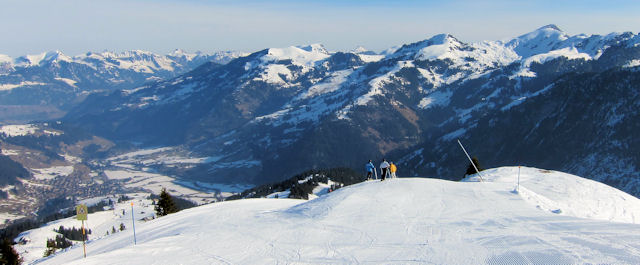
Ski the Simmental valley
And I found another Stockhorn. The website for the resort states “Erlenbach in the Simmental lies in the Bernese Oberland at the start of the Simmental, in the direction of Lenk and Gstaad. The valley station of the Stockhorn cableway can be reached easily in approx. 30 mins by car from Bern, and in approx. 15 minutes from Thun. The timetable of the Stockhorn cableway has been coordinated with the train timetable.” Yes, this is Switzerland, there is a railway station in Erlenbach im Simmental with lifts timetabled to connect with the train timetable. I know Erlenbach – it is a small sleepy village in the Simmental valley and at a 700m elevation never a great candidate for ski-in, ski-out facilities. Could it have once been the throbbing heart of a ski region whose fame stretched across the planet as far as Australia?

The top of the Stockhorn is 2190m, but it seems skiing off the summit is not feasible. If there ever was skiing here, it would have been from the mid-station at Chrindi at a modest elevation of 1642m or possibly from local facilities in Erlenbach, but the village is very low to sustain a decent piste for any duration – in fact I know of NO resort with runs that low.

So it does have a cableway, but appears to have no other ski facilities. But surely, then, you can ski down still? And it does appear you can. As well as snowshoe walks, winter walks, an igloo village, fabulous views and fine dining, there are ski tours you can do in the area, organised by a local ski school. Starting at 9.50am on 30th December 2014, 3rd January 2015, 17th January 2015, 1st February 2015 and 28th February 2015 for between CHF140 and CHF290 Alpinschule Bergfalke (+41 (0)795025080/info@bergfalke.ch) take guided ski tours in the area. No touring experience is necessary, just that you are a reasonably good piste skier or snowboarder and in good physical condition. It looks like you have a three hour ascent from the lifts to start the downhill section of the tour. The claim is the tour suits both beginners and connoisseurs.

And it doesn’t look like you ski the Stockhorn anyway – the area you ski is the Lasenberg (Laseberg) which peaks at 2019m and the Cheibenhorn at 1952m, but you use the Stockhorn lift to get there, getting out at the Chrindi mid-station.

The Simmental is a fabulous region, renowned for its food, at least in Switzerland, and probably best known for the ski resort at Lenk and its access to Gstaad Mountain rides from Zweisimmen. Locals also often ski the small resorts at Diemtigtal and Beatenberg.

Were there ever ski facilities at the Stockhorn? I can find no evidence it was graced with as much as a drag lift at any period, but I suspect competing resorts in the Bernese Oberland rather than global warming did for the facilities if they ever did exist. It may have been that the locals tried out a drag lift for a period, but these are usually dismantled in the summer, and hardly constitutes the making of a ski region. Sometimes it is simply not economic to re-assemble and repair, or replace, an old and little-used lift. And if there were any ski facilities in the area once I doubt if anyone other than the good citizens of Erlenbach ever used them.

But there is another more prosaic explanation for this new story. Back in 2007, a cable car system, initally constructed in 1958 linking Gornergrat (3089m) to Stockhorn (3405m) above Zermatt (1620m) was dismantled and replaced with a new lift. Could this be the origin of the news story? Possibly not, since the story cites a “refocus on winter hiking and snowshoeing” as the replacement activity to skiing. Any readers ever seen somebody snowshoe walking the Triftji Jumps? No, nor have I. But possibly the intrepid newshounds from AFP,a French news agency that seems to have originated the story, got confused and linked two events about two different mountains and came up with a whole new angle.

So hitting my inbox and that of many other people round the world, and syndicated across a whole bunch of Australian, Asian, American and European newspapers and journals (including the famously gaff-prone UK Daily Mail), is a story entitled “Dismantling ski lifts in Europe as world warms up”. And they cite the Stockhorn as their sole justification, and there is no evidence to support any mountain in Switzerland called the Stockhorn had a lift dismantled in the face of global warming. Oh well, why let the facts get in the way of a good story.