Winter holidays for non-skiers

For a lot of people winter is something to be endured, a long season of cold, short days and stark skylines. The only escape seems to be a long haul flight to somewhere sunny and warm.

But nothing could be further from the truth.

In 1864 four English visitors to the Swiss Alps were due to return home for the winter. Their hotelier, Johannes Badrutt, said that they should come back at Christmas and stay until Easter, and if they didn’t find St Moritz as sunny in winter as it was in summer, he would pay their fares and hotel bills.

Badrutt won the bet, and winter tourism was born.

But what was there to do? Alpine skiing was yet to take off – Conan Doyle in nearby Davos was to have a large part to play in that story. With a well-developed summer tourist industry, St Moritz, Davos and many other resorts quickly developed a significant infrastructure to enable winter visitors to while away their days, and nights, and the longest established resorts still have a huge variety of non-Downhill activities on offer.

A recent article I read in the BA Leisure magazine, recommended a handful of resorts that suited both skiers and non-skiers. Megève, St Christoph, Cortina d’Ampezzo, Zermatt and Lake Tahoe make their shortlist, and it’s a good list. For the Americas, however, there are a number of resorts I would add to the list (see my ski USA page), and I think there are at least a couple of dozen other Alpine resorts as good for skiers as for non-skiers, particularly in Switzerland.

But what to actually do? Innsbruck, Montreux and Basel have wonderful winter markets, although they close before Christmas. Many resorts and Alpine towns have wonderful outdoor and indoor ice rinks, and professional ice hockey teams play throughout the Alpine nations, with a major hockey festival in Davos known as the Spengler Cup. Bob sleigh also features at a few resorts, and at Celerina adrenalin junkies can actually take part in a four man bob team!

More sedate winter sports available in the Alpine resorts include snowshoe trekking, cross-country skiing, curling and tobogganing. A town called Bergün is a mecca for tobogganing, with people visiting from all over Europe to take advantage of the runs there (and enjoy the breathtaking UNESCO listed railway you need to take to get to the start of the runs). My Swiss Winter Sports web site covers other winter sports you can participate in Switzerland in addition to skiing and snowboarding.

There is a network of well maintained winter walks throughout the Alps, the reward mid-way along the walk often being a charming mountain restaurant. There are even Michelin listed resorts in the Alps! Zermatt is particularly renowned for its mountain restaurants.

We love visiting resorts with spas, the best of which is probably Leukerbad, but there is plenty of choice. Villars opened a new spa this year.

Switzerland and Austria have a highly reliable and extensive transport network which makes it very easy to choose a destination suited primarily to non-skiers, but which skiers can also use as a base for day trips to a variety of different destinations. Lucerne and Innsbruck are particularly good choices.

Often the best time to go is March. The days are getting longer and the days warmer, but the snow base is usually still good. If you are prepared to leave it late to see how the snow conditions are developing, a lot of resorts provide particularly good deals before Christmas.
The mystery of the missing Swiss couple

The mystery of a missing Swiss couple seems to have been solved. Or has it? The Guardian reported it as follows:

The frozen bodies of a Swiss couple who went missing 75 years ago in the Alps have been found on a shrinking glacier, Swiss media said.

Marcelin and Francine Dumoulin, the parents of seven children, had gone to milk their cows in a meadow above Chandolin in the Valais canton on 15 August 1942.

“We spent our whole lives looking for them, without stopping. We thought that we could give them the funeral they deserved one day,” their youngest daughter, Marceline Udry-Dumoulin, 75, told the Lausanne daily Le Matin.

“I can say that after 75 years of waiting this news gives me a deep sense of calm.”

Valais cantonal police said two bodies bearing identity papers had been discovered last week by a worker on Tsanfleuron glacier near a ski lift above Les Diablerets resort at an altitude of 2,615 metres (8,600ft).

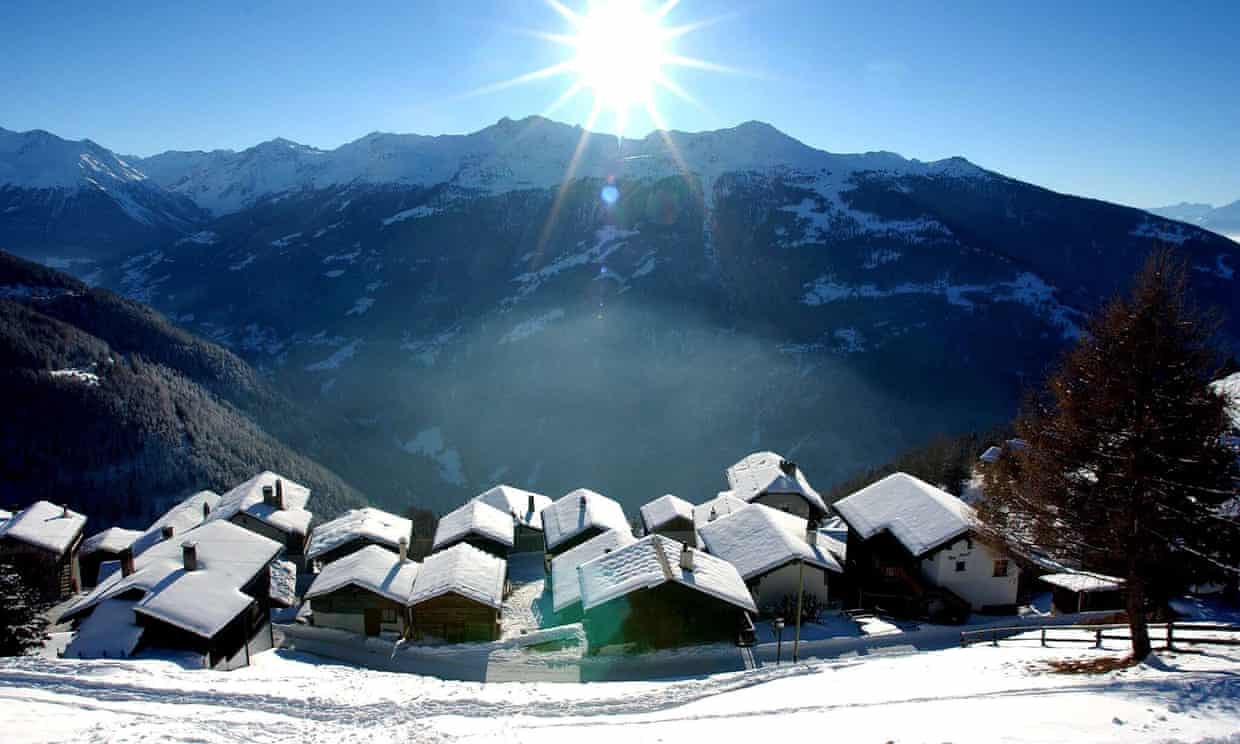
The Guardian conveniently posts a picture of the Swiss ski resort, Chandolin:

A truly tragic mystery finally solved. But wait a minute…

Apparently they went for a walk from the ski resort Chandolin in Valais and were found above Les Diablerets near the Glacier3000 ski resort. Now Wikipedia tells me that is a 25 hour hike, mostly along the Rhone valley (which would need to be crossed). Why would the couple have walked so far?

The answer is rather prosaic. They didn’t head out from the village of Chandolin in Val D’Anniviers, but the village of Chandolin-près-Savièse, just above Sion and opposite Nendaz. A minor oversight by all the English-speaking newspapers who either didn’t bother to check the location or didn’t care, but it would have confused anyone who knew the better known ski resort of Chandolin (together with St-Luc, making up one of my favourite ski areas).

Why would the couple, make the significant ascent to the glacier, some 2615m high? Many newspapers reported that Marcelin and Francine Dumoulin had vanished after going to milk their cows in a meadow above their home. Whilst the glacier lies in the same municipality, Savièse, it doesn’t explain how they ended up on the glacier. Cows don’t graze on or anywhere near glaciers.

The Local, an English-language Swiss-based news web site, offers an explanation:

Dumoulin, then 40, and his 37-year-old wife had left their home that morning hoping to check on their cattle, which were being kept in an alpine pasture in neighbouring Bern canton.

The fastest route at the time was via a glacier footpath. The sky was clear when the couple set out, but clouds later worsened visibility and the couple vanished, likely after falling into a crevasse, orphaning five sons and two daughters. Shrinking glaciers are slowly uncovering the bodies of several hundred people known to have disappeared on or near glaciers in the Alps, many after tumbling down a crevasse.

“I saw them leave that Saturday morning,” recalled Monique Gautschy, one of the surviving children who was 11 years old at the time. “They were supposed to spend the night in the alpine pasture at Grilden and come back on Sunday.”

After two months of fruitless searching for the couple, the seven children, then aged 2 to 13, were placed in foster care.

Apparently Madame Dumoulin was making the trip with her husband for the first time. She was reportedly almost always pregnant or nursing. With seven children at home, one assumes they got little privacy. Perhaps the explanation for their joint ascent and planned overnight stop was a romantic encounter under the stars?

We shall never know.

Longest Pedestrian Bridge Opens

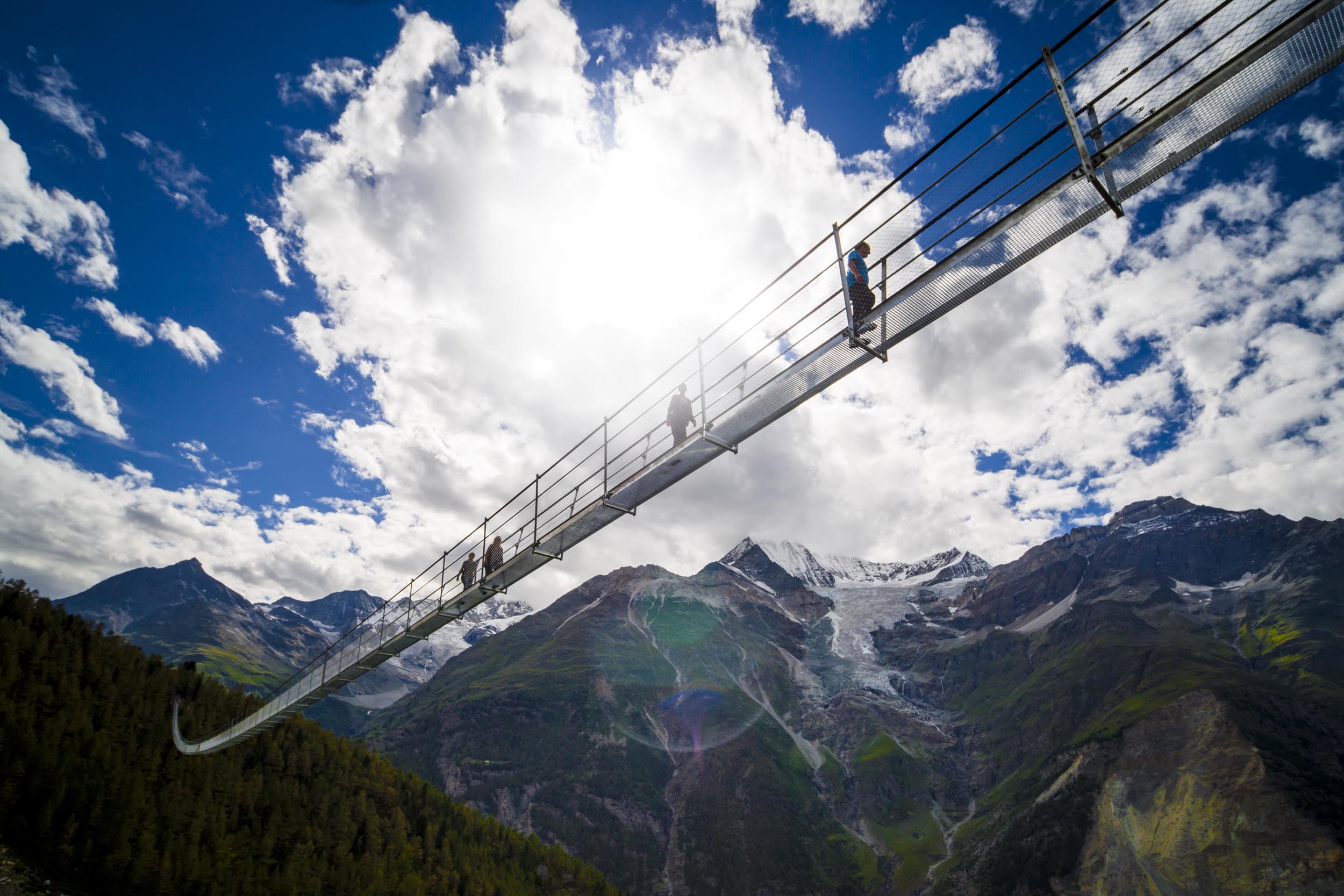
The world’s first peak-to-peak suspension bridge opened in 2014 in Switzerland at the Glacier3000 ski area. The 107m long bridge, known as “Peak Walk by Tissot”, has been more than matched by a new suspension bridge in nearby Valais.

The 31km long Europaweg, a hiking trail between Zermatt and Grächen, lies along a route prone to rockfalls. A bridge was built along a section of the route in 2010, crossing the Dorfbach river, but was swept away in a rock avalanche two months later. The determined Swiss went about building a replacement, high enough to avoid the fate of its predecessor. The resulting Charles Kuonen Hängebrücke, or Europe Bridge, opened on 29th July 2017, and is 494 metres long, making it the longest pedestrian suspension bridge in the world. At its highest it is 84 metres above the valley.

The bridge has around 8 tons of cable, and employs a system that prevents it from swinging. It is named after the principal sponsor behinds its construction and is located just east of Randa at map co-ordinates 46° 6′ 6.5″, 7° 48′ 4.7″.

To walk the Europaweg usually takes two days, with an overnight stop in the Europahütte. It is rated T3, i.e. a challenging hike that requires good footwear, orientation skills and some basic Alpine experience (the rating associated with the most difficult hikes is T6). However it is possible to visit the bridge without taking the entire hike by taking the train to Randa – 2 stations from Zermatt – and hiking up from there. It is a steep 650m ascent, and takes around 2 hours each way.

The World’s Most Popular Ski Resorts

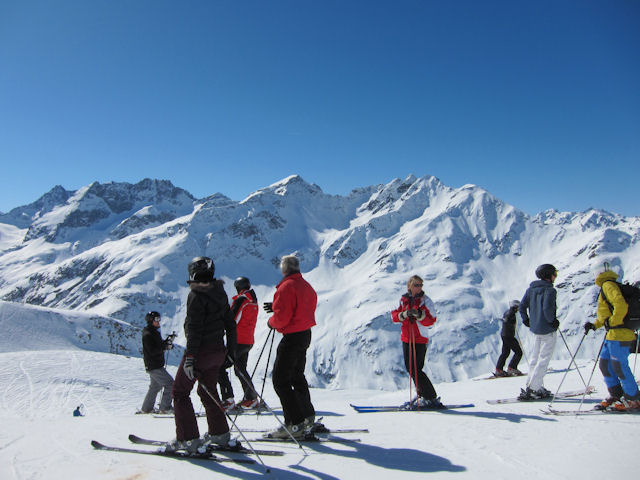
Skiers in the AlpsA topic of conversation amongst most skiers and snowboarders at one time or another is which is the best ski resort in the world. Of course, there is no clear definition of what constitutes the best, but there is one man who has established which are the world’s most popular ski resorts.

Laurent Vanat publishes an epic “International Report on Snow & Mountain Tourism” every year (see http://www.vanat.ch/). This comprehensively researched report is fascinating, not least for the ranking of ski resorts.

One of the more interesting conclusions he draws this year is that winter sports are in decline in the traditional markets. Switzerland has seen almost a 20% reduction in skier days since 2004, a figure perhaps not so surprising give the strength of the Swiss Franc. However even the USA, Canada and Italy have started to slump in the last few years. Austria and France have been the major beneficiaries of people choosing alternative destinations, but even these have seen a decline in the last couple of years and have grown barely 5% in the last ten years.

The situation is mitigated by the explosive growth of skiing in China and some other emerging markets. In a separate report Laurent reports that China now has over five hundred ski resorts from a base of only a dozen twenty years ago.

Laurent attributes the relative decline of interest in winter sports, at least in part, to the failure of teaching techniques to adapt. He may have a point. Traditionally most skiers tend to give up the sport by their 60s, but the replacement rate is dictated by a number of factors. If the first experience of winter sports is unsatisfactory, it is hard to get people to give up their valuable holiday time and money to do it again. When I came through Gatwick in the middle of the ski season earlier this year I was struck by the overwhelming number of flights to and from winter sun destinations compared to ski resorts, and the demographic of the passengers reflected that an aging population is not going to benefit the winter sports industry.

Laurent’s report goes on to state that there are now around 66 countries that can be said to provide at least basic opportunities for lift-assisted, outdoor downhill skiing, around 20 others that provide indoor skiing facilities and 15 that have some snow coverage for at least some of the year and which, technically, could be skiable. By his estimate there are around 2000 ski resorts worldwide, with 35% in the Alps, 12% elsewhere in Western Europe, 21% in America, 13% in Eastern Europe and Central Asia and 19% in East Asia. China’s rise as a skiing super-power is offset in Asia by Japan’s relative decline.

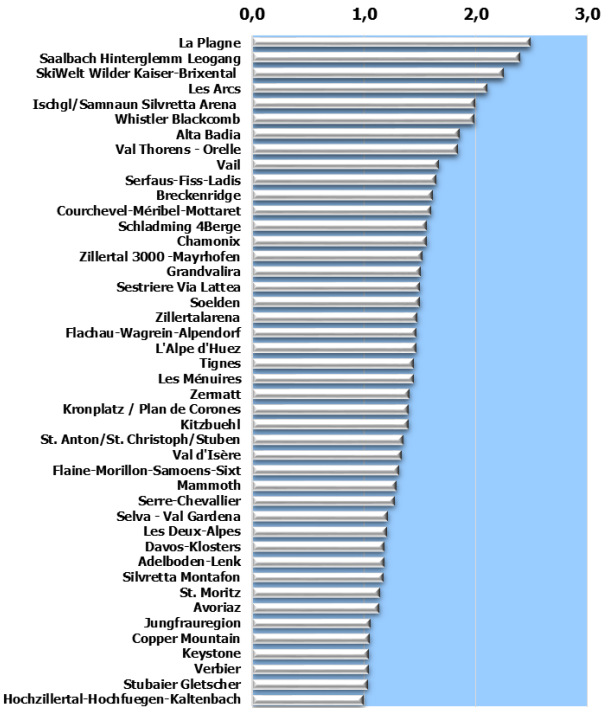
Laurent uses the number of days the slopes are visited as the basis for estimating skier numbers. Only 44 resorts receive more than one million skier visits in a typical winter season and top of the list as the world’s most popular ski resort is… La Plagne! The top ten reads like this:

  1. La Plagne (France)
  2. Saalbach Hinterglemm Leogang (Austria)
  3. Skiwelt Wilder Kaiser-Brixental (Austria)
  4. Les Arcs (France)
  5. Ischgl/Samnaun Silvretta Arena (Austria/Switzerland)
  6. Whistler Blackcomb (Canada)
  7. Alta Badia (Italy)
  8. Val Thorens – Orelle (France)
  9. Vail (USA)

Somewhat surprising to me is how different this list is compared with a list of the ten most extensive ski resorts given that skiers in poll after poll rate the extent of the ski terrain as the most important single factor – see here for most extensive.

Interestingly, only 20% of resorts account for 80% of skier visits with the Alps taking in 43% of all skier visits – more than double the number of skier visits in North America.

Top world resorts in millions of skier visits

Ski culture is clearly most marked in countries with extensive ski facilities, but Germany and the UK have limited ski facilities but a large ski culture. The desinations of choice for the Germans are respectively Austria, Italy and Switzerland, whilst the Brits prefer France, then Austria and Italy. The Dutch contribute about 1 million ski visits each year, and choose Austria and France as their preferred destinations.

Surprisingly, more Swiss takes their ski holidays in Austria than Brits take in Italy. It puts some perspective on how far the strong Swiss franc is hurting the domestic tourist industry. However Switzerland, along with Austria and Norway, has over a quarter of the population active in winter sports. Although it doesn’t have any resorts in the top 20 most visited, I would have little difficulty placing at least half a dozen Swiss resorts in the best 20 in the world.

Of the approximately 400 million skier visits undertaken each season, around 20 million are from visits to the 43 indoor snow centres, half of which are in Western Europe.

Blogarama - Individual Sports Blogs