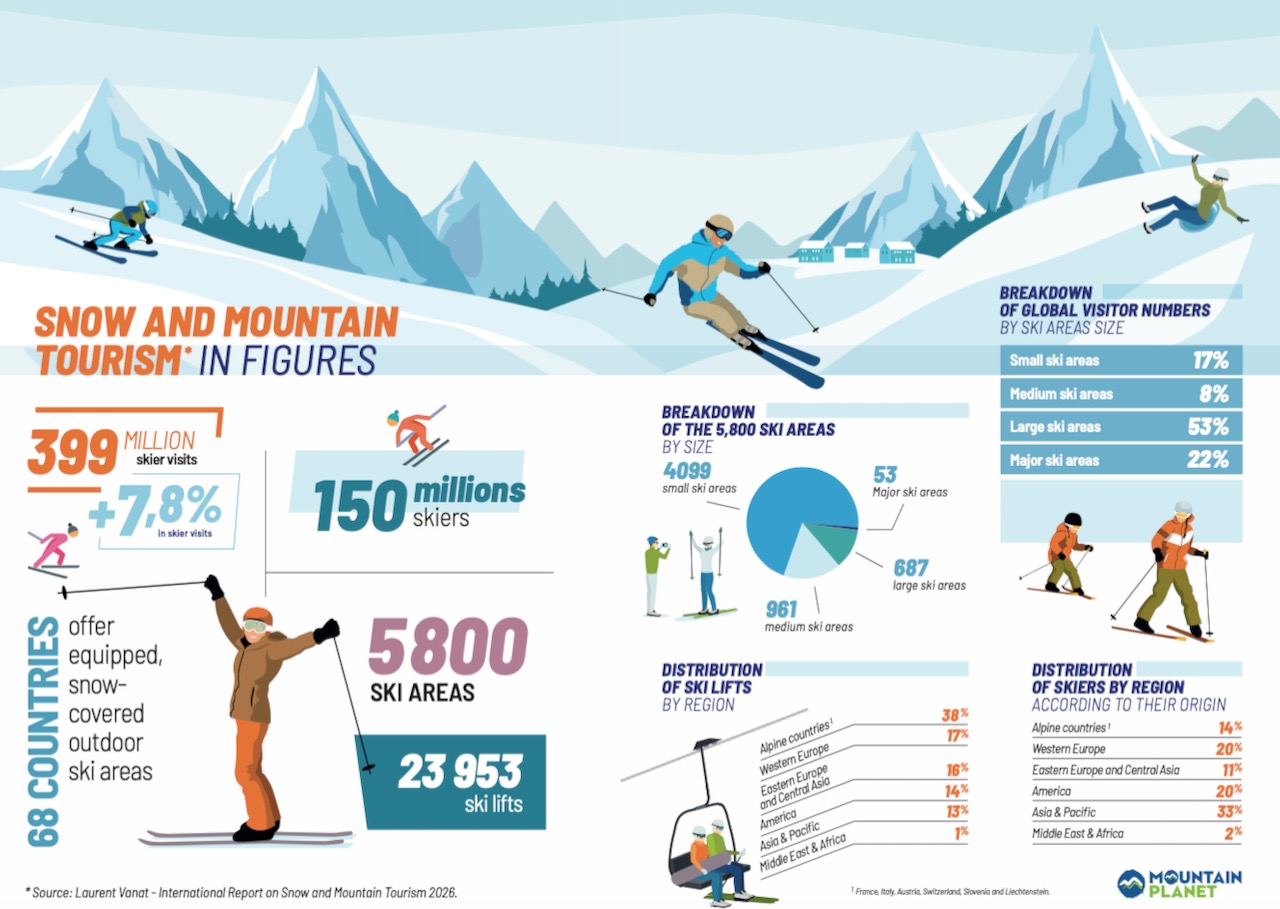
The 2024-25 season saw a record 399 million global skier visits, a 7.8% increase from the previous year. While this growth was widespread, the report highlights that the Alpine countries—Austria, France, Italy, Liechtenstein, Slovenia, and Switzerland—collectively account for 14% of the world’s estimated 150 million skiers. This places the Alpine region, including Switzerland, as a key pillar of the global ski market, alongside Western Europe (20%), the Americas (20%), and Asia-Pacific (33%). Notably, the 2024-25 season saw strong demand despite below-average snow in parts of Europe, with snowmaking and operations helping to maintain visitation levels. While countries like the U.S., Italy, and Russia exceeded pre-Covid averages, the report notes that Japan and Germany have not yet returned to pre-pandemic levels. China once again leads the ranking of countries performing above their historic pre-Covid five-year average.
The leading ski nations are:
1 United States — 61.6 million (+1.8%)
2 France — 54.8 million (+5.6%)
3 Austria — 51.9 million (+3.6%)
4 Italy — 34.8 million (+8.8%)
5 Japan — 28.2 million (+15.6%)
6 Switzerland — 26.3 million (+13.7%)
7 China — 26.1 million (+13.0%)
8 Canada — 19.8 million (+13.1%)
9 Sweden — 10.2 million (-2.9%)
The findings were released at the Mountain Planet trade show in Grenoble, France in the The International Report on Snow & Mountain Tourism 2024/5.
The Milano Cortina 2026 Winter Olympics has been a bit of a rollercoaster. On one hand, you’ve got the sheer thrill of Britain’s first-ever gold on snow, with Charlotte Bankes and Huw Nightingale making history in the snowboard cross . On the other, you can’t ignore the backdrop against which all the many wonderful sporting achievements unfolded.
However in terms of sustainability and the legacy of these Games, it feels like a real mixed bag.
The Wins: A Responsible Approach
Credit where it’s due, the organisers have genuinely tried to put their money where their mouth is, especially compared to the excessive construction we saw at some previous Games.
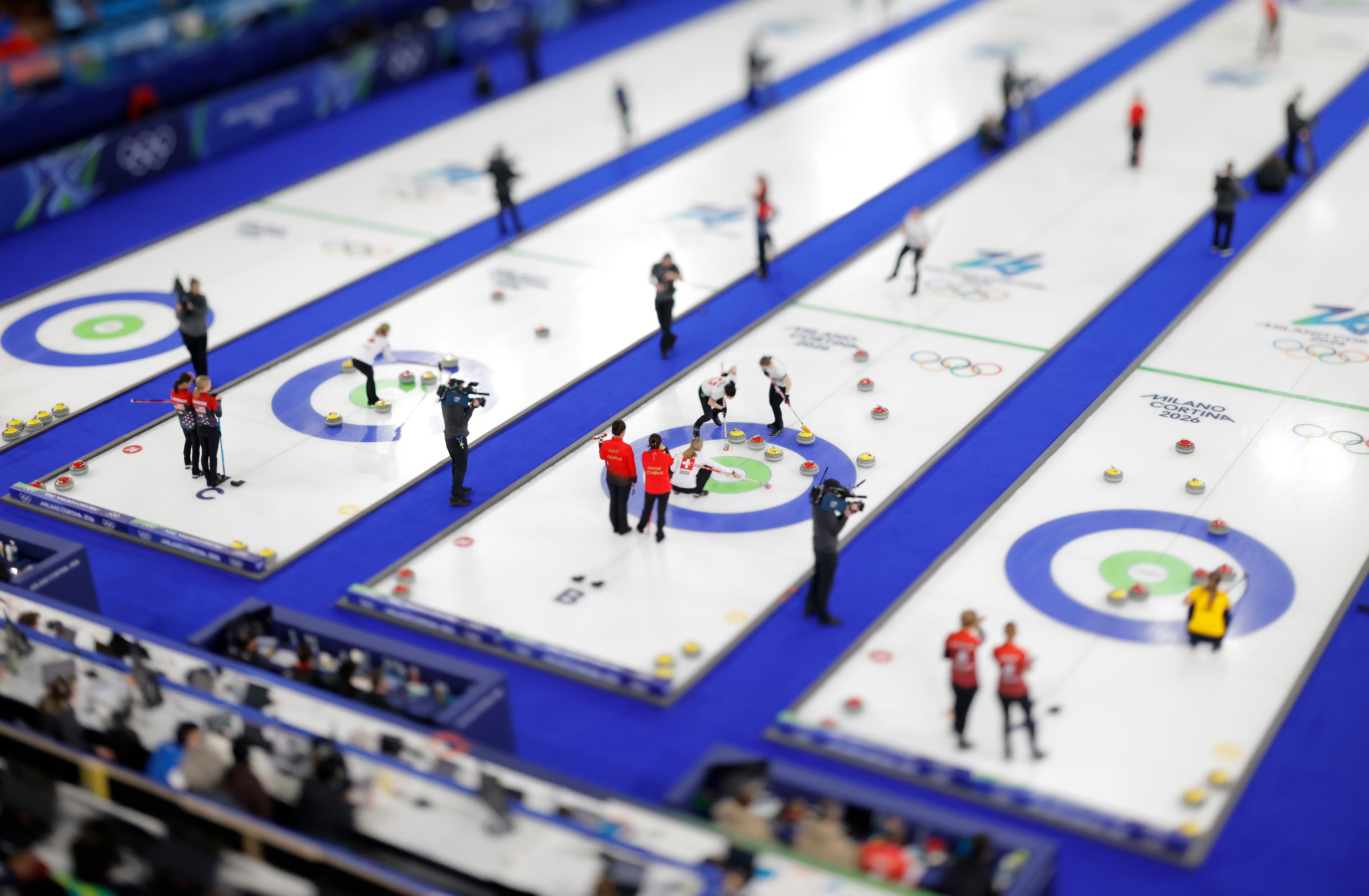
Using What’s Already There: The headline stat is that 85% of the competition venues were either existing or temporary . This is a massive win. Seeing iconic, historic venues like the Cortina Curling Stadium—first built for the 1956 Games—renovated rather than rebuilt from scratch is exactly what you want to see . It respects the heritage and avoids the “white elephant” problem.
Powering Up Cleanly: Almost all the venues are running on certified renewable electricity. Even the temporary generators, which are unavoidable, are running on renewable biofuel (HVO) rather than standard diesel . It’s a practical, sensible solution.
A Circular Economy: It was brilliant to hear they reused around 24,000 items of furniture and equipment from the Paris 2024 Summer Games . That kind of forward-thinking logistics is exactly the legacy we want to build between host cities.
A Legacy for Italians, Not Just Olympians: The legacy isn’t just about the two weeks of sport. The athletes’ village is designed to become student accommodation, and the Games are projected to create over 36,000 new jobs and a net economic benefit of over €5 billion for Italy . Over 2 million school kids got involved in educational programmes too . That’s a tangible, social legacy.
The Cracks in the Snow: The Sponsorship Contradiction
Although I enjoyed very much the absence of adverts and excessive advertising, this doesn’t mean that the Games didn’t escape the shadow of corporate sponsorship.
The ‘Torching the Future’ Paradox: The event is proudly sponsored by an oil and gas giant (Eni), a major car manufacturer (Stellantis), and an airline (ITA Airways) . It feels deeply hypocritical to watch athletes compete on fragile, climate-threatened snow while the boards around the track are advertising the very products driving the problem.
The Hidden Carbon Footprint: This isn’t just pearl-clutching. Reports from the New Weather Institute and Scientists for Global Responsibility estimate that the emissions induced by these sponsorship deals—through the companies’ own operations and advertising—could be 1.3 million tonnes of CO2. That’s actually 40% more than the entire carbon footprint of running the Games themselves . You can’t help but think of the irony when Italy has reportedly lost 265 ski resorts due to a lack of natural snow . It’s like selling tickets for a sinking ship while advertising the drill that made the hole.
The British Perspective: Fighting Above Our Weight
British athletes are at a disadvantage in that the country does not have reliable conditions for snow sports. Our entire winter sports programme operates on a fraction of the budget of the top nations .
This makes our success at these “sustainable” Games feel particularly poignant. We are, by necessity, the ultimate experts in working with what we’ve got, not building shiny new infrastructure. When Matt Weston and the skeleton squad bounce back from disappointment to win, or when Mia Brookes pushes the limits of freestyle, they embody a scrappy, efficient, and very British spirit of innovation .
A Bleak but Hopeful Future
Looking ahead to the 2030 Games in the French Alps, it’s clear that 2026 has started a vital conversation. There is growing public support (77% of Italians agree) to ban high-emission companies from sponsoring winter sports . The athletes themselves are speaking out, drafting open letters saying, “Oil companies don’t belong in the Olympics” . Although the Italians reversed the lack of sustainability of previous Olympics, it could have gone further.
So, as I reflect on the 2026 Games, I feel proud of Team GB’s resilience, in awe of many of the amazing Olympians from so many nations and cautiously optimistic about the operational side of hosting. I am pleased the boycott of Russia was maintained, although sadly rescinded for the Paralympics. But the lingering memory will be that uncomfortable contradiction: celebrating human endurance while platforming the forces that endanger the very snow we compete on.
Holidu has come up with a list of the most expensive resorts in Europe – and surprisingly no resort in France makes the top 10, whilst only two Swiss resorts do.
The most expensive resorts are mainly in Austria and Italy. Here is the list:
1. Obergurgl-Hochgurgl, Austria – €287 per day 2. Cortina d’Ampezzo, Italy – €279.50 3. Obertauern, Austria – €276.50 4. Zermatt (CH) – €273 5. Gitschberg Jochtal (IT) – €238 6. Ischgl (AT) – €228.50 7. St. Moritz – Corviglia (CH) – €222 8. Madonna di Campiglio (IT) – €221 9. Kitzbühel/Kirchberg/KitzSki (AT) – €214.75 10. Hintertux Glacier (AT) – €214
The study considers both daily ski pass prices and accommodation costs per person.
The cheapest resorts are all in France, but it is worth considering that they all have less than 40km of ski domain, have short seasons and are generally hard to get to.
Conversely, despite Zermatt’s relative expense, it has an extensive domain, a long season and excellent public transport links.
Which are the most expensive ski resorts in Europe? A recent survey, published at Statista rated the following the most expensive (prices given are average price per day in Euros):