The Russian Invasion of the Alps

Anybody skiing in the Alps in the last twenty years can’t but help notice the large number of Russian tourists. Whether it is hearing Russian spoken in the resorts or Cyrillic estate agent listings, the Russians had clearly taken to the Alps in a big way since the fall of the Iron Curtain. But this was a popular invasion.

The Russian influx was welcomed in particular by the ski resorts. Wealthy Russians weren’t shy about buying chalets and luxury items. Russians also filled the quieter ski period in January because it coincided with the Russian Orthodox Christmas vacation season. Courchevel in January, in particular, is usually awash with Russian billionaires, their entourages and their dosh.

Resorts saw a downturn in the number of middle-class Russians after the first Russian invasion of Ukraine in 2014. However it did not affect the oligarchs who continued to flood in to the Alps, even though the resorts were sometimes less welcoming to the oligarchs than hitherto. In 2018 Roman Abramovich, the owner of Chelsea football club, applied for, but was denied, residency in Verbier. Swiss police arrested Russian businessman Vladislav Klyushin on his way to Zermatt in 2021, and extradited him to the USA on charges of commercial espionage.

None the less, in the winter season 2018/19 Russians spent 140,000 night stays in hotels in the French Three Valleys resorts alone. Switzerland had 195,000 Russian night stays in the same season, with the main destinations being Verbier, Zermatt, St Moritz and Davos. Resorts in the Tyrol such as St Anton and Ischgl were particularly popular with a segment of the Russian market who liked the extensive pistes and hard core apres ski. Despite a small dip in 2014/15, luxury chalets in the main ski resorts continue to be purchased by wealthy Russians, or on behalf of wealthy Russians.

And it is not only wealthy and middle class Russians who enjoy the Alps. Le Monde established that Russian spooks have long favoured the Haute Savoie as a base for targeted assassinations around Europe, including that by the agents who planned the UK poisoning of ex Russian intelligence agent Sergei Skripal and his daughter in March 2018.

Outside the Alps the Bulgarian ski resorts, such as Borovets and Bansko, have always been popular winter destinations for Russians. Before the Iron Curtain came down, I met many Russians in my ski trips to the country. There is a strong cultural bond between the people of Russia and the people of Bulgaria, and skiing in Bulgaria is significantly cheaper than Alpine ski resorts. Consequently Russian tourists have continued to flock to Bulgaria for winter sports even after the Iron Curtain came down and opened up the Alps as a ski destination. In the 2021/22 season Russian tourists came in even larger numbers because Bulgaria recognises Russian-made COVID vaccines.

The invasion of Ukraine by the Russian military in February 2022 has changed everything for Russian winter tourists. For the foreseeable future, it is going to be impractical for Russians to get to the Alps, and – in any case – not affordable for many of them as the rouble plunges against the Euro and the Russian economy goes into recession. For Russian tourists on holiday in Europe and caught unaware by the invasion, the sanctions from the EU and Switzerland have left tens of thousands stranded in European ski resorts. Middle class Russians face an expensive trip home since all flights out of the EU to Russia have been grounded. Additionally many ATMs and  establishments will no longer approve Russian debit and credit cards.

Switzerland has long been a popular destination for the wealthy, but their presence is no longer as welcome as it once was. The 2022 Verbier Festival has cancelled all Russian artists and the Music Director, Valery Gergiev, a prominent Putin apologist, has been asked to resign. Aligning with EU restrictions, eight Russian oligarchs resident in Switzerland with close ties to Putin have received travel bans. Many oligarchs will see their chalets sequestrated. At least a dozen private planes owned by wealthy Russians are stranded at Basel airport. Billions of dollars worth of assets managed or held by Swiss banks on behalf of wealthy Russians have been frozen.

Still, Belarus, North Korea, Syria and Eritrea remain friendly to the Russian regime and will no doubt welcome winter tourists from Russia – although the skiing options are limited. But there’s always Sochi, where the biggest ski resort, Krasnaya Polyana, has 102 km of piste and still serves Russian vodka.

Choosing the Right Flower Service

Selecting the perfect flower delivery in Lahore requires understanding your needs and preferences. Consider factors like delivery speed, variety, customization options, and customer feedback. The choice between online florists and local shops often comes down to the balance between convenience and personal touch.

Sustainable and Eco-Friendly Options

An increasing number of Lahore’s florists are embracing sustainable practices, from sourcing locally grown flowers to using eco-friendly packaging. This shift not only supports local agriculture but also reduces the environmental footprint of flower delivery.
Swiss Winter Sports in 1925

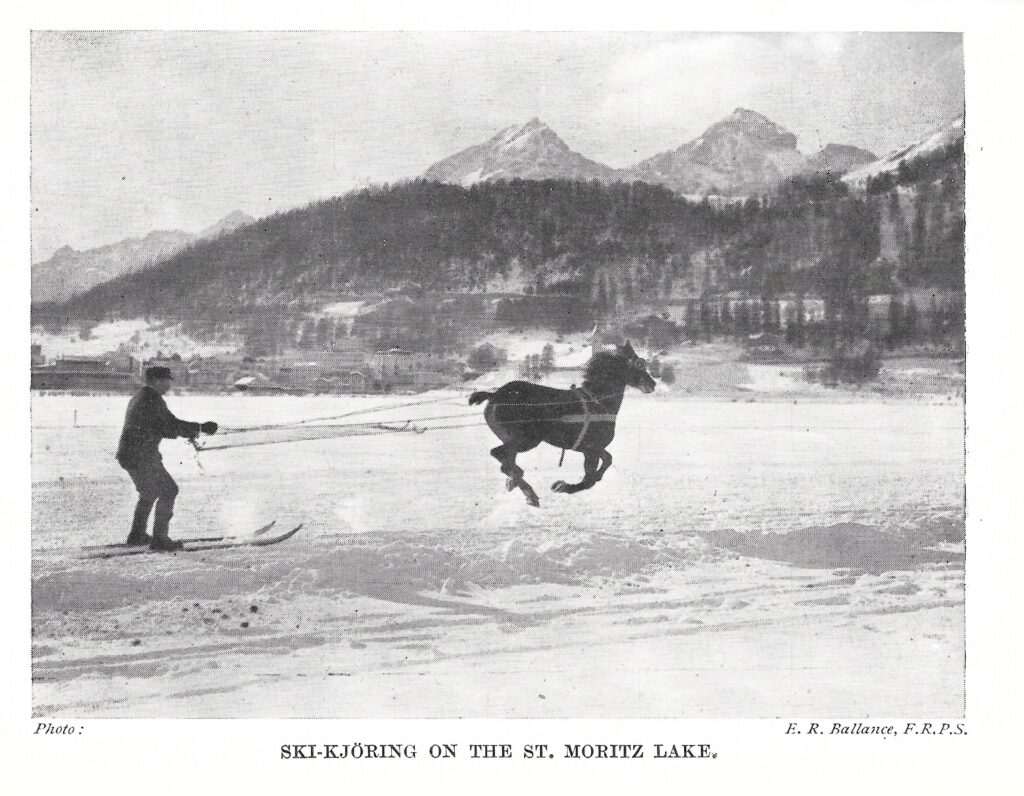
Skijoring on the lake at St Moritz 1925

Although I have been skiing for over 50 years, I don’t have a great sense of it changing much since I first tumbled down a Scottish mountain. OK, we did wear some uncool ski outfits back then, nobody snowboarded and there were a higher proportion of surface lifts. But I don’t remember it being so different. Largely the same resorts and the same vibe in them.

Track back another 50 years, and what was often called ski running involved very long wooden skis, one stick and a pair of stout leather ski boots. And it was by no means the major attraction for people visiting the Alps in winter.

I’ve been reading “Things Seen in Switzerland in Winter”, written by Charles Domville-Fife in 1925. He writes that interest in visiting Switzerland was divided between those for whom it was termed “The Playground of Europe”, and those who went hoping to recover from tubercolosis.

Until 1946 there was no effective medication to treat tubercolosis, a disease that killed as many as one in four people in England in the 19th Century. Swiss mountain air and sunshine achieved a remarkable recovery rate in the clinics that sprung up in hitherto sleepy hamlets like Davos and Arosa in the late nineteenth century. And the therapeutic benefits were enjoyed as much, or even more, in the winter.

St Moritz had also become a popular destination for its winter sun and the many diversions organised in the sophisticated hotels there – the hotelier Badrutt taking a lot of credit for popularising winter holidays in the Engadine. In 1873 for the first time St Moritz recorded more winter visitors than summer ones.

One English visitor to Switzerland in the late nineteenth century was Sir Arthur Conan Doyle, who stayed in Davos where his wife was recuperating from tuberculosis. Ever impatient to be doing something, he imported some skis from Norway (where skiing had long been a practical means of transport) and became the first person to ski from Davos to Arosa – still a popular back country route. In 1893 he wrote an article in the English press of his experiences and helped popularise what was to diverge from Norwegian ski techniques to become what we now know as the sport of downhill skiing.

Skiing was by no means the only winter sport that became popular in Switzerland. Domville-Fife records that skating was introduced as a winter sport in 1876 (from England), curling (from Scotland) in 1882, tobogganing (from Canada) in 1884, ice hockey (also from Canada) in 1992 and the quaint sport of skijoring (from Scandinavia) in 1906.

In the second half of the nineteenth century Switzerland benefitted from a growing electrified rail system, opening up destinations such as the new sanatoria in Montana and Leysin, and new winter sports destinations like Klosters, Celerina, Grindelwald, Wengen, Murren, Gstaad, Villars, Engelberg and Andermatt. Adelboden later emerged as both a health centre and a ski destination, with the world’s first winter sports holiday package organised by Sir Henry Lunn in 1903. Outside of Switzerland, Chamonix and St Anton – both with rail links – were early adopters of sport skiing, St Anton claiming to have founded the first ski club in 1901.

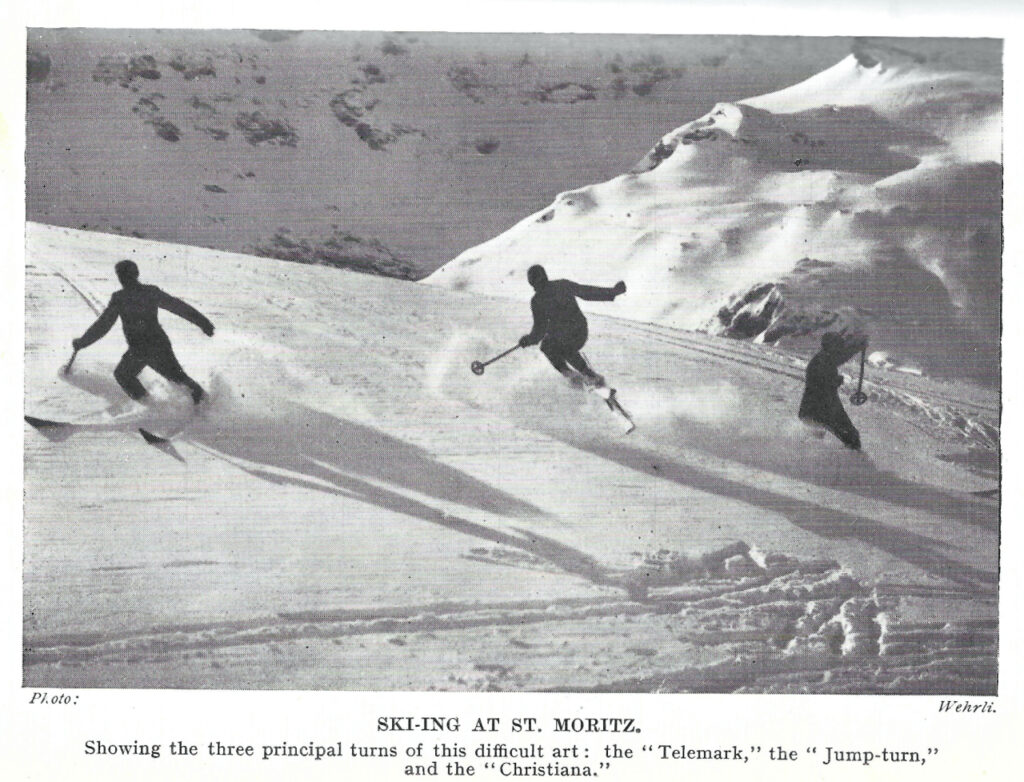
Skiers demonstrate Telemark, Jump Turn and Christiana in St Moritz 1925

Most of the new winter sports were introduced by the British, but soon became popular with the Swiss and visiting Germans. The opening of the cog railways in winter in Grindelwald, Wengen and Villars are attributed to British requests that they be available outside the summer timetable.

It’s noteworthy that, at this time, British tourists tended to come over only in December and January, and what we now largely associate with the peak winter sports period was left to the locals. Domville-Fife declares that “at nearly all the best known resorts the predominance of British people during Christmas and New Year festivities is usually so great that even the Swiss themselves are scarcely seen. It is during this period and for about five weeks afterwards that a sojourn at any of the winter sports centres becomes one of the most delightful experiences of life”.

Domville-Fife, writing in 1925, doesn’t mention a single ski destination in the canton of Valais, now probably the pre-eminent ski region in the world. Champéry, in the Portes du Soleil did not have its first lift access to the slopes until 1939, Verbier’s first lift arrived in 1946, Saas-Fee a popular summer spa destination did not have road access until 1950 and Zermatt, although it has had the Gornergrat cog railway since 1898, was primarily known as a summer destination for climbers, and did not open the railway to the summit during the winter season until 1941. Only Montana (later Crans-Montana), had adopted skiing by 1925, following the opening of the funicular railway in 1911. However the village was still mostly popular for its sanatoria and, from 1906, for golfing.

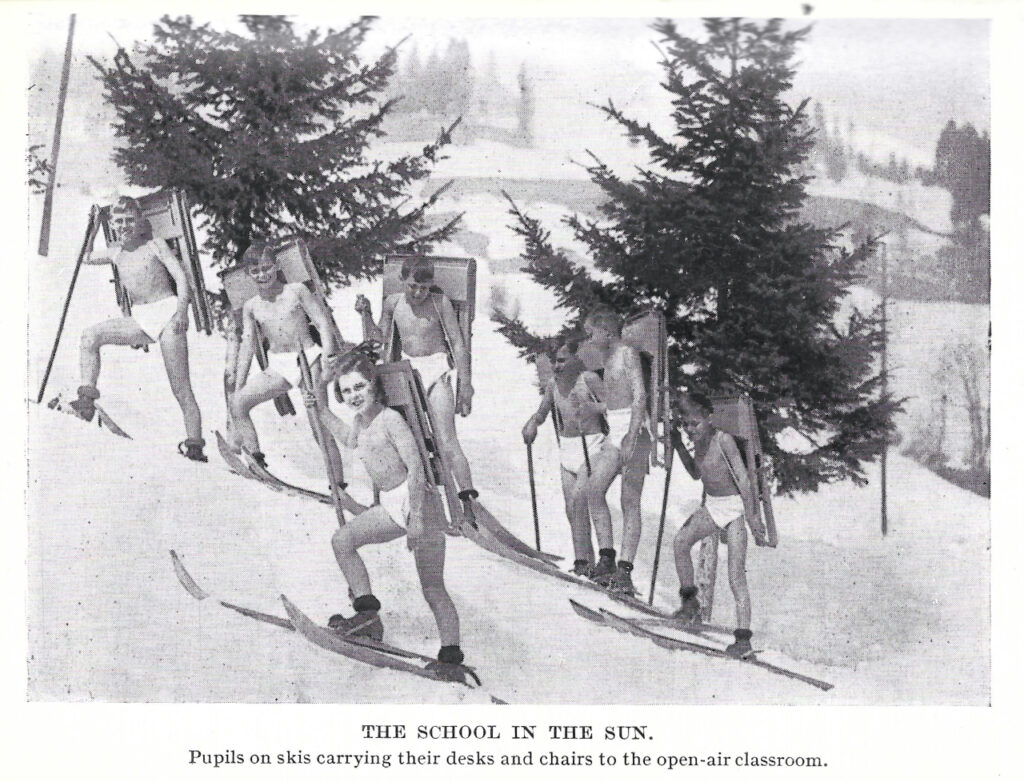
Skijoring, meanwhile, has its adherents but has achieved only a limited popularity. Although my Swiss mother-in-law recalls skiing to school on skis, I don’t think it looks anything like this today at Aiglon College!

Switzerland - school in the sun 1925.

End of Ski Season review

Phew! What a season it has been for skiing and snowboarding. I was fortunate to get some good skiing in before Christmas, but in general it has been a dismal season for everyone.

The Swiss lift operators association (Seilbahnen Schweiz/Remontées Mécaniques Suisses) has published its analysis of the season up until the end of March – which for all but a handful of resorts is end of season.

The lift operators report a grim picture. By the end of March, lift usage and turnover in Switzerland had fallen by 24% in total, compared to the 2018/19 winter season. Large resorts, dependent on international visitors, have suffered most, but the closure of bars and restaurants has also deterred local winter sports enthusiasts. Additionally, ski camps and club and business trips have not taken place. Ski lifts in the Prealps and in areas close to towns, which cater more for day tourists, have not done quite as badly. Ticino has actually done quite well compared to 2018/19, but that was a season where the canton suffered from a lack of adequate snow – something that cannot be said of this season, where the snow conditions remain very good in those resorts still open.

On the whole comparison with the 2018/19 season is more meaningful than for 2019/20, because Covid-19 had an impact on the latter part of the 2019/20 season. It was hard to forecast a year ago we would be where we are now, and it is only with some optimism that we can look forward to next year being without some restrictions. None the less, overseas visitors are booking in advance for next season like never before, with many winter tour operators reporting bumper bookings.

The long-term impact on the lift operators is hard to gauge. Despite running at a considerable loss this season, lift operators have seen themselves as providing a public service and largely remained open. If the ski lifts had closed, mountain regions would have faced a shutdown of even more tourist activities, resulting in greater economic damage than has anyway been inflicted. Government support, the lift operators association says, is needed to avoid systemic damage to tourism.

The impact on the whole winter sports infrastructure is devastating. Some businesses will not return, others will cancel plans for expansion or investment. Many resorts were already worried about the long-term impact of climate change, and Covid-19 is hardly likely to positively impact their thinking. Additionally, with ski resorts being amongst the Covid-19 hotspots at the start of the pandemic, the image of winter sports has suffered.

I think the ski industry will recover strongly, although the level of growth will likely be lower than in previous years. From a sustainability perspective and in light of the impact of climate change, that is probably not a bad thing.

Ski and Snowboard – Vaping

E-cigarettes, otherwise known as vapes, have become increasingly popular. Many people believe that e-cigarettes are ‘less damaging’ for you than traditional cigarette smoking. With a rise in vaping by Australians, particularly among young people, it’s important to understand the long-term health risks. Visit vaprzon.

What is vaping?

Vaping is the act of using an e-cigarette, or ‘vape,’ which are lithium battery-powered devices that use cartridges filled with liquids, or ‘juice.’ The liquids typically contain nicotine, artificial flavourings, and various chemicals, some of which have been shown to be toxic. The liquid is heated into an aerosol, or vapour, and inhaled into the user’s lungs.

Some vapes are designed to look similar to tobacco cigarettes, cigars, and pipes, while others resemble everyday items, such as pens and USBs. Even though e-cigarettes do not contain tobacco many liquids still contain nicotine, which is highly addictive, as well as other chemicals. These chemicals can be toxic when they are inhaled. Some are included to add a fruit, alcohol, or confectionary flavour to the product. In a pioneering study, funded by Lung Foundation Australia, Minderoo Foundation and the Scottish Masonic Charitable Foundation WA, researchers at Curtin University tested the chemicals and toxicity of 52 flavoured e-liquids available for sale over the counter in Australia1. The research unveiled a cocktail of chemicals which raise serious concerns about the safety of these products and their risks to the respiratory health of young people.Download the free pack

100%

of the e-liquids were inaccurately labelled.

100%

contained chemicals with unknown effects on respiratory health.

21%

contained nicotine despite this being illegal in Australia.

62%

contained chemicals likely to be toxic if vaped repeatedly.

Vaping in Australia

It is illegal to use, sell or buy nicotine for use in e-cigarettes to anyone in Australia without a prescription. With the exception of Western Australia, each state and territory permit the sale of vapes and e-cigarettes, but not the sale or purchase of liquid cartridges that contain nicotine. For this reason, many users purchase their products and liquid cartridges online. These products are often imported from overseas, meaning there is little control over how they are manufactured and what they contain.

Smoking cessation

In some cases, doctors can prescribe nicotine e-cigarettes as a means of weaning off tobacco use. There is little evidence that using this method is successful in achieving this outcome. From 1 October 2021, the Australian government introduced further restrictions to limit access to the use of nicotine e-cigarettes among adolescents and young adults. This included requiring a valid prescription to import nicotine e-cigarettes and liquids containing nicotine.

Vaping and young people

E-cigarettes can serve as a “gateway” to nicotine addiction and tobacco cigarette smoking. There have been many studies which found experimentation with e-cigarettes encouraged the use of tobacco cigarettes, particularly among young people. According to the Australian Bureau of Statistics, more than 1 in 5 (21.7%) young Australians aged 18-24 and 7.6% of 15-17 year olds have used an e-cigarette or vaping device at least. It’s likely that these figures are under-reported because responses were provided by an adult living in the same household.

Research of e-liquids available to purchase over the counter in Australia found 1 in 5 contain nicotine, among a concoction of other toxic chemicals – all had inaccurate labelling. With the inclusion of fruit, alcohol and confectionary flavours, e-cigarettes are designed to appeal to young people. Experts are concerned these products will create another generation of nicotine addiction and a rise in serious health issues including lung disease and cancer.

Lung Foundation Australia has developed a suite of resources to fill the knowledge gap around vaping and e-cigarettes. These resources are designed by and for young Australians, educators and parents and carers, to arm you with accurate and evidenced-based information.