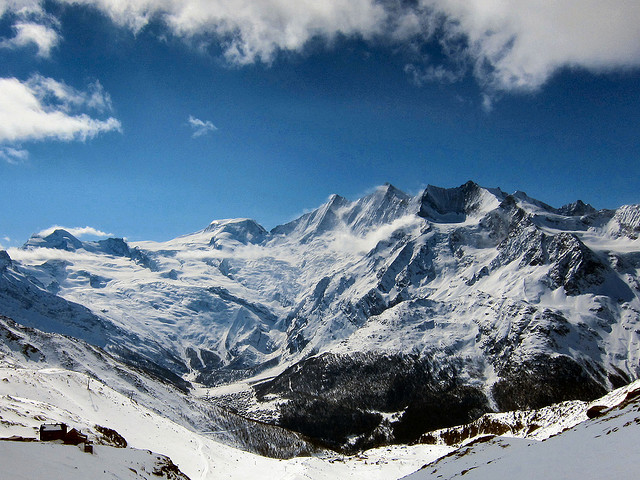
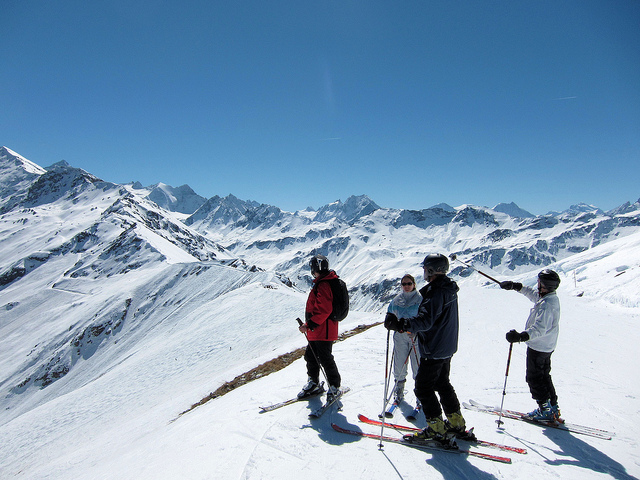
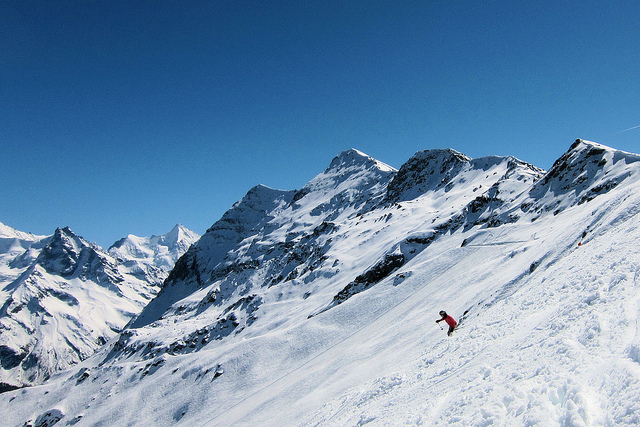
I was reading an article in an online version of an Australian newspaper, the Sydney Morning Herald, which was addressing the issue of global warming and its impact on the Alps. Apparently “a recent Austrian climate change report found that the country’s temperatures had risen twice as fast as the global average since 1880, with the number of sunshine hours in the Alps increasing by 20 per cent.” I have certainly seen the impact of climate change on glaciers I have visited over the years, and there is no denying it will have an impact on the Alps.
Anyway, one of the more interesting observations was that a “ski region” called Stockhorn has dispensed with its ski lifts to concentrate on snowshoe walkers and such like. Now, as a self-declared expert on skiing in Switzerland, I feel a little ashamed to say I didn’t even know there was a place called the Stockhorn which had dismantled its ski infrastructure, and don’t have it in my winter sports website. Certainly the Stockhorn (3405m) in Zermatt is not suffering from global warming or lift closures, at least not last time I visited earlier this year! But as is often the case, several mountains often share the same name in the Alps.
So I did a little research.
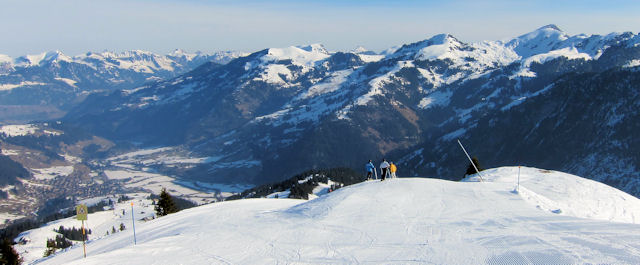
And I found another Stockhorn. The website for the resort states “Erlenbach in the Simmental lies in the Bernese Oberland at the start of the Simmental, in the direction of Lenk and Gstaad. The valley station of the Stockhorn cableway can be reached easily in approx. 30 mins by car from Bern, and in approx. 15 minutes from Thun. The timetable of the Stockhorn cableway has been coordinated with the train timetable.” Yes, this is Switzerland, there is a railway station in Erlenbach im Simmental with lifts timetabled to connect with the train timetable. I know Erlenbach – it is a small sleepy village in the Simmental valley and at a 700m elevation never a great candidate for ski-in, ski-out facilities. Could it have once been the throbbing heart of a ski region whose fame stretched across the planet as far as Australia?
The top of the Stockhorn is 2190m, but it seems skiing off the summit is not feasible. If there ever was skiing here, it would have been from the mid-station at Chrindi at a modest elevation of 1642m or possibly from local facilities in Erlenbach, but the village is very low to sustain a decent piste for any duration – in fact I know of NO resort with runs that low.
So it does have a cableway, but appears to have no other ski facilities. But surely, then, you can ski down still? And it does appear you can. As well as snowshoe walks, winter walks, an igloo village, fabulous views and fine dining, there are ski tours you can do in the area, organised by a local ski school. Starting at 9.50am on 30th December 2014, 3rd January 2015, 17th January 2015, 1st February 2015 and 28th February 2015 for between CHF140 and CHF290 Alpinschule Bergfalke (+41 (0)795025080/info@bergfalke.ch) take guided ski tours in the area. No touring experience is necessary, just that you are a reasonably good piste skier or snowboarder and in good physical condition. It looks like you have a three hour ascent from the lifts to start the downhill section of the tour. The claim is the tour suits both beginners and connoisseurs.
And it doesn’t look like you ski the Stockhorn anyway – the area you ski is the Lasenberg (Laseberg) which peaks at 2019m and the Cheibenhorn at 1952m, but you use the Stockhorn lift to get there, getting out at the Chrindi mid-station.
The Simmental is a fabulous region, renowned for its food, at least in Switzerland, and probably best known for the ski resort at Lenk and its access to Gstaad Mountain rides from Zweisimmen. Locals also often ski the small resorts at Diemtigtal and Beatenberg.
Were there ever ski facilities at the Stockhorn? I can find no evidence it was graced with as much as a drag lift at any period, but I suspect competing resorts in the Bernese Oberland rather than global warming did for the facilities if they ever did exist. It may have been that the locals tried out a drag lift for a period, but these are usually dismantled in the summer, and hardly constitutes the making of a ski region. Sometimes it is simply not economic to re-assemble and repair, or replace, an old and little-used lift. And if there were any ski facilities in the area once I doubt if anyone other than the good citizens of Erlenbach ever used them.
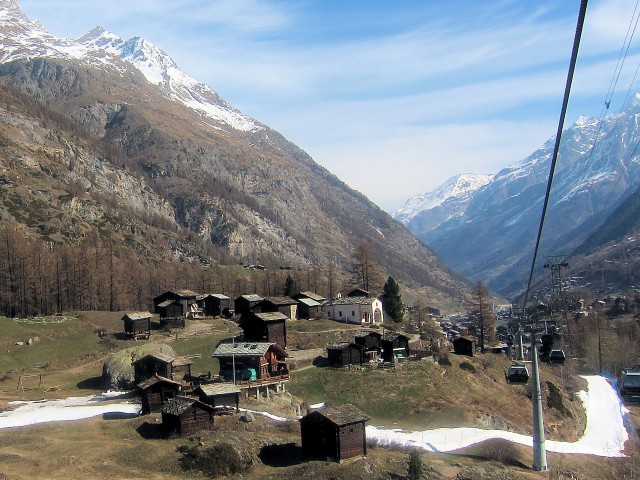
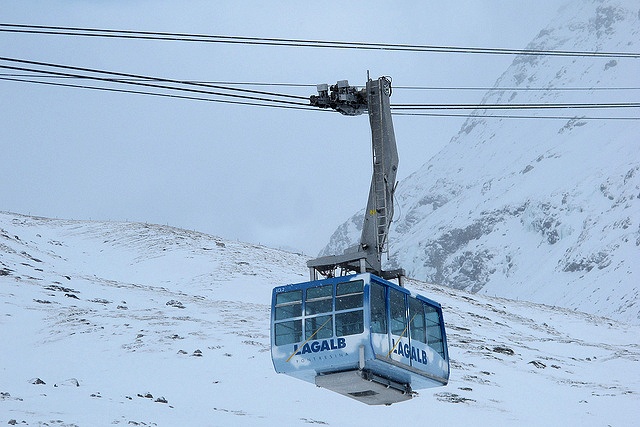
But there is another more prosaic explanation for this new story. Back in 2007, a cable car system, initally constructed in 1958 linking Gornergrat (3089m) to Stockhorn (3405m) above Zermatt (1620m) was dismantled and replaced with a new lift. Could this be the origin of the news story? Possibly not, since the story cites a “refocus on winter hiking and snowshoeing” as the replacement activity to skiing. Any readers ever seen somebody snowshoe walking the Triftji Jumps? No, nor have I. But possibly the intrepid newshounds from AFP,a French news agency that seems to have originated the story, got confused and linked two events about two different mountains and came up with a whole new angle.
So hitting my inbox and that of many other people round the world, and syndicated across a whole bunch of Australian, Asian, American and European newspapers and journals (including the famously gaff-prone UK Daily Mail), is a story entitled “Dismantling ski lifts in Europe as world warms up”. And they cite the Stockhorn as their sole justification, and there is no evidence to support any mountain in Switzerland called the Stockhorn had a lift dismantled in the face of global warming. Oh well, why let the facts get in the way of a good story.