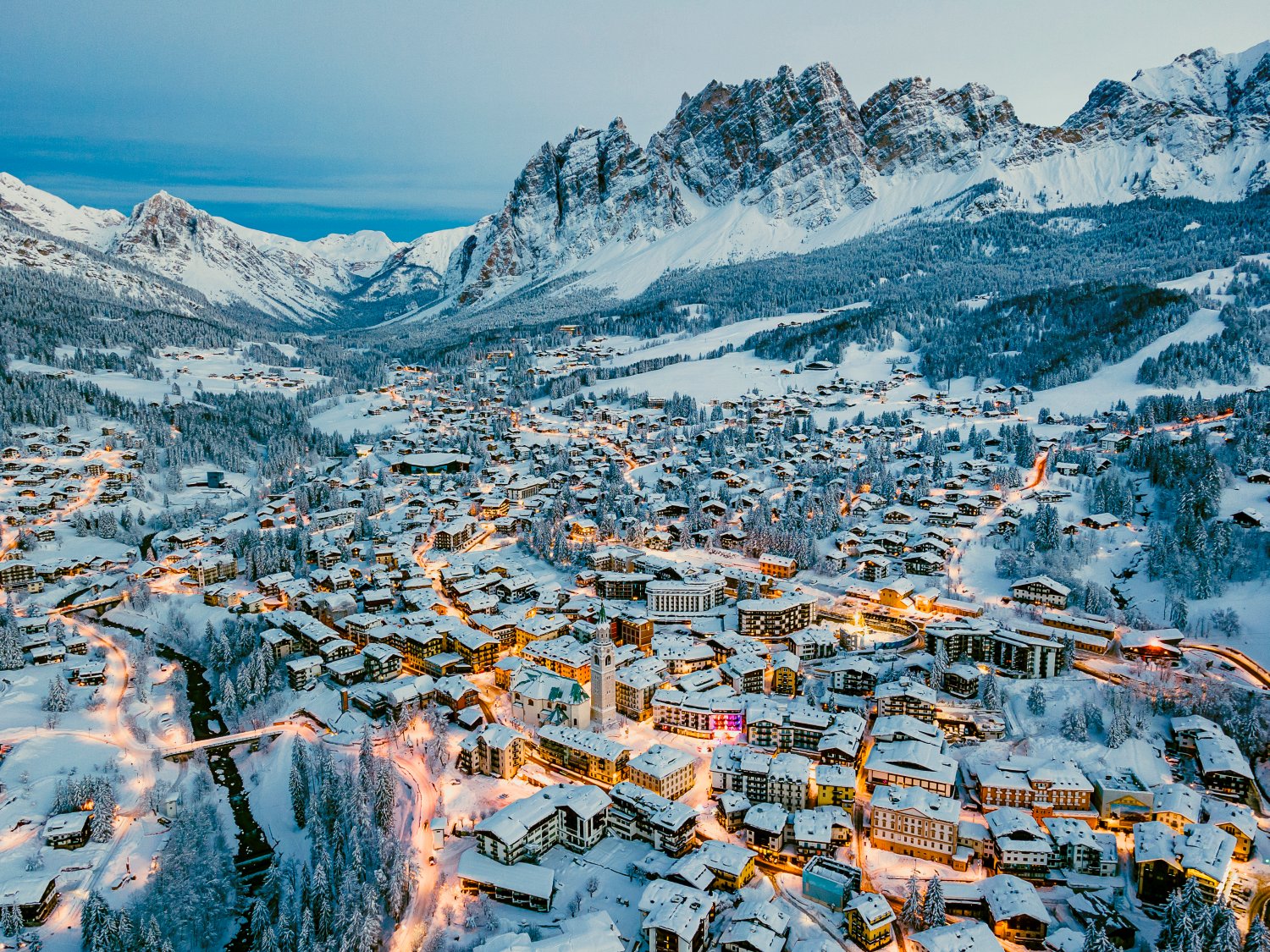
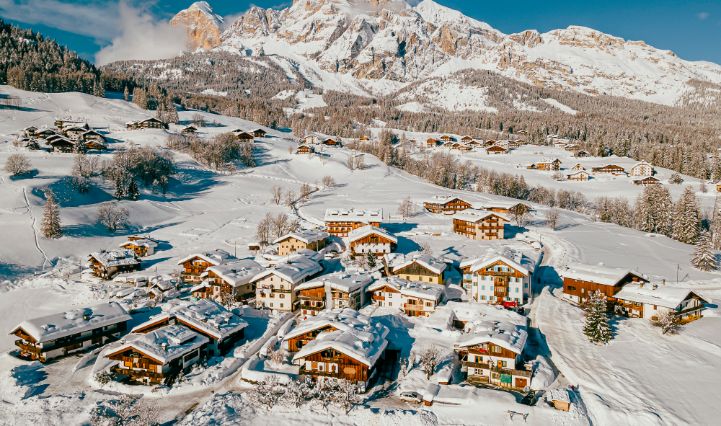
Holidu has come up with a list of the most expensive resorts in Europe – and surprisingly no resort in France makes the top 10, whilst only two Swiss resorts do.
The most expensive resorts are mainly in Austria and Italy. Here is the list:
1. Obergurgl-Hochgurgl, Austria – €287 per day 2. Cortina d’Ampezzo, Italy – €279.50 3. Obertauern, Austria – €276.50 4. Zermatt (CH) – €273 5. Gitschberg Jochtal (IT) – €238 6. Ischgl (AT) – €228.50 7. St. Moritz – Corviglia (CH) – €222 8. Madonna di Campiglio (IT) – €221 9. Kitzbühel/Kirchberg/KitzSki (AT) – €214.75 10. Hintertux Glacier (AT) – €214
The study considers both daily ski pass prices and accommodation costs per person.
The cheapest resorts are all in France, but it is worth considering that they all have less than 40km of ski domain, have short seasons and are generally hard to get to.
Conversely, despite Zermatt’s relative expense, it has an extensive domain, a long season and excellent public transport links.
The rise of artificial snow is inexorable. In 2009 about a fifth of slopes in the French Alps were supplied by snow-machines. Today it is over half, and rising fast. In some resorts in America the artificial takeover is nearly total. According to International Ski Federation rules, it would now effectively be impossible to make competition-grade slopes without using artificial snow.
An article in 1843 magazine provides the following explanation of what artificial snow is:
Snow machines take water, mix it with compressed air and blast it into a mist of tiny droplets that freeze into hard balls of ice as they fall to the ground. Under a microscope, these look nothing like snow crystals. They’re just lumpen spheres crammed together like misshapen Maltesers. Snow machines have two big advantages beyond the obvious: creating snow when none is falling. First, artificial snow is about 50 times harder than the real stuff, which makes it far less likely to melt. Compared with a piste of natural snow, an artificial one will last up to five weeks longer when temperatures rise above zero.Second, the structure of artificial snow is uniform. The natural sort settles into packs with wildly different textures.
This different structure of artificial snow can have a negative impact on the mountain ecosystem.
And why is it sometimes too warm to make snow even when it is below freezing? the article continues:
What matters for snowmaking is the combination of air temperature and humidity, what’s known as “wet-bulb temperature”. Just as human bodies struggle to cool down on humid days, so snowflakes struggle to freeze in moist air. At a wet-bulb temperature of -8℃, which, for example, registers when the air temperature is -5℃ and the humidity a low 20%, it’s easy to make snow. But as the air’s cooling capacity declines, snowmakers have to compensate by pumping less water through the machines. The result is ruinous inefficiency. It takes three times as much energy – and three times longer – to make a cubic metre of snow at a wet-bulb reading of -4℃ as it does at -8℃. At -3℃, you’re using quadruple the energy you needed at -8℃ – though it’s technically possible to make snow, you’d really rather not. Above -2℃, forget about it. The water won’t freeze as it falls to the ground.
Even snow machines do not provide a complete solution for global warming. Human ingenuity is finding increasing numbers of ways to keep skiing viable, but at a cost.
Artificial snow is an environmental disaster. Typically a ski resort will use a billion litres of water in a season to produce artificial snow, with as much as 40% of the water lost through leakage, evaporation or because artificial flakes blow away from the piste they’re supposed to land on. Snowmaking also accounts for approximately 50% of the average American ski resort’s energy costs
When Beijing secured the bid to host the 2022 Winter Olympics, China’s leader, Xi Jinping, encouraged the populace to embrace winter sports enthusiastically. This led to the construction of new resorts. The government claims that around 300 million Chinese citizens (from a population of 1.4 billion) have participated in winter sports since 2015. Although this figure may be exaggerated, the campaign appears to resonate more with middle-class Chinese than other more ideologically driven initiatives.
“If sports are strong, a nation is strong,” Xi Jinping has stated. China secured just one gold medal at the 2018 Winter Olympics, but this number rose to nine in 2022. Part of this success was due to the naturalization of foreign athletes, such as Eileen Gu, an American-born freestyle skier who chose to compete for China and became a prominent figure during the Beijing games. She won two gold medals at the Olympics and another victory at the Freestyle Skiing World Cup in December, held in China.
However, the government’s push for winter sports extends beyond medal acquisition. China’s latest five-year plan includes targets for increased participation in sports and physical exercise, aiming primarily to enhance public fitness. In 2020, the National Health Commission reported that about half of China’s population is overweight. Additionally, the state hopes to encourage Chinese holidaymakers to spend their money on domestic activities, like skiing.
Most Chinese skiers are beginners, so there are few complaints about the country’s ski destinations, which typically feature small slopes with gentle inclines. The largest Chinese resorts are comparable to small European ones. At Mission Hills, more space is dedicated to photo opportunities and arcade games than to skiing. However, those who conquer its simple run can anticipate the opening of the world’s largest indoor ski center in Shenzhen in 2025.
For now, Chinese skiers seeking more challenging terrain might look to Xinjiang in the northwest, with its high mountains and lengthy winters. Xinjiang boasts 64 ski resorts, nearly 10% of China’s total. According to Xinhua, the state news agency, visitors to the skiing haven of Altay increased six-fold over the five years leading up to 2022. While this tourism surge boosts the local economy, it also diverts attention from the human rights abuses that the government has perpetrated in Xinjiang over the past decade.
Which are the most expensive ski resorts in Europe? A recent survey, published at Statista rated the following the most expensive (prices given are average price per day in Euros):