Scuol

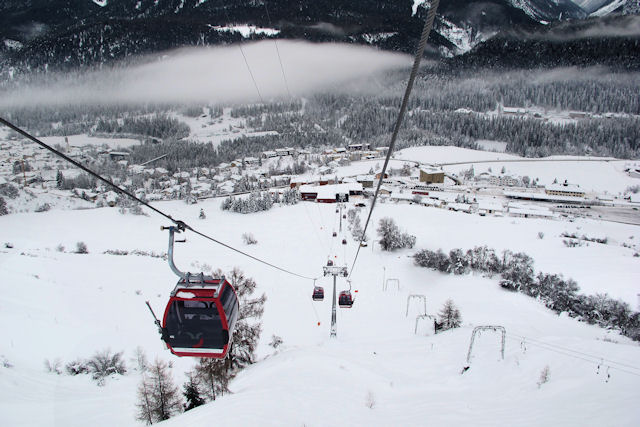
Scuol from Motta Naluns
Scuol, in the Lower Engadine, lies in a beautiful setting below the peaks of the Silvretta and Dolomites mountain ranges. Although Austria and Italy lie only a few miles away, the most likely route you will take to get here in winter is on a train of the Rhaetian Railways from Klosters through the 19km Vereina Tunnel. It’s a fairly easy journey by train from Basel or Zurich, with only one change required at Landquart; for drivers there is a car transporter shuttle running every 30 minutes from just outside Klosters.

Scuol is a spa town and developed as a winter sports destination after the first ski lift was installed in 1956. The railway arrived in 1913 and terminates at Scuol Tarasp station. Conveniently the station is right next to the gondola bottom station with the centre of Scuol and the main Bogn Engiadina spa about 10 minutes walk away or two stops on the bus. Most of the hotels are in the main part of the town, but Scuol Youth Hostel is right next to the station and the gondola, so it was a no-brainer to choose it to stay for a family break.

The hostel is modern and friendly, not quite as well appointed as the one in St Moritz but pretty good nonetheless. For apres ski there are a couple of bars near the bottom station, but they didn’t seem very lively and there was more activity up on the slopes at the Palma below Schlivera. There didn’t seem to be a lot of nightlife going on in Scuol either, but there are some pleasant restaurants, a couple of glitzy hotels with bars, and the spa, which is open late so ideal for a post-ski soak. This is a resort suited to quiet weekend breaks, family holidays or for groups who are happy to entertain themselves.

The beginners area is at the top of the gondola stop at Motta Naluns, although the Ski School offices are at the bottom station. Ski classes run from Monday to Friday so you need to book private lessons at weekends. The ski school staff seemed friendly and relaxed.

The run back down to Scuol from Motta Naluns is a pleasant and very varied red run below the tree line, although there were signs posted when we were there describing it as for experts only. Threading across the run are lots of bits of off-piste. Above Motta Naluns there are lots of lovely scenic runs for intermediates, and in the bowl below Mot da Ri a couple of black runs and varied off-piste. There are valley runs down to the villages of Sent and Ftan as well as Scuol, but there are no lifts back up from Sent so you need to take a bus back to Scuol, and the lifts back from Ftan requires you to take a surface lift part of the way (albeit not a difficult one). However they are both good runs, the one to Sent in particular.

There is a snow park just above Motta Naluns with a good range of boxes and kickers spread around four lines. All the lifts are modern and efficient and you can get around most of the resort without having to use surface lifts. The mountain restaurants all seemed fine without being exceptional. All in all, Scuol has a number of very pleasant, varied slopes for skiers and snowboarders of all standards – certainly enough for a day or two – and gets into my list of favourite medium-sized resorts.

http://www.swisswintersports.co.uk/scuol.php

St Moritz Youth Hostel

St Moritz has a glitzy reputation, but it also has some awesome skiing. The main resort area is Corviglia, which has 160km of piste between 1730 and 3057m, mostly cruisy reds with a respectable amount of off-piste, largely around Piz Nair, and the old Olympic downhill run from Corviglia itself. You can access the runs from Celerina, downtown St Moritz and the St Moritz Bad Signalbahn cable car. Across the Engadine valley is Corvatsch, with 130km of piste between 1797 and 3303m and the highest lift station in the Eastern Alps. Corvatsch is a short bus ride from St Moritz with access via the Surlej Corvatschbahn, or further up the valley at Sils, and for my money provides best runs in the valley. There are also a few runs up beyond Pontresina, on Lagalb and Diavolezza, which are definitetly worth a visit and take about 30 minutes or so to get to from St Moritz.

St Moritz Youth HostelSt Moritz is more than a ski and snowboard mecca, however. Cross-country skiing is at least as well catered for, with beautiful circuits all around the valley. Snowshoe walks, winter walks, toboggan runs, skating, curling and a range of other diversions ensure nobody is bored in st Moritz. Sadly there seems to be no public spa in the resort, although there clearly was one and it looks like one is planned, but the Kempinski has a spa open ot the public at a fee. Indeed many of the swanky hotels allow the hoi polloi to enjoy their facilities at rates that are not unduly extravagent.

Despite the stream of private jets flying into Samedan, the swanky hotels, the furs and the Michelin-starred restaurants, St Moritz caters well for those of more modest means. The railway line across the Albula pass is on the UNESCO World Heritage list, and it is indeed spectacular. Once in the Engadine public transport is good, although you suspect run by those of the Italian-speaking community rather than the Schweizerdeutsch – Italian-speakers are indeed much in evidence, and the traditional Romansh tongue is limited to some place names and remote communities. Prices in bars and restaurants are generally-speaking the same as anywhere else in Switzerland, but you clearly have more top-end options – including what some consider the best mountain restaurant in the Alps, La Marmite at the Corviglia top station.

I’ve stayed before in St Moritz in low-end hotels and the prices, service and character have been good. However this Christmas we decided to stay as a family in the St Moritz Youth Hostel. it is located in St Moritz Bad, right on the edge of the town, but it is on the end of the #9 bus line, which also serves Signalbahn, St Moritz railway station and the stop for the Corviglia mountain railway, Schulhaus. As a result getting there from Basel was a doddle: direct train from Basel to Chur with a family carriage that includes an in-train playground; walk across the platform for the connecting train to St Moritz, and then pick up a bus from the same carriage to be dropped at the door of the Youth Hostel. Even with two kids and gear for four people, it really was very painless. Similarly getting to the slopes was also very easy, with Signalbahn being the most convenient stop five minutes away. In addition there were a couple of convivial bars near the stop for apres ski despite St Moritz Bad being a generally quieter community than St Moritz Dorf. It is also easy enough to get off at Signalbahn to switch to bus #1 or #6 for a 10 minute trip to Surlej Corvatschbahn.

The Youth Hostel itself is fabulous. A modern building, spotlessly clean with genuinely friendly staff and a range of sleeping options. We chose a four-person dorm for the four of us, and had a shared WC and shower opposite. The hostel boasts a games room, a children’s play room, a TV room, a boot room, a ski room and a good communal area with a roaring log fire.  Drinks are available from reception or in the restaurant at a reasonable price. Both breakfast and dinner were simple but adequate fare, the lack of choice in the main dinner course compensated for by the excellent salad bar.

The kids were booked into the Ski School St Moritz at Salastrains. This purpose-built ski school facility is part of the oldest ski school in the world. It isn’t particularly convenient for non-skiers though. You can walk or ski down from the top of Signalbahn or walk up (or take a horse drawn carriage) from the mountain railway at Chantarella. The school is very good, however, and the kids loved it.

I would recommend St Moritz to anyone who hasn’t been there before, and I think the choices we made in terms of transport, accomodation and ski school were perfect. It really is a most beautiful spot with a unique microclimate, fabulous winter sports activities and spectacular scenery. And if you like people-watching, there is nowhere quite like it.

One last tip, the Swiss Railways Snow’n’Rail scheme, if you have a half-price card, effectively gives you six days of skiing with the rail travel thrown in for free.

Facelift for the Jungfrau

A proposed SFr 350m investment in upgrading the facilities in the Jungfrau region has hit opposition from environmentalists and  local landowners according to Swissinfo.

The proposals address concerns that the Jungfrau is losing ground against other international destinations, with the long travel times, lack of integration between the facilities in Murren and Wengen and fact that Grindelwald is not a ski-in, ski-out resort cited as areas to be addressed.

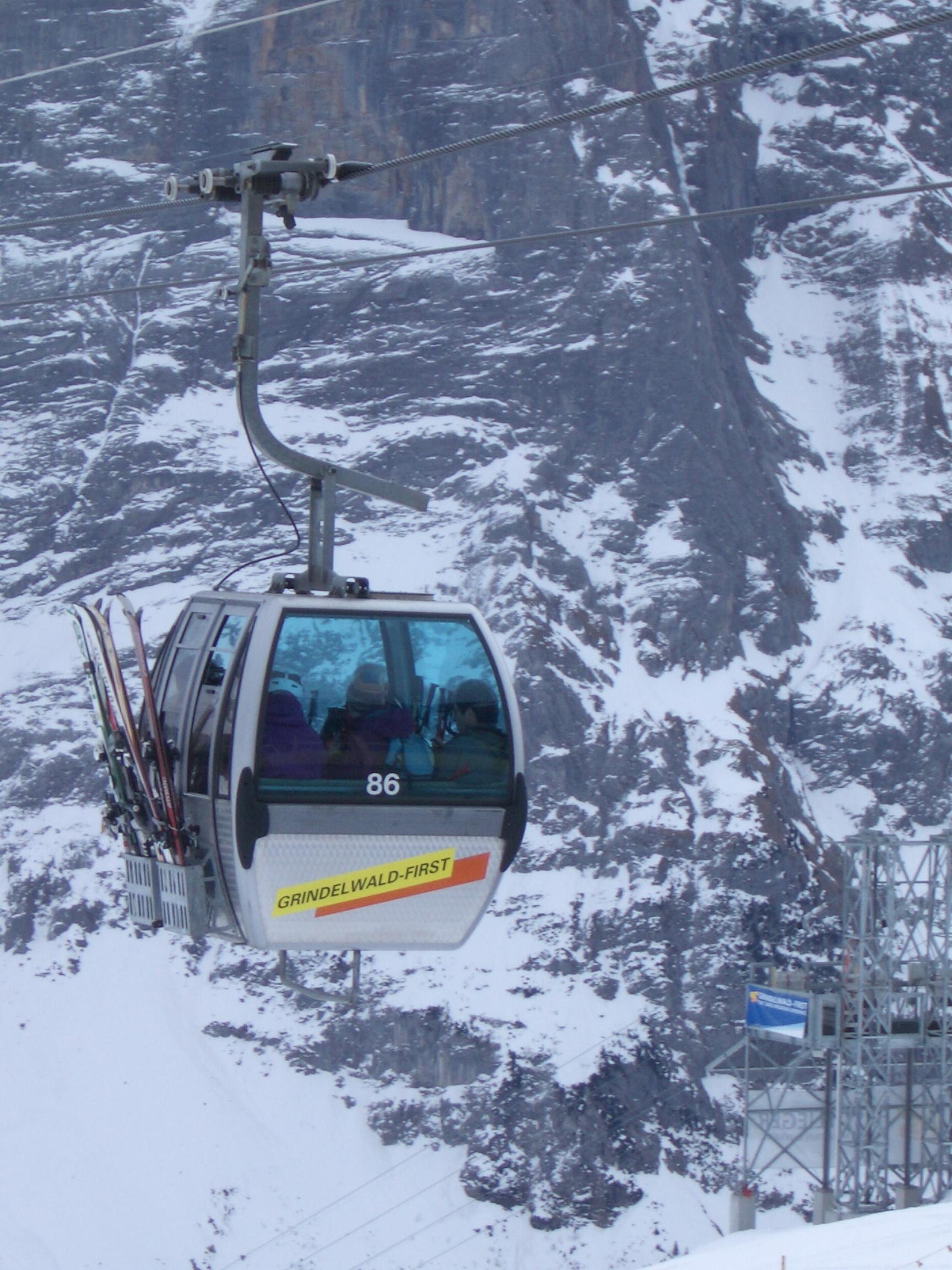
Greater infrastructure integration, a new freeride area, a new rail stop in the Grindelwald valley and a  gondola to Kleine Scheidegg area are proposed. In addition a gondola across the Lauterbrunnen valley is mooted. There is also talk of other development including a bypass for Grindelwald to make it car free.

For sure, the Jungfrau is one of the most beautiful areas in the World and the rail network is quaint and pretty effective. However it is also clear that a gap is starting to emerge between leading winter sports resorts, with the ones making investments doing well and those not doing so, or having  limited facilities, falling behind. The Jungfrau suffers from not having the length of season of some of the other major resorts in Europe, but it has a unique place in the development of winter sports and fabulous variety. Getting the balance right will be a tough challenge, and the outcome is likely to be a compromise. I certainly think attempts to increase the challenge for more experienced skiers and snowboarders off First and Mannlichen would be good, making Grindelwald car-free would be excellent, and reducing the journey time from Bern is always going to be popular. However, people who know the area realize that the challenging runs are off the Schilthorn and that beginners and intermediates will find plenty to occupy them around Wengen, Kleine Scheidegg , Mannlichen and First (an unexpected gem for those who always head the other way). Personally I find it an easy day trip from Basel, and probably one of the best places to head to for weekenders from Northern Europe, probably more so than Chamonix.  I feel that there is room for improvement, but the resort is far better marketed in summer than winter, and a clearer winter marketing strategy (coupled with infrastructure improvements) will go further than extensive investment.

Swiss Winter Tourism Outlook

Swissinfo report on an analysis by Credit Suisse on the state of the Swiss winter sports industry, and say that there are major challenges to the Swiss industry’s competitiveness. Whereas Austrian resorts saw a 6% increase in overnight stays between 1993 and 2011  Swiss resorts experienced a 12% drop. With the strong Swiss Franc and a more expensive underlying cost base, Swiss resorts are set to see further declines in business unless they focus on niche markets and try to be more attractive in the mid-price and budget markets.

The Swiss tourist industry contributes around 5% to GDP,  and the 650 lift companies employ 11,000 people and turnover SFr 840m per annum.  There have to be some question marks over the long-term viability of some of the smaller, lower resorts unless they can discover their niche, although bigger resorts like Zermatt, St Moritz and the Engadine, Davos, Verbier, Crans-Montana and Gstaad seem to remain strong draws.