Black Forest

The Black Forest is relatively low-lying and you cannot guarantee good snow throughout the season, but it is still relatively reliable for the peak season. It is convenient for much of northern Switzerland, including Basel, and is much cheaper than the Alpine resorts for a winter holiday.

We organised a family holiday this month to Todtnauberg, a high valley not far from Feldberg, the highest point in the Black Forest (and in the whole of Germany, outside the Alps).
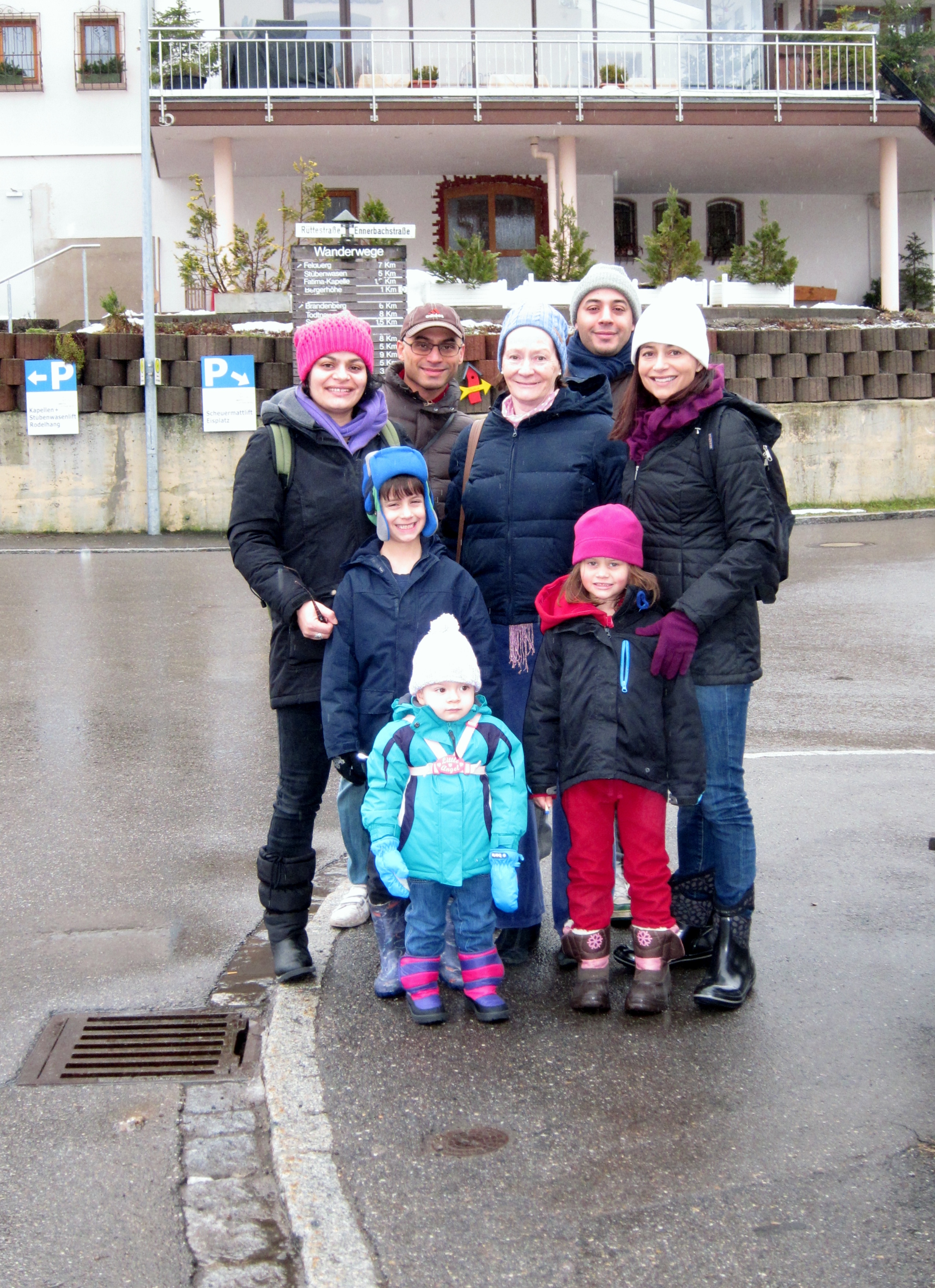
Schwarzwald
Mazumdars in the Black Forest
Despite the good snow in December the temperatures had risen unseasonably high and even at 1150m, the village had patchy snow. Nonethless, the nursery area near the centre of the village and the larger, connected section across the valley were open.

In total Todtnauberg boasts 6 surface lifts, 12 red runs and 4 trails. There is an excellent high cross-country circuit. Should the snow not be too good on the lower slopes, the runs above Liftstüble can still offer good conditions and whatever the snow conditions, there are some lovely winter walks in the area. Todtnauberg is also situated at the top of what claims to be the highest waterfall in Germany, the Todtnau Waterfall, and there are a number of pleasant walking trails that take you down along the length of the falls.

The setting is spectacular and from various points around the village and the surrounding hills you can see the Alps in the distance. We stayed at the family-run Pension Enzian, conveniently located next to the Kapellenlift. It is a lovely little establishment, very simple but with good food and wonderful hosts and certainly one I would recommend. In our case the party included skiers, non-skiers, pensioners, infants and children and we felt we were all catered for well.

Driving to Todtnauberg is relatively straightforward, with the village being served by a dedicated road running off the main Todtnau to Freiburg road. There is also reasonably good public transport with a direct bus to Freiburg (which is well worth a visit if you have not been there before) and a bus to Todtnau which connects to the service to Basel (either direct, or via the train from Zell im Wiesental). I’ve known people come from Basel to ski here for the day, although most people opt for Feldberg.
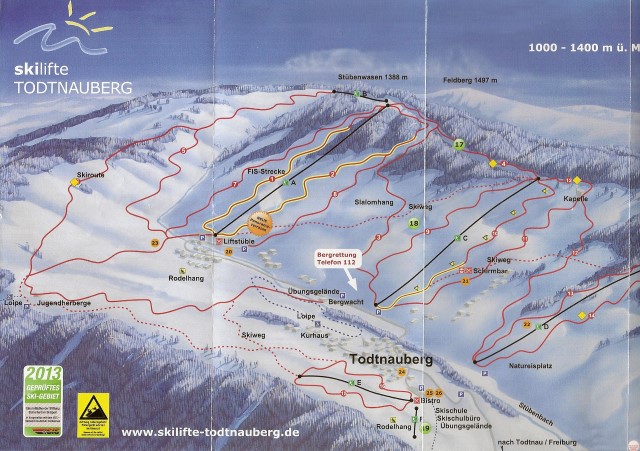
Piste Map Todtnauberg
The skiing in Todtnauberg lies between 1021m amd 1388m and probably provides around 20km of ski runs and trails in total. The runs are all graded red but are generally easy enough for people more comfortable on blue runs. There are no particular gotchas for boarders other than that all of the lifts are surface lifts, and mainly t-bars at that. There is a ski school in the village.

Felderg is very close to Totdnauberg as the crow flies, but around 15km away by road. You can get to Feldberg by bus, changing in Todtnau.

I’ve posted details on Feldberg at the companion site here. It is easily the most comprehensive winter sports area in the Black Forest, and Todtnauberg is probably the second largest. There are others, though. Muggenbrun (970-1243) and Brandenberg-Fahl (850-1380) have a handful of lifts. Herrenschwand (Todtmoos), Widen, and Aitern-Multen also have more than one lift. Additionally a number of other villages have basic facilities, perhaps one lift and a couple of runs back into the village.

For Cross-country, Feldberg, Todtnauberg, Muggenbrun, Widen and Aitern-Multen have both prepared trails and Langlauf ski schools. They also have prepared winter trails, often the same ones as used by cross-country skiers but not exclusively so. Which of course, gives you also the opportunity to whistle along to that old sixties classic “A Walk in the Black Forest”. There is also plenty of scope for snowshoe walkers, especially using the extensive summer trails that are not prepared in winter.

All in all the Black Forest is a good choice for winter sports enthusiasts. It represents excellent value for money compared with Alpine resorts and, in general, better caters for tourists than the Jura. The cuisine is delicious and you really should savour a proper, freshly-made Black Forest Gateau and some of the outstanding local wines. There is also plenty to see and do, with marvellous spas dotted around – we particularly like Bad Bellingen and Badenweiler, but Titisee has the most impressive. In addition there are rustic villages steeped in history, quaint little museums, lots of waterfalls, the ubiquitous souvenir shops (for your cuckoo clock) and the wonderful old towns of Freiburg, Colmar and Basel not too far away.

If you book well in advance, you may be disappointed if you have set your heart on perfect snow conditions, but generally Feldberg, at least, is reliable from Christmas through the end of February or later. For a last minute getaway, though, you could do a lot worse.

Early Season Skiing in Austria

A number of friends have already hit the pistes and have generally given good feedback on snow conditions. There were some good early dumps and cold conditions, although by Christmas a warm front lifted the temperatures alarmingly. However few lift systems were fully open to take advantage of the fresh snow, but with Christmas that has all changed. Many resorts have switched to their peak season schedules since 22nd December and the Oatridge family had their first ski outing.

The venue was Austria, initially Pitztal (with a top run from 3440m) and then Kitzbühel.

Pitztal has its main installations at the head of the valley, with two main areas at Rifflsee and the Glacier which together offer 68km of pistes and 44km of trails. There is also a small beginners area a couple of hundred metres from the Rifflsee base station. Rifflsee is a pleasant area of runs that are largely of similar standard irrespective of colour and connects to the Glacier base station – although to get back to Rifflsee you need to take the bus. The Glacier area is reached by a train service at Mittelberg and, although there is a trail back down, there is currently no pistes back to the base station. However with runs between 2840 and 3440m, this is a great area for early and late season skiing. The valley also has some good cross-country trails.

We stayed in the Seppl Sport & Vital Hotel in Weisswald, just a short bus ride from the valley stations. The hotel is a family-run establishment with a spa, pool, sauna, bowling alley etc and would generally get top marks but for the relatively expensive extras which could significantly add to the hotel bill if you are not careful. It lies conveniently at the terminus of the most frequent bus service, and only a short walk from the main post bus stop.

To get there from Switzerland you need to take the outstanding Railjet from Zurich to Landeck, switch to a local train to Imst then get off smartly to take the post bus connection that runs up Pitztal to Mittelberg. The journey is spectacular although the section by bus takes around 50m and is quite windy.

Like Swiss Railways with Snow’n’Rail, their Austrian counterparts (ÖBB) run a Kombitickets Wintersport scheme. It is nowhere near as extensive as the Swiss scheme and has some strange omissions, but it does include Lech, Zurs, St Anton, Kitzbühel, Nassfeld, Schladming, St Johann, Gastein, Zell am See and a dozen or so other resorts. The Austrians are almost as efficient as the Swiss, so taking the train and bus makes a lot of sense.

Kitzbühel has a rail station with a direct service to Innsbruck, although switching to a local train at Wörgl enables you to get off at the Kitzbühel Hanhenkamm stop, right next to the main gondola lift. There is also a good bus service from the main rail station, which is inclusive of a lift pass.

Kitzbühel actually comprises four sections. The small unconnected Gaisberg area in Kirchberg, the larger unconnected Kitzbüheler Horn area, a large area above Jochberg and the main area between Kitzbühel and Kirchberg which takes in the Hahnenkamm and Pengelstein peaks. From Pengelstein a gondola runs to and from the Jochberg section, although it is not possible to ski or snowboard between them. Although the highest peak across the area covered by the lift pass is only 2004m, the slopes are largely North-facing and have a good snow record. I love the runs of and around Pengelstein, lots of nice cruisy runs with enough variety and challenge and off-piste variations to keep anyone happy.

And then, of course, there is the Hahnenkamm run itself. In practice it is not one run but a series of variations, enabling you to pick and choose whether to take steep or flatter sections. it has stunning views over Kitzbühel and the surrounding areas where the valleys of the Kitzbühler Ache and Inn converge. However, what makes this run so special is that you know that are taking the route of one of the greatest ski races in the world. Truly a unique experience, and definitely a candidate in the “ten runs you should do before you die”.

Swiss Winter Sports on the Radio

Swiss Winter Sports features now on the radio, albeit only if you live in the Basel and Baselland areas. The excellent Basel-based Radio-X runs an English language show every Tuesday evening from 6.30pm until 8pm, and they now feature a short section on winter sports in which Kiwi John interviews Nic Oatridge to get the low down on a different resort every week. Radio-X is on 94.5 FM and the English Show has a web site at http://www.theenglishshow.com where you can catch up on older broadcasts. If you do live in the Basel area and are an English-speaker I really do recommend you tune into this informative programme quite apart from listening to hear ski and snowboard tips.

The new season begins!

The new ski season always opens more with a whimper than a bang. The tourism industry kicks off around the start of November, with ski shows, new season brochures and resort information updates. Oh, yes, and the first of the winter season openings.

I visited the London Ski and Snowboard Show. There wasn`t a lot new – I was most impressed by the emergence of a the new generation HD cameras built into goggles. My wife has ordered one for me so I look forward to adding some video footage to the blog and associated web site. What was disappointing was how thin the Swiss resort presence was. The Jungfrau Region was represented by the Euroairport stand and Verbier had a decent stall, but that was it. Although the UK is the second largest overseas market for winter tourism in Switzerland, it risks losing trade to the more aggressively marketed countries.

I was lucky enough to be invited to the World Snow Awards which took place alongside the Ski and Snowboard show. Launched by VOS Media, who publish Ski and Snowboard magazine and run the Ski and Snowboard Show, the awards winners included Swiss as the best airline, presumably for being the only mainstream airline still offering free ski and snowboard carriage (although BA and others seem to have risen to the challenge with qualified free carriage). Geneva was voted the best airport. Zermatt got voted the best resort for apres ski, a vote I would endorse. The best family resort award went to Avoriaz, part of the Portes du Soleil circuit it shares with Switzerland. Livigno in Italy and Fernie in Canada won the best overall resort awards. Crstal, Ski Independence and Ski Solutions won the awards for best operators in their respective categories – they all offer packages for Switzerland.

Back in Switzerland the excellent Snow’n’Rail scheme launched its season with its customary brochures and web site (the latter available in English). Prices haven’t changed much, nor has the selection of resorts. All the changes are reflected in the web site. my thanks to Florence at Swiss Railways for all her help in helping me get this information on the web site so promptly.

Unfortunately not such a helpful story from Swiss Tourism and their MySwitzerland web site. They have taken down the feed I used last year as part of a revamp of their site and have not made it easy for me to replace it. For a couple of years I have been trying to apply to get the information with a minimum of fuss, but have still not succeeded for reasons that I can hardly fathom. They do want to promote winter sports in Switzerland don’t they? Sadly, I can’t really commend the revamped Swiss Tourism site. It sucks. The good news is that the Swiss Winter Sports web site gets you the information you need more quickly and even helps you navigate the Swiss Tourism site with fewer clicks.

The new season sees some improvements around the resorts. The Jungfrau has a useful new six seater lift replacing the old Wixi lift, a speedcheck below the Arven chairlift, a photopoint at the Lauberhorn and a skimovie on the Mannlichen – I can only guess at what the latter two are. First also has a photopoint and a new skicross run above Schilt. Children under 15 also ski for free on Saturdays . up to two for each adult pass bought.

In typically understated Swiss style, gradual improvements are taking place right across the country’s resorts. Old lifts are being replaced, more freeride areas, winter walks and snowshoe trails are being opened and there is much more snowmaking being installed. At Adelboden there will be a new blue run from Sillerenbühl to Aebi. Flims/Laax will see some new runs too, alongside a couple of new six seat chairlifts. Anzere continues to see improvements to the lifts following the opening of the new spa last year. Les Crosets has a new six person chairlift, replacing a drag lift and an older chair. A new terrain park will be opened at Saanenmöser (Zweisimmen/Gstaad) continuing to make this one of the best kept secret snowboarders destinations.

The season started in the Engadine on 20th October and will run until 20th May next year, although the early and late season will be limited to Diavolezza. Throughout the season you can purchase a ski pass for CHF 25 per person/day provided you stay at a participating hotel for at least two nights. The list of hotels is pretty much every hotel – even the youth hostel qualifies.

Incidentally, St Moritz will be hosting the Alpine Ski World Championships in 2017 and, together with Davos, is bidding to host the 2022 Winter Olympic Games.

Already open are the runs on the glaciers at Saas-Fee, Engelberg and Les Diablerets (Glacier 3000). Zermatt of course never goes away, but for now it is only the glacier runs that are open. Warm weather will persist for at least another week or two, so it is unlikely there will be any serious skiing and snowboarding available until early December.